Rituals have always been a focus of ethnographies of Melanesia, providing a ground for important theorizing in anthropology. This is especially true of the male initiation rituals that until recently were held in Papua New Guinea. For the most part, these rituals have been understood as all-male institutions, intended to maintain and legitimate male domination. Women's exclusion from the forest space where men conducted most such rites has been taken as a sign of their exclusion from the entire ritual process.
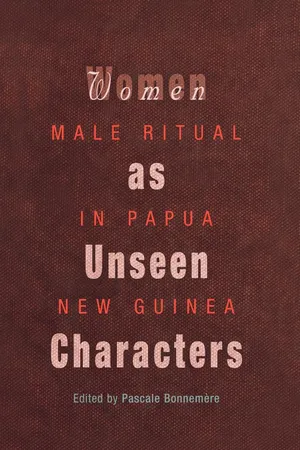
Women as Unseen Characters is the first book to examine the role of females in Papua New Guinea male rituals, and the first systematic treatment of this issue for any part of the world. In this volume, leading Melanesian scholars build on recent ethnographies that show how female kin had roles in male rituals that had previously gone unseen. Female seclusion and the enforcement of taboos were crucial elements of the ritual process: forms of presence in their own right.
Contributors here provide detailed accounts of the different kinds of female presence in various Papua New Guinea male rituals. When these are restored to the picture, the rituals can no longer be interpreted merely as an institution for reproducing male domination but must also be understood as a moment when the whole system of relations binding a male person to his kin is reorganized. By dealing with the participation of women, a totally neglected dimension of male rituals is added to our understanding.
- 264 pages
- English
- ePUB (mobile friendly)
- Available on iOS & Android
eBook - ePub
About this book
Information
Publisher
University of Pennsylvania PressYear
2013Print ISBN
9780812237894
9780812237894
eBook ISBN
9780812201376
Chapter 1
Sambia Women’s Positionality and Mens Rituals
The interpretation of gender positionality and hegemony have long been debated in the literature, with scholars differing on the degree to which material or ideological factors, or religious and ritual factors, or both, are primary in how men and women interact.1 As the work of Kenneth Read (1952) hinted and Donald Tuzin (1980) in particular has stressed in Melanesia, the relationship between positionality and domination in the domestic sphere can differ greatly from or even contradict matters in ritual. Maurice Godelier’s (1986) critical work among the Baruya has generally opened up the richer complex of material, ideological, and sexual factors on the subject of male domination of women.2 Pascale Bonnemère (1996) is a new notable study of gender relations and symbolic elaboration among the Ankave, an Anga area people. She shows clearly the complex of factors that create parallels in the experience of men and women, with a variety of ritual practices, both secret and public, underlying women’s positionality in Ankave society. My own work among the Sambia of Papua New Guinea has focused upon how sexuality and secrecy are critical to the formation of male subjectivity and desires: male/female relations in general and the cultural reality and homosociality of the men’s house in particular create gender hierarchies between older and younger males (Herdt 1992, 1999a, b).
The Sambia collective male initiations include the first-stage, second-stage, and third-stage rites, that form the Sambia “Mokeiyu” cycle of collective practices, spatially centered around the raising of a great men’s cult house every three to four years. The positionality of women in these events has remained incomplete in my own writing (Herdt 1981, 1987b, 1999b). However, among the neighboring Baruya, as described by Godelier (1986), women’s knowledge of male ritual, as well as their positionality vis-à-vis men, leads to the impression that women’s presence was a vital and necessary ingredient of the success of male ritual performance (Bateson 1958 [1936]; Schwimmer 1984).
Thus, among the Sambia as well as the Baruya, women are brought into the arena of men’s ritual. The men understand this as symbolically necessary and vital to the cultural performance, but they complain about it and regard the women as polluting and a nuisance to manage. It is as if the men desire for the women to serve as their primary audience, as Gregory Bateson once observed for the Iatmul, even though they complain about it. Women’s positions in these events suggest that the men are transforming the women in certain ways, or—to take Marilyn Strathern’s felicitous phrase—that the men are “making complete” what is incomplete (especially the status and sexuality of the boy-initiates) through the material and/or symbolic presence of women (1988). This view is well established in the Melanesian literature now—the product of a new perspective from gender studies and feminism, again, substantiated in the work of Marilyn Strathern most famously, as well as in Annette Weiner, Gillian Gillison, and the recent collection of Nancy Lutkehaus and Paul Roscoe (1995). Bruce Knauft (1999), in his important review of this area, has critically contrasted Melanesia and Amazonia, questioning the stability of “social organization” and “warfare” in tradition, and the postcolonial positionality of men and women’s identities and material status.
Among the historical Sambia, women are, by custom as well as by male belief, a necessary “audience” for certain ritual male performances. However, women may only be present materially in public, never in secret. Women are represented by men’s praxis in secret by icons and symbols, or sometimes by the proxy of a male actor who “performs” as or “fills in the cultural space” of women. For example, cassowaries are typically represented as “women” in secret praxis, and men who impersonate the flute spirit are dressed and serve as the proxy for male ideas about women (Herdt 1981). Why must women be kept removed physically from the secret rites? We enter here into the fundamental issues of ritual rhetorics and schismogenesis (Bateson 1935); of structural gender relations, well studied by Schwimmer (1984); and of male ritual secrecy, a large topic that has been treated elsewhere (Herdt 2003). What is particular to the Sambia men’s ideology is to regard women’s bodily powers as polluting to boys and a general threat to the men’s secret society. Thus, as I have suggested before, the absence of the women in secret contexts enables men to create and instill a hierarchy of homosociality among the newly initiated or recruited boys, recently taken from their mothers; the absence of women also enables the men to abrogate the generative powers of women (e.g., menstruation and parturition), and thus to permit the secret knowledge that the men alone give birth to boys, have the boys menstruate, and suckle them into manhood through insemination (Herdt 1981).
In this chapter I will describe and analyze the position of women in men’s rituals and the “positional” relationship between women and men in Sambia men’s rituals.3 The concept of “positionality” indicates both the symbolic status of the structural position taken by a woman or women in a particular ritual and the meanings men attribute to this position. In the latter sense, the position of women in certain ritual events is signified by secret male representations or icons, or by the performances of male persons that express these meanings.4
Here, I highlight four distinctive forms of women’s positionality in men’s rituals. All these types occur in the Mokeiyu ritual cycle, performed every three or four years by the Sambia. First is the generative position of female bodies, their fluids and reproductive functions, which are drawn upon symbolically and materially in raising the men’s ritual cult house. Second is the structural role of a woman who serves as the female ritual “guardian” mother (the counterpart of the male ritual guardian or “father”) in public practices; she gives ornaments to decorate, and she is also protective of the boy in public beating rites, for which she must be repaid in prestations by the boy and his male kin. Third is the collective practice of women in certain rituals of rebellion, a form of positionality that is the most active “voice” in protecting and protesting the “theft” of boys as sons from women and the women’s community. Fourth and last is the moral pedagogy of women in publicly teaching and scolding boys, assuming a moral authoritative “voice” rarely allowed by men, as the boys are treated situationally not as sons but as prospective husbands and sons-in-law by the aggressive women. This marks a shift in the subjectivity and moral careers of the boys vis-à-vis their relations to the world of women.
One issue that always complicates such an analysis should be highlighted for a moment: ritual secrecy. Due to the existence of ritual secrecy as a separate sign system, existing apart from public discourse in the political economy of the village, the meaning of any object is always contingent upon the setting and the type of linguistic praxis. Thus, again, to speak of cassowaries in public is to speak of the mysterious ostrich-like bird which prowls the forests and which men hunt; in secret, the cassowary is a primary signifier for women, its meat forbidden to boys and women, and the ornaments made from it a means of representing the flute spirits as well (Herdt 1981). Likewise, the rhetoric of men about women must be marked off in ritual by a careful delineation of which women the men are referring to on any occasion. That is, Sambia men’s discursive use of “women” in ritual and in language depends upon categorical distinctions made (in the first- and second-stage ritual initiations) between the mothers of boys, the category of female ritual guardians, and marriageable women, over all other women who participate in the male ritual. Sambia men’s discourses about women also cut along these lines: the distinction between women related by kinship, especially within the nuclear family, and women who are unrelated and may become the object of marriage pursuits or sexual interest. This difference parallels a public/secret distinction also: public discourse lumps all women together at the most inclusive level of rhetorical cultural representations, generally depicting women as polluting, depleting, and disloyal, whereas secret discourse splits the imagery of women between marriageable and kin-related.
Sambia Male Rituals
In the period of the mid-1970s when initial fieldwork was conducted, the Sambia numbered some 2,000 people living in extremely rugged, isolated mountain valleys of the Eastern Highlands of Papua New Guinea. Airstrips and roads were absent, and first contact had occurred within the previous decade. The Sambia hamlets were built atop steep ridges formerly barricaded against enemy assault. The harsh beauty of the land belied the fierce, endemic warfare that pervaded Sambia life before pacification in 1964. Descent was generally patrilineal and residence was patrilocal; hamlets were composed of tiny exogamous patricians that facilitated both intra-hamlet marriage and male solidarity in times of war. All marriage was arranged between clans by elders; social relationships between the sexes were not only ritually polarized but often hostile at the interpersonal level, although this tended to change as the couple had children and aged. Like other Highlands societies, these segmentary descent groups were associated with a men’s secret society that ideologically disparaged women as inferior, dangerous creatures who could pollute men and deplete them of their masculine substance.
Since warfare was endemic, nagging, and destructive, and pacification was a recent memory, the male cult remained of supreme importance in local cultural and social tradition. Village gender relations were still based on the need to create and support a force of warriors on whom community survival depended. That defensive warriorhood was guaranteed by collective ritual initiations connecting neighboring hamlets. Males became members of a politically volatile regional age-grade of co-initiates. Within a hamlet, this warriorhood was locally identified with the men’s clubhouse, wherein all initiated bachelors resided. Married men also frequented the clubhouse constantly, and on occasion (during fight times, rituals, or their wives’ menstrual periods) they slept there. But once married, men normally lived with their wives in separate “women’s houses” elsewhere in the hamlet—an institutional arrangement that makes Sambia anomalous compared to most Highlands people’s enforcement of separate residence for the sexes.
The male secret cult was organized through six initiation grades that early on removed boys from their mothers and natal households, conscripting them into an authoritarian, male hierarchical system. First-stage (for boys seven to ten years old), second-stage (ages eleven to thirteen), and third-stage (youths aged fourteen to sixteen) initiations are collectively performed on boys as age-sets every three or four years by the confederacy of neighboring hamlets. Initiates reside exclusively in the clubhouse and absolutely avoid all interaction with females, including their mothers, on pain of severe punishment, including death. Only at fourth-stage initiation—performed for youths sixteen years and older, depending on their being assigned a girl for marriage—the formal marriage ceremony, does this absolute female avoidance change. Minimal contact with females is thereafter permitted, but heterosexual coitus remains forbidden until the adolescent wife’s menarche. Only then may the girl, who has stayed with her parents, begin cohabiting separately with her husband. For the young man, his wife’s menarche is celebrated in fifth-stage initiation rites that secretly focus on a painful nosebleeding and other bodily purifications. Last, a year or so later, the birth of a child triggers sixth-stage initiation and accords the young father, especially after the birth of his second child, full adult status.
Ritualized boy-inseminating practices are the object of the most vital and secret ritual teachings in first-stage initiation, and they tend to take on the most dramatic focus in men’s narratives and later depictions of the events. The novices are expected to be orally inseminated. Homoerotic relationships are rigidly structured: novices may only act as fellators in private, appropriate sexual contacts with older bachelors, who are seen as dominant and primarily in control of the same-sex contacts.5 The adolescent youth is the erotically active party during fellatio, for his erection and ejaculation are necessary for intercourse, and a boy’s oral insemination is the socially prescribed outcome of the encounter. These rules mean that boy-insemination—as well as heterosexual coupling—occurs mainly between males of hostile groups who sometimes warred. Ritual insemination of boys is hidden from women and children; it is purported to have nutritive functions in “growing” (masculinizing) boys. Puberty and third-stage initiation result in the psychosexual transition from fellator to sexually mature fellated. Following the marriage rite, which occurs before the betrothed woman achieves menarche, he should slow down his involvement in boy-inseminating practices; with the achievement of fatherhood, the vast number of Sambia men become exclusively heterosexual.
Sambia conceive of the development of maleness and femaleness as fundamentally different. Biological femaleness is considered “naturally” competent and innately complete; maleness, on the other hand, is considered more problematic, since males are believed incapable of achieving adult reproductive manliness without ritual treatment. All males have a semen organ (keriku-keriku), but in boys this remains immature and empty, while in girls it will not activate. The purpose of ritual insemination is to fill up the organ and hence to masculinize a boy’s body, ultimately masculinizing his phallus.
By contrast to boys, girls do not have initiations until they are well into their adolescence, typically beginning with the girl’s ceremonial marriage to a youth. This event, often between the ages of fourteen and seventeen, comes before menarche, which is late (on average, nineteen years). However, girls are believed to be born with female genitalia, a birth canal, a womb, and, behind that, a functional menstrual-blood organ or tingu. An infant girl’s tingu is thought to contain a smear of her mother’s menstrual blood transmitted while she is still in utero. Following birth, that blood increases, filling the tingu, activating somatic development, and hastening motor coordination, speech, and overall reproductive maturation. This endogenous operator of femaleness eventually stimulates the appearance of secondary sex traits—especially breast enlargement and the menses. Feminine behaviors like success in gardening and mothering are also by-products. As the tingu and womb become engorged with blood, puberty and menarche occur; the menses regularly follow, and they are linked with the women’s childbearing capacities. This initiates the girl’s second initiation ceremony, at menarche, around age nineteen. All a woman then needs is a penis (i.e., semen) to facilitate adult reproductive competence: childbirth. Birth initiates the final initiation. These female ritual events occur in the menstrual hut and are secret and forbidden to men.
In my own work on the Sambia of Papua New Guinea, I have had little to say until now about the series of ritual events and symbolic positions of the great collective Mokeiyu cycle that locates women within the arena of men’s initiation rites. Particularly regarding the first-stage moku initiation of boys aged seven to ten, the role of their mothers, female ritual guardians, male ritual guardians, and symbolic proxies for women inside the men’s house all raise critical questions: Are women themselves undergoing a “rite de passage” during the male initiations? If so, what is the purpose or ritual intention of such a symbolic positioning of the women? Should we regard the changes in women’s rites and duties, along with changes in temporal and spatial movements, as indications of liminality in women? My answer in general is yes. However, before I enter into the reasons for this, it is important to outline the Sambia ritual system and the positionality of women within it, since a clear structural pattern emerges from the overview.
The Positionality of Women in the Ritual System
The Sambia Mokeiyu cycle, performed every three or four years, is a grand seasonal event that articulates gender relations and the larger cluster of political relationships between groups. With respect to the male initiations, the women’s participation is greatest in the launching of the Mokeiyu cycle itself, which includes the raising of a great cult house, and involves men and women who are related to the boy to be initiated. The symbolism grounds the collective ethos of emotions, gender avoidance, ritual cooperation, and exchanges that will unfold over the months that follow. This set of opening events then folds into the ritual events of the first-stage moku initiation, wherein women play important rhetorical, and material roles, as discussed below. The second-stage initiation, performed two or three years later, also has women engaged, though not as much as in the first-stage initiation, since the ritual events are shorter and less elaborate. Following this, the role of women declines markedly, and while they play a role in the opening ceremonies of the third-stage initiation, especially night-time dancing and feasts, they are totally left out of the ritual events that follow. During that time, their role as audience emerges, and they continue to take this role, with a few minor exceptions played from time to time by senior women and great women. In short, the women’s agency declines and all but falls off. What accounts for this change?
In the first-stage initiation, the mother of the boy-initiate plays a pivotal role in providing material resources for the events that follow, as well as in taking a position at key stages of the events. That the mother is symbolically identified with the boy to be initiated is perfectly obvious from many of the key rites and processes set in motion, such as the very idea that the boy must be “separated” from his mother to grow “big and strong” and move over to the men’s house. A part of this rhetoric is the understanding that the treatment of the boy has an effect upon his mother and what the mother does has an effect upon the boy. The mother and father are thus enjoined to strict sexual abstinence during the time of the Mokeiyu. Should the parents (especially the mother) violate this taboo, it is strongly believed that the initiate will be weak or sick, that his face will turn black, or that he will revert to a baby-like appearance, become ugly and stunted, and prematurely die. The materiality of resource provision consists of feast-crops and gardens the mother must plant, tend, and harvest (tubers, greens, bananas, etc.). It also involves bringing in material for the cult house raising at the outset of the Mokeiyu cycle. The mother is also responsible for weaving a new grass sporran for her son. When the events begin, she is expected to play a role in the thrashing rites staged in public at the beginning of the initiation, primarily by following the boy, who is carried on the back of his male ritual guardian, between the two lines of men. The mother will also attend to her son on the final night before the ritual procession or parade, and in the moonlight she will feed smoked frog to her son—the last food from her hands to reach him. Finally, she will play a role of wailing for the boy and at other times become part of the audience of the men’s rites.
The residential segregation and the reshuffling of the genders at the time of initiation, and throughout the Mokeiyu cycle, is genuinely impressive. During the weeks and months that bring on the rites, not only is sexual abstinence enjoined, but the couple often reside apart, particularly after the hun...
Table of contents
- Cover
- Title
- Copyright
- Contents
- Note for Readers
- Introduction The Presence of Women in New Guinea Secret Male Rituals: From Ritual Space to Ritual Process
- 1. Sambia Women’s Positionality and Men’s Rituals
- 2. Embodiments of Detachment: Engendering Agency in the Highlands of Papua New Guinea
- 3. When Women Enter the Picture: Looking at Anga Initiations from the Mothers’ Angle
- 4. Ujawe: The Ritual Transformation of Sons and Mothers
- 5. The Bachelors and Their Spirit Wife: Interpreting the Omatisia Ritual of Porgera and Paiela
- 6. Cults, Closures, Collaborations
- 7. The Variability of Women’s “Involvement” in Anga Male Initiations
- 8. Of Human and Spirit Women: From Mother to Seductress to Second Wife
- 9. Relating to Women: Female Presence in Melanesian “Male Cults”
- Notes
- Bibliography
- List of Contributors
- Index
- Acknowledgments
Trusted by 375,005 students
Access to over 1.5 million titles for a fair monthly price.
Study more efficiently using our study tools.
Frequently asked questions
Yes, you can cancel anytime from the Subscription tab in your account settings on the Perlego website. Your subscription will stay active until the end of your current billing period. Learn how to cancel your subscription
No, books cannot be downloaded as external files, such as PDFs, for use outside of Perlego. However, you can download books within the Perlego app for offline reading on mobile or tablet. Learn how to download books offline
Perlego offers two plans: Essential and Complete
- Essential is ideal for learners and professionals who enjoy exploring a wide range of subjects. Access the Essential Library with 800,000+ trusted titles and best-sellers across business, personal growth, and the humanities. Includes unlimited reading time and Standard Read Aloud voice.
- Complete: Perfect for advanced learners and researchers needing full, unrestricted access. Unlock 1.5M+ books across hundreds of subjects, including academic and specialized titles. The Complete Plan also includes advanced features like Premium Read Aloud and Research Assistant.
We are an online textbook subscription service, where you can get access to an entire online library for less than the price of a single book per month. With over 1.5 million books across 990+ topics, we’ve got you covered! Learn about our mission
Look out for the read-aloud symbol on your next book to see if you can listen to it. The read-aloud tool reads text aloud for you, highlighting the text as it is being read. You can pause it, speed it up and slow it down. Learn more about Read Aloud
Yes! You can use the Perlego app on both iOS and Android devices to read anytime, anywhere — even offline. Perfect for commutes or when you’re on the go.
Please note we cannot support devices running on iOS 13 and Android 7 or earlier. Learn more about using the app
Please note we cannot support devices running on iOS 13 and Android 7 or earlier. Learn more about using the app
Yes, you can access Women as Unseen Characters by Pascale Bonnemère in PDF and/or ePUB format, as well as other popular books in Social Sciences & Cultural & Social Anthropology. We have over 1.5 million books available in our catalogue for you to explore.