During the thirty years following ratification of the U.S. Constitution, the first American novelists carried on an argument with their British counterparts that pitted direct democracy against representative liberalism. Such writers as Hannah Foster, Isaac Mitchell, Royall Tyler, Leonore Sansay, and Charles Brockden Brown developed a set of formal tropes that countered, move for move, those gestures and conventions by which Samuel Richardson, Jane Austen, and others created their closed worlds of self, private property, and respectable society. The result was a distinctively American novel that generated a system of social relations resembling today's distributed network. Such a network operated counter to the formal protocols that later distinguished the great tradition of the American novel.
In Novels in the Time of Democratic Writing, Nancy Armstrong and Leonard Tennenhouse show how these first U.S. novels developed multiple paths to connect an extremely diverse field of characters, redefining private property as fundamentally antisocial and setting their protagonists to the task of dispersing that property—its goods and people—throughout the field of characters. The populations so reorganized proved suddenly capable of thinking and acting as one. Despite the diverse local character of their subject matter and community of readers, the first U.S. novels delivered this argument in a vernacular style open and available to all. Although it differed markedly from the style we attribute to literary authors, Armstrong and Tennenhouse argue, such democratic writing lives on in the novels of Cooper, Hawthorne, Melville, and James.
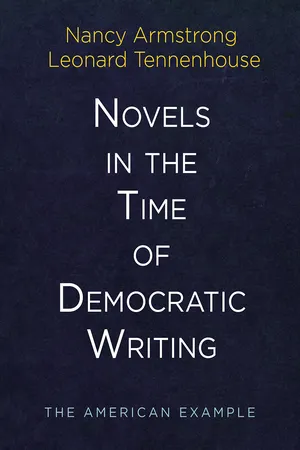
eBook - ePub
Novels in the Time of Democratic Writing
The American Example
- 264 pages
- English
- ePUB (mobile friendly)
- Available on iOS & Android
eBook - ePub
About this book
Information
Publisher
University of Pennsylvania PressYear
2017Print ISBN
9780812249767
9780812249767
eBook ISBN
9780812294613
Chapter 1

Style in the Time of Epidemic Writing
Despite the fact that well over a hundred American novels were published between the 1780s and the 1820s, neither increasing critical attention to this body of fiction nor its recent availability in classroom editions has made us rethink the canonical tradition, what is distinctively American about this body of fiction, and how it asks us to imagine a national community. To the degree that this is first of all a “literary” problem, we want to address the question of why the novels of the new republic have all but vanished from our national heritage, first, as a problem of style.
One could trace that problem back to an evening in the 1820s, when the American publisher Samuel Goodrich engaged his dinner companion, Sir Walter Scott, in a discussion of the relative merits of various novelists.1 Though offering a rather spotty account of this conversation some years later, Goodrich did recall no less than four related points on which Scott had faulted the novels of Charles Brockden Brown. Scott objected to the American novelist’s use of the tale of terror, first, on the grounds that “it is wholly ideal; it is not in nature” (Goodrich II: 203). By this, Scott meant that the American’s writing style dealt in abstractions rather than attending to the actual details of ordinary life. Second, Scott found the characters of Brockden Brown’s tales of terror unsatisfactory on grounds that they were “alien to common experience” and so failed to demand the sympathy that readers owed to members of their community. Third, Brockden Brown’s narratives kept the reader “constantly on the rack of uncertainty,” in Scott’s opinion, because they violated the causal logic of individual intention and agency (Goodrich II: 203). Fourth, and for all these reasons, Scott declared that Brockden Brown had written in imitation of an outdated style of the British novel, by which Scott of course meant the gothic romance. Though granting that Brockden Brown possessed many literary talents and especially excelled in the power of description, Scott concluded that the American had been “led astray by falling under the influence of bad examples” and had consequently sacrificed his own perspective to that of “others” (Goodrich II: 204). What Scott meant by the “bad examples” that had compromised his authorial perspective becomes clear in the light of Scott’s earlier and highly favorable review of Emma as a contrastingly good example of what style a novelist should emulate.
Published nine years before his dinner conversation with Goodrich, this review equated the appearance of Jane Austen’s Emma (1815) with the maturation of a form that had spent its “childhood” indulging in romance (“Emma” 227). Scott identified the qualities that made Emma superior to romance by way of contrast to the very deficiencies in previous novels that he also identified in Brockden Brown. Austen’s characters do not seem “alien to common experience,” Scott explains, because Austen draws them “from the common walks of life,” which refers, throughout the critical reviews, to the experience of the middling classes (“Emma” 230). Her novels consequently offer the reader “a correct and striking representation of that which is daily taking place around him” instead of “the splendid scenes of an imaginary world” offered by her predecessors, presumably the “bad examples” that had influenced Brockden Brown (“Emma” 230). Trading in the “splendid” for the “common” could only enhance the novel’s appeal for readers, Scott argued, because the “splendid” scenes of romance had “lost most of their poignancy by their repeated and injudicious use” (“Emma” 230). Austen, by contrast, had “produced sketches of such spirit and originality that we never miss the excitation which depends upon a narrative of uncommon events, arising from the consideration of minds, manners, and sentiments greatly above our own” (“Emma” 231).
To make the daily life of an eighteenth-century shire in the south of England seem so fresh and fascinating, Austen indeed took the customs “common” to the lower gentry with which she was intimately familiar and made those customs “common” by way of creating a new sense of class. To engage her readership, Scott reasoned, it was not necessary for Austen’s novels to describe social relations her readers were seldom likely to experience themselves, so long as those relationships were the result of “the motives and principles which the readers may recognize as ruling their own and most of their acquaintances” (“Emma” 231, our italics). Thus, what Scott applauded as Austen’s “art of copying from nature as she really exists in the common walks of life” was actually her ability to create a community of readers who felt they shared the protocols that regulated the feelings and behavior of her characters. In comparing their respective “styles” of writing, we are not suggesting that these novelists wanted to outdo each other. Quite the contrary, we want to understand how the protocols for making social relationships distinguished the first American novels from their British counterparts. Convinced that Brockden Brown succeeded with American readers for all the reasons that Scott found him wanting, we figured that his style should indicate how he differentiated his writing as American from hers as British. We consider the notion of style that served this purpose closer to the social scientific concept of “a style of relationship” than to the modernist concept of style as the highly individuated use of language that distinguishes a particular work or works of literature. As we adapted it, style consists of formal rules that writers must observe in order to engage prospective readers in a community that forms according to those rules. We think it was by means of their style of relationships, rather than their personal execution of such a style, that writers transformed a given field of characters into a system of relationships that identified their work as novels.
To perform this magic on the conflict-riddled population of the new United States, Brockden Brown saw fit to activate the same set of narrative moves, tropes, or aspects that, with commonsensical eloquence, E. M. Forster would describe more than a century later in the lectures he published as his classic work of novel criticism, Aspects of the Novel. No less self-conscious in making these moves than Austen was in crafting her famously self-enclosed communities, Brockden Brown’s style departs decisively from hers as it drags those communities into the international field of vernacular writing from which she extricates them and puts the elements of her country houses back in play for purposes of telling other stories. Seen in these terms, it should seem rather obvious why Brocken Brown fell short of the British standard in Scott’s estimation. What is not so clear is how the novels of the new republic successfully engaged an American readership by countering the very aspects of the novel that eventually defined both national traditions of the novel. The answer depends to a greater degree than literary criticism acknowledges on the measures those novels took to recruit a readership. We shall begin by showing how each novelist developed a style of relationships that proved the other’s to be antisocial, indeed deleterious, to forming a community. Where Austen demonstrates that Brockden Brown’s way of making relationships is dangerously indiscriminate and thus in need of containment and suppression, Brockden Brown returns the favor by mischaracterizing Austen’s style as virtual captivity. To escape the restrictions of any closed community, his protagonists break up and disperse the component parts of a traditional household, making those parts available for recombination.
We want to think of the codependence implied by the presence of one style of relationship as a threat to the other as the dialogical engagement of contrary ways of dealing with a common problem of economic instability. England, as it happened, was feeling the impact of the crisis in currency brought on by debts incurred during the war in North America, as well as the conflicts in India, compounded by the waves of inflation accompanying the French Revolution.2 Not unrelated was the situation in the United States during that same period, where the value of property was similarly at the mercy of multiple currencies whose value was in turn calculated not in relation to that of gold or guaranteed by a national bank but in relation to various forms of debt.3 If by reattaching property to land and imagining a more liberal way of distributing it Austen provided her readers with protocols for social relationships that seemed to include them, then Brockden Brown pronounced that solution to the problem of economic instability unworkable to a substantial number of American readers. In order to explain what he came up with instead, we have to consider how each of their respective styles overturned the means of forming the social relationships that characterized the other’s style.
Two Worlds of Style
Written between 1794 and 1817, Austen’s novels are today venerated and sometimes patronized for their minimalism. And who would not admire the economy of her style—just enough detail to get the job done and no more? Austen pared down Samuel Richardson’s epistolary excesses and stripped her English manor house of Ann Radcliffe’s oppressive atmospherics in order to expose the process that organizes both, namely, a process by which the protagonist secures for herself and her family a lasting relationship to property. The memorable opening line of Pride and Prejudice says it all: “It is a truth universally acknowledged, that a single man in possession of a good fortune, must be in want of a wife” (5). Each of Austen’s six major novels opens onto a situation where inherited property is in danger of falling into the hands of strangers, thereby threatening to leave the next generation—largely represented by women—without a home or means of income. By novel’s end, in keeping with the Austen style, property and thus the very notion of home become extensions and expressions, respectively, of the man of fortune and the woman whom he “wants.” As such a home, that property becomes a new compound substance: the foundation of an individual’s social position, the source of wealth that frees him from labor, a reflection of his taste and discretion, the means of securing her private life, and the source of value that increases sufficiently over time and with improvement to sustain an expanding household.
All this is at stake in the marriage plots that unfold in a sequence of personal decisions that shifts the protagonist’s position in society from one in peril to one that is comfortably secure. For all the attention paid to her minimalism, though, we have yet to consider what Austen achieves by sparing us all but the essential details of dress, landscape, and household appointments. Even in famously confining her protagonists’ sphere of action to the radius of a one-day’s carriage ride, Austen neglects to tell us what her heroine sees from this mobile viewpoint. In thus withholding such description, she sets her novels apart from those of Ann Radcliffe and Samuel Richardson. What, then, makes her sparsely furnished world nevertheless seem full? What, indeed, if not the merger of economic and affective value, can provide the sense of solidity, centrality, and normativity that stabilizes the economically unsustainable household in each of her novels. Austen brings about this merger by reconciling two distinct forms of property: (1) land and the resources that maintain it, including one’s own labor, and (2) what Locke meant by “property in his own person,” such as education, taste, and sensibility (Two Treatises II.28: 1–2). The detail is all in the preparation for this moment of closure—that is to say, in the process by which the Austen narrator transmutes what had been Elizabeth’s dislike of Darcy’s arrogance into her dawning appreciation of the way he exercises his responsibilities as a man of property. The process of falling in love includes Darcy’s deepening appreciation of Elizabeth’s personal qualities as well. This process sentimentalizes the mercenary negotiations that rescue her sister Lydia from a ruinous elopement, thus inoculating the Bennett family from a scandal that would have canceled out the value of Elizabeth’s personal taste and intelligence in the marriage market. Were she deprived of this “property in herself,” Darcy’s alliance with Elizabeth would go down in the annals of local history as a dreadful mismatch.
The economic and social narratives attach themselves to the “flutter of spirits” that triggers this decisive moment in the heroine’s gradual recognition of the kind of man Darcy really is beneath his mannered surface. Where a letter from her Aunt Gardiner discloses Darcy’s role in engineering the marriage of Lydia Bennett to the infamous Wickham, Austen uses that revelation to disclose the complex interplay of reason and emotion that takes place in Elizabeth’s mind. Within a paragraph, this information completely transforms the affective economy of characters that had included Wickham into one that connects her family to Darcy by way of her worthy aunt:
The contents of this letter threw Elizabeth into a flutter of spirits, in which it was difficult to determine whether pleasure or pain bore the greatest share. The vague and unsettled suspicions which uncertainty had produced of what Mr. Darcy might have been doing to forward her sister’s match, which she had feared to encourage, as an exertion of goodness too great to be probable, and at the same time dreaded to be just, from the pain of obligation, were proved beyond their greatest extent to be true! He had followed them purposely to town, he had taken on himself all the trouble and mortification attendant on such a research; in which supplication had been necessary to a woman whom he must abominate and despise, and where he was reduced to meet, frequently meet, reason with, persuade, and finally bribe, the man whom he always most wished to avoid. . . . Her heart did whisper that he had done it for her. But it was a hope shortly checked by other considerations, and she soon felt that even her vanity was insufficient, when required to depend on his affection for her—for a woman who had already refused him—as able to overcome a sentiment so natural as abhorrence against a relationship with Wickham. Brother-in-law of Wickham! Every kind of pride must revolt from the connection. . . . For herself she was humbled; but she was proud of him. Proud that in a cause of compassion and honour, he had been able to get the better of himself. She read over her aunt’s commendation of him again and again. It was hardly enough; but it pleased her. (308–9)
The prose itself—or what D. A. Miller calls “Austen’s style”—delivers a fine thread of affective glue that not only makes the entire community cohere around a pair of characters from slightly different levels of the traditional social hierarchy but also affixes that community to property.4 As the pulse of Austen’s prose, romantic love, is disciplined by judgment, it begins to transform property from the means of dividing the field of characters into a form of affiliation that coalesces them. To put it another way, as it fastens onto property, love itself becomes something akin to the affective intelligence or sensibility that informs the narrator’s description of the protagonist’s inner life.
No less distinctive than Austen’s, Brockden Brown’s style can be considered minimalism of another kind. His style, as we see it, pares down the descriptive excesses of William Hill Brown’s The Power of Sympathy (1789) to a narrative process that incorporates a tale of mistaken identity, incestuous love, and the near impossibility of marrying both well and for love. In a novel like Arthur Mervyn (1799), Brockden Brown offers just enough and no more information than it takes to disperse and reconnect the virtually unlimited number and variety of characters with whom Mervyn makes contact, whether directly or by way of interpolated tales, during the year of the yellow fever epidemic. The principle that turns his account into the delivery system for a series of “incidents” is forthrightly described in the opening lines of the novel with an economy akin to Austen’s but in a style that differs conspicuously from hers. Without saying who he is, his reason for writing, or the genre for which he is the spokesman, the narrator begins, “I was resident in this city during the year 1793. Many motives contributed to detain me, though departure was easy and commodious, and my friends were generally solicitous for me to go” (5). Without explaining whom he addresses in writing or why, this narrator then proceeds to adjust the expectations that his reader might bring to a novel: “It is not my purpose to enumerate these motives, or to dwell on my present concerns and transactions, but merely to compose a narrative of some incidents with which my situation made me acquainted” (5). Not until two chapters later do we learn that these are the words of Dr. Stevens, who took Mervyn, “disabled by sickness,” into his home and found himself sufficiently distracted by his guest’s aimless story to remain while he recuperated. Amounting to an elaboration that never reconnects with the marriage plot from which Mervyn flees to fever-ridden Philadelphia, his journey through that city suggests that exposure to other people rather than removal from such social contact is paradoxically the way to manage the threat of contagion.
In order to render a recent shift in the British economy as a shift in a young woman’s feelings that paves the way for marriage between people of slightly different ranks, Austen recapitulates the marriage plot in miniature. Resolution of the problem posed by the differences in rank between herself and Mr. Darcy exacerbated by economic instability all hinges entirely on the process by which the heroine becomes aware of her admiration for a man whom she had more than once dismissed as arrogant. A close look at Mervyn’s encounter with the Hadwin family shows Brockden Brown using the concept of property to dismantle the very synthesis achieved by marriage in Pride and Prejudice. Chapter VIII of Arthur Mervyn begins as the protagonist falls deliriously in love with the otherwise undistinguished Eliza Hadwin, the younger daughter of a Quaker family: “My days were little else than uninterrupted reveries, and night only called up new phantoms more vivid and equally enchanting” (96). A few sentences later, we learn that these reveries “gradually lead” Mervyn’s thought “to rest on futurity.” But let him imagine his attraction to Eliza as a possible future, and the pleasure of anticipated fulfillment turns sour: “My present labors were light and were sufficient for my subsistence in a single state; but wedlock was the parent of new wants and of new cares” (96). The instant he finds it unpleasant to contemplate marriage with Eliza, Mervin begins to cast about for “some means of controlling and beguiling my thoughts” (96), an attempt that leads to at least two lengthy digressions before his “thoughts were called away from pursuing these inquiries by a rumour which had gradually swelled to formidable dimensions, and which, at length, reached us in our quiet retreats” (99). As...
Table of contents
- Cover
- Half title
- Title
- Copyright
- Dedication
- Contents
- Introduction. Argumentum ad Populum
- Chapter 1. Style in the Time of Epidemic Writing
- Chapter 2. Refiguring the Social Contract
- Chapter 3. Novels as a Form of Democratic Writing
- Chapter 4. Dispersal
- Chapter 5. Population
- Chapter 6. Conversion
- Chapter 7. Hubs
- Chapter 8. Anamorphosis
- Chapter 9. Becoming National Literature
- Notes
- Works Cited
- Index
- Acknowledgments
Trusted by 375,005 students
Access to over 1.5 million titles for a fair monthly price.
Study more efficiently using our study tools.
Frequently asked questions
Yes, you can cancel anytime from the Subscription tab in your account settings on the Perlego website. Your subscription will stay active until the end of your current billing period. Learn how to cancel your subscription
No, books cannot be downloaded as external files, such as PDFs, for use outside of Perlego. However, you can download books within the Perlego app for offline reading on mobile or tablet. Learn how to download books offline
Perlego offers two plans: Essential and Complete
- Essential is ideal for learners and professionals who enjoy exploring a wide range of subjects. Access the Essential Library with 800,000+ trusted titles and best-sellers across business, personal growth, and the humanities. Includes unlimited reading time and Standard Read Aloud voice.
- Complete: Perfect for advanced learners and researchers needing full, unrestricted access. Unlock 1.5M+ books across hundreds of subjects, including academic and specialized titles. The Complete Plan also includes advanced features like Premium Read Aloud and Research Assistant.
We are an online textbook subscription service, where you can get access to an entire online library for less than the price of a single book per month. With over 1.5 million books across 990+ topics, we’ve got you covered! Learn about our mission
Look out for the read-aloud symbol on your next book to see if you can listen to it. The read-aloud tool reads text aloud for you, highlighting the text as it is being read. You can pause it, speed it up and slow it down. Learn more about Read Aloud
Yes! You can use the Perlego app on both iOS and Android devices to read anytime, anywhere — even offline. Perfect for commutes or when you’re on the go.
Please note we cannot support devices running on iOS 13 and Android 7 or earlier. Learn more about using the app
Please note we cannot support devices running on iOS 13 and Android 7 or earlier. Learn more about using the app
Yes, you can access Novels in the Time of Democratic Writing by Nancy Armstrong,Leonard Tennenhouse in PDF and/or ePUB format, as well as other popular books in Literature & English Literary Criticism. We have over 1.5 million books available in our catalogue for you to explore.