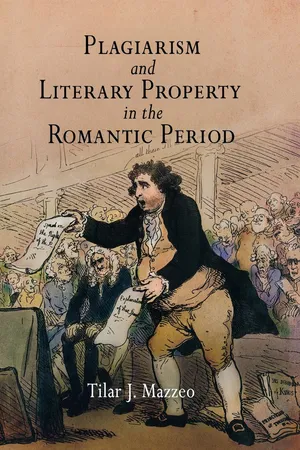
In a series of articles published in Tait's Magazine in 1834, Thomas DeQuincey catalogued four potential instances of plagiarism in the work of his friend and literary competitor Samuel Taylor Coleridge. DeQuincey's charges and the controversy they ignited have shaped readers' responses to the work of such writers as Coleridge, Lord Byron, William Wordsworth, and John Clare ever since. But what did plagiarism mean some two hundred years ago in Britain? What was at stake when early nineteenth-century authors levied such charges against each other? How would matters change if we were to evaluate these writers by the standards of their own national moment? And what does our moral investment in plagiarism tell us about ourselves and about our relationship to the Romantic myth of authorship?
In Plagiarism and Literary Property in the Romantic Period, Tilar Mazzeo historicizes the discussion of late eighteenth- and early nineteenth-century plagiarism and demonstrates that it had little in common with our current understanding of the term. The book offers a major reassessment of the role of borrowing, textual appropriation, and narrative mastery in British Romantic literature and provides a new picture of the period and its central aesthetic contests. Above all, Mazzeo challenges the almost exclusive modern association of Romanticism with originality and takes a fresh look at some of the most familiar writings of the period and the controversies surrounding them.
- 256 pages
- English
- ePUB (mobile friendly)
- Available on iOS & Android
eBook - ePub
Plagiarism and Literary Property in the Romantic Period
About this book
Information
Publisher
University of Pennsylvania PressYear
2013Print ISBN
9780812239676
9780812239676
eBook ISBN
9780812202731
Index
Adams, Percy, 109
Addison, Joseph, 82
Altieri, Charles, xii
anonymous publication, 83, 109–11
Augustan literature, 12, 14. See also neoclassical aesthetics
authorship: assumptions regarding solitary genius, ix, xi, xiii, 6–7, 16, 30, 182, 186–88; commercial or professional, ix, xii, 54–62, 66, 75, 81, 85, 95–96, 123–24, 144, 166–75; poststructuralist theories of, xi, xiii, 1, 6–7, 147, 186–88; pre-Romantic constructions of, xiii, 1. See also gender
ballads, 49, 54, 70–85. See also Wordsworth, William
Barrell, John, 157
Barthes, Roland, 6, 47–48, 196–97 n.27
Bayley, Peter, 15–6, 103, 119, 147–49, 152, 207–8 n.10
Beach, Joseph Warren, 46
Beattie, James, 178
Beaumont, Francis, and John Fletcher, 151
Beckford, William, 108, 111, 116
Bennett, Andrew, 85, 153
Bently, Lionel, 11
Birns, Nicholas, 137
Blackstone, William, 51–53
Blessington, Marguerite Gardiner, countess of, 116, 119–21
Bloom, Harold (The Anxiety of Influence), 136
Bloomfield, Robert, 179
Bonjour, Adrien, 46, 56
Boruchoff, David, 182, 187
Bostetter, Edward, 30, 195 n.12
Bradley, A. C, 3, 190 n.2
Brewer, William, 180
Brown, Capability, 145
Brownlow, Timothy, 145–46
Brun, (Sophie Christiane) Friederike, 18–19, 45–46, 50, 55–57, 62
Burgher, Gottfried August, 75, 82
Burke, Edmund, 15
Burke, Séan, xiii
Burns, Robert, 176
Byron, George Gordon, lord: accused of plagiarism, x, xii, 2, 8, 41, 44, 73, 86, 106, 144–45, 147; concern with textual unity, 128, 130; conflict with William Wordsworth, 44, 86–87, 94–96, 106–7, 119, 144, 147; debts in Childe Harold, 94–107, 111, 144; debts to Coleridge, 91–94, 96–97, 100–101, 110, 116; debts to Continental literature, 104–7, 116–21, 202–3 n.15, 204 n.30; debts in Deformed Transformed, 119; debts in Don J...
Table of contents
- Cover
- Title
- Copyright
- Contents
- Abbreviations
- Preface
- Romantic Plagiarism and the Critical Inheritance
- Coleridge, Plagiarism, and Narrative Mastery
- Property and the Margins of Literary Print Culture
- ”The Slip-Shod Muse’: Byron, Originality, and Aesthetic Plagiarism
- Monstrosities Strung into an Epic: Travel Writing and the Defense of “Modern” Poetry
- Poaching on the Literary Estate: Class, Improvement, and Enclosure
- Afterword
- Notes
- Bibliography
- Index
- Acknowledgments
Trusted by 375,005 students
Access to over 1.5 million titles for a fair monthly price.
Study more efficiently using our study tools.
Frequently asked questions
Yes, you can cancel anytime from the Subscription tab in your account settings on the Perlego website. Your subscription will stay active until the end of your current billing period. Learn how to cancel your subscription
No, books cannot be downloaded as external files, such as PDFs, for use outside of Perlego. However, you can download books within the Perlego app for offline reading on mobile or tablet. Learn how to download books offline
Perlego offers two plans: Essential and Complete
- Essential is ideal for learners and professionals who enjoy exploring a wide range of subjects. Access the Essential Library with 800,000+ trusted titles and best-sellers across business, personal growth, and the humanities. Includes unlimited reading time and Standard Read Aloud voice.
- Complete: Perfect for advanced learners and researchers needing full, unrestricted access. Unlock 1.5M+ books across hundreds of subjects, including academic and specialized titles. The Complete Plan also includes advanced features like Premium Read Aloud and Research Assistant.
We are an online textbook subscription service, where you can get access to an entire online library for less than the price of a single book per month. With over 1.5 million books across 990+ topics, we’ve got you covered! Learn about our mission
Look out for the read-aloud symbol on your next book to see if you can listen to it. The read-aloud tool reads text aloud for you, highlighting the text as it is being read. You can pause it, speed it up and slow it down. Learn more about Read Aloud
Yes! You can use the Perlego app on both iOS and Android devices to read anytime, anywhere — even offline. Perfect for commutes or when you’re on the go.
Please note we cannot support devices running on iOS 13 and Android 7 or earlier. Learn more about using the app
Please note we cannot support devices running on iOS 13 and Android 7 or earlier. Learn more about using the app
Yes, you can access Plagiarism and Literary Property in the Romantic Period by Tilar J. Mazzeo in PDF and/or ePUB format, as well as other popular books in Literature & English Literary Criticism. We have over 1.5 million books available in our catalogue for you to explore.