In the thirteenth century, Paris was the largest city in Western Europe, the royal capital of France, and the seat of one of Europe's most important universities. In this vibrant and cosmopolitan city, the beguines, women who wished to devote their lives to Christian ideals without taking formal vows, enjoyed a level of patronage and esteem that was uncommon among like communities elsewhere. Some Parisian beguines owned shops and played a vital role in the city's textile industry and economy. French royals and nobles financially supported the beguinages, and university clerics looked to the beguines for inspiration in their pedagogical endeavors. The Beguines of Medieval Paris examines these religious communities and their direct participation in the city's commercial, intellectual, and religious life.
Drawing on an array of sources, including sermons, religious literature, tax rolls, and royal account books, Tanya Stabler Miller contextualizes the history of Parisian beguines within a spectrum of lay religious activity and theological controversy. She examines the impact of women on the construction of medieval clerical identity, the valuation of women's voices and activities, and the surprising ways in which local networks and legal structures permitted women to continue to identify as beguines long after a church council prohibited the beguine status. Based on intensive archival research, The Beguines of Medieval Paris makes an original contribution to the history of female religiosity and labor, university politics and intellectual debates, royal piety, and the central place of Paris in the commerce and culture of medieval Europe.
eBook - ePub
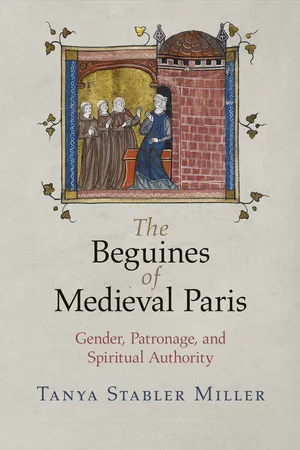
The Beguines of Medieval Paris
Gender, Patronage, and Spiritual Authority
- 304 pages
- English
- ePUB (mobile friendly)
- Available on iOS & Android
eBook - ePub
About this book
Information
Publisher
University of Pennsylvania PressYear
2014Print ISBN
9780812224115
9780812246070
eBook ISBN
9780812209686
CHAPTER 1
The Prud’homme and the Beguines
Louis IX and the Foundation of the Beguinage of Paris
By the mid-thirteenth century Paris was home to an increasingly visible population of religious women who lived in a manner that earned them the label beguinae. In the early 1250s, the secular cleric William of Saint-Amour (d. 1272) complained of “young women who are called beguines,” lamenting that they were becoming “widespread throughout the kingdom.”1 In the late 1250s and early 1260s, William’s contemporary Robert of Sorbon (d. 1274) found the beguine life worthy of extensive commentary and praise in his sermons and treatises addressed to students in Paris. Although details about informal beguine communities are lacking, such women had become a widely recognized phenomenon in Paris before Louis IX (r. 1226–1270) purchased lands in the parish of Saint-Paul for the purpose of building a house for “honest women who are called beguines.”2 It is likely that prior to Louis’s foundation, religious laywomen in Paris—as in other northern European cities—gathered in informal communities or attached themselves to one of the city’s churches or religious houses (see map 1).3 In any case, it is clear that Louis’s beguinage found immediate success attracting large numbers of lay religious women. In his Bonum universale de apibus, which was completed before May 1263, the Dominican Thomas of Cantimpré (d. 1272) marveled at the “great multitude” of beguines Louis had “gathered together” (collegerit) in the royal beguinage.4 The king’s Dominican confessor and biographer, Geoffrey of Beaulieu (d. 1275), claimed that Louis’s foundation housed “around four hundred” beguines.5 While there is no way to verify Geoffrey’s estimate, it was probably close to accurate.6 The size of the enclosure, as well as the substantial funds Louis invested in the foundation, indicate that the beguinage of Paris, like the court beguinages in the Low Countries on which it was modeled, housed hundreds of women.7
By all accounts, Louis was deeply invested in the success of his foundation, which represented the spiritual and practical sensibilities of a king influenced by new forms of spirituality and driven by an acute sense of responsibility to rule justly.8 Known for his admiration for the mendicant, or “begging,” orders, which extended beyond the established Dominican and Franciscan orders to lesser-known groups such as the Friars of the Sack and the Crutched Friars, Louis’s patronage of beguines fits a larger pattern of support for groups of men and women committed to living a life in accordance with new conceptions of the vita apostolica.9 Most accounts of Louis’s religious and charitable foundations, however, limit mention of the beguinage as just one of many “works of mercy” undertaken by the pious king.10
While there is little doubt that Louis perceived beguines as a group of women in need of royal support and protection, his personal admiration for the beguine life as well as his practical reasons for supporting a certain type of beguine community merit greater scrutiny. An examination of the socioreligious context in which Louis established the beguinage not only provides important insight into the significance the beguine life held for Louis on a personal level, it illuminates the circumstances under which beguines in Paris first gained official recognition. This recognition was crucial for the beguine community as it developed and endured in medieval Paris. Indeed, the king’s central role in the foundation and support of the beguinage set the course for the treatment of the beguine community throughout the history of its existence in medieval Paris.
The Conversion of Louis IX
In the summer of 1254, Louis returned to France from his failed first crusade. As nearly all accounts of his life attest, his personal disappointment over the crusade and sense that the loss was in some ways attributable to his own sins precipitated a major life turn in Louis.11 His hagiographers report that the king, in an effort to expiate his sins, submitted himself to flagellation and extreme fasting. In evident disregard for his own health, he fed lepers with his own hands and personally ministered to the poor and the sick. The hagiographical reports accord well with documentary evidence, which bears witness to the king’s generous support of the poor and the sick.12 Louis also threw himself into the task of spiritually and administratively reforming the kingdom from which he had been absent for six years. On the administrative front, he set to work reforming royal government, personally settling disputes and investigating local problems and complaints.13 He also turned his attention to promoting spiritual reform in his realm. To this end, he gave generously to religious and charitable houses throughout the kingdom and founded several new houses, such as the Quinze-Vingts (a hospital for the blind) and the beguinage of Paris.14
Among the many acts celebrated in Louis’s vitae, the foundation of a house for beguines is usually treated as but one example of the king’s pious concern for the sick, the poor, and the vulnerable.15 Geoffrey of Beaulieu, Louis’s confessor and the author of the earliest hagiographical account of the king’s life, reported that Louis founded the beguinage in Paris for “honest women called beguines.”16 Geoffrey’s account emphasizes the charitable impulse driving this foundation, reporting that Louis provided daily sustenance—or pensions—especially for beguines hailing from impoverished noble families.17 Similarly, Jean of Joinville, who penned his vita sometime between 1270 and 1309, reports that Louis founded and endowed the beguinage in order to house women who “wished to devote themselves to a life of chastity.”18
Louis undoubtedly held women who chose to live a religious life in the world in particularly high regard. His own sister Isabelle (d. 1270), who embodied the ideals of thirteenth-century lay sanctity, devoted herself to a life of chastity at an early age.19 Significantly, Isabelle never became a nun, remaining at court for sixteen years after rejecting a politically significant marriage alliance and eventually retiring to Longchamp, the Franciscan convent near Paris she founded in 1260. As several scholars have noted, Isabelle’s religiosity paralleled, and probably helped shape, that of her sainted brother.20 Both siblings pursued lives of devotion that did not always mesh with the wishes and expectations of others. Sometime before Louis made his crusader vow in December 1244, Isabelle famously resisted what must have been considerable pressure from her family—and even the pope—to marry the son and heir of Emperor Frederick II.21 Isabelle’s steadfast rejection of marriage impressed courtly observers and her virginity was a prominent theme in her biography.22
In his Bonum universale de apibus, Thomas of Cantimpré draws explicit connections between Isabelle of France’s chastity and rejection of a worldly life and her brother’s support for beguines. In a chapter dedicated to the virtue of chastity, Thomas praises Isabelle for rejecting marriage, even to the son of the Holy Roman Emperor, and “giving herself so much to contemplation and virtue that she seemed to have no care for any transitory things.”23 Having extolled Isabelle’s virginity, Thomas immediately turns to Louis’s foundation of the beguinage in Paris. According to Thomas, the French king founded the beguinage out of great admiration for “the modesty of virginal dignity,” so that the beguines could “employ themselves in the submission and salvation of humility.”24 While Thomas’s praise for Isabelle is delivered within the context of a broader discussion of chastity, it is also a commentary on Isabelle’s rejection of social expectations and embrace of a beguine-like lifestyle. As Sean Field puts it, Isabelle was an example “not only of resolute devotion to virginity in the face of parental opposition but also of a devout laywoman’s ability to remain in the world.”25
Thus, the various accounts of Louis’s foundation for beguines tend to emphasize the king’s charitable motivations as well as the worthiness of the beguinage’s residents, who, Louis’s hagiographers insisted, lived honestly and chastely and came from noble backgrounds. Yet the term beguina originally seems to have been used pejoratively to describe someone of ostentatious, and thus probably insincere, piety.26 By dress and demeanor, beguines made a claim to live a religious life and their behavior, consequently, invited a great deal of scrutiny. In Paris, lay religious women were highly visible, attracting both positive and negative commentary for their refusal to conform to the expectations of urban life, such as marriage, cultivation of reputation, and acquisition of wealth. While Louis’s hagiographers stressed the beguines’ chastity and respectability, some contemporary observers strongly objected to their adoption of humble dress, expressed skepticism regarding their pious self-representation, and accused them of mendicancy, hypocrisy, and sexual impropriety.
The writings of the secular cleric William of Saint-Amour (d. 1272), a vociferous critic of the beguines, give voice to some of the suspicions regarding the beguine life in Paris at the time of Louis’s foundation. William’s principal objection to the beguines seems to have been their association with the mendicant friars, against whom he composed his famous eschatological treatise De periculis novissimorum temporum (On the Perils of the Last Times) in 1256 at the height of the bitter and protracted dispute between the secular and mendicant orders at the University of Paris.27 But it was not just the beguines’ association with the friars that drew William’s ire. The beguines’ assumption of religious dress and public displays of devotion violated what William viewed as important distinctions between clerical and lay status, a pernicious trend that even the king himself followed.28 By making a claim to lead a religious life, the beguines exposed themselves to intense scrutiny and inevitable charges of hypocrisy.29 In William’s attacks on the beguines, then, can be detected some of the broader suspicions some Parisians harbored against them.
Employing biblical exegesis and drawing on apocalyptic themes, William’s treatise aimed to warn the secular clergy in particular about the dangers posed by the mendicant friars, whom he associated with the “pseudo-Apostles,” or the forerunners of the Antichrist.30 Citing Paul’s Second Letter to Timothy (“Know also this, that in the final days, dangerous times will threaten … for of this sort are those who penetrate homes and lead captive silly women laden with sins”),31 William warned that the friars unlawfully penetrated the house of the soul by usurping the pastoral tasks of preaching and confession from the secular clergy who rightfully exercised them.32 As for the mulierculas (or silly little women) of verse 6, William was quick to associate them with certain women of his own time, who, laden with sins, preferred the friars to their own parish priests.33 Embedded in the apocalyptic message of the treatise were the secular clergy’s concerns about mendicant appropriation of the pastoral responsibilities of the secular clergy, a concern that intensified with the appearance of lay religious women who sought spiritual experiences apart from and beyond those of the ordinary parish laity.34 By accusing the friars of unlawfully entering houses and seducing “silly women laden with sin,” moreover, William gave voice to suspicions that the beguines, who were unenclosed and unprofessed, were inappropriately intimate with the friars.
When compelled to defend his attacks on the friars, William avoided direct mention of the orders themselves, claiming that his work was not directed against any approved order.35 The beguines, never recognized as an official order by the papacy, therefore represented an easy target. These beguines, William complained, seemed to be multiplying throughout the kingdom and posed a burden to society since, although young and able-bodied, they shamefully begged for alms.36 Here, William’s critique turns from the beguines’ gullibility and attachment to false preachers to their mendicancy. According to a list of accusations against the secular cleric, William had criticized the beguines’ claims to live a religious life as false and prideful, criticizing the beguines for donning humble clothes and cutting their hair in order to be thought holier than others. This assumption of “religious” clothing, he argued, deceitfully advertised a religious vocation when in fact, he insisted, they were ordinary laywomen. Such women, he charge...
Table of contents
- Cover
- Title Page
- Copyright
- Dedication
- Contents
- Introduction
- Chapter 1. The Prud’homme and the Beguines: Louis IX and the Foundation of the Beguinage of Paris
- Chapter 2. The World of the Beguinage
- Chapter 3. Beguines, Silk, and the City
- Chapter 4. Masters and Pastors: Sorbonne Scholars, Beguines, and Religious Instruction
- Chapter 5. Religious Education and Spiritual Collaboration at the Beguinage of Paris
- Chapter 6. “There Are Among Us Women Called Beguines”
- Chapter 7. The King’s Beguines
- Appendix. Beguines Whose Occupations Are Known
- Notes
- Bibliography
- Index
- Acknowledgments
Trusted by 375,005 students
Access to over 1.5 million titles for a fair monthly price.
Study more efficiently using our study tools.
Frequently asked questions
Yes, you can cancel anytime from the Subscription tab in your account settings on the Perlego website. Your subscription will stay active until the end of your current billing period. Learn how to cancel your subscription
No, books cannot be downloaded as external files, such as PDFs, for use outside of Perlego. However, you can download books within the Perlego app for offline reading on mobile or tablet. Learn how to download books offline
Perlego offers two plans: Essential and Complete
- Essential is ideal for learners and professionals who enjoy exploring a wide range of subjects. Access the Essential Library with 800,000+ trusted titles and best-sellers across business, personal growth, and the humanities. Includes unlimited reading time and Standard Read Aloud voice.
- Complete: Perfect for advanced learners and researchers needing full, unrestricted access. Unlock 1.5M+ books across hundreds of subjects, including academic and specialized titles. The Complete Plan also includes advanced features like Premium Read Aloud and Research Assistant.
We are an online textbook subscription service, where you can get access to an entire online library for less than the price of a single book per month. With over 1.5 million books across 990+ topics, we’ve got you covered! Learn about our mission
Look out for the read-aloud symbol on your next book to see if you can listen to it. The read-aloud tool reads text aloud for you, highlighting the text as it is being read. You can pause it, speed it up and slow it down. Learn more about Read Aloud
Yes! You can use the Perlego app on both iOS and Android devices to read anytime, anywhere — even offline. Perfect for commutes or when you’re on the go.
Please note we cannot support devices running on iOS 13 and Android 7 or earlier. Learn more about using the app
Please note we cannot support devices running on iOS 13 and Android 7 or earlier. Learn more about using the app
Yes, you can access The Beguines of Medieval Paris by Tanya Stabler Miller in PDF and/or ePUB format, as well as other popular books in History & European Medieval History. We have over 1.5 million books available in our catalogue for you to explore.