Selected by Choice magazine as an Outstanding Academic Title
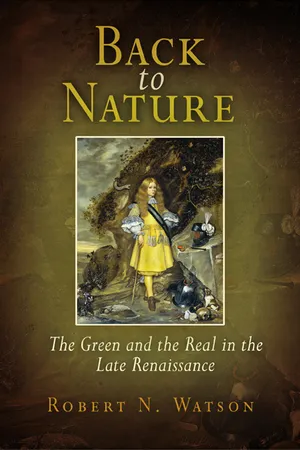
Sweeping across scholarly disciplines, Back to Nature shows that, from the moment of their conception, modern ecological and epistemological anxieties were conjoined twins. Urbanization, capitalism, Protestantism, colonialism, revived Skepticism, empirical science, and optical technologies conspired to alienate people from both the earth and reality itself in the seventeenth century. Literary and visual arts explored the resulting cultural wounds, expressing the pain and proposing some ingenious cures. The stakes, Robert N. Watson demonstrates, were huge.
Shakespeare's comedies, Marvell's pastoral lyrics, Traherne's visionary Centuries, and Dutch painting all illuminate a fierce submerged debate about what love of nature has to do with perception of reality.
- 446 pages
- English
- PDF
- Available on iOS & Android
eBook - PDF
About this book
Information

PART
I
Introduction
The
Green
and
the
Real

This
page
intentionally
left
blank
Table of contents
- Cover
- Title
- Copyright
- Contents
- Part I: Introduction: The Green and the Real
- Part II: Paradoxes: Alienation from Nature in English Literature
- Part III: Reformations: Protestant Politics, Poetics, and Paintings
- Part IV: Solutions: The Consolations of Mediation
- Conclusion
- Notes
- Bibliography
- Index
- Acknowledgments
Trusted by 375,005 students
Access to over 1.5 million titles for a fair monthly price.
Study more efficiently using our study tools.
Frequently asked questions
Yes, you can cancel anytime from the Subscription tab in your account settings on the Perlego website. Your subscription will stay active until the end of your current billing period. Learn how to cancel your subscription
No, books cannot be downloaded as external files, such as PDFs, for use outside of Perlego. However, you can download books within the Perlego app for offline reading on mobile or tablet. Learn how to download books offline
Perlego offers two plans: Essential and Complete
- Essential is ideal for learners and professionals who enjoy exploring a wide range of subjects. Access the Essential Library with 800,000+ trusted titles and best-sellers across business, personal growth, and the humanities. Includes unlimited reading time and Standard Read Aloud voice.
- Complete: Perfect for advanced learners and researchers needing full, unrestricted access. Unlock 1.5M+ books across hundreds of subjects, including academic and specialized titles. The Complete Plan also includes advanced features like Premium Read Aloud and Research Assistant.
We are an online textbook subscription service, where you can get access to an entire online library for less than the price of a single book per month. With over 1.5 million books across 990+ topics, we’ve got you covered! Learn about our mission
Look out for the read-aloud symbol on your next book to see if you can listen to it. The read-aloud tool reads text aloud for you, highlighting the text as it is being read. You can pause it, speed it up and slow it down. Learn more about Read Aloud
Yes! You can use the Perlego app on both iOS and Android devices to read anytime, anywhere — even offline. Perfect for commutes or when you’re on the go.
Please note we cannot support devices running on iOS 13 and Android 7 or earlier. Learn more about using the app
Please note we cannot support devices running on iOS 13 and Android 7 or earlier. Learn more about using the app
Yes, you can access Back to Nature by Robert Watson in PDF and/or ePUB format, as well as other popular books in Literature & English Literary Criticism. We have over 1.5 million books available in our catalogue for you to explore.