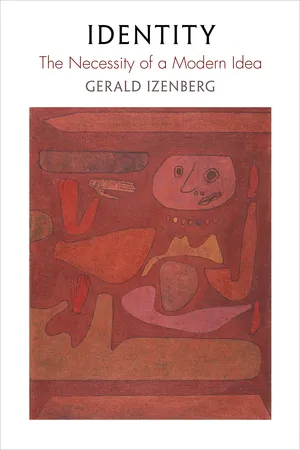
Identity: The Necessity of a Modern Idea is the first comprehensive history of identity as the answer to the question, "who, or what, am I?" It covers the century from the end of World War I, when identity in this sense first became an issue for writers and philosophers, to 2010, when European political leaders declared multiculturalism a failure just as Canada, which pioneered it, was hailing its success. Along the way the book examines Erik Erikson's concepts of psychological identity and identity crisis, which made the word famous; the turn to collective identity and the rise of identity politics in Europe and America; varieties and theories of group identity; debates over accommodating collective identities within liberal democracy; the relationship between individual and group identity; the postmodern critique of identity as a concept; and the ways it nonetheless transformed the social sciences and altered our ideas of ethics.
At the same time the book is an argument for the validity and indispensability of identity, properly understood. Identity was not a concept before the twentieth century because it was taken for granted. The slaughter of World War I undermined the honored identities of prewar Europe and, as a result, the idea of identity as something objective and stable was thrown into question at the same time that people began to sense that it was psychologically and socially necessary. We can't be at home in our bodies, act effectively in the world, or interact comfortably with others without a stable sense of who we are. Gerald Izenberg argues that, while it is a mistake to believe that our identities are givens that we passively discover about ourselves, decreed by God, destiny, or nature, our most important identities have an objective foundation in our existential situation as bodies, social beings, and creatures who aspire to meaning and transcendence, as well as in the legitimacy of our historical particularity.
- 552 pages
- English
- ePUB (mobile friendly)
- Available on iOS & Android
eBook - ePub
About this book
Information
Publisher
University of Pennsylvania PressYear
2016Print ISBN
9780812224535
9780812248081
eBook ISBN
9780812292718
Topic
PhilosophySubtopic
World HistoryChapter 1

Identity Becomes an Issue: European Literature Between the World Wars
I am never anything but what I think of myself—and this varies so incessantly, that often, if I were not there to make them acquainted, my morning’s self would not recognize my evening’s. Nothing could be more different from me than myself.
—André Gide, The Counterfeiters, 1925
There is no ideal to which we can sacrifice ourselves, for all we know is lies. . . . The earthly shadow which falls behind marble gods is enough to keep us from them. How firmly man is bound to himself! Fatherland, justice, grandeur, truth—which of his statues does not carry such a trace of human hands as would evoke in us the same ironic sadness as old and once-loved faces?
—André Malraux, The Temptation of the West, 1926
As Virginia Woolf’s Orlando drives out of London toward her country estate—at precisely 11:00 a.m. on October 11, 1928, we are told—her view from the speeding car is a kaleidoscopic succession of fragmentary images: half-words of shop signs, red flashes of meat in butchers’ windows, women passed so quickly “they almost had their heels sliced off.” Immediately the description becomes a spectacular metaphor—in both literal and vernacular senses—for an ultimate truth about the self:
Nothing could be seen whole or read from start to finish. What was seen begun—like two friends starting to meet each other across the street—was never seen ended. After twenty minutes the body and mind were like scraps of torn paper tumbling down from a sack and, indeed, the process of motoring fast out of London so much resembles the chopping up small of identity which precedes unconsciousness and perhaps death itself that it is an open question in what sense Orlando can be said to have existed at the present moment.1
This passage represents the first serious use of the word “identity” that I have found in its now-prevalent sense of the self as a continuous something. Woolf’s metaphor entails a complex understanding of its meaning and historical moment. The automobile vignette brings together in brilliant compression three distinct realms: a psychological experience of self-fragmentation; the ontological condition of the self’s insubstantiality that underlies it—hinted at in Woolf’s evocation of the sense of ephemerality provoked by the thought of death; and finally a concrete situation, the motorcar as a personal technology of speed widely available only after the Great War, which provides the historical occasion for the breakthrough of fragmentation and nothingness into daytime consciousness.2
If the language of identity was rare in the 1920s, a deep sense of the self’s lack of substantial being was not. Few may have used the word, but the experience Woolf describes is at the core of much European fiction and drama during the decade. Woolf herself had probed identity even more deeply three years earlier in Mrs. Dalloway. She and writers like André Gide, Marcel Proust, Luigi Pirandello, Hermann Hesse, Robert Musil, and Hermann Broch stand as the discoverers of the modern idea of identity as self-definition in their works of the interwar years. And the paradox that will haunt the concept from then on is that they discovered identity in the negation of its possibility as it had been taken for granted until then: the ability to define what the self “was” as a stable, permanent something—sexual, racial, national, social, or religious. For some writers—Pirandello, for example—the discovery led to a kind of nihilism; identity was impossible but selfhood without identity was unlivable. For others like Proust, Musil, and Woolf, identity had to be fundamentally reconceived if it were to be rescued at all. For all of them, however, the old idea of identity, along with so many other things, had been done to death by the Great War.
The Inadequacy of Memory
He was still seeing [his] baby shoes. Or not seeing them: he merely saw them as if he were seeing them. . . . And he thought: “This having-nothing-to-do-with-me-anymore somehow expresses the fact that all our lives, we’re somehow only half integrated with ourselves.”
—Robert Musil, The Man Without Qualities3
It was Marcel Proust who most directly tested Locke’s equation of memory and personal identity and found it wanting. Time Regained, the last volume of In Search of Lost Time—significantly the only one set in the postwar years—offered an interpretation of memory that was meant to finally explain the epiphany Marcel had experienced years before, when the taste of a madeleine soaked in tea had released overwhelming memories of childhood happiness.4In the despairing reflections that preceded a second and final epiphany, which would reveal to Marcel the saving power of art derived from memory rightly understood, Proust confronted the defects of Locke’s idea. He acknowledged the continuity of memory in Locke’s forensic terms, but suggested its relative insignificance for the deepest concerns of the self. “The memory of the most multiple person,” Marcel asserts, in defending the moral reliability of even the flightiest soul (he is thinking of Gilberte), “establishes a sort of identity in him and makes him reluctant to go back on promises which he remembers, even if he has not countersigned them.”5 A sort of identity—but not, as Marcel says again and again in the novel, the kind whose absence tears at us most painfully. Proust easily conceded the possibility of ethical constancy within identity inconstancy because he did not see ethics as the crux of the problem.
At the Guermantes’ party, which takes up much of Time Regained, Marcel analyzes the experience of meeting friends and acquaintances he had not seen since before the war and recalling what he knew about them:
As I followed the stream of memory back towards its source, I arrived eventually at images of a single person separated from one another by an interval of time so long, preserved within me by “I’s” that were so distinct and themselves . . . fraught with meanings that were so different, that ordinarily when I surveyed . . . the whole past course of my relations with that particular person I omitted these earlier images and had even ceased to think that the person to whom they referred was the same as the one whom I had later got to know, so that I needed a fortuitous lightning flash of attention before I could re-attach this latter-day acquaintance, like a word to its etymology, to the original significance which he or she had possessed for me.6
Because the self changes so radically, memory is substantively discontinuous—one can encounter recognizable memories of someone that nonetheless don’t at all seem like one another or like the person one knows in the present. Despite his recourse to the Bergsonian and Jamesian metaphor of the stream of consciousness, Marcel’s analysis of his encounter suggests that memory is not a continuous stream which can only artificially be disarticulated into separate elements. It is more like discrete bundles floating in a stream, bundles so apparently different from one another that it takes an act of focused attention to connect them. And even that kind of attention is not under one’s conscious control, depending rather on “a fortuitous lightning flash.” Such disconnectedness is shockingly true even of love, the most consuming of human attachments. At one point Proust had described it as “like an evil spell in a fairy tale against which one is powerless”; when in love, one can’t let go of the beloved no matter how hard one tries. But that is true only until the enchantment has passed.7 Then love may disappear so completely that one cannot recognize either the once beloved in the other person or the self that once loved her. In his most shattering evocation of ephemerality, Proust asserted the impermanence even of loss: “For in this world of ours where everything withers, everything perishes, there is a thing that decays, that crumbles into dust even more completely, leaving behind still fewer traces of itself than beauty: namely grief.”8 Memory is discontinuous not because one cannot remember that one once loved and lost, but because the memory no longer carries existential weight. It no longer constitutes who one is now.
Identity Before the War
The anguish of Marcel’s discontinuous stream of memory is its insubstantiality. But for a more historical sense of what that might have meant to writers in the 1920s, it should be understood not against Locke’s account of identity but against identity as they had understood it before the war. Two vignettes from other novels of the decade can give an initial sense of the world their authors felt they had lost, for good and ill.
The first is from Robert Musil’s The Man Without Qualities. Written during the late 1920s, it is set in Vienna in 1913, the last, blissfully unselfaware year of Austro-Hungarian innocence before the catastrophe that destroyed the empire. An early chapter titled “Even a Man Without Qualities Has a Father with Qualities” introduces readers to the protagonist Ulrich’s father, his antitype. Father is a middle-class Viennese law professor who by dint of assiduous service in his student years as a tutor in the houses of the high aristocracy had risen to become their legal adviser. Though now retired, professionally respected, and independently wealthy, he remains fawningly subservient to “the owners of horses, fields and traditions.” For their part, while happy to have used his services, the nobility “never regarded him as anything but the personified spirit of the rising middle class.”9 Yet despite the aristocracy’s indelible if genial condescension, Ulrich’s father is completely at one with himself, never doubting the legitimacy of the existing social and political order or the justice of his subordinate place in it. From the vantage point of an unquestioned sense of who he is he criticizes Ulrich for flouting his proper station by buying a large house that however run-down could still be considered an aristocratic chateau. With such pointed details Musil sketches the picture of the quintessential European upper bourgeois, the same picture that will reappear in later historical accounts of the “persistence of the Old Regime” and the “feudalization of the middle class” in late nineteenth-century Central Europe.10 But above all the image depicts the quintessential man of identity: Ulrich’s father “sincerely venerated the state of affairs that had served him so well, not because it was to his advantage, but because he was in harmony and coexistent with it.”11 What matters to him, pace Marx or Weber, is not the material interest or social status that his class position and belief system serve but the self-definition they offer him. He is a solid, undivided self because he has a definite place in the Austro-Hungarian imperial and social structure, sanctioned by history and God; more exactly, he is that place. It is against the ontological density of his father’s social and political identity that the irreverent Ulrich, with no attachments, no vocation, and a mordant sense of the rickety hollowness of Austria-Hungary, is “The Man Without Qualities.”
The second vignette, from Hermann Hesse’s Steppenwolf (1927), involves an equally alienated protagonist, in the postwar years, who however measures the self-awareness that dawns on him against a very different previous reality. Before the war, in partial rebellion against his bourgeois upbringing, Harry Haller had come to think of himself as divided into two distinct and antagonistic selves, man and wolf. The “man” is decent, humane, cultured, and orderly, the embodiment of all the nineteenth-century bourgeois virtues. The wolf is wild, potentially destructive, a creature of impulse, passion, and anger longing to tear up the fabric of orderly society out of hatred for its decency and lawfulness. So frightening is the wolf to Haller that after one of its particularly egregious eruptions he contemplates suicide. He can neither shake the bourgeois in himself nor fully accept him, and sees no other way out of this inner conflict than death.
The “Treatise on the Steppenwolf” thrust on Haller one night by a mysterious stranger transforms him. It first articulates the man-wolf polarity in more precise terms than Haller had ever been able to do, then seeks to disabuse him of it. It ascribes the dualistic way of thinking primarily to artists, alluding to the “two souls” warring within Goethe’s Faust that had become an integral part of the nineteenth century cultivated German’s self-image. Faust’s two souls, originally evoking the Romantic conflict between the wish to embrace earthly finitude and the desire to transcend it, had by the late nineteenth century come to mean something less exalted and more dangerous. The division between rational human and instinctual animal that bedevils Haller was the common trope of a European-wide rebellion against bourgeois rationalism. The nonrational might indeed include “higher” infinite spiritual yearning but more commonly it was “low” sexual and aggressive drives, morally unacceptable, culturally problematic, and hence consciously unavailable to the normative middle-class personality. Artist versus bourgeois, immoralist versus moralist, unconscious versus conscious, charisma versus bureaucratic rationality, instinct against intellect, Apollo and Dionysus, Dr. Jekyll and Mr. Hyde—in different but parallel figures the art and thought of prewar Europe painted a dualistic portrait of humanity in order to subvert the false unity and harmony of its “Victorian” self-image. Whether enthusiastically embraced, vehemently rejected, or, as in most cases, regarded with deep ambivalence, the irrational was omnipresent in prewar avant-garde culture as the suppressed other of the bourgeois self.
To the author of the Steppenwolf treatise, however, this prewar dualism is false. It is, he claims, only a paradoxical instance of the inborn human need to create an illusory unity within the self. Though dualism begins to recognize multiplicity, it is still too bounded a formulation of the self, even if someone who arrives at it can be thought “almost a genius,” a rare exception to the usual self-deception, so pressing is the human need for the illusion of unity. Even so, the trope of “two souls” is an unacceptably reduced account of the self. Every “I” is in reality “a manifold world, a constellated heaven, a chaos of forms, of states and stages, of inheritances and potentialities.” Not all that bites is wolf, nor is “man” exhausted by the bourgeois. The artist who divides man into two fails to see that “this whole world, this Eden and its manifestations of beauty and terror, of greatness and meanness, of strength and tenderness is crushed and imprisoned by the wolf legend just as the real man in him is crushed and imprisoned by that sham existence, the bourgeois.”12
In correcting Haller, Hesse was correcting himself. His own early novels had been constructed around the very dualism the Steppenwolf treatise excoriates. There is no better evidence for the radical novelty of the analysis of the self in Steppenwolf and The Man Without Qualities than the artistic trajectories of their authors. Both Hesse and Musil had written novels before the war with dualistic premises that had brought them considerable acclaim.
Hesse had actually used the wolf image to describe one side of the “split within myself” in his most popular prewar novel, Peter Camenzind (1903), but there the animal was more benign than the snarling beast of Steppenwolf. Camenzind is a self-described “poet, wanderer, drunkard, lone wolf,” a soulful melancholic from a tiny farming village in the Alps who experiences early in life the infinite grandeur of nature in the mountains. His talent for writing wrenches him out of his rural idyll and sends him to the city, to higher education and the world of commercial publishing. He yearns to translate his “dispassionate” lo...
Table of contents
- Cover
- Half title
- Title
- Copyright
- Dedication
- Contents
- Introduction. The New “Discourse” of Identity
- Chapter 1. Identity Becomes an Issue: European Literature Between the World Wars
- Chapter 2. The Ontological Critique of Identity: Heidegger and Sartre
- Chapter 3. Identity Becomes a Word: Erik Erikson and Psychological Identity
- Chapter 4. Social Identity and the Birth of Identity Politics, 1945–1970
- Chapter 5. Collective Identities and Their Agendas, 1970–2000
- Chapter 6. The Practical Politics of National and Multicultural Identity: Germany, France, Canada, and the United States, 1970–2010
- Chapter 7. The Problem of Collective Identity in Liberal Democracy
- Chapter 8. The Contradictions of Postmodern Identity
- Chapter 9. Identity Transforms the Social Sciences
- Chapter 10. The Kinds of Kinds: Explaining Collective Identity
- Chapter 11. Identity as an Ethical Issue
- Conclusion. The Necessity of Identity
- Notes
- Bibliography
- Index
- Acknowledgments
Trusted by 375,005 students
Access to over 1.5 million titles for a fair monthly price.
Study more efficiently using our study tools.
Frequently asked questions
Yes, you can cancel anytime from the Subscription tab in your account settings on the Perlego website. Your subscription will stay active until the end of your current billing period. Learn how to cancel your subscription
No, books cannot be downloaded as external files, such as PDFs, for use outside of Perlego. However, you can download books within the Perlego app for offline reading on mobile or tablet. Learn how to download books offline
Perlego offers two plans: Essential and Complete
- Essential is ideal for learners and professionals who enjoy exploring a wide range of subjects. Access the Essential Library with 800,000+ trusted titles and best-sellers across business, personal growth, and the humanities. Includes unlimited reading time and Standard Read Aloud voice.
- Complete: Perfect for advanced learners and researchers needing full, unrestricted access. Unlock 1.5M+ books across hundreds of subjects, including academic and specialized titles. The Complete Plan also includes advanced features like Premium Read Aloud and Research Assistant.
We are an online textbook subscription service, where you can get access to an entire online library for less than the price of a single book per month. With over 1.5 million books across 990+ topics, we’ve got you covered! Learn about our mission
Look out for the read-aloud symbol on your next book to see if you can listen to it. The read-aloud tool reads text aloud for you, highlighting the text as it is being read. You can pause it, speed it up and slow it down. Learn more about Read Aloud
Yes! You can use the Perlego app on both iOS and Android devices to read anytime, anywhere — even offline. Perfect for commutes or when you’re on the go.
Please note we cannot support devices running on iOS 13 and Android 7 or earlier. Learn more about using the app
Please note we cannot support devices running on iOS 13 and Android 7 or earlier. Learn more about using the app
Yes, you can access Identity by Gerald Izenberg in PDF and/or ePUB format, as well as other popular books in Philosophy & World History. We have over 1.5 million books available in our catalogue for you to explore.