In the seventeenth century, even as the Spanish Habsburg monarchy entered its irreversible decline, the capital of its most important overseas territory was flourishing. Nexus of both Atlantic and Pacific trade routes and home to an ethnically diverse population, Mexico City produced a distinctive Baroque culture that combined local and European influences. In this context, the American-born descendants of European immigrants—or creoles, as they called themselves—began to envision a new society beyond the terms of Spanish imperialism, and the writings of the Mexican polymath Carlos de Sigüenza y Góngora (1645-1700) were instrumental in this process. Mathematician, antiquarian, poet, and secular priest, Sigüenza authored works on such topics as the 1680 comet, the defense of New Spain, pre-Columbian history, and the massive 1692 Mexico City riot. He wrote all of these, in his words, "out of love for my patria."
Through readings of Sigüenza y Góngora's diverse works, Baroque Sovereignty locates the colonial Baroque at the crossroads of a conflicted Spanish imperial rule and the political imaginary of an emergent local elite. Arguing that Spanish imperialism was founded on an ideal of Christian conversion no longer applicable at the end of the seventeenth century, More discovers in Sigüenza y Góngora's works an alternative basis for local governance. The creole archive, understood as both the collection of local artifacts and their interpretation, solved the intractable problem of Spanish imperial sovereignty by establishing a material genealogy and authority for New Spain's creole elite. In an analysis that contributes substantially to early modern colonial studies and theories of memory and knowledge, More posits the centrality of the creole archive for understanding how a local political imaginary emerged from the ruins of Spanish imperialism.
eBook - PDF
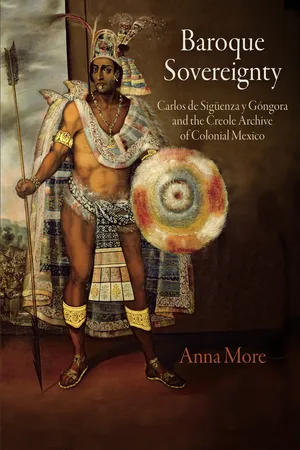
Baroque Sovereignty
Carlos de Sigüenza y Góngora and the Creole Archive of Colonial Mexico
- 361 pages
- English
- PDF
- Available on iOS & Android
eBook - PDF
About this book
Information
Publisher
University of Pennsylvania PressYear
2012Print ISBN
9780812244694
9780812244694
eBook ISBN
9780812206555
Table of contents
- Cover
- Title
- Copyright
- Contents
- Introduction: Sigüenza y Góngora and the Creole Archive
- 1. Allegory, Archives, and Creole Sovereignty
- 2. “Nostra Academia in Barbara . . . ”: Building an Archive on the Imperial Frontier
- 3. Mexican Hieroglyphics: Creole Antiquarianism and the Politics of Empire
- 4. Counterhistory and Creole Governance in the Riot of 1692
- 5. Creole Citizenship, Race, and the Modern World System
- Conclusion: The Afterlife of a Baroque Archive
- Notes
- Bibliography
- Index
- Acknowledgments
Trusted by 375,005 students
Access to over 1.5 million titles for a fair monthly price.
Study more efficiently using our study tools.
Frequently asked questions
Yes, you can cancel anytime from the Subscription tab in your account settings on the Perlego website. Your subscription will stay active until the end of your current billing period. Learn how to cancel your subscription
No, books cannot be downloaded as external files, such as PDFs, for use outside of Perlego. However, you can download books within the Perlego app for offline reading on mobile or tablet. Learn how to download books offline
Perlego offers two plans: Essential and Complete
- Essential is ideal for learners and professionals who enjoy exploring a wide range of subjects. Access the Essential Library with 800,000+ trusted titles and best-sellers across business, personal growth, and the humanities. Includes unlimited reading time and Standard Read Aloud voice.
- Complete: Perfect for advanced learners and researchers needing full, unrestricted access. Unlock 1.5M+ books across hundreds of subjects, including academic and specialized titles. The Complete Plan also includes advanced features like Premium Read Aloud and Research Assistant.
We are an online textbook subscription service, where you can get access to an entire online library for less than the price of a single book per month. With over 1.5 million books across 990+ topics, we’ve got you covered! Learn about our mission
Look out for the read-aloud symbol on your next book to see if you can listen to it. The read-aloud tool reads text aloud for you, highlighting the text as it is being read. You can pause it, speed it up and slow it down. Learn more about Read Aloud
Yes! You can use the Perlego app on both iOS and Android devices to read anytime, anywhere — even offline. Perfect for commutes or when you’re on the go.
Please note we cannot support devices running on iOS 13 and Android 7 or earlier. Learn more about using the app
Please note we cannot support devices running on iOS 13 and Android 7 or earlier. Learn more about using the app
Yes, you can access Baroque Sovereignty by Anna More in PDF and/or ePUB format, as well as other popular books in Literature & European Literary Criticism. We have over 1.5 million books available in our catalogue for you to explore.