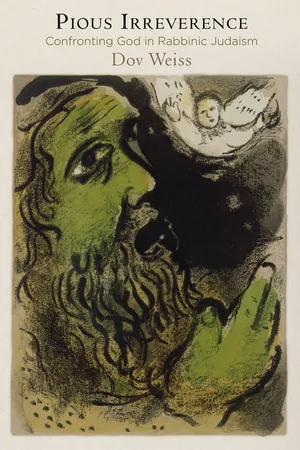
Judaism is often described as a religion that tolerates, even celebrates arguments with God. Unlike Christianity and Islam, it is said, Judaism endorses a tradition of protest as first expressed in the biblical stories of Abraham, Job, and Jeremiah. In Pious Irreverence, Dov Weiss has written the first scholarly study of the premodern roots of this distinctively Jewish theology of protest, examining its origins and development in the rabbinic age.
Weiss argues that this particular Jewish relationship to the divine is rooted in the most canonical of rabbinic texts even as he demonstrates that in ancient Judaism the idea of debating God was itself a matter of debate. By elucidating competing views and exploring their theological assumptions, the book challenges the scholarly claim that the early rabbis conceived of God as a morally perfect being whose goodness had to be defended in the face of biblical accounts of unethical divine action. Pious Irreverence examines the ways in which the rabbis searched the words of the Torah for hidden meanings that could grant them the moral authority to express doubt about, and frustration with, the biblical God. Using characters from the Bible as their mouthpieces, they often challenged God's behavior, even in a few remarkable instances, envisioning God conceding error, declaring to the protestor, "You have taught Me something; I will nullify My decree and accept your word."
- 304 pages
- English
- PDF
- Available on iOS & Android
eBook - PDF
About this book
Information
Publisher
University of Pennsylvania PressYear
2016Print ISBN
9780812248357
9780812248357
eBook ISBN
9780812293050
Topic
Theology & ReligionSubtopic
Jewish TheologyTable of contents
- Cover
- Contents
- A Note on Manuscripts, Critical Editions, and Translations Used in the Text
- Introduction
- Chapter 1. Confrontation as Sin
- Chapter 2. From Sin to Virtue
- Chapter 3. Varieties of Confrontation
- Chapter 4. Confrontation as Ethics
- Chapter 5. The Humanization of God
- Chapter 6. Divine Concessions
- Conclusion
- Notes
- Bibliography
- Index
- Acknowledgments
Trusted by 375,005 students
Access to over 1.5 million titles for a fair monthly price.
Study more efficiently using our study tools.
Frequently asked questions
Yes, you can cancel anytime from the Subscription tab in your account settings on the Perlego website. Your subscription will stay active until the end of your current billing period. Learn how to cancel your subscription
No, books cannot be downloaded as external files, such as PDFs, for use outside of Perlego. However, you can download books within the Perlego app for offline reading on mobile or tablet. Learn how to download books offline
Perlego offers two plans: Essential and Complete
- Essential is ideal for learners and professionals who enjoy exploring a wide range of subjects. Access the Essential Library with 800,000+ trusted titles and best-sellers across business, personal growth, and the humanities. Includes unlimited reading time and Standard Read Aloud voice.
- Complete: Perfect for advanced learners and researchers needing full, unrestricted access. Unlock 1.5M+ books across hundreds of subjects, including academic and specialized titles. The Complete Plan also includes advanced features like Premium Read Aloud and Research Assistant.
We are an online textbook subscription service, where you can get access to an entire online library for less than the price of a single book per month. With over 1.5 million books across 990+ topics, we’ve got you covered! Learn about our mission
Look out for the read-aloud symbol on your next book to see if you can listen to it. The read-aloud tool reads text aloud for you, highlighting the text as it is being read. You can pause it, speed it up and slow it down. Learn more about Read Aloud
Yes! You can use the Perlego app on both iOS and Android devices to read anytime, anywhere — even offline. Perfect for commutes or when you’re on the go.
Please note we cannot support devices running on iOS 13 and Android 7 or earlier. Learn more about using the app
Please note we cannot support devices running on iOS 13 and Android 7 or earlier. Learn more about using the app
Yes, you can access Pious Irreverence by Dov Weiss in PDF and/or ePUB format, as well as other popular books in Theology & Religion & Jewish Theology. We have over 1.5 million books available in our catalogue for you to explore.