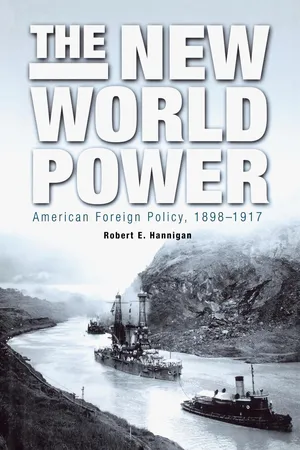
From the era of the Spanish American war onward, the United States found itself increasingly involved in the affairs of countries beyond North America. The New World Power offers an interpretive framework for understanding U.S. foreign policy during the first two decades of America's emergence as a world power. Robert E. Hannigan describes the aspirations of American leaders, explores the bedrock social views and ideological framework they held in common, and shows how the approach of U.S. policymakers overseas mirrored their attitudes toward domestic progressivism. While the vast bulk of work on U.S. foreign policy has been concerned with the period from World War II to the present, this comprehensive examination of American policy at the turn of the twentieth century is of vital importance to the comprehension of subsequent events.
Hannigan relates U.S. foreign policy to domestic society in ways that are new; in particular, he examines how issues of class, race, and gender were combined in the ideology held by policy makers and how this shaped their approaches to foreign affairs. His study reveals a fundamental unity to U.S. activity throughout the period, not only toward the Caribbean and China, regions that have been the traditional focus of historians, but toward the rest of North and South America as well. It also relates these regional activities to American policy toward the British Empire, European great power rivalries, and international institutions, arbitration, and law, culminating in a reinterpretation of U.S. involvement in World War I.
Based on exhaustive research in the writings of presidents, secretaries of state, and key diplomats and advisers, The New World Power draws parallels between the methods by which policy makers sought to shape international society and the methods by which many of them hoped to secure the conditions they wanted within the United States. Most important, the book describes how an international search for order constituted the fundamental strategy by which American leaders sought to ensure for the United States a position of what they saw as wealth and greatness in the coming twentieth-century world.
- 384 pages
- English
- ePUB (mobile friendly)
- Available on iOS & Android
eBook - ePub
About this book
Information
Publisher
University of Pennsylvania PressYear
2013Print ISBN
9780812236668
9780812236668
eBook ISBN
9780812202175
Chapter 1
Ideology and Interest
Despite their differences, all the major policy makers in this period are exploring shared certain key fundamental assumptions about how the world worked and what their responsibilities in it were, assumptions that—it will be argued here and in subsequent chapters—had a great impact on diplomacy. These ideas, and the attitudes that they helped to engender and reinforce, influenced how policy makers read and responded to foreign developments. They also offered justifications for the posture that, under their leadership, the U.S. government assumed toward the world.1
Social evolutionary thought, in particular, was central. This is hardly unfamiliar terrain. The racialist hierarchies and ideas about “stages of development” that were fundamental elements of that outlook have certainly been noted by diplomatic historians, especially to explain the condescension toward nonwhite peoples that was characteristic of policy in this era. But what has been insufficiently appreciated is just how broadly influential this thought was and what its central dynamics were.
Social evolutionism has occupied its most important place in the historiography of American diplomacy in connection with the overseas territorial expansion of the late 1890s. Pride of place belongs to historian Julius Pratt, who in the 1930s argued that not business interests but Social Darwinian ideas took the lead in bringing on that imperialism (especially with regard to America’s acquisition of the Philippines).2 The need to enter the struggle for survival, the need to grow or fall behind, that in his view was the motivation behind U.S. policy. And, indeed, this explanation has continued to be employed often by historians studying America’s turn-of-the-century colonial acquisitions.
Since it was seen to be connected to military conflict and territorial expansion, however, Social Darwinism, as Pratt employed the concept, has never been accorded quite the same relevance for the years beyond the late 1890s.3 In much the same way, historians of domestic American politics have tended to see Social Darwinism as tied to the nineteenth-century rise, and turn-of-the-century fall, of unadulterated laissez-faire.
Part of the problem stems from a collapsing of social evolutionism into Social Darwinism, which was in fact merely one social prescription based on evolutionary premises. But it undoubtedly stems as well from a misunderstanding of the appeal that social evolutionism, including Social Darwinism, had in late nineteenth-century America. As several studies of the popular philosopher Herbert Spencer have shown, his message had much less to do with a celebration of militarism and military conquest than it did with a vision of progress that in fact saw a so-called military stage of human evolution passing away before a more orderly industrial age of individual, marketplace competition.4
The social evolutionary ideas discussed below were in fact virtually all-pervasive among comfortable, propertied, old-stock Americans during the late nineteenth and early twentieth centuries. In an era of great domestic socioeconomic change and social conflict, they provided such Americans with reassurance that there was a definite order to life, that there were indeed discernible laws governing societal development. Moreover, there was also a widespread belief that if the laws of evolution, as they supposedly related to society, were properly understood and followed, the results would be highly beneficial (Woodrow Wilson captured the spirit of this when he remarked that America was in the process of seeing a Newtonian constitution replaced by a Darwinian one). As it had done for the middle class throughout the nineteenth century, science would continue to show the way. A teleology was built into social evolutionism that was absent from Darwin’s own formulations about biology. Social evolutionism put on new foundations the nineteenth century middle-class belief in “progress,” while it played simultaneously to a growing concern among the propertied about order and security.5
Perhaps most important, social evolutionary ideas also provided the core around which was shaped an updated ideology of the self-made man in America.6 In the mid-nineteenth century, heralds of the new industrial capitalist order then taking shape in the North had proclaimed what they saw as that society’s advantages over the slave system of the South. The North, they argued, was creating a society where all men could be whatever they would make of themselves and where the best interests of society at large would be furthered under conditions that allowed individuals the maximum leeway to pursue their own economic interest. Hard work was the key. By observing the work ethic, any man could, and it was assumed most men would, rise from the ranks of wage laborer to self-employed entrepreneur during the course of his lifetime. If he failed to do so, the fault was to be found in his own moral shortcomings.7
In the decades after the Civil War, however, even as the U.S. developed into a great industrial giant, American society became much more, not less, stratified socially. Moreover, this condition increasingly became the target of farm and labor critics who argued that the organization of society actually worked to perpetuate such disparity and inequality.8 In their most popular formulation, social evolutionary ideas provided a supposedly scientific and objective rejoinder to such criticisms and protest and a reassuring explanation of the workings of American society. They did so basically by reasserting the notion that where people were in the society was by and large a reflection of themselves and by accounting for the growth of inequality by seeing it as a reflection of an inequitable distribution of capabilities throughout humanity.
From the late eighteenth century through the Civil War, a relatively favorable view of human nature, at least by Western standards, plus a theoretical, if not always practical, commitment to the notion that “all men are created equal” had predominated in the rising commercial and industrial centers of America. It is probably in these two spheres that the thought being investigated here broke most clearly with the past. The social groups that dominated American society at the turn of the twentieth century continued to have a quite positive view of themselves and their kind, and if anything an increasingly optimistic view of their capabilities. Yet at the same time, they generally held that the great Western liberal thinkers of the Age of Revolutions had been much too naive and positive in their appraisal of humanity at large.9
Meanwhile, such “respectable” Americans—and, as scientist and historian Stephen Jay Gould (among others) has shown, none more so for a while than academics and intellectuals—were almost obsessively preoccupied with identifying, describing, sometimes measuring, and always categorizing what they saw as significant differences within humanity.10 The notion that “all men are created equal” now came formally to be replaced by an emphasis on different races with different capabilities.11
There are several distinguishing characteristics of this new evolutionary racism. First of all, reflecting fears of social and labor unrest in the industrial North and West, the threat of which was attributed especially to new immigration, this racism made sharp, prejudicial distinctions within the population of Americans of European background as well as between old stocks and non-Europeans. Second, while there had been hierarchical classifications of race employed before, the racialist thought of this era held that there was a particular dynamic and pattern to the development of races, and to their relationship to one another, and this specific framework was new. Third, outside frontier-colonial areas and the Old South, openly espoused racialist thinking had probably never achieved such a high degree of social respectability as it did at this time, in part because of the scientific and academic support that could be claimed for these ideas. Deemed to be scientific, such racial notions were held to be progressive.
This “biological,” social evolutionary worldview was meanwhile also one that was highly gendered.12 Visions of social order in this period were closely related to ideas about appropriate domestic, family relationships. And for the people of most interest to this study, notions of what was appropriate, even though they were under challenge from other quarters, still revolved very much around the idea that women were profoundly weak and passive and that there should be sharp distinctions made between men’s and women’s roles. It is critical to note as well that the comparisons of races that were so central to the social views of this time were in fact generally comparisons of the supposed attributes of the men of various ethnic backgrounds. As such, they reflected the preoccupation with masculinity and definitions of manhood that historians have noted among upper- and upper-middle-class men in America during these years.13
Within important intellectual and academic circles, as historian Carl Degler shows, scientific racism was already coming under attack by World War I.14 But this certainly did not affect the views of the individuals of principal concern to this study. Likewise, it seems clear that some of those associated with progressivism were also coming to see many of these evolutionary categories as irrelevant. Philosopher John Dewey is a good example, although he valued Darwinism on quite different grounds, for what he saw as its challenge to fixity.15 It has to be emphasized, however, that this set of ideas was by no means at odds with either state interventionism or with environmentalist approaches per se. Indeed, on the latter count, as numerous scholars have made clear, social evolutionism in America was from its inception framed more along the lines of Jean Baptiste Lamarck’s ideas than those of Charles Darwin, especially in its discussions of the mechanisms of evolution, and it remained so even after Lamarck’s ideas (centering on the inheritability of acquired characteristics) were discredited in the field of biology.16 Moreover, although Social Darwinism was closely tied to the notion of laissez-faire, social evolutionary ideas could and did coexist with and provide support for more interventionist approaches on the part of those people who were deemed by it to be the “responsible” members of society.17
In Julius Pratt’s day, American historians commonly viewed ideas and interests as historical explanations that were at variance with one another, with “Progressive-school” historians often visualizing the former as propaganda to be understood as a smoke screen masking other, usually direct economic desires. It was in part as an effort to get around the resultant economic determinism that, in the field of diplomatic history, William A. Williams subsequently focused on an “open door ideology” which, he argued, led American policy makers to seek to realize and sustain their vision of the good society at home through open door marketplace expansion abroad after 1890.18 The great success of this approach was Williams’s ability to establish the vital importance of economics in U.S. foreign policy. Yet this resolution of the problem also tended to restrict the explanatory power of his interpretation. By treating the “open door ideology” as the ideology of policy makers and then assigning to it control over U.S. diplomacy, Williams ultimately worked at cross purposes to the interest he showed elsewhere in studying foreign policy as the product of an entire social, rather than just economic, order.
More recently, historian Michael H. Hunt has sought to promote the study of this general topic in his work Ideology and U.S. Foreign Policy.19 There he seeks also to describe what he terms “America’s twentieth century foreign policy ideology.” Hunt identifies, and provides a valuable discussion of, three prominent and long-standing American cultural attitudes (racism, the desire for national greatness, and a hostility to revolutions) and argues that by the early 1900s these had become fused together into “an informal but potent ideology that would point the direction for subsequent foreign policy.”20 For any given point in time, however, Hunt’s approach seems able to provide only a fragmented and incomplete picture of the outlook of an era, and then only at a fairly high level of generalization.21 His yield does not appear to be comparable to the increases in understanding that have come from studies of the ideologies of specific groups of people within specific historical contexts done by a number of American historians in recent decades.22
The ideology of American policy makers in this era was based on the premise that the world was inhabited by many quite different kinds of people. What differentiated them, as well as most other socially secure, old-stock Americans like themselves, from the rest—and what both explained and justified their leadership status in society—had to do at bottom with a strength that they believed they possessed in greater measure than anyone else. This was a strength of character that was both their special legacy from their forefathers, as they saw it, and a product of their own achievements.
“Character” had always been central to middle-class thought, but in the mid-nineteenth century a good character had been held to be something that almost any man could have.23 By the late nineteenth century, a good character required not only conducting oneself in accordance with an ethic of hard work, abstinence, and the like. It also required a mastery of oneself. “There is no prohibition ... so potent as the prohibition which each individual puts upon himself,” asserted McKinley.24
“Self-mastery” too was not a new term or concept at the turn of the twentieth century. But earlier it had referred to the Protestant religious injunction to avoid sin and temptation.25 Now it was a condition or state, and while it was believed that the individual had some control over it, it was also felt to be a biological inheritance from one’s forebears. This dual explanation for “self-mastery” was important. Those who held these ideas were anxious not to be considered merely lucky. They also wanted to be able to hold those old stocks who did not fare well, or who simply did not comport themselves in ways considered proper, personally responsible. Thus the gravitation toward Larmarckian notions of inheritance. What such people saw as their strong character, stemming from their “self-mastery,” was seen to be the product both of inheritance and of generations of continued accomplishment on the part of their “race,” alternately termed Anglo-Saxons, Teutons, or simply “real Americans.” Their strong character was the product of centuries of development on the part of people who had been special to begin with, but who had also developed themselves again and again by rising to numerous challenges and by training each successive generation to be stronger than the last.26
Chief among their race’s accomplishments had literally been the taming of the basic human nature they shared with all other men. By contrast with views common during the Enlightenment, and now pointedly described as naive, all the people of interest to this study held that human beings were at bottom essentially “brutish,” “cruel,” and “beastly.” It was this original animal nature that their ancestors had gradually become strong enough to hold in check. Yet each generation still had to tend to the task. “The truth,” said Theodore Roosevelt, “is that each one of us has in him certain passions and instincts which if they gained the upper hand in his soul would mean that the wild beast had come uppermost in him.”27
“Self-mastery” had enabled these peoples of northern European background to control and tame the “lower passions” of man so that they could be directed toward productive ends. It had also enabled them increasingly to respect and protect the rewards of each man’s industry. It had enabled them, as they saw it, to discover and pioneer the one an...
Table of contents
- Cover
- Title
- Copyright
- Contents
- Preface
- 1. Ideology and Interest
- 2. The “Center of Gravity”: Caribbean Policy and the Canal
- 3. Dominance Throughout the Hemisphere: South America
- 4. “Where the Far West Becomes the Far East”: China
- 5. The Home Continent: Canada and Mexico
- 6. World Order (to 1914)
- 7. World Order (1914–17)
- Conclusion
- List of Abbreviations
- Notes
- Index
- Acknowledgments
Trusted by 375,005 students
Access to over 1.5 million titles for a fair monthly price.
Study more efficiently using our study tools.
Frequently asked questions
Yes, you can cancel anytime from the Subscription tab in your account settings on the Perlego website. Your subscription will stay active until the end of your current billing period. Learn how to cancel your subscription
No, books cannot be downloaded as external files, such as PDFs, for use outside of Perlego. However, you can download books within the Perlego app for offline reading on mobile or tablet. Learn how to download books offline
We are an online textbook subscription service, where you can get access to an entire online library for less than the price of a single book per month. With over 1.5 million books across 990+ topics, we’ve got you covered! Learn about our mission
Look out for the read-aloud symbol on your next book to see if you can listen to it. The read-aloud tool reads text aloud for you, highlighting the text as it is being read. You can pause it, speed it up and slow it down. Learn more about Read Aloud
Yes! You can use the Perlego app on both iOS and Android devices to read anytime, anywhere — even offline. Perfect for commutes or when you’re on the go.
Please note we cannot support devices running on iOS 13 and Android 7 or earlier. Learn more about using the app
Please note we cannot support devices running on iOS 13 and Android 7 or earlier. Learn more about using the app
Yes, you can access The New World Power by Robert E. Hannigan in PDF and/or ePUB format, as well as other popular books in Politics & International Relations & North American History. We have over 1.5 million books available in our catalogue for you to explore.