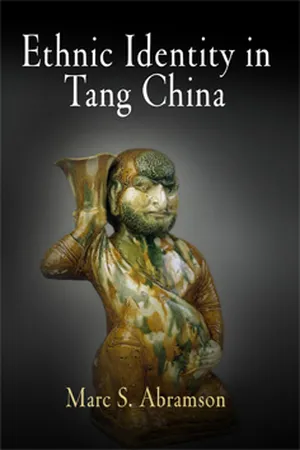
Ethnic Identity in Tang China is the first work in any language to explore comprehensively the construction of ethnicity during the dynasty that reigned over China for roughly three centuries, from 618 to 907. Often viewed as one of the most cosmopolitan regimes in China's past, the Tang had roots in Inner Asia, and its rulers continued to have complex relationships with a population that included Turks, Tibetans, Japanese, Koreans, Southeast Asians, Persians, and Arabs.
Marc S. Abramson's rich portrait of this complex, multiethnic empire draws on political writings, religious texts, and other cultural artifacts, as well as comparative examples from other empires and frontiers. Abramson argues that various constituencies, ranging from Confucian elites to Buddhist monks to "barbarian" generals, sought to define ethnic boundaries for various reasons but often in part out of discomfort with the ambiguity of their own ethnic and cultural identity. The Tang court, meanwhile, alternately sought to absorb some alien populations to preserve the empire's integrity while seeking to preserve the ethnic distinctiveness of other groups whose particular skills it valued. Abramson demonstrates how the Tang era marked a key shift in definitions of China and the Chinese people, a shift that ultimately laid the foundation for the emergence of the modern Chinese nation.
Ethnic Identity in Tang China sheds new light on one of the most important periods in Chinese history. It also offers broader insights on East Asian and Inner Asian history, the history of ethnicity, and the comparative history of frontiers and empires.
- 285 pages
- English
- PDF
- Available on iOS & Android
eBook - PDF
Ethnic Identity in Tang China
About this book
Information
Publisher
University of Pennsylvania PressYear
2011Print ISBN
9780812240528
9780812240528
eBook ISBN
9780812201017
Table of contents
- Cover
- Title Page
- Copyright Page
- Table of Contents
- Introduction
- Chapter 1. Ethnicity in the Chinese Context
- Chapter 2. The Ambiguity of the Non-Han: Stereotyping and Separation
- Chapter 3. Buddhism as a Foreign Religion
- Chapter 4. Deep Eyes and High Noses: The Barbarian Body
- Chapter 5. The Geopolitics of Ethnicity
- Chapter 6. Varieties of Ethnic Change
- Conclusion
- Appendix A. Chinese Dynasties
- Appendix B. Sui and Tang Emperors
- List of Abbreviations
- Notes
- Bibliography
- Index
- Acknowledgments
Trusted by 375,005 students
Access to over 1.5 million titles for a fair monthly price.
Study more efficiently using our study tools.
Frequently asked questions
Yes, you can cancel anytime from the Subscription tab in your account settings on the Perlego website. Your subscription will stay active until the end of your current billing period. Learn how to cancel your subscription
No, books cannot be downloaded as external files, such as PDFs, for use outside of Perlego. However, you can download books within the Perlego app for offline reading on mobile or tablet. Learn how to download books offline
Perlego offers two plans: Essential and Complete
- Essential is ideal for learners and professionals who enjoy exploring a wide range of subjects. Access the Essential Library with 800,000+ trusted titles and best-sellers across business, personal growth, and the humanities. Includes unlimited reading time and Standard Read Aloud voice.
- Complete: Perfect for advanced learners and researchers needing full, unrestricted access. Unlock 1.5M+ books across hundreds of subjects, including academic and specialized titles. The Complete Plan also includes advanced features like Premium Read Aloud and Research Assistant.
We are an online textbook subscription service, where you can get access to an entire online library for less than the price of a single book per month. With over 1.5 million books across 990+ topics, we’ve got you covered! Learn about our mission
Look out for the read-aloud symbol on your next book to see if you can listen to it. The read-aloud tool reads text aloud for you, highlighting the text as it is being read. You can pause it, speed it up and slow it down. Learn more about Read Aloud
Yes! You can use the Perlego app on both iOS and Android devices to read anytime, anywhere — even offline. Perfect for commutes or when you’re on the go.
Please note we cannot support devices running on iOS 13 and Android 7 or earlier. Learn more about using the app
Please note we cannot support devices running on iOS 13 and Android 7 or earlier. Learn more about using the app
Yes, you can access Ethnic Identity in Tang China by Marc S. Abramson in PDF and/or ePUB format, as well as other popular books in Social Sciences & Asian History. We have over 1.5 million books available in our catalogue for you to explore.