Selected by Choice magazine as an Outstanding Academic Title
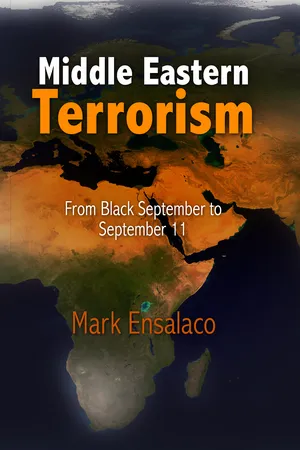
Since the first airplane hijacking by the Popular Front for the Liberation of Palestine in September 1970, Middle Eastern terrorists have sacrificed innocent human lives in the name of ideology. From Black September to the Munich Olympics, to the embassy bombing in Beirut, to the devastating attacks of September 11 and beyond, terrorism has emerged as the most important security concern of our time.
"Where did this come from?" Inspired by a student's question on the morning of September 11, 2001, Mark Ensalaco has written a thoroughly researched narrative account of the origins of Middle Eastern terrorism, addressing when and why terrorists started targeting Americans and American interests and what led to the September 11 attacks.
Ensalaco reveals the changing of motivations from secular Palestinian nationalism to militant Islam and demonstrates how competition among terrorists for resources and notoriety has driven them to increasingly extreme tactics. As he argues, terrorist attacks grew from spectacle to atrocity. Drawing on popular works and scholarly sources, Middle Eastern Terrorism tells this story in rich detail and with great clarity and insight.
- 328 pages
- English
- ePUB (mobile friendly)
- Available on iOS & Android
eBook - ePub
About this book
Information
Chapter 1
No One Heard Our Screams or
Our Suffering
Our Suffering
In the spring of 1967, Lyndon Johnson was agonizing over the escalating war in South East Asia. It had been nearly two years since he announced the fateful decision to commit U.S. combat forces in South Vietnam in order to defeat the Viet Cong guerrillas fighting to liberate South Vietnam and unify it with the Communist North. Johnson, who had assumed office after the assassination of John F. Kennedy in 1963, and went on to a landslide victory in the 1964 presidential election, saw his presidency destroyed by an intractable guerrilla war in the jungles of Vietnam. But by the spring of 1967 he was becoming concerned about a guerrilla war in the deserts of the Middle East and the possibility of a conventional war between Israel and the Arab states encircling it. Palestinian guerrillas were regularly conducting guerrilla raids against Israel from Jordan, Syria, and Lebanon. In May, the Egyptian president mobilized Egyptian forces, expelled the United Nations peacekeeping force deployed in the Sinai Peninsula, and closed the Gulf of Aqaba to Israeli shipping. “The danger implicit in every border incident in the Middle East,” Johnson wrote after leaving office, “was not merely war between Israelis and Arabs but an ultimate confrontation between the Soviet Union and the United States.” Johnson urged restraint on Israeli Prime Minister Levi Eshkol, but the president understood that the Egyptian provocations constituted a cause for war: “I used all the energy and experience I could muster to prevent war. But I was not too hopeful.”1 Under the exigent circumstances, to ask for Israel's forbearance was to ask for too much. On the morning of 5 June, Israel launched a massive preemptive strike against the Egyptian air force, destroying virtually all its Soviet-made combat aircraft on the ground. Over the next six days Israeli troops engaged Arab armies on three fronts. By the time the Israelis complied with UN Security Council Resolution 242 demanding an end to the fighting on 10 June, Israeli forces had occupied Egyptian territory in the Sinai Peninsula and the Gaza strip, Syrian territory in the Golan Heights, and Jordanian territory on the West Bank and Jerusalem, giving Israel sovereignty over the site of its ancient Temple and one of Islam's holiest places, the Al-Aksa Mosque.2 The Israeli victory in the Six Day War demoralized the Arab states, but it radicalized the Palestinian national movement and marked the onset of an era of terrorism directed against Israel, moderate Arab states and, inevitably, Europe and the Unites States. By the time Johnson left office in January 1969, Palestinian terrorists had launched a full-scale assault on civilian aviation intended to compel the world to consider the plight of the Palestinian people.
Origins
Palestinians refer to the creation of the state of Israel in 1948 as al-nakba, the catastrophe. Hundreds of thousands of Palestinians were displaced as result of the creation of the Jewish state, the ensuing war between the Arabs and Israelis, and an Israeli policy of expulsion.3 As Jews—many of them Holocaust survivors—toiled to build a viable democratic state, the Palestinians chafed under Israeli occupation or languished in sprawling refugee camps in Jordan, Syria, and Lebanon or in the émigré communities throughout the Middle East. In the decades after the founding of Israel, and especially after the Arab's ignominious defeat in the Six Day War, thousands of Palestinians rushed to become fedayeen—“men of sacrifice” in Arabic—in the ranks of several guerrilla organizations later affiliated with the Palestine Liberation Organization. Founded in 1964, the PLO came to be identified with Yasser Arafat, its perennial chairman, and associated with the international terrorism committed under the banner of Palestinian nationalism after the Six Day War. The reality is more complex. Arafat actually resisted leading his guerrilla movement fully into the PLO until 1969, five years after its creation, when he was in a position to dominate it. By then another Palestinian organization had already committed the first acts of international terrorism.
Born in Cairo in August 1929 to Palestinian parents as Mohammed Abdel Rahman Raouf Arafat, Yasser Arafat would emerge as the acclaimed leader of the Palestinians before his fortieth birthday. Yet he lived only briefly in Palestine in the mid-1930s, as a young child when his father sent him to live with relatives in Jerusalem after the death of his mother.4 Arafat returned to the Egyptian capital in 1937 and spent his formative years there. Soon after he entered the university to study engineering in 1947, he became engaged in the politics of the Palestinian émigré community, participating in Palestinian student organizations and smuggling weapons into a Palestine still under the British mandate. When Israel declared independence and war erupted between the Arabs and Jews in 1948, Arafat set off to fight with the irregular forces of the Muslim Brotherhood in Gaza, where he distinguished himself by his valor. The Arab defeat left Arafat with some inveterate judgments about the inclination of Arab states to betray their Palestinian brothers. The coup that brought Gamal Abdel Nasser to power in Egypt in 1952 did not substantially alter his thinking. In 1956, when Egypt went to war against combined forces of Israel, Great Britain, and France, Arafat was called up with other Egyptian reserve officers and sent to Port Said to clear mines. But a year after the Suez Crisis he left—or was compelled to leave—Egypt for Kuwait.
It was in Kuwait where Arafat and other Palestinian exiles incrementally formed the Palestine Liberation Movement, or Fatah, a process complete by 1959.5 With Arafat was a tight group of close collaborators that included Khalil al-Wazir, who went by the name Abu Jihad, and Salah Khalaf, who took Abu Iyad as his nom de guerre. (Both men would be killed for their politics, al-Wazir in 1988 by Israeli commandos led by a future Israeli prime minister, Khalaf in 1991 by a rival Palestinian terrorist group.) Arafat called his movement Fatah, the Qur'an's word for “conquest,” by inverting the Arabic acronym for the Palestine Liberation Movement, Harakat al-Tahrir al-Watani al-Filastini. But despite the allusion to Islam and his earlier connection with the Muslim Brotherhood, Arafat was a secular Palestinian nationalist who eschewed ideology in order to broaden Fatah's appeal. For Arafat and the men around him the armed struggle to liberate Palestine took priority over all else. Fatah's guiding principle approached heresy in 1959 when pan-Arab nationalism was at its zenith. Embodied by Egyptian president Gamal Abdel Nasser, the pan-Arab dream envisioned the liberation of Palestine, but only after the unification of the Arab nations made the military defeat of Israel practicable. Arafat inverted the logic of pan-Arabism. Whereas Nasser insisted that Arab unity was necessary for the liberation of Palestine, Arafat countered that the war to liberate Palestine would produce Arab unity: “an armed Palestinian revolution is the only way to liberate our homeland…. Only the idea of the armed struggle can bridge ideological differences and accelerate the process of unification.”6 The triumphs of revolutionary movements in China in 1949, Cuba in 1959, and Algeria in 1962 gave the Palestinian fedayeen reasons to believe in the efficacy of guerrilla warfare. (Each of these revolutionary states would provide Fatah substantial material support for the coming struggle.) Fatah was to become the preeminent guerrilla movement, Arafat the acclaimed leader of the Palestinians and eventually president of the Palestine National Authority, a title he held until his mysterious death in November 2004.
Nasser was aware of the Palestinian discontent with the hesitancy of the Arab states to confront Israel. Nasser, who came to power in the 1952 military coup that ousted King Farouk, emerged as the icon of secular Arab nationalism after he seized control of the Suez Canal and survived an assault by British, French, and Israeli forces in 1956 to retake it. Nasser could not forsake the Palestinian cause, but he was careful to subordinate it to his own grandiose vision of pan-Arab unity. Subordination of the Palestinian cause was critical because, unless controlled, the Palestinians would prematurely provoke war between Egypt and the militarily superior Israel. A master strategist who was ever mindful of other Arab leaders' ambitions to replace him as the symbol of the Arab nation, Nasser responded by attempting to coopt the Palestinian cause. This was the origin of the Palestine Liberation Organization, the PLO.
In January 1964 Nasser convened the first Arab Summit to plan for an eventual war with Israel. Although Nasser avoided the Palestinian question during the summit, he invited Ahmed Shuqayri, a Palestinian diplomat, to attend. At the conclusion of the summit, Shuqayri took the urging to continue consultations with Arab leaders as a mandate to create a separate Palestinian entity.7 At the end of May, Shuqayri summoned Palestinian leaders to a conference in East Jerusalem to proclaim the creation of the Palestine Liberation Organization. The PLO was thus the creation of the old guard. The PLO charter provided for a Palestinian National Council (PNC), its supreme legislative body, and an executive committee to be elected annually. Shuqayri was the obvious choice for chairman. But although the Palestinians now had a distinct Palestinian entity, two issues were left unsettled—the PLO's relations with the Arab states and with Fatah and other guerrilla organizations committed to the liberation of Palestine by force of arms.
For Nasser and the other heads of state there could be no doubt about the imperative to subordinate the nascent PLO to the Arab states and to deny the Palestinian guerrillas freedom of action to confront Israel. That war with Israel was inevitable was never in doubt. But Nasser and the other heads of state demanded patience from the Palestinians while the Arab armies amassed weapons and forces for a conventional war. Palestinian impatience posed as great a challenge as the Palestinian demand for autonomy, because guerrilla raids into Israel from Syria and Jordan created the risk of Israeli retaliation and therefore the risk of war. In order to gain some measure of control of the Palestinian fedayeen, the Arab states pledged funds, weapons, and training to field the Palestine Liberation Army (PLA), but its under-strength units were deliberately scattered among the Arab states and integrated into the command structure of the Arab armies. The PLA was as much Arab as Palestinian. When the Israelis launched the preemptive war in June 1967, the PLA saw almost no action. Arafat understood that the Arab states created the PLO not to advance the Palestinian struggle but to restrain it. But the mere existence of the PLO posed a formidable challenge to Fatah and Arafat's personal ambitions to dominate the Palestinian cause, because Arab recognition of the PLO bestowed legitimacy upon it. It became imperative for Fatah to take action to wrest the initiative from the nascent PLO and its liberation army. So, on New Year's Day 1965, Fatah's guerrilla forces—which Arafat called al-Asifa, the Storm—mounted their first attack against Israel. The war to liberate Palestine from Israeli occupation—and to provoke a war between the Arab and Jewish states—was reality.
Over the next two and a half years Fatah conducted hundreds of ineffectual guerrilla raids. The Israeli Defense Forces (IDF) repelled Fatah's incursions. But Fatah's strategy was not so much to inflict casualties on the Israelis or cripple the Israeli economy as to forge a Palestinian identity guided by the spirit of resistance and provoke Israeli retaliation that could precipitate the war that would reverse the catastrophe of 1948. Palestinian attacks, in fact, contributed to the May crisis and the June War. But the defeat of the Arab armies in the Six Day War actually strengthened Arafat, who intensified his appeal to Palestinians to liberate the new territories lost to Israeli conquest. Fatah was not alone. By the mid-1960s there were several guerrilla organizations pleading for arms and funds from Arab states. Most of them were small and ineffective. But the Six Day War was a catalyst for the Palestinian fedayeen. The conversion of the Arab Nationalist Movement into the PFLP in late 1967 was one of its most important consequences.
George Habash and Wadi Haddad created the Arab Nationalist Movement (ANM) in Beirut in 1951, almost a decade before Arafat, al-Wazir, and Khalaf founded Fatah. Born into a relatively wealthy Greek Orthodox family in 1925, Habash witnessed his family's expulsion from Lydda, known as Lod in present-day Israel, in 1948. Three years later Habash graduated from medical school at the prestigious American University in Beirut with a specialty in pediatrics.8 Habash's determination to destroy the Jewish state motivated him to found the ANM. But as its name implied, Habash's ANM shared Nasser's views about Arab, and not merely Palestinian, national unity. The ANM did not form a separate Palestinian branch until 1961. Like Fatah, ANM mounted raids against Israel before the Six Day War and, like Fatah's operations, its attacks were inconsequential. Then came the Six Day War. Within months of Israel's victory, Habash converted the ANM into the PFLP. The PFLP was the fusion of the ANM and several small guerrilla organizations, the most notable the Palestine Liberation Front, formed in 1961 by Ahmed Jabril, a Palestinian who served as a captain in the Syrian army. With the transformation of the ANM into the PFLP came a radicalization in ideology. The PFLP adopted Marxism-Leninism and organized itself along classic Leninist lines. Habash became secretary general, but his Marxism did not run deep. The most important feature about the Marxist rhetoric was the call to establish alliances with revolutionary forces worldwide. In the coming years, this would translate into operational alliances with European and Japanese terrorist organizations.
The formation of the PFLP marked the beginning of a struggle for control of the PLO and the onset of a campaign of international terrorism in the cause of Palestinian liberation. The defeat in the Six Day War discredited the PLO almost as much as it discredited the Arab states. PLO chairman Ahmed Shuqayri was the first victim. Six months after the Israeli victory, the PLO executive committee replaced him with Yahya Hammouda, who proved to be as ineffective as Shuqayri. Arafat's hour was coming. Fatah's reputation was not damaged by the dismal performance of the Arab armies against the Israelis. On the contrary, because the defeat weakened the disciples of Nasser, it strengthened Arafat. Arafat was careful to cultivate a mystique about himself. The Palestinian leader managed to evade capture by Israeli intelligence during his forays into the occupied territories of Gaza and the West Bank, and Arafat's Fatah guerrillas crossed into Israel from Jordan to mount attacks. Fatah propaganda exaggerated the impact of the guerrilla raids, forcing other guerrilla organizations to press the attack and distort the truth about advances in the armed struggle. Arafat sought deliberately to embody the Palestinian nation in the popular perception, even though the effort to create a cult of personality conflicted with Fatah's principle of collective leadership. All this worked to his advantage. But Arafat benefited most from an Israeli operation to destroy the guerrillas in their enclave in Jordan.
In March 1968—the same month Lyndon Johnson astonished Americans with his decision to not seek reelection—some 15,000 Israeli troops supported by aircraft, artillery, and tanks assaulted Palestinian guerrilla bases near the Jordanian town of Karameh. The Israeli force was some fifteen times larger than the combined number of Fatah, PFLP, and PLA fedayeen amassed in Jordan. Rather than retreating in the face of superior enemy forces, Arafat ordered his men to stand their ground. Although the Israeli forces inflicted heavy casualties—killing more than one hundred Palestinians—Arafat's fedayeen managed to kill 29 Israelis and wound many more before the Israelis withdrew when the Jordanian army came to the defense of Fatah. In the popular perception, Fatah had forced an Israeli retreat, a feat of arms the combined armies of Egypt, Syria, and Jordan had never accomplished. The battle of Karameh transformed Arafat into the most credible leader of the Palestinians. In February 1969, Arafat was elevated to the chairmanship of the PLO.
The battle of Karameh forced the PFLP, as the principal opposition to Fatah, to take the offensive to restore its diminished image. The PFLP did not distinguish itself in the confrontation with the IDF, although PFLP secretary-general Habash bore no direct responsibility for his men's performance; he was in custody in Damascus when the Israelis moved against the guerrilla bases in Jordan. Nonetheless, while Fatah stood and fought, the PFLP fled to the mountains with the PLA. Withdrawal in the face of a superior enemy was sound guerrilla tactics, but it was politically damaging. All Palestinian guerrilla organizations were captive to the logic of armed struggle, which dictated that victory in battle is the measure of political legitimacy. To prove its militancy the PFLP made the ominous decision to attack Israel on its vulnerable “external front.” Fatah had launched the guerrilla war of national liberation in 1965; the PFLP now launched an international terror campaign.
The Popular Front's Campaign of Air Piracy
On 23 July 1968, three PFLP terrorists hijacked an Israeli El Al flight en route from Rome to the Ben Gurion International Airport in Lod and directed it to Algeria.9 The El Al hijacking was the first by a Palestinian terrorist organization and one of the longest in the history of air piracy—negotiations for the release of the hostages and the jet dragged on for 39 days. The PFLP action produced something no isolated guerrilla raid in Israel could produce, an international incident.
Terrorism is violence, but the violence is invariably symbolic. The symbolism was obvious. El Al is the national airline of the Jewish state, and attacking it was tantamount to attacking Israel. For Palestinians eager to see harm inflicted on Israel in retaliation for their sufferings, the PFLP's audacious action was cause for rejoicing. The decision to redirect the jet to Algeria had symbolic importance as well. The PFLP consciously entangled the Algerian government in the Palestinian struggle. The Algerian war of independence was the source of inspiration to the Palestinian fedayeen, and Algeria, which remained in a formal state of war with Israel, actively supported the guerrillas, principally Arafat's Fatah. Although a PFLP spokesman in Beirut insisted that the PFLP did not forewarn the Algerian government of the operation and would later demand that Algeria explain its reasons for resolving the crisis without consulting with the PFLP, it obviously was counting on the Algerian regime to abet an act of terrorism. Algeria's foreign minister, Abdelaziz Bouteflika, rebuked the PFLP for the action, but Algerian authorities took custody of the hostages and moved them a hotel.10
The day after the hijacking, Algerian authorities released nineteen passengers. Two days later they released ten more, all women and children. After their release, the passengers came close to praising their treatment. “The food was almost too good,” said an Israeli flight attendant after her release.11 But Algerian authorities refused to release the remaining seven passengers and five crew members on the pretext of conducting an investigation into the hijacking. The explanation was disingenuous in the extreme. By refusing to release the last hostages while the PFLP issued demands for the release of more than one thousand fedayeen imprisoned by the Israelis, Algeria implicated itself in the crime of air piracy. Israel demanded action from the United Nations and threatened to take action itself. Some Israeli politicians demanded retaliation by attacking Algerian civilian airliners on the ground.
In the end, it was not the threat of military action but the threat of an international boycott of Algeria, and Israeli concessions, that resolved the crisis. On 12 August, the International Association of Airline Pilots announced its members would refuse to fly to Algeria. The PFLP strategy to isolate Israel by making airline travel dangerous backfired. Although the Algerian government denounced these pressures, its position was untenable. While the Algerians held out, the Italians attempted to mediate. Unless Algeria was prepared to incur the wrath of the Palestinians by simply releasing the passengers, the only apparent hope for a resolution of the crisis was some movement by the Israelis. The PFLP demand for the exchange of more than one thousand fedayeen for the hostages was unconscionable. But as the crisis neared a second month, the Israelis modified their position. It was not an exchange of prisoners for hostages that was unacceptable, only the number of prisoners and the appearance of a quid pro quo. At the end of August the press leaked word that Israel was prepared to make a “humanitarian gesture” after the hostages and the aircraft were repatriated. Then, on 29 August, Palestinian guerrillas ambushed an Israeli patrol on the confrontation line on the Suez Canal, killing two Israelis and capturing a third. If the Israeli government needed another incentive to resolve the Algerian crisis, this was it. On 1 September, Algeria allowed the remaining hostages to fly to Israel via Rome. Israel made good on its pledge of a humanitarian gesture by quietly releasing 16 fedayeen held prisoner in Israel.
The hijacking initiated a terror campaign against civilian aviation that became more and more lethal over the next several years. Just after the hijacking, the PFLP called a press conference in the Beirut office of the al-Anwar newspaper. Ghassan Kanafani, the PFLP spokesperson, whom the Israelis would assassinate in July 1972, did all the speaking, but he repeate...
Table of contents
- Cover Page
- Title Page
- Copyright Page
- Dedication Page
- Contents
- Introduction
- 1. No One Heard our Screams or our Suffering
- 2. Revolutionary Violence is a Political Act, Terrorism is Not
- 3. Much Blood will Flow, Not all of it ours
- 4. Peace would be the End of all our Hopes
- 5. We Accept to Live with you in Permanent Peace
- 6. We will Get Slaughtered Down there
- 7. America will Never Make Concessions to Terrorists
- 8. The Real Enemy is America
- 9. Kill Them on the Land, the Sea, and in the Air
- 10. Today, our Nation Saw Evil
- Epilogue
- Notes
- Bibliography
- Index
- Acknowledgments
Trusted by 375,005 students
Access to over 1.5 million titles for a fair monthly price.
Study more efficiently using our study tools.
Frequently asked questions
Yes, you can cancel anytime from the Subscription tab in your account settings on the Perlego website. Your subscription will stay active until the end of your current billing period. Learn how to cancel your subscription
No, books cannot be downloaded as external files, such as PDFs, for use outside of Perlego. However, you can download books within the Perlego app for offline reading on mobile or tablet. Learn how to download books offline
Perlego offers two plans: Essential and Complete
- Essential is ideal for learners and professionals who enjoy exploring a wide range of subjects. Access the Essential Library with 800,000+ trusted titles and best-sellers across business, personal growth, and the humanities. Includes unlimited reading time and Standard Read Aloud voice.
- Complete: Perfect for advanced learners and researchers needing full, unrestricted access. Unlock 1.5M+ books across hundreds of subjects, including academic and specialized titles. The Complete Plan also includes advanced features like Premium Read Aloud and Research Assistant.
We are an online textbook subscription service, where you can get access to an entire online library for less than the price of a single book per month. With over 1.5 million books across 990+ topics, we’ve got you covered! Learn about our mission
Look out for the read-aloud symbol on your next book to see if you can listen to it. The read-aloud tool reads text aloud for you, highlighting the text as it is being read. You can pause it, speed it up and slow it down. Learn more about Read Aloud
Yes! You can use the Perlego app on both iOS and Android devices to read anytime, anywhere — even offline. Perfect for commutes or when you’re on the go.
Please note we cannot support devices running on iOS 13 and Android 7 or earlier. Learn more about using the app
Please note we cannot support devices running on iOS 13 and Android 7 or earlier. Learn more about using the app
Yes, you can access Middle Eastern Terrorism by Mark Ensalaco in PDF and/or ePUB format, as well as other popular books in Politics & International Relations & Middle Eastern History. We have over 1.5 million books available in our catalogue for you to explore.