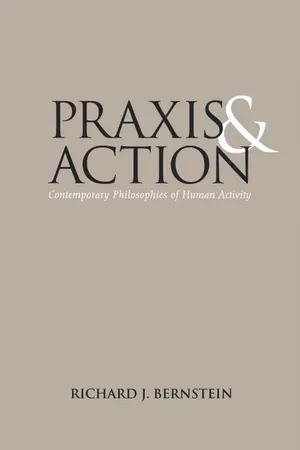
This inquiry is concerned with the themes of praxis and action in four philosophic movements: Marxism, existentialism, pragmatism, and analytic philosophy. It is rare that these four movements are considered in a single inquiry, for there are profound differences of emphasis, focus, terminology, and approach represented by these styles of thought. Many philosophers believe that similarities among these movements are superficial and that a close examination of them will reveal only hopelessly unbridgeable cleavages. While respecting the genuine fundamental differences of these movements, this inquiry is undertaken in the spirit of showing that there are important common themes and motifs in what first appears to be a chaotic babble of voices. I intend to show that the concern with man as an agent has been a primary focal point of each of these movements and further that each contributes something permanent and important to our understanding of the nature and context of human activity.
THE CHIEF DEFECT of all previous materialism (including Feuerbach's) is that the object, actuality, sensuousness is conceived only in the form of the object or perception [Anschauung], but not as sensuous human activity, practice [Praxis], nor subjectively. Hence in opposition to materialism the active side was developed by idealism—but only abstractly since idealism naturally does not know actual, sensuous activity as such. Feuerbach wants sensuous objects actually different from thought objects: but he does not comprehend human activity itself as objective. Hence in The Essence of Christianity he regards only the theoretical attitude as the truly human attitude, while practice is understood and fixed only in its dirtily Jewish form of appearance. Consequently he does not comprehend the significance of “revolutionary,” of “practical-critical” activity.
(2)
The question whether human thinking can reach objective truth—is not a question of theory but a practical question. In practice man must prove the truth, that is, actuality and power, this-sidedness of his thinking. The dispute about the actuality or non-actuality of thinking—thinking isolated from practice—is a purely scholastic question.
(3)
The materialistic doctrine concerning the change of circumstances and education forgets that circumstances are changed by men and that the educator must himself be educated. Hence this doctrine must divide society into two parts—one of which towers above [as in Robert Owen, Engels added].
The coincidence of the change of circumstances and of human activity or self-change can be comprehended and rationally understood only as revolutionary practice.
(4)
Feuerbach starts out from the fact of religious self-alienation, the duplication of the world into a religious and secular world. His world consists in resolving the religious world into its secular basis. But the fact that the secular basis becomes separate from itself and establishes an independent realm in the clouds can only be explained by the cleavage and self-contradictoriness of the secular basis. Thus the latter must itself be both understood in its contradiction and revolutionized in practice. For instance, after the earthly family is found to be the secret of the holy family, the former must then be theoretically and practically nullified.
(5)
Feuerbach, not satisfied with abstract thinking, wants perception; but he does not comprehend sensuousness as practical human-sensuous activity.
(6)
Feuerbach resolves the religious essence into the human essence. But the essence of man is no abstraction inhering in each single individual. In its actuality it is the ensemble of social relationships.
Feuerbach, who does not go into the criticism of this actual essence, is hence compelled
1. to abstract from the historical process and to establish religious feeling as something self-contained, and to presuppose an abstract—isolated—human individual;
2. to view the essence of man merely as “species,” as the inner, dumb generality which unites the many individuals naturally.
(7)
Feuerbach does not see, consequently, that “religious feeting” is itself a social product and that the abstract individual he analyzes belongs to a particular form of society.
(8)
All social life is essentially practical. All mysteries which lead theory to mysticism find their rational solution in human practice and the comprehension of this practice.
(9)
The highest point attained by perceptual materialism, that is, materialism that does not comprehend sensuousness as practical activity, is the view of separate individuals and civil society.
(10)
The standpoint of the old materialism is civil society; the standpoint of the new is human society or socialized humanity.
(11)
The philosophers have only interpreted the world in various ways; the point is, to change it.
The eleven theses on Feuerbach jotted down by Marx in 1845 when he was only twenty-seven, but published with some revisions only after his death as an appendix to Engels' Ludwig Feuerbach, is one of the most remarkable and fascinating documents of modern thought. The theses were written after a period of intensive philosophic study and a deepening interest in politics and economics. They contain the quintessence of Marx's thought at the time, which is articulated in greater detail in the famous 1844 Paris Manuscripts (Economic and Philosophic Manuscripts), and The German Ideology written less than a year after the theses. This was a period when Marx's diverse studies and interests were developing into a coherent perspective, and the theses can serve as a basis for understanding his later development, including the writing of Capital. All of these theses revolve around the meaning and significance of praxis. Praxis is the central concept in Marx's outlook—the key to understanding his early philosophic speculations and his detailed analysis of the structure of capitalism. It provides the perspective for grasping Marx's conception of man as “the ensemble of social relationships” and his emphasis on production; it is the basis for comprehending what Marx meant by “revolutionary practice.” The theses have important critical practical consequences; they also have metaphysical and epistemological ramifications. To comprehend these theses in detail, we must look backwards to the origin of praxis, and forward to the way in which this concept affects Marx's later development. To understand what Marx meant by praxis we must first dig back into Hegel. It was Feuerbach who helped Marx see what was wrong and what was right in Hegel's philosophy. But as the theses made clear, Marx was severely critical of Feuerbach's solution to the “riddle” of Hegel.
Geist2
Geist (which is best translated as “spirit,” not “mind”) is the most fundamental concept in Hegel's philosophy, just as praxis is baśic in Marx's thought. There is not a theme or subject in Hegel that does not lead us back to the nature and dynamics of Geist, and the same can be said about the centrality of praxis in Marx. Praxis, I intend to show, is itself the result of a dialectical critique of Hegel's Geist.
Geist is at once a most elusive and seductive concept. It turns up every place in Hegel's philosophy and plays numerous roles. If we are to gain some grasp of what Hegel means by Geist, we must approach it from a variety of partial (Hegel would say, “abstract”) perspectives. Hegel self-consciously attempts to integrate and synthesize in a single concept two independent leading ideas that have shaped Western thought. The first is that of Reason or Noûs, especially as this concept emerges from Greek philosophy. The second is that of God as Spirit as this concept emerges from the Judaeo-Christian tradition, where God is conceived of as an omniscient, omnipotent, active Being who makes Himself manifest in history and guides history in the form of Divine Providence.
To appreciate what Hegel intends when he tells us that Geist is rational, or is Reason, we must divest ourselves of certain modern conceptions of reason and project ourselves back into the Greek—more specifically—the Aristotelian understanding of Noûs. Much of modern thinking about reason has been shaped by the Humean doctrine that separates reason from experience and the passions, and conceives of reason as a faculty of individual men that has no inner conatus or dynamic force of its own. Reason is a faculty or instrument for drawing logical consequences. Except for the narrow class of analytic truths (or in Humean terminology, “relations of ideas”) reason cannot make any inferences without presupposing premises or starting points that are based on experience. Hume's famous doctrine that “reason is, and ought only to be the slave of the passions”3 is not intended to be a license for irrationality, but rather a way of calling attention to the impotence of reason when not motivated by the passions. Furthermore, “reason” is actually a predicate and not a subject. Reason, by itself, doesn't do anything. To speak of reason is to speak of an abstraction. It is individual men who reason; reason is a faculty possessed by and exercised by individuals. It sounds odd to the modern ear to say, for example, that “Reason knows the world,” or that “Reason rules the world.” But if we think of the ways in which reason has been understood in the mainstream of Western philosophy, we realize that the Humean conception of reason is a tributary of the mainstream. Philosophers from Anaxagoras to Spinoza felt no intellectual embarrassment in speaking of Reason itself as a subject with its own power and telos. From this point of view, we are rational insofar as we manifest or participate in universal Reason or Noûs—a universal Reason closely associated with the concept of the Divine. For Aristotle as well as for many modern rationalists, we are most godlike when we manifest our Reason. Reason, from the perspective of this tradition, is not merely a faculty, capacity, or potentiality, it is an actuality. When Reason is fully actualized, both the understanding and what is understood are characterized as rational: they are, according to Aristotle, identical. When Reason is understood in this manner, the aim or telos of philosophy as the highest form of theoria is to interpret the world—to grasp its ultimate rational principles and to contemplate the nature of reality. This reality is properly understood when we grasp the rational order inherent in it. It is not a metaphor to speak of Reason pervading the world; it is a literal and fundamental truth. To say that Reason rules the world is to say that there are rational principles, or universal unchangeable laws that govern the world.
For Hegel these general claims about Reason are “abstract,” and consequently “false,” until we have shown concretely and in detail precisely how Reason is realized in the world. When Hegel comments on Socrates' criticism of Anaxagoras' claim that Reason rules the world, he says: “It is evident that the insufficiency which Socrates found in the principle of Anaxagoras has nothing to do with the principle itself, but with Anaxagoras' failure to apply it to concrete nature. Nature was not understood or comprehended through this principle; the principle remained abstract—nature was not understood as a development of Reason, as an organization brought forth by it.”4Geist for Hegel is Reason or Noûs as characterized by the Greeks, but Geist is not “abstract” understanding, it is not Verstand; it is Reason (Vernunft) fully actualized in the world.
The above comment on Anaxagoras, especially the phrase “the development of Reason,” reveals an important distinction for Hegel and suggests a second perspective for understanding Geist. The distinction is that between nature and spirit. Ultimately, Geist is all-comprehensive, but in the course of its development it dirempts itself into a realm of nature and a realm of spirit. “Spiritual life is distinguished from natural, and particularly from animal, life in this, that it does not merely remain in itself, but is for itself.”5 Hegel here is making the point that what distinguishes the spiritual from the natural is the development of consciousness, and ultimately self-consciousness. But this diremption of Geist into the natural and the spiritual spheres is eventually aufgehoben6 in the full development of Geist. “Nature is by no means something fixed and finished for itself, which could also exist without Spirit: rather does it first reach its aim and truth in Spirit. Just so Spirit on its part is not merely something abstractly beyond nature, but exists truly and shows itself to be Spirit, insofar as it contains nature as subjugated in itself.”7
When Hegel speaks of Geist in this manner, he is thinking of Geist as God who does not abandon the world to chance and accident but guides it by Providence. “The truth that a Providence, that is to say, a divine Providence, presides over events of the world corresponds to our principle; for divine Providence is wisdom endowed with infinite power which realizes its own aim, that is, the absolute, rational final purpose of the world.”8Geist, according to Hegel, turns out not only to be the final cause of the world, it is also the material, efficient, and formal cause. It is the material cause in the form of the natural and spiritual realms (the spiritual realm is the realm of history). It is the efficient cause, for through the “cunning of Reason” (List der Vernunft) which works in devious ways through the passions of men, Geist is the agency of historical development. It is the formal cause, for as Noûs, it is the source of the rational structure or form of the world. And it is the final cause, because Geist guides history to its true and final aim—the complete realization of freedom. Hegel is claiming that if we take a world historical perspective, we will see that there is an inner logos to the seemingly chaotic multiplicity of events. This logos has a teleological form. There is a narrative or “story” to be discovered in history—this is the epic of the devious ways in which Geist is realizing itself, moving from freedom and self-determination as an abstract idea to its concrete embodiment in human institutions.
Hegel is fully aware of the ambitiousness, initial implausibility, and emptiness of these grand claims. He fully realizes that he is drawing together the two most profound traditions that have shaped Western culture—the classical Greek tradition and the Judaeo-Christian tradition. As he himself emphasizes, these abstract claims are empty, for they neither provide us with a clear meaning of “Geist” nor a proof that it is actually manifest. But if we grasp the import of Hegel's claims, we can already see what he would have to do to make these abstract claims concrete and to validate them. He would have to show us in complete systematic detail how Geist manifests itself. This is precisely what he attempted to do. Hegel's entire system can be viewed as an attempt to reveal the meaning and to demonstrate the truth of these claims. This is why in his Phenomenology of Spirit, he announces that the time is ripe to show that philosophy can relinquish the name of the love of wisdom and finally become actual wisdom; philosophy is finally to be elevated to a science revealing the inner necessity of the truth of Geist.9
But how does Geist realize itself or make itself manifest? Here we have a third perspective for understanding Geist. The logic or dynamic structure of Geist manifesting itself is not a direct or immediate unfolding of its nature.
The transition of its potentiality into actuality is mediated through consciousness and will. These are themselves first immersed in their immediate organic life; their first object and purpose in this natural existence as such. But the latter, through its animation by Spirit, becomes infinitely demanding, rich, and strong. Thus Spirit is at war with itself. It must overcome itself as its own enemy and formidable obstacle. Development, which in nature is a quiet unfolding, is in Spirit a hard, infinite struggle against itself.10
Geist is perpetually alienating itself, dirempting itself, and struggling with itself. But it is not a meaningless struggle. It is by means of this life and death struggle with itself that Geist emerges triumphant and realizes itself. Hegel uses and modifies the oriental image of the Phoenix to convey his meaning about the nature of the ceaseless activity of Geist. The Phoenix prepares its own pyre and consumes itself “so that from its ashes the new, rejuvenated, fresh life continually arises.”11 Hegel goes on to comment:
This picture, however, is Asiatic; oriental, not occidental. The Spirit, devouring its worldly envelope, not only passes into another envelope, not only arises rejuvenated from the ashes to its embodiment, but it emerges from them exalted, transfigured, a purer Spirit. It is true that it acts against itself, devours its own existence. But in so doing it elaborates upon this existence; its embodiment becomes material for its work to elevate itself to a new embodimen...
Table of contents
Cover Page
Title Page
Copyright Page
Dedication Page
Contents
Preface to the New Edition
Preface
Introduction
Part I. Praxis: Marx and the Hegelian Background
II. Consciousness, Existence, and Action: Kierkegaard and Sartre
III. Action, Conduct, and Inquiry: Peirce and Dewey
IV. The Concept of Action: Analytic Philosophy
Epilogue
Bibliography
Index of Names
Index of Subjects
Trusted by 375,005 students
Access to over 1.5 million titles for a fair monthly price.
Study more efficiently using our study tools.
Frequently asked questions
Yes, you can cancel anytime from the Subscription tab in your account settings on the Perlego website. Your subscription will stay active until the end of your current billing period. Learn how to cancel your subscription
No, books cannot be downloaded as external files, such as PDFs, for use outside of Perlego. However, you can download books within the Perlego app for offline reading on mobile or tablet. Learn how to download books offline
Perlego offers two plans: Essential and Complete
Essential is ideal for learners and professionals who enjoy exploring a wide range of subjects. Access the Essential Library with 800,000+ trusted titles and best-sellers across business, personal growth, and the humanities. Includes unlimited reading time and Standard Read Aloud voice.
Complete: Perfect for advanced learners and researchers needing full, unrestricted access. Unlock 1.5M+ books across hundreds of subjects, including academic and specialized titles. The Complete Plan also includes advanced features like Premium Read Aloud and Research Assistant.
Both plans are available with monthly, semester, or annual billing cycles.
We are an online textbook subscription service, where you can get access to an entire online library for less than the price of a single book per month. With over 1.5 million books across 990+ topics, we’ve got you covered! Learn about our mission
Look out for the read-aloud symbol on your next book to see if you can listen to it. The read-aloud tool reads text aloud for you, highlighting the text as it is being read. You can pause it, speed it up and slow it down. Learn more about Read Aloud
Yes! You can use the Perlego app on both iOS and Android devices to read anytime, anywhere — even offline. Perfect for commutes or when you’re on the go. Please note we cannot support devices running on iOS 13 and Android 7 or earlier. Learn more about using the app
Yes, you can access Praxis and Action by Richard J. Bernstein in PDF and/or ePUB format, as well as other popular books in Filosofia & Esistenzialismo in filosofia. We have over 1.5 million books available in our catalogue for you to explore.