In the last quarter of the twentieth century, urban colleges and universities found themselves enveloped by the poverty, crime, and physical decline that afflicted American cities. Some institutions turned inward, trying to insulate themselves rather than address the problems in their own backyards. Others attempted to develop better community relations, though changes were hard to sustain.
Spurred by an unprecedented crime wave in 1996, University of Pennsylvania President Judith Rodin knew that the time for urgent action had arrived, and she set a new course of proactive community engagement for her university. Her dedication to the revitalization of West Philadelphia was guided by her role not only as president but also as a woman and a mother with a deep affection for her hometown.
The goal was to build capacity back into a severely distressed inner-city neighborhood—educational capacity, retail capacity, quality-of-life capacity, and especially economic capacity—guided by the belief that "town and gown" could unite as one richly diverse community.
Cities rely on their academic institutions as stable places of employment, cultural centers, civic partners, and concentrated populations of consumers for local business and services. And a competitive university demands a vibrant neighborhood to meet the needs of its faculty, staff, and students. In keeping with their mission, urban universities are uniquely positioned to lead their communities in revitalization efforts, yet this effort requires resolute persistence.
During Rodin's administration (1994-2004), the Chronicle of Higher Education referred to Penn's progress as a "national model of constructive town-gown interaction and partnership." This book narrates the challenges, frustrations, and successes of Penn's campaign, and its prospects for long-term change.
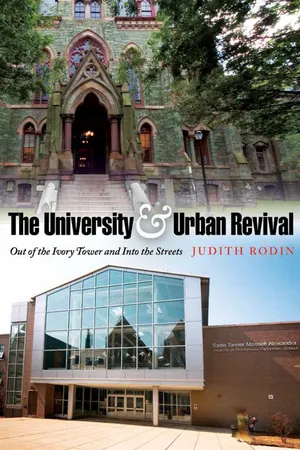
eBook - ePub
The University and Urban Revival
Out of the Ivory Tower and Into the Streets
- 232 pages
- English
- ePUB (mobile friendly)
- Available on iOS & Android
eBook - ePub
About this book
Information
Publisher
University of Pennsylvania PressYear
2015Print ISBN
9780812240221
9780812240221
eBook ISBN
9780812293371
Topic
ArchitectureSubtopic
Urban Planning & LandscapingCHAPTER 1
Mobilizing for Action
MORE THAN HALF of the nation’s colleges and universities are located in cities. They represent significant contributors to the character of their cities and to the definition of the urban environment. By virtue of their mission, intellectual capital, and investments in physical facilities, urban universities and their medical centers are uniquely positioned to play a leading role in their communities in powerful ways.
Yet urban universities have not typically been the most agreeable neighbors. At best, their involvement with adjacent communities has been intermittent and inconsistent. For decades these institutions have flexed their huge muscles of property ownership and pushed their way into the surrounding areas. The all-too-familiar cycle of depopulated urban neighborhoods and resultant increase in crime, which in turn made a neighborhood even less desirable, had its beginnings in the 1950s with “white flight” to the suburbs. The ensuing urban-renewal projects of the 1960s increased the dissension between town and gown as disgruntled homeowners were displaced to make room for the expansion of these institutions with newly available federal urban-renewal dollars. Then, as the funds dried up and the neighborhoods around them deteriorated, academic and medical institutions turned inward, preferring to remain insulated rather than address the problems in their own backyards. When there were institutional attempts at developing better community relationships, they were most often inadequate, lacking sustainable changes and solutions. And so the cycle continued.
The situation of the neighborhood surrounding the University of Pennsylvania campus in the 1990s exemplified these issues. The whole of West Philadelphia, the broad contiguous section that encompasses University City, had been in a state of serious decline since the 1950s. From the mid- to late 1980s, the area had become increasingly blighted and unsafe. One in five residents had income below the poverty line. Shops and businesses were closing, pedestrian traffic was vanishing, middle-class families were leaving, and more houses were falling prey to abandonment and decay. The streets were littered with trash, and abandoned homes and buildings became canvases for graffiti artists and business addresses for drug dealers.
The public schools were in especially bad shape. They were overcrowded and antiquated, and three local elementary schools ranked at the bottom in state-administered math and reading tests. The main commercial thoroughfare through Penn’s campus was dominated by surface parking lots, while the depressed and desolate commercial corridor of 40th Street at the western edge of Penn’s campus had become an invisible boundary beyond which many Penn students and faculty dared not venture. And despite the efforts of some faculty and administrators to reach out to the community, the relationship between the University and the community was testy, to say the least. Residents by and large felt that Penn had turned its back on the neighborhood.
Who could blame them? Penn was so near and loomed large, yet felt so remote. The city’s largest private employer spent hundreds of millions of dollars a year on goods, services, and construction, yet little of that trickled down to local businesses. Penn operated commercial real estate with seemingly little regard for what kinds of businesses were leasing its properties. Some establishments, like the local fast-food eatery, were especially seedy and menacing. If quality of life means all those aspects of the environment—physical, economic, and social—that make a community a desirable place in which to live or do business, then Penn was not only failing to do its part to enhance the quality of life in the neighborhood but was also, albeit unwittingly, contributing to its decline. Even the University buildings kept their distance, with windowless walls of brick or stone facing the street and forming a fortresslike barrier.
The issue of mending its deteriorating relations with the community and revitalizing West Philadelphia had long been on Penn’s agenda, and many efforts had been made. But when the problem of security was driven once again to the forefront, we had to find an entirely new model for action. One unforgettable meeting that stiffened my resolve to search for new paradigms and sustainable solutions took place just a few weeks after Vladimir Sled’s murder in the fall of 1996. It was Family Weekend on campus, and we held a previously scheduled open forum on safety issues. Some five hundred parents attended and grilled me about my administration’s efforts to safeguard their children. Understandably, the atmosphere was heated—the parents were angry, terrified, consumed with worry. A few threatened to pull their children out of school. I highlighted the safety initiatives I had announced that fall, outlined the University’s safety-related programs, and discussed our plans for new residences and retail spaces to draw student activity back onto campus. At one point, the irate crowd booed the very popular Mayor Ed Rendell (the city’s former district attorney and a Penn alum) when he tried to discuss possible solutions to crime besides a heightened police presence, ones that involved their children’s behavior. The booing was not restricted to the mayor. My response, however, was equally vehement. I reminded the parents that we were in this together and that we shared a mutual need and desire for our students to be safe. I meant every word, because I, too, was a parent. My son and stepson lived with my husband and me in the president’s house on the western edge of the campus.
The president’s house at 3812 Walnut Street is an elegant French chateau, built for West Philadelphia cigar manufacturer Otto C. Eisenlohr in 1912 and renovated in 1982. The house is considered one of the gems of architect Horace Trumbauer’s career. Life was comfortable in that wonderfully grand classical mansion conveniently located within minutes of my office, but it was in bizarre juxtaposition to the neighborhood around it. The nearest grocery store was many blocks away, and it was often plagued by long lines at the checkout and by inadequate food quality, with prices reflecting the lack of competition. There was no place to buy a new sweater or a nice birthday gift. There were few restaurants. And I confess that the dark, empty streets made everyone jumpy. Having school-age children, I could relate to what every West Philadelphia parent felt about the safety of the area and the lack of good educational options.
When I assumed the presidency, my son, Alex, was in seventh grade and my stepson, Gibson, was in tenth grade. As a product of public schools, I have always been fully committed to public-school education. It was with tremendous dismay that my husband and I decided to send the boys to private schools. But in light of the failing neighborhood schools, private school seemed the only option for many University City parents. Each weekday morning, more than fifteen buses crisscrossed West Philadelphia, transporting neighborhood children to private and parochial schools throughout the city and the western suburbs. Because our sons did not attend neighborhood schools, their friends were dispersed throughout the city and the surrounding towns. We were not the only family with these issues—similar scenes were routine in many households across University City. And we were the lucky ones. Most West Philadelphia parents lacked cars and money for private schools.
The streets of University City did not feel safe. The dearth of public parks and green spaces left parents no choice but to push strollers through broken glass, litter, and sometimes discarded drug paraphernalia in the few parks that did exist. Vladimir Sled’s murder was the last straw.
The University had been working on community relations for a decade, and there had been progress and improvements in the neighborhood. We had instituted many new safety measures and had invested heavily in security. Now there was an urgent need to accomplish broader and more sweeping change at warp speed. Two years before, when Alimohamed was murdered, I was unsure that we had the resources or the institutional will to accomplish holistic change on a neighborhood-wide scale. The stakes were even higher now. It was apparent that we were going to have to invest huge amounts of creativity, time, and money in an integrated, broad, community-development effort.
We could no longer rely on the great efforts of faculty to work in West Philadelphia if doing so fitted within their research purview. We could no longer feel good about encouraging students and staff to volunteer in the local schools, or about several of our smaller community-improvement initiatives. We had to face the prospect of taking the lead in redeveloping a distressed neighborhood that disliked us and of assuming an unprecedented level of financial and social risk.
Many have asked what other factors contributed to my personal passion and depth of commitment to the revitalization of West Philadelphia. After all, when I accepted the presidency, I was going to lead an Ivy League school with an outstanding faculty of academic scholars and leaders in their respective fields. Penn students were bright, creative, and intellectually curious. My job description did not include transforming the neighborhood.
I suppose it was only natural that some questioned whether my role as the first female president of an Ivy League university influenced me to push the West Philadelphia initiatives. Of course, I was aware that my leadership would be especially scrutinized because of my gender. While I knew that there was no one particular style of “female leadership” and that ultimately my leadership would be judged by my accomplishments, perhaps I was more determined to fix the neighborhood because I was a woman and a mother. And certainly my commitment to the revitalization of West Philadelphia had to do with deep affection for the city and the neighborhood in which I had grown up and for the credibility of my alma mater, which had been so critical in shaping my life. It was also an outgrowth of political activism, formulated early in my education and further encouraged at Penn, where I honed leadership skills in student government. And it grew out of a lifetime of living and working in urban areas and an appreciation for the intellectual excitement and cultural stimulation—as well as the considerable challenges—they offered.
After graduating from Penn, I continued my doctoral studies in psychology at Columbia University. With that move, my political and social awareness increased in quantum leaps as I found myself in the midst of campus turmoil unlike anything I had experienced before. Recall that Columbia in the 1960s experienced the most significant crisis in its history, placing the Morningside Heights campus in the national spotlight. The currents of unrest sweeping the nation—opposition to the Vietnam War, an increasingly militant civil-rights movement, and the ongoing decline of America’s inner cities—all converged in a chaotic upheaval at Columbia. In the last week of April 1968, more than a thousand protesting students occupied five buildings, effectively shutting down the university until they were forcibly removed by the New York City police.
I closely observed the mediation between Columbia administrators and students who had taken over university buildings to protest the razing of a decaying neighborhood to put up a gymnasium. Those tumultuous events led to the cancellation of the proposed gym in Morningside Park, the termination of certain classified research projects, the retirement of President Grayson Kirk, and a slump in Columbia’s finances and morale. They also led to the creation of the University Senate, in which faculty, students, and alumni acquired a larger voice in university affairs.
Witnessing the confrontation between authority figures (whether police or university administrators) and students, who passionately voiced their beliefs, was a tutorial in human behavior. I saw that violence can arise from a clash between strongly held beliefs and a system that does not seem to get it. Ultimately, the system did respond, but a healthy, engaged dialogue would have accomplished more. It was a lesson I would never forget.
With an offer to teach at Yale, I moved to New Haven, where I remained for the next twenty-two years, the last two as provost. New Haven was experiencing the same pangs of turmoil as many other cities throughout the country. The community was still suffering the effects of the riots of the summer of ’67, a backlash against the federal government’s shift away from aiding the poor and helping those living in the inner city. While the participants in the riots during those two days were a minority of the population in the neighborhood where the incidents occurred, it was evident that political leaders had failed to recognize that this minority represented the voice of the majority. Once again, I saw how critical it was to be in tune with the community and to respond in kind. Another lesson was imprinted on me for the future.
At Yale I also became familiar with Jane Jacobs’s seminal work, The Death and Life of Great American Cities (1961), which scoffed at much of the urban planning of the twentieth century and instead offered a studied, considered observation of the features that ultimately make and keep a city livable.1 My perspective on urban life was hugely influenced by Jacobs’s remarkable book. From these myriad influences, it became clear to me that the leaders of cities needed help in enhancing, reviving, and reaffirming urbanism as a critical feature of American life. Little did I know I would be called upon to act, to test this crucible of commitment in the aftermath of violence.
I was thrilled and honored in 1994 to return to Penn as president and to my hometown. In my Freshman Convocation speech that year, I pointed out the greatness of the city: “Within a five-mile radius of the campus, you will find a world-class art museum, a renowned orchestra, a marvelous zoo, a celebrated planetarium and natural history museum as well as world-class restaurants, shopping and entertainment. Philadelphia is also the place where the two most important documents in American history—the Constitution and the Declaration of Independence—were debated, drafted, and signed. In short, Philadelphia is a vibrant, exciting city. Yet within a five-mile radius of the campus, there are communities where unemployment is high, housing is deteriorated, and where children struggle to escape from poverty and neglect. In Philadelphia, you will see the most vivid of contrasts between high culture and devastating poverty. And yet both are part of Penn.”
I spoke too about what had drawn me back to Penn: “Penn has always been for me a place where ideas generated tremendous excitement, and where intellectual and social life flowed together seamlessly. It was the place where I learned to think well, to be bold and take chances, to challenge old paradigms. It was, above all, a place deeply committed to the open and free expression of new ideas of all kinds.”
But exhilarating as it was to return to Penn, it was also devastating to see how much the surrounding area had deteriorated. The neighborhoods I remembered as adjoining the campus no longer existed. Gone was the vitality I recalled, which was all the more distressing because my memories of growing up on 59th and Windsor streets were particularly wonderful. The Cobbs Creek area in Southwest Philadelphia, where we had lived, had been a lower-middle-class neighborhood of row houses inhabited by a tightly knit mix of Jewish and Catholic families. We did not have much, nor did we really want much. Everything we needed was nearby. The neighborhood seemed like a paradise for kids. In fact, until I started elementary school, I did not know many children from around the corner on Warrington Street because we had enough kids on our street for a baseball game. It did not get any better than that!
So with my responsibilities as president, and the distinct history and advantage I had of being a hometown kid who was a product of the Philadelphia public schools and a Penn alum, I built on my experiences as an observer of the power and the decay of American cities. It was a privilege to lead Penn as it sought to become a catalyst for neighborhood transformation. The goal was to build capacity back into a deeply distressed inner-city neighborhood—educational capacity, retail capacity, quality-of-life capacity, and especially economic capacity. We demolished literal and figurative walls that kept Penn and its neighbors from forging nourishing connections with one another. We restructured buildings and open spaces to make the campus “more like seams and less like barriers” to the community, as Jacobs had advocated.2 And we worked to unite “town and gown” as one richly diverse community that could learn, grow, socialize, and live together in a safe, flourishing, and economically sustainable urban environment.
As I wrote this book, I was haunted by images of the victims of Hurricane Katrina in New Orleans—poor people, largely black, who were literally left behind. America is reaching out for new solutions. In a trenchant New York Times op-ed piece, David Brooks comments:
Especially in these days after Katrina, everybody laments poverty and inequality. But what are you doing about it? For example, let’s say you work at a university or a college. You are a cog in one of the great inequality producing machines this country has known. What are you doing to change that?3
This book describes one university’s answer.
CHAPTER 2
Why Neighborhood Revitalization
IN THE PAST few decades, it has become increasingly difficult for urban colleges and universities to turn their backs on the problems of their cities, because these institutions cannot deny that the cities’ troubles have become their own as well. Many cities, suffering from the press of poverty, crime, and physical deterioration, have called upon the academic institutions in their midst for help. A few university presidents stepped up early to take on major civic...
Table of contents
- Cover
- Half title
- Title
- Copyright
- Dedication
- Contents
- Prologue
- 1 Mobilizing for Action
- 2 Why Neighborhood Revitalization
- 3 The Growth of University City
- 4 Policy, Organization, and Planning
- 5 Making the Neighborhood Clean and Safe
- 6 Reclaiming Housing
- 7 Invigorating the Local Economy
- 8 Investing in Public Education
- 9 Civic Leadership
- Conclusion
- Appendix: Projects Developed
- Notes
- Index
- Acknowledgments
Trusted by 375,005 students
Access to over 1.5 million titles for a fair monthly price.
Study more efficiently using our study tools.
Frequently asked questions
Yes, you can cancel anytime from the Subscription tab in your account settings on the Perlego website. Your subscription will stay active until the end of your current billing period. Learn how to cancel your subscription
No, books cannot be downloaded as external files, such as PDFs, for use outside of Perlego. However, you can download books within the Perlego app for offline reading on mobile or tablet. Learn how to download books offline
Perlego offers two plans: Essential and Complete
- Essential is ideal for learners and professionals who enjoy exploring a wide range of subjects. Access the Essential Library with 800,000+ trusted titles and best-sellers across business, personal growth, and the humanities. Includes unlimited reading time and Standard Read Aloud voice.
- Complete: Perfect for advanced learners and researchers needing full, unrestricted access. Unlock 1.5M+ books across hundreds of subjects, including academic and specialized titles. The Complete Plan also includes advanced features like Premium Read Aloud and Research Assistant.
We are an online textbook subscription service, where you can get access to an entire online library for less than the price of a single book per month. With over 1.5 million books across 990+ topics, we’ve got you covered! Learn about our mission
Look out for the read-aloud symbol on your next book to see if you can listen to it. The read-aloud tool reads text aloud for you, highlighting the text as it is being read. You can pause it, speed it up and slow it down. Learn more about Read Aloud
Yes! You can use the Perlego app on both iOS and Android devices to read anytime, anywhere — even offline. Perfect for commutes or when you’re on the go.
Please note we cannot support devices running on iOS 13 and Android 7 or earlier. Learn more about using the app
Please note we cannot support devices running on iOS 13 and Android 7 or earlier. Learn more about using the app
Yes, you can access The University and Urban Revival by Judith Rodin in PDF and/or ePUB format, as well as other popular books in Architecture & Urban Planning & Landscaping. We have over 1.5 million books available in our catalogue for you to explore.