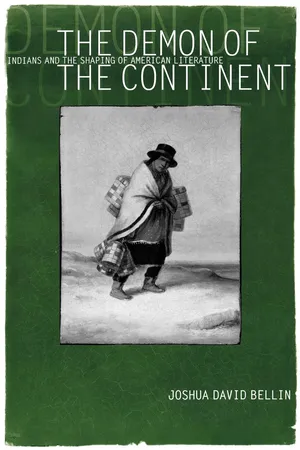
In recent years, the study and teaching of Native American oral and written art have flourished. During the same period, there has been a growing recognition among historians, anthropologists, and ethnohistorians that Indians must be seen not as the voiceless, nameless, faceless Other but as people who had a powerful impact on the historical development of the United States. Literary critics, however, have continued to overlook Indians as determinants of American—rather than specifically Native American—literature. The notion that the presence of Indian peoples shaped American literature as a whole remains unexplored.
In The Demon of the Continent, Joshua David Bellin probes the complex interrelationships among Native American and Euro-American cultures and literatures from the mid-seventeenth to the mid-nineteenth centuries. He asserts that cultural contact is at the heart of American literature. For Bellin, previous studies of Indians in American literature have focused largely on the images Euro-American writers constructed of indigenous peoples, and have thereby only perpetuated those images. Unlike authors of those earlier studies, Bellin refuses to reduce Indians to static antagonists or fodder for a Euro-American imagination.
Drawing on works such as Henry David Thoreau's Walden, William Apess' A Son of the Forest, and little known works such as colonial Indian conversion narratives, he explores the ways in which these texts reflect and shape the intercultural world from which they arose. In doing so, Bellin reaches surprising conclusions: that Walden addresses economic clashes and partnerships between Indians and whites; that William Bartram's Travels encodes competing and interpenetrating systems of Indian and white landholding; that Catherine Sedgwick's Hope Leslie enacts the antebellum drama of Indian conversion; that James Fenimore Cooper and Henry Wadsworth Longfellow struggled with Indian authors such as George Copway and David Cusick for physical, ideological, and literary control of the nation.
The Demon of the Continent proves Indians to be actors in the dynamic processes in which America and its literature are inescapably embedded. Shifting the focus from textual images to the sites of material, ideological, linguistic, and aesthetic interaction between peoples, Bellin reenvisions American literature as the product of contact, conflict, accommodation, and interchange.
eBook - ePub
The Demon of the Continent
Indians and the Shaping of American Literature
- 280 pages
- English
- ePUB (mobile friendly)
- Available on iOS & Android
eBook - ePub
About this book
Information
Chapter One
Indian Conversions
Woe be to me if I call that conversion to God, which is indeed subversion of the soules of Millions. . . . For it is not a forme, nor the change of one forme into another . . . that makes a man a convert.
—Roger Williams, “Christenings Make Not Christians”
In 1850, Henry A. S. Dearborn, mayor of Roxbury, Massachusetts, proposed a monument to John Eliot, the seventeenth-century “Apostle” to the neighboring Indians. The monument was to be an elaborate affair: “A Corinthian column, surmounted by a Funereal Urn. . . . Whole height, forty-two feet. The fence is supported by Doric columns . . . the pales alternate Crosses and Arrows, as emblematical of Eliot’s Christian office, and of the Indians for whom it was assumed. On the front side of the pedestal of the column, a basso-relievo of an open folio Bible, exhibiting the title page of Eliot’s translation; the letters in intaglio and gilded.” None of the posterity of Eliot’s converts would, presumably, visit this shrine: the Christian Indians of the town of Natick, once Eliot’s showpiece, had been pronounced “practically extinct” two years earlier, and when Dearborn refers to “that much wronged, long suffering, yet unsubdued, undismayed, energetic and persevering race,” he is, however incredibly, speaking of his own. Yet despite the ultimate failure of Eliot’s mission, the monument would testify to “the profound veneration which is entertained for the FIRST and time-honored herald of the Christian Religion to the primeval inhabitants of this vast Republic.”1
Auspiciously, if astoundingly, a representative of these people had recently arrived in Roxbury to view Eliot’s tomb. This was Kahgegagahbowh2 or George Copway, an Ojibwa convert who, “when informed of the measures which had been adopted for doing honor to [Eliot’s] memory . . . expressed the deepest solicitude, that they should be crowned with success, and volunteered his aid, so far as he was enabled to do so, in the accomplishment of that object.” Copway sent a twenty-five-dollar contribution and his compliments: “This will be a lasting memento before your children and our children, what true greatness is; and would to God, that while they are under its shadow, the self-sacrificing spirit which was in Eliot, might be felt by them, for the moral elevation of man and glory to the Great Spirit.” In return, Dearborn ordered that a figure be added to the engraving printed to fund the monument: a feathered Indian, draped in a blanket and holding a bow, who stands before the fence with its alternating crosses and arrows, pointing to the massive column in gratitude or devotion. Suppressing numerous ironies and worse—months earlier, President Taylor had ordered the removal of the Lake Superior Ojibwas; Copway, depicted in his autobiography as anything but a painted warrior, was boosting a removal scheme of his own on the tour that brought him to Roxbury; and Dearborn, in the 1830s, had helped draft fraudulent treaties for the removal of the Seneca Indians—this image condenses encounter to a single, symbolically charged moment: dwarfed by the pillar, shut out by the fence, and mute before the textual acts of Bible and proposal, the wild Indian has failed to enter the covenant of conversion that Eliot opened.3
This image illustrates an idea Roy Harvey Pearce termed “savagism” but, for reasons I will explore, I prefer to call “conversionism.” It is an idea that speaks, as in the following quote from D. H. Lawrence, of absolute difference, absolute conflict, and absolute resolution to America’s encounters: “The red life flows in a different direction from the white life. You can’t make two streams that flow in opposite directions meet and mingle soothingly.” It is an idea that has shaped conceptions of Indian-white encounter from Eliot’s day to the present. Yet however compulsory or ironclad conversionism seems, encounter reveals its inadequacy; for as the experience of people such as Copway attests, conversionist claims of disparity and incommensurability fail to account for the amorphous, destabilizing process of conversion itself. As Victor Turner writes in his study of ritual transformation, the initiate’s condition “is one of ambiguity and paradox, a confusion of all the customary categories. . . . This coincidence of opposite processes and notions in a single representation characterizes the peculiar unity of the liminal: that which is neither this nor that, and yet is both.”4 Viewed (as Turner sees it) as a mechanism for maintaining order, conversion can be defined only in relation to the oppositions between which it oscillates. Viewed, however, as the oscillation, conversion becomes instead an image of the indefiniteness of encounter. In this chapter, then, I argue that conversionism, whether as practice—a blueprint for the alteration of Indian souls—or representation—an ideal that mandated opposition as the grounds of homogeneity—cannot control the forces of encounter. Indian conversion is thus not only the subject of this chapter but a means of interrogating the subject, of exploring a conversion process that embraced individuals, peoples, a country, and its literature.
Conversion and Subversion
If Dearborn’s temple of the apostle bordered on the vulgar, he was nonetheless correct in assigning Eliot a seminal role in the development of the ideology and practice of Indian conversion among American Protestants.5 Commencing his ministry in 1646, Eliot managed during the next three decades to gather several hundred native hopefuls into internal colonies or “Praying Towns,” where the converts pursued a twin emphasis: civilization and Christianity. As Eliot explained, only after the Indians had been “brought from their scattered and wild course of life, unto civill Cohabitation and Government” could they “be fit to be betrusted with the sacred Ordinances of Jesus Christ.” Measured solely by numbers, Eliot’s labors were largely unavailing. Yet the idea behind his program provided a touchstone for future efforts. Rooted in what Robert Berkhofer terms the “fusion of religion and lifestyle”—or the “confusion,” in George Tinker’s perhaps more apt term—Eliot’s paradigm of conversion demanded that Indians renounce all aspects of their heritage, sacred and secular.6 However unlikely Indians were to achieve, or Christians to accept, this revolution, in theory conversion anticipated the extirpation of Indians, as Indians, from the continent.
Given the central role Indian conversion played in shaping both the practical and the conceptual emphases of encounter, it is surprising how little has been done to investigate or, more properly, theorize it; critics have described its methods, makers, and martyrs, while taking its existence largely for granted. Two contradictory appraisals of conversion have emerged: while some see missionary enterprise as a sign of Christian benevolence—“Evangelization was simple in motivation: first, giving glory to God, and second, compassion for the ruined spiritual and physical state of the Indians”—others dismantle it as a vile and violent conspiracy, meant to “subdue a troublesome racial minority under the pretense of Christian paternalism.”7 The first of these analyses is plainly wanting: to laud evangelism is to slight not only its tragic consequences but its contexts, conflicts, and controversies. Conversely, if it is reductive to view missionary ardor as wholly disingenuous, it is no less false to view it as wholly duplicitous. For Eliot and his followers, the “confusion” of spirit and culture was no confusion: Indian “culture”—a term none would have used—was merely an elaboration of heathenism and was thus doomed perforce and providentially. However grievous the outcome of their convictions, one must not oneself “confuse” the results of missionary labors with the motivations.
Rather than viewing Indian conversion as separable from or a feint for other concerns, then, one must place it where its practitioners did: at the center of their belief system, where it both illuminates and draws from a range of activities. On the one hand, Indian conversion grew out of Christian ideals, aspirations, and fears. For instance, as Richard Cogley has shown, the opinion that the Indians were remnants of the Lost Tribes made their recovery a matter of some urgency, since many Christians held that the conversion of the Jews was a precursor of the millennium.8 Then, too, conversion served more immediate spiritual needs. Missionary bulletins often seem less appeals than jeremiads: “Let these poor Indians stand up, incentives to us,” Thomas Shepard wrote. “Who knows but God gave life to New England to quicken Old, and hath warmed them that they might heat us.” Conversion, moreover, could be seen as a means of appeasing the deity in the here and now—“it is not to be wondred at, that the Lord hath afflicted us by the Indians,” wrote Increase Mather during the 1675–1676 conflict that would come to be called King Philip’s War, “since the body of the present Generation hath no more of an heart to endeavour their Conversion”—or of tempering the divine wrath to come: if Christians failed in their duty, one critic warned, “these poore Indians will certainly rise up against us, and with great boldnesse condemn us in the great day of our accompts.”9 If this is hypocrisy, it is of a particularly earnest strain; if it is benevolence, it is of a particularly self-serving sort. In either case, it is evident how literally Christians read the Indians’ fate as inseparable from their own.
Not only, however, did conversion help satisfy divine mandates; at the same time, it took part in secular concerns. Eliot had written that he intended, in addition to broadcasting the gospel, to “bridle, restrain,” and “also to humble” the Indians; and while he would likely have seen such bowing to authority as a universal ideal, in practice it seemed a means of breaking Indians to a temporal master. Whether one agrees with Francis Jennings that Eliot’s ministry was but a smokescreen for a Puritan land-grab, or accepts Neal Salisbury’s assessment that proselytizing followed settlement, helping to “clear the few Indians who remained,” it is evident that missionaries contributed to dispossession in a variety of ways, even if they did not favor it: by pressuring Indians to relinquish lands, fomenting internal dissension, placing converts under colonial jurisdiction, and—least forthrightly but most pervasively—contesting Indian self-conceptions and allegiances.10
Indeed, missionaries often acknowledged, if covertly, their role in boosting worldly interests. Eliot, as usual, set the pattern, admitting that he must discredit native chiefs to make headway: “Since the [sachems] are cut off,” he wrote, their people “do bow the Ear to hear, and submit to pray unto God.” Less circumspect was Cotton Mather: “May the New-Englanders be so far politick, as well as religious,” he counseled, “as particularly to make a mission of the gospel unto the mighty nations of the Western Indians[,]. . . lest those horrid pagans . . . [be] a scourge to us.” In 1723, Solomon Stoddard posed a like solution to the region’s ongoing Indian troubles: “ ’Tis much better to convert them: Then they will do good, they will serve and glorify God, they will help to enlarge his Kingdom, and be a benefit to their Neighbours.”11 None of this proves that missions were mere pawns or props of colonial power; it does suggest, however, that the conquest of souls went hand in hand with the conquest of the continent.
Thus far I have focused on Indian conversion solely as it relates to Euro-America. To grasp conversion’s scope, however, it is insufficient to separate preceptor from receptor. In saying this, I do not mean merely that one must recover the Indian “side”; rather, considering the convert reveals, among other things, the inadequacy of the discourse of “sides.” This discourse has dominated depictions of converts, who have been slotted into a hierarchy based on the extent to which one side has been abandoned for the other. At the top are the model Christians, like the man who, “if any did abuse him . . . could lie downe at their feet, and if any did smite him on the one cheeke . . . would rather turne the other.” Next are the “friendless outcasts, to whom the earth has denied a place beyond the extent of a grave—half-mingling with their people, from whose wretchedness and depravity they recoil, and half-mingling with the whites, where their bitterness of soul becomes not less intolerable.” At the base are the cheats, backsliders, and dissemblers, reaping the rewards of civilization while luxuriating in the outrages of savagism: “There was [one] praying Indian,” Mary Rowlandson recalls, “so wicked and cruel as to wear a string about his neck, strung with Christian’s fingers.”12 Viewing conversion as a radical transfer from one steady state to its virtual opposite, commentators have relied on a positivist language of signs and tokens, tangible evidences of the real, the genuine, the pristine.
Such language, troublingly, lingers, preventing even works with revisionist aims from transcending the model of contrasting or opposing sides. Among the ethnohistorians who have sought to explode stereotypes of Indian converts, for example, James Axtell has led the way in arguing that one cannot focus on the converters alone, but must “ask whether the Indians, from their point of view, were successful or not in adopting or adapting Christianity.” Axtell notes that conversion might represent an opportunity to manipulate hostile colonial conditions, to forge creative alliances between peoples, and to adopt effective, if unspectacular, measures of resistance and revitalization. Yet though Axtell’s project would seem to encourage an intercultural approach, his desire—perhaps, as an ethnohistorian, his need—to identify the Indian “side” leads him to search for an essential Indian beneath the “protective coloration” of Christianity. Believing that conversion was a means by which converts guarded their “cultural integrity,” Axtell must conclude that “Christianity often lay very lightly on the surface of their lives,” that many were merely “paying lip service” to the Christian faith—that, in short, converts were chameleons who donned spiritual dazzle to conceal traditional practices, placate earthly overlords, and wheedle newfound privileges. There is, to be sure, some evidence for this, the most striking I know being one missionary’s claim that Indian leaders wished to “get into the church” to “assert their own authority”—in effect, to use the church as the seat of tribal governance.13 Yet however valid Axtell’s portrait is in particulars, its twinned beliefs that one can readily distinguish genuine core from artificial accretions and that one can sift distinct, incarnate cultures from texts are hazardous on the whole.14
What is striking about the texts of conversion is that they make a shambles of such beliefs. Consider, for example, the works of Eliot, who sought as much as any to crop Indians to the conversionist frame: he was famous for levying fines on all lapses from a Utopian cultural purity, from the residual (powwowing) to the trivial (hair length) to the bizarre (bestiality),15 while the confessions and other supposed instances of Indian self-representation that pepper his writings are policed to ensure orthodoxy. Yet despite—or because of—his omnivorousness, Eliot could be slow to catch conversion experience pulling against conversionism. In 1654, for example, during a public catechism staged before the civil and ecclesiastical leaders of the colony, he posed a simple question and received, seemingly, a simple reply: “Q. What is God? A. An Ever-living Spirit.”16 Evidently satisfied, Eliot moved on; the catechumen, for his part, performed admirably, nailing the doctrines of the unity, ubiquity, and eternality of the ever-living spirit called God.
This moment that produces not a murmur in Eliot’s text, however, opens a host of questions that Eliot did not think to ask, or perhaps knew better than to raise. For according to fellow linguist Roger Williams, the word translated as “spirit”—likely “manitou”—was patently not equivalent to the Christian “God”: “There is a generall Custome amongst them, at the apprehension of any Excellency in Men, Women, Birds, Beasts, Fish, &c. to cry out Manittóo, that is, it is a God . . . and therefore when they talke amongst themselves of the English ships, and great buildings, of the plowing of their Fields, and especially of Bookes and Letters, they will end thus: Manittôwock They are Gods.” In light of this suggestion that the Indian word stands less for a fixed thing than for a protean quality—in light, moreover, of the claim that textuality is the crowning example of manittóo—it seems that the translation of the word “God,” or the word of God, cannot control the word’s ambiguous, polysemous potential. Eliot himself ponders, though obliquely, this problem of multiplicity where there should be unity. Whether assuming a conventional humility or honestly uncertain of his fluency (or both), he habitually laments the incompleteness of translation: “Some things spoken I understood not, and some things slipt from me. . . . I requested the Assembly, That if any one doubted of the Interpretations that should be given of [the Indians’] Answers, that they would Propound their doubt, and they should have the words scanned and tryed by the Interpreters, that so all things maybe done most clearly.” That Eliot leaned heavily on catechisms was, perhaps, attributable to this anxiety; yoking answers to questions, the catechism seeks to squelch discursive latitude. Toward this end, though one of Eliot’s works was titled The Indian Dialogues, each of the book’s fictional “dialogues” ends with a missionary outmaneuvering his savage int...
Table of contents
- Cover
- Title
- Copyright
- Dedication
- Contents
- Introduction
- 1. Indian Conversions
- 2. The Charm of the Indian
- 3. Radical Faiths
- Interlude
- 4. Stories of the Land
- 5. Mind out of Time
- 6. Myth and the State
- 7. Traditional Histories
- Conclusion
- Notes
- Index
- Acknowledgments
Trusted by 375,005 students
Access to over 1.5 million titles for a fair monthly price.
Study more efficiently using our study tools.
Frequently asked questions
Yes, you can cancel anytime from the Subscription tab in your account settings on the Perlego website. Your subscription will stay active until the end of your current billing period. Learn how to cancel your subscription
No, books cannot be downloaded as external files, such as PDFs, for use outside of Perlego. However, you can download books within the Perlego app for offline reading on mobile or tablet. Learn how to download books offline
Perlego offers two plans: Essential and Complete
- Essential is ideal for learners and professionals who enjoy exploring a wide range of subjects. Access the Essential Library with 800,000+ trusted titles and best-sellers across business, personal growth, and the humanities. Includes unlimited reading time and Standard Read Aloud voice.
- Complete: Perfect for advanced learners and researchers needing full, unrestricted access. Unlock 1.5M+ books across hundreds of subjects, including academic and specialized titles. The Complete Plan also includes advanced features like Premium Read Aloud and Research Assistant.
We are an online textbook subscription service, where you can get access to an entire online library for less than the price of a single book per month. With over 1.5 million books across 990+ topics, we’ve got you covered! Learn about our mission
Look out for the read-aloud symbol on your next book to see if you can listen to it. The read-aloud tool reads text aloud for you, highlighting the text as it is being read. You can pause it, speed it up and slow it down. Learn more about Read Aloud
Yes! You can use the Perlego app on both iOS and Android devices to read anytime, anywhere — even offline. Perfect for commutes or when you’re on the go.
Please note we cannot support devices running on iOS 13 and Android 7 or earlier. Learn more about using the app
Please note we cannot support devices running on iOS 13 and Android 7 or earlier. Learn more about using the app
Yes, you can access The Demon of the Continent by Joshua David Bellin in PDF and/or ePUB format, as well as other popular books in Literature & North American Literary Criticism. We have over 1.5 million books available in our catalogue for you to explore.