How is it that American intellectuals, who had for 150 years worried about the deleterious effects of affluence, more recently began to emphasize pleasure, playfulness, and symbolic exchange as the essence of a vibrant consumer culture? The New York intellectuals of the 1930s rejected any serious or analytical discussion, let alone appreciation, of popular culture, which they viewed as morally questionable. Beginning in the 1950s, however, new perspectives emerged outside and within the United States that challenged this dominant thinking. Consuming Pleasures reveals how a group of writers shifted attention from condemnation to critical appreciation, critiqued cultural hierarchies and moralistic approaches, and explored the symbolic processes by which individuals and groups communicate.
Historian Daniel Horowitz traces the emergence of these new perspectives through a series of intellectual biographies. With writers and readers from the United States at the center, the story begins in Western Europe in the early 1950s and ends in the early 1970s, when American intellectuals increasingly appreciated the rich inventiveness of popular culture. Drawing on sources both familiar and newly discovered, this transnational intellectual history plays familiar works off each other in fresh ways. Among those whose work is featured are Jürgen Habermas, Roland Barthes, Umberto Eco, Walter Benjamin, C. L. R. James, David Riesman and Marshall McLuhan, Richard Hoggart, members of London's Independent Group, Stuart Hall, Paddy Whannel, Tom Wolfe, Herbert Gans, Susan Sontag, Reyner Banham, and Robert Venturi and Denise Scott Brown.
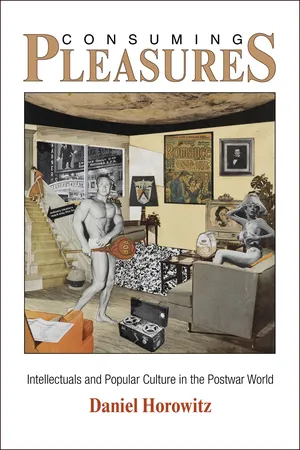
eBook - ePub
Consuming Pleasures
Intellectuals and Popular Culture in the Postwar World
- 504 pages
- English
- ePUB (mobile friendly)
- Available on iOS & Android
eBook - ePub
About this book
Information
Publisher
University of Pennsylvania PressYear
2012Print ISBN
9780812243956
9780812243956
eBook ISBN
9780812206494
Chapter 1

For and Against the American Grain
During the 1950s, American intellectuals participated in a spirited debate over the impact of mass culture. Although leading observers were by no means unanimous in their perspectives, a number of themes dominated what they wrote. They focused most of their attention on middle-class Americans who, in a rush to put the Depression and World War II behind them, chased after materialistic goals that critics believed were more tempting than genuinely satisfying. Most observers assumed that powerful corporations tricked passive consumers into paying for commercial goods and experiences that offered false satisfactions. Memories of European totalitarianism haunted them as they worried that Americans did not have the moral strength to resist a popular culture that might erode character and undermine democracy. In the midst of the Cold War, they countered the threat of Soviet collectivism and of 1930s Popular Front culture with paeans to what they saw as distinctive American individualism. They fiercely debated the tension between elite and popular commitments. They worried that a combination of excessive femininity and aberrant sexuality infused popular culture and in turn threatened national well-being. They feared that advertising, television, public relations campaigns, and suburban living eroded cultural standards, raising the prospect of the ascendancy of the lowest common denominator. A tone of disappointment undergirded much of the discussion. One observer’s incantation about “the silliness of television, the childishness of the comic strips, the triviality of the press” only served to underscore how locked-in many intellectuals in the postwar generation were to familiar and increasingly trite formulations.1
In the immediate postwar years, the locus classicus of these debates was the 1957 book Mass Culture: The Popular Arts in America, edited by Bernard Rosenberg and David Manning White, professors respectively of sociology at City College of New York and journalism at Boston University. The book appeared at a time when the issues it raised were urgent. “Marxism apart,” remarked the sociologist Daniel Bell soon after, the theory of mass society, which he went on to link to the spread of mass culture, “is probably the most influential social theory in the Western world today.” The year of Mass Culture’s publication, the historian Michael Kammen has written, was “when the whole debate over mass culture reached a crescendo in terms of sheer volume.” Indeed, as Theodor Adorno remarked in 1962, “outrage at the alleged mass era has become an article for mass consumption.” An examination of Mass Culture—what it contained and what it omitted, where its authors agreed and disagreed, its dead ends and potential breakthrough—provides the contexts essential in understanding the even broader issues discussed in Consuming Pleasures.2
Authors and Essays
In geographical, sociological, and political terms, certain patterns in the book were striking. Of the over four dozen authors, two—Walt Whitman and Alexis de Tocqueville—wrote in the nineteenth century. José Ortega y Gasset, George Orwell, Adorno, and Marshall McLuhan were the only twentieth-century figures who lived most of their lives outside the United States—in Spain, Britain, Germany, and Canada respectively. Of all the authors, only one, the Canadian-born Japanese American linguist S. I. Hayakawa, was what a later generation would call a person of color, an ethnic designation he would doubtlessly have opposed had the phrase even existed at the time. Indeed, in an essay in a book that rarely discussed jazz, let alone did so in positive terms, he looked favorably on jazz, albeit in terms that denied any distinctive African American contribution or perspective. As best as can be determined, Whitman was the only homosexual among the essayists. The anthropologist Hortense Powdermaker was the only woman who was the sole author of a contribution; Martha Wolfenstein and Patricia J. Salter, the only other women among the writers, each coauthored her essay with a man. Émigrés from Europe to America, most of them Jews who had stayed at least one step ahead of the Nazis, were prominently represented, comprising at least a fifth of the authors. Of those contributors born in the United States, about half were Jewish, at least in background. Others were native born, and primarily Protestant. Most authors were on the anti-Stalinist or non-Stalinist left. Ernest van den Haag was the only clearly identifiable conservative contributor then living in the United States. Yet when Rosenberg linked positions on popular culture with larger ideologies, he unintentionally revealed how problematic political labels were. He made clear that both “radicals” (he named Dwight Macdonald, Clement Greenberg, and Irving Howe) and “arch-conservatives” (he listed Ortega y Gasset and T. S. Eliot), “for opposite reasons, are repelled by what they commonly regard as vulgar and manipulative.” In contrast, “liberals” (he mentioned Gilbert Seldes, David Riesman, and Max Lerner) expressed greater appreciation for mass culture. Thus the authors were mostly male, liberal or left, citizens of the United States, in 1957 in their late thirties to late fifties, and as likely to be Jewish as Protestant.3
Not surprisingly given the times, the authors focused relatively little on race, ethnicity, or class—as later generations understood those terms. Yet powerfully formative in the book’s tone and arguments was the influence of Jews—both native born and émigré. The connection between Jewish background or identity, on the one hand, and interest in mass culture, on the other, is important but complicated. German, middle European, and American Jews had significant relationships to the production and consumption of varied types of culture. Jews were among the most important creators of a wide range of culture, from the avant-garde (Arnold Schoenberg), to middle-brow (George Gershwin), to mass or popular (Samuel Goldwyn or Al Capp). Jews were also avid consumers of varieties of cultures—in Europe from which they emigrated and in America as both immigrants and natives. Jews crowded the boardwalk of Coney Island and went to the opera or listened to chamber music. Some Jewish writers opposed what entrepreneurial Jews created, as when Jewish advocates of elite culture attacked popular culture. In other cases they were calling for respect for ethnically inflected popular culture that many critics of Christian background—and many Jewish ones as well—scorned or avoided. Whatever the sociological origins of concerns among Jews about popular culture, it is hard to overestimate the impact on them of an awareness of how Hitler had used mass media to advance Nazism.4
Gender raises other issues. As James Gilbert has written perceptively, many of those who worried about mass culture in the 1950s saw the problem in highly gendered terms. They linked the feminine with popular culture as “submissive, soft, flighty, emotional, and consumerist” and the masculine with modernist high culture as “productive, inventive, creative, action-oriented, and tough-minded.” Thus in his opening essay Bernard Rosenberg wrote of how in Madame Bovary Gustave Flaubert pictured Emma’s search for satisfaction as involving “an osmotic process that has only in our day come into its own as full-blown mass culture.” In their essay, Paul Lazarsfeld and Robert Merton, two of the nation’s most prominent sociologists, were sure that “the women who are daily entranced for three or four hours by some twelve consecutive ‘soap operas,’ all cut to the same dismal pattern, exhibit an appalling lack of esthetic judgment.”5
In contrast to a feminized mass culture stood a masculine, elite one. It is hardly surprising that most of the producers of high culture whom these cultural critics heralded—Schoenberg, Pablo Picasso, D. H. Lawrence, James Joyce—were men. More than that, critics of mass culture saw elite or avantgarde culture as tough: representing intellect rather than sentimentality, the disciplined mind rather than the too easily pleasured sensibilities. Only partly hidden in all this was a fear of male homosexuality. If popular culture was feminized and swept up gay men in its wake, then a tough masculine high culture would protect against both the feminization of American culture and what many contemporaries assumed was its corollary, the influence of effete, homosexual men. As Adorno wrote in his essay in the volume, without adopting the position he was describing, popular culture pictured the artist as “an ‘aesthete,’ a weakling, and a ‘sissy.’ ” Media tended “to identify the artist with the homosexual and to respect the ‘man of action’ as a real, strong man.”6
Popular or Mass Culture and Its Discontents
Rosenberg and White set the book up as a dialogue between those who were optimistic and those who were pessimistic about mass or popular culture. They probably reached a compromise on the book’s name with the word “mass” in the title, which Rosenberg as the acerbic critic doubtlessly preferred, standing in opposition to the phrase “popular arts” in the subtitle, which White, a cautious advocate, perhaps defended. The pairings were often of opposites, with Whitman and Herbert Gans, for example, on one side, and Ortega y Gasset, de Tocqueville, Macdonald, and Adorno on the other. Though they tried to be even-handed in their choices, the editors acknowledged that “there have been far more excoriators of mass culture than defenders,” an imbalance their selections reflected.7
Most of the contributors to the book worked within a widely accepted ideology that many American intellectuals relied on to understand commercial culture for much of the twentieth century, which I have elsewhere called the new or modern moralism, an outlook that saw middle-class culture as degrading. In addition, many, especially the detractors, were haunted by the specter of the Popular Front. As one of the contributors wrote, what he called “the New ‘Popular Front’ ” could undermine an “open society” built on “the prominence and persistence of a body of persons who remain skeptical, critical, querulous and deeply hesitant about popular imagination and taste.” Many of the authors, especially the pessimists, believed that the spread of mass culture involved a revival of the Popular Front’s rejection of ambiguity and an embrace of totalitarianism—a term then in fashion that combined Nazi and Soviet horrors. Tellingly, when Rosenberg and White reprinted Greenberg’s 1939 “AvantGarde and Kitsch,” they omitted some key passages in the essay, not only those that referred to events of the 1930s but also Greenberg’s espousal of socialist politics that did not fit well with the celebration of democratic capitalism common in 1957. Most but not all of the contributors engaged, if they did not actually embrace, the mixture of modernism and Marxism offered by those connected with or influenced by Partisan Review beginning in the late 1930s. As the historian Paul Gorman has written, they considered “the people to be passive victims of commercial entertainments” and believed “that the only effective cultural countermeasure was to cultivate the most difficult arts.”8
Rosenberg led off the debate with a short essay in which he excoriated contemporary American mass culture. A series of words that would appear throughout the book dominated his essay: sameness, interchangeable, dehumanized, deadened, bored, alienated, lonely, entrapped, anxious, manipulated, and vulgar. “Never before have the sacred and the profane, the genuine and the specious, the exalted and the debased,” he asserted, “been so thoroughly mixed that they are all but indistinguishable.” He singled out examples to drive home his point. “Shakespeare is dumped on the market along with Mickey Spillane,” he wrote, “and publishers are rightly confident that their audience will not feel obliged to make any greater preparation for the master of world literature than for its latent lickspittle.” He indicted “sleazy fiction, trashy films, and bathetic soap operas, in all their maddening forms.” Anyone who justified “organized distraction,” he insisted, had to understand that it exploited rather than fulfilled human needs. Whenever “kitsch pervades the atmosphere,” it made virtually impossible “a genuine esthetic (or religious or love) experience.” Rosenberg realized that his attitude toward “cultural pap and gruel” might be “dismissed as snobbery, an egghead affectation,” but he defended his position as democratic, offering as it did an aspiration of all people for higher things than the “sub-art and pseudo-knowledge” of mass culture. Indeed Rosenberg made clear that his criticism came from the left not the right. Citing White Collar by C. Wright Mills and using a Marxist phrase, he described the United States as “an enormous salesroom devoted to the fetishism of commodities.” Then he pulled back from the potential radicalism of his analysis. He blamed not capitalism but technology for mass culture, proof of which was that it flourished even more in the Soviet Union than in America.9
Rosenberg took special aim at the portrayal of excessive or non-normative sexuality in popular culture, and then went on to connect that to the totalitarian threat. He doubted that anyone could find “hidden virtue” in pin-up magazines with titles such as Cover Girls, Whirl, Keyhole, Stag, Brief, Bare, Titter, and Flirt whose names suggested nudity, excess, and homosexuality. He found especially distasteful the depiction of lesbians in popular fiction, “dressed in riding attire with spurs and whips, mercilessly flogging their victims.” Then in the next sentence he talked with disgust of the juxtaposition in U.S. Camera of “an offer of lewd photographs” with that for Nazi “atrocity pictures.” For Rosenberg, as for other authors included in the volume, especially powerful was the connection between degraded mass culture and what had happened in Europe in the 1930s and 1940s. Driving his point home, he wrote that “At its worst, mass culture threatens not merely to cretinize our taste, but to brutalize our senses while paving the way to totalitarianism.”10
In his opening essay White responded cautiously to Rosenberg’s attack on contemporary mass culture. By beginning with a quote from Socrates that denounced youth for their contempt for authority and love of luxury, White drove home his point that postwar complaints had abundant historical precedents. Thus he asserted that “xenophilic critics who discuss American culture as if they were holding dead vermin in their hands” incorrectly assumed that there was a golden age in the past when the people were creative lovers of beauty. White wrote that “masochism, sadism, sexual fantasies” were “as old as recorded history.” While not denying the pervasiveness of mass culture in contemporary America, he criticized its critics for focusing on the worst examples. He insisted that to turn comics into the dragon “whose slaying . . . will eliminate children’s tensions, [and] juvenile delinquency” was “neither scientifically defensible or reasonable.”11
Instead White asserted that popular culture enriched America. Citing Life magazine’s publication of Ernest Hemingway’s Old Man and the Sea, children’s television that communicated cultural values, paperbacks that made great literature accessible, concerts that offered serious music in hundreds of small towns, and a TV documentary on mental illness that featured Orson Welles and Dr. William Menninger, he argued that critics, by overlooking contributions to culture that the media made, encouraged “the very banality they purport to despise.” He also called into question the elitism of mass culture critics, whose “mixture of noblesse oblige and polite contempt” for people who were not in universities or the avant-garde blinded them to the way the media offered an unprecedented “cultural richness” to average citizens.12
Compared to Rosenberg’s confident assertiveness about what frightened him, White was defensive. This came through most clearly in the ground he conceded to Rosenberg and his like-minded critics. As with Rosenberg, the specter of totalitarianism haunted him, but White gave this concern a distinctive twist by arguing that German Nazis and Soviet Communists simultaneously embraced high culture and carried out heinous acts. Above all, what is striking is how much White sharply critiqued what he supposedly supported and often did so in language that resembled Rosenberg’s. White deplored “the pathological quality of some” comic books and declared that he would not defend on “either on esthetic or moral grounds” aspects of popular culture he considered “banal, dehumanizing and downright ugly.” One indication that Rosenberg and White shared more than they realized was that, missing the ambiguities of McLuhan’s The Mechanical Bride (1951), the subject of a later chapter in this book, they assumed the Canadian author was unambiguously against popular culture. Neither White nor Rosenberg imagined the possibility of embracing commercial culture as a source of genuine pleasure, utopian possibilities, or symbolic communication, ideas that became more common in succeeding generations.13
The book’s authors elaborated on the themes that its editors articulated in their opening essays. Some authors made clear that what stood in opposition to popular culture was high culture. As Leo Lowenthal, an émigré who was a core member of the Frankfurt School, put it in ways others echoed, there was an “unbridgeable difference between art and popular culture”—between what he called “a genuine experience as a step to greater individual fulfillment” and “spurious gratification.” Pessimistic critics denounced mass culture for making elite art precarious at best. Ernest van den Haag wrote that “corruption of past high culture by popular culture” involved “direct adulteration,” a category in which he included “Bach candied by Stokowski, Bizet coarsened by Rodgers and Hammerstein, the Bible discolored and smoothed down into academic prose, Shakespeare spiced and made into treacly musical comedy, Freud vulgarized into columns of newspaper correspondence advice.” On the other hand, more optimistic essayists offered qualifications—...
Table of contents
- Cover
- Half Title
- Title
- Copyright
- Dedication
- Contents
- Preface
- Introduction: Understanding Consumer Culture in the Post–World War II World
- Chapter 1. For and Against the American Grain
- Chapter 2. Lost in Translation
- Chapter 3. Crossing Borders
- Chapter 4. Reluctant Fascination
- Chapter 5. Literary Ethnography of Working-Class Life
- Interlude
- Chapter 6. Pop Art from Britain to America
- Chapter 7. From Workers and Literature to Youth and Popular Culture
- Chapter 8. Class and Consumption
- Chapter 9. Sexuality and a New Sensibility
- Chapter 10. Learning from Consumer Culture
- Conclusion: The World of Pleasure and Symbolic Exchange
- List of Abbreviations
- Notes
- Index
- Acknowledgments
Trusted by 375,005 students
Access to over 1.5 million titles for a fair monthly price.
Study more efficiently using our study tools.
Frequently asked questions
Yes, you can cancel anytime from the Subscription tab in your account settings on the Perlego website. Your subscription will stay active until the end of your current billing period. Learn how to cancel your subscription
No, books cannot be downloaded as external files, such as PDFs, for use outside of Perlego. However, you can download books within the Perlego app for offline reading on mobile or tablet. Learn how to download books offline
Perlego offers two plans: Essential and Complete
- Essential is ideal for learners and professionals who enjoy exploring a wide range of subjects. Access the Essential Library with 800,000+ trusted titles and best-sellers across business, personal growth, and the humanities. Includes unlimited reading time and Standard Read Aloud voice.
- Complete: Perfect for advanced learners and researchers needing full, unrestricted access. Unlock 1.5M+ books across hundreds of subjects, including academic and specialized titles. The Complete Plan also includes advanced features like Premium Read Aloud and Research Assistant.
We are an online textbook subscription service, where you can get access to an entire online library for less than the price of a single book per month. With over 1.5 million books across 990+ topics, we’ve got you covered! Learn about our mission
Look out for the read-aloud symbol on your next book to see if you can listen to it. The read-aloud tool reads text aloud for you, highlighting the text as it is being read. You can pause it, speed it up and slow it down. Learn more about Read Aloud
Yes! You can use the Perlego app on both iOS and Android devices to read anytime, anywhere — even offline. Perfect for commutes or when you’re on the go.
Please note we cannot support devices running on iOS 13 and Android 7 or earlier. Learn more about using the app
Please note we cannot support devices running on iOS 13 and Android 7 or earlier. Learn more about using the app
Yes, you can access Consuming Pleasures by Daniel Horowitz in PDF and/or ePUB format, as well as other popular books in History & North American History. We have over 1.5 million books available in our catalogue for you to explore.