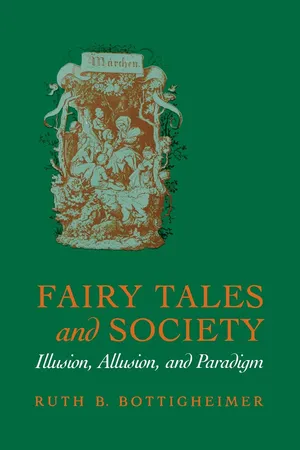
This collection of exemplary essays by internationally recognized scholars examines the fairy tale from historical, folkloristic, literary, and psychoanalytical points of view. For generations of children and adults, fairy tales have encapsulated social values, often through the use of fixed characters and situations, to a far greater extent than any other oral or literary form. In many societies, fairy tales function as a paradigm both for understanding society and for developing individual behavior and personality.
A few of the topics covered in this volume: oral narration in contemporary society; madness and cure in the 1001 Nights; the female voice in folklore and fairy tale; change in narrative form; tests, tasks, and trials in the Grimms' fairy tales; and folklorists as agents of nationalism. The subject of methodology is discussed by Torborg Lundell, Stven Swann Jones, Hans-Jorg Uther, and Anna Tavis.
- 336 pages
- English
- ePUB (mobile friendly)
- Available on iOS & Android
eBook - ePub
About this book
Information
Part One
FAIRY TALES AS ORAL PHENOMENA
1. Oral Narration in Contemporary North America
Fairy tales, for both scholars and general readers alike, most often mean printed texts in books. Folklorists are aware that behind each printed text are hundreds of unrecorded tales by hundreds of traditional artists, with no single telling capturing the full potential of any story. Nonfolklorists, however, place far too much weight on a single text or at best a handful of variants, without giving much attention to the dynamics of oral context. Traditional tales were meant to be heard, not read, and exist in specific geographical, historical, and cultural settings. No traditional tale can be fully comprehended without some understanding of its vitality in these settings.
For the past few decades folklorists have examined traditional tales and tellers within specific tale-telling societies and have contributed greatly to our understanding of narrative traditions.1 However, scholarly attention has focused totally on traditional tales, tellers, and listeners. It is my intent here to expand this perspective to include what has been described popularly as “The storytelling revival,” a phenomenon of the past two decades. To provide a context for this “revival” I will briefly examine traditional narration in English only as it continues to exist in some rural areas of North America, as well as the nontraditional urban storytelling that preceded and continues to exist along with revivalist storytelling. This is unexplored territory, a new continent whose coastline can only begin to be described here. My hope is that other scholars, folklorists and nonfolklorists, will see the value in including contemporary tale-telling in their various examinations of the Märchen.
This article has had many retellings since its oral delivery in March 1984. I have particularly welcomed the comments of Ruth B. Bottigheimer, John Harrell, Margaret Mills, and Ruth Stotter, among others. Material on storytellers was gathered on the East Coast in 1982–83 when I had a leave of absence.
I will concentrate here on the process of narration rather than on the Märchen as a unique genre, but I emphasize that Märchen continue to exist alongside other narrative forms favored by traditional and nontraditional tellers. I am constantly surprised at the resistance I receive from students, listeners, and other scholars when I insist that Märchen are still very much alive (along with the other oral forms) beyond the printed page. I insist that anyone who studies Märchen with serious intent should be aware of their continuing oral vitality within known geographical and historical settings. I intend this essay, then, to provide a useful framework for anyone attempting an examination of Märchen or of oral tale-telling.
To clarify the literary and verbal artistry of traditional tales and tellers, I will briefly examine four key folkloric studies offering complementary approaches. The earliest of these is Max Lüthi’s literary and philosophic work, The European Folktale: Form and Nature, which explores the traditional Märchen as a unique form of human expression. Lüthi challenges folklorists by insisting that the full power of the Märchen lies in the text itself, without reference to either individual narrators or specific storytelling communities:
Although in many ways, like everything human, the folktale is to be interpreted historically, I have preferred to search for its lasting truths. Today more than ever I am convinced that, despite increased interest in the functions of tales and in what has been called folktale biology, the tales themselves merit the greatest attention, just as always. Even though much is clarified by their context, the texts themselves take on an ever new life with the passage of time. They speak to all kinds of people and to widely separated generations; they speak in terms that sometimes differ and yet in many ways remain the same. Only a small part of the secret and the fascination of folktales can be grasped by research into the present-day context of their performance in days past. The secret of the folktale resides essentially in its message, structure and style.2
Lüthi’s careful examination of oral tales in print explains the continuing vitality of old tales in today’s world of written literature.
Linda Dégh’s study of Hungarian peasant narrators presents traditional tales in their oral and social contexts.3 In another article on this contextual approach, termed “the biology of storytelling” by folklorists, Dégh insists on the necessity of looking at tales as they actually live for the people who tell and listen.
“Biology” indicates a significant switch of focus in scholarship, from text to context. The term signals a change in concentration from the static view of artificially constructed and isolated oral narrative sequences, to the dynamics of telling and transmitting stories from person to person and from people to people, through means of direct contact, interaction, and resulting processes responsible for the formation and continual recreation of narratives.4
Another classic study of oral material in context, Albert Lords The Singer of Tales, examines the ways in which traditional narratives are learned, practiced, performed, and received.5 Based on the Yugoslav heroic epic, his observations are nonetheless relevant to other narrative forms, particularly the complex Märchen. Like Dégh, Lord concentrates on the actual existence of oral narratives in specific communities, and like Lüthi he is interested in the artistic and historic merits of specific texts. He is also aware of the misunderstandings literate societies impose on oral creativity.
A culture based upon the printed book, which has prevailed from the Renaissance until lately, has bequeathed to us — along with its immeasurable riches — snobberies which ought to be cast aside. We ought to take a fresh look at tradition, considered not as the inert acceptance of a fossilized corpus of themes and conventions, but as an organic habit of re-creating what has been received and is handed on. It may be that we ought to re-examine the concept of originality, which is relatively modern as a shibboleth of criticism; there may be other and better ways of being original than that concern for the writer’s own individuality which characterizes so much of our self-conscious fiction.6
Taken together, these three works are indispensable to a full understanding of traditional narratives as forms of artistic, social, and personal expression. A fourth and more recent work, Richard Bauman’s Verbal Art as Performance, is even more immediately relevant to the subject of oral narration.7 Bauman emphasizes the necessity of viewing verbal arts in actual performance as well as in broad social contexts. He defines performance flexibly enough to cover the various aspects of verbal creativity addressed here, and I will refer to it throughout this essay.
Fundamentally, performance as a mode of spoken verbal communication consists in the assumption of responsibility to an audience for a display of communicative competence. This competence rests on the knowledge and ability to speak in socially appropriate ways.8
While in a broad sense his definition could also be applied to nontraditional arts such as drama or opera, he expands on the essential quality of verbal material as ever-changing rather than static, as in dramatic scripts or literary texts.
The emergent quality of performance resides in the interplay between communicative resources, individual competence, and the goals of the participants, within the contexts of particular situations. We consider as resources all those aspects of the communication system available to the members of a community for the conduct of performance.9
Bauman includes with his theoretical statements texts and textual analysis by folklorists and anthropologists working in many world cultures. Thus he combines the considerations expressed by Lüthi, Dégh, and Lord. These works and others are familiar to traditional narrative scholars but are generally not so familiar either to those studying texts alone (as in literary and psychological studies) or to those writing about nontraditional storytelling.10 Folklorists, in devoting their attention to traditional narration alone, have not considered other forms of nontraditional storytelling found today in schools and libraries and at concerts and festivals.11
Oral narration of both traditional and nontraditional stories is carried on in three broad public contexts in North America today:12 among traditional storytellers in predominantly rural communities such as the maritime provinces of Canada and the mountains of the southern United States, among nontraditional storytellers in predominantly urban school classrooms and libraries, and among “neotraditional” storytellers in concerts and festivals in both urban and rural areas. Traditional storytellers (excluding native Americans) were active from the beginnings of European settlement here, nontraditional urban storytellers since about the 1870s, and neo-traditional storytellers since the late 1960s. The term neo-traditional is deliberately paradoxical since these storytellers, despite their recent emergence, blend old and new in challenging ways.
Within each of these contexts storytellers learn and perform their tales differently, and the listeners receive them differently. I am more interested in the connections than the differences and will illustrate how storytellers, tales, and performances interweave in North America today.
Traditional Oral Narration
Folklore scholarship reveals that oral tales are the products of chains of individual, though usually anonymous, narrators. In the sense that each verbal artist contributes to any single tale, this literature can be regarded as a communally created product. We should remember that this communal creativity is not superorganic, not some mystical concept suspended above human culture, but can only come into being when actual people retell actual tales. The first people to retell tales on this continent were native Americans, for whom tale-telling continues to provide a body of oral literature. Other ethnic and racial groups, notably black Americans, also continue the active recreation of their traditional literature. Much of this literature — native American, ethnic, black American — has been gathered in published collections available for use by storytellers from any background.13 In fact, these traditions are extensive enough to deserve complete attention, and the scope of this essay is too narrow to do them justice here. Hence most of my remarks are relevant to tales and tale-telling adapted to this continent from the traditions of the British Isles.14
Much popular and scholarly attention centers on storytelling in the southern mountains. In two compilations of reworked tales from North Carolina by Richard Chase, for example, we meet storytellers whose tales can be traced to ancestors alive in the 1700s.15 The descendents of one such family, Ray Hicks, Stanley Hicks, and Hattie Presnell, are still performing today. Another contribution, Marie Campbell’s descriptions of tellers, tales, and community, was inspired by her years as a school teacher in the Kentucky mountains.16
Within tale-telling communities such as these, tellers learn tales in the same way that they learn language, as part of a holistic complex of cultural expression. Tale texts are not isolated, consciously memorized, and formally performed. Instead they are gradually learned and absorbed through watching, listening, and imitating. Traditional tellers with the opportunity of hearing a variety of tellers and tales over long periods develop a flexible concept of verbal creativity quite different from our perceptions of a story as a fixed text. They also learn, by observing many different narrative styles and techniques, to balance between the traditional limitations of old tales and their own individuality in reinterpreting them. As Parry and Lord have emphasized, such creativity is never static and is capable of recreating not only old stories but also new tales based on traditional models.17 It is precisely this flexibility that allowed traditional European tales to find new roots in North America.
Unlike in other parts of the world where tale-telling was sometimes limited to specific times of the day or the year, in North America storytelling could take place any time, at any place, for anyone, and for any length of time.18 Teller and listeners tacitly determined what, for that moment, was socially appropriate. The precise wording and length of any given tale was in a constant state of emergence throug...
Table of contents
- Cover
- Title Page
- Copyright
- Contents
- Preface
- Introduction
- Part One: Fairy Tales as Oral Phenomena
- Part Two: Fairy Tales in Society
- Part Three: Fairy Tale Research Today
- Contributors
- Index
Trusted by 375,005 students
Access to over 1.5 million titles for a fair monthly price.
Study more efficiently using our study tools.
Frequently asked questions
Yes, you can cancel anytime from the Subscription tab in your account settings on the Perlego website. Your subscription will stay active until the end of your current billing period. Learn how to cancel your subscription
No, books cannot be downloaded as external files, such as PDFs, for use outside of Perlego. However, you can download books within the Perlego app for offline reading on mobile or tablet. Learn how to download books offline
We are an online textbook subscription service, where you can get access to an entire online library for less than the price of a single book per month. With over 1.5 million books across 990+ topics, we’ve got you covered! Learn about our mission
Look out for the read-aloud symbol on your next book to see if you can listen to it. The read-aloud tool reads text aloud for you, highlighting the text as it is being read. You can pause it, speed it up and slow it down. Learn more about Read Aloud
Yes! You can use the Perlego app on both iOS and Android devices to read anytime, anywhere — even offline. Perfect for commutes or when you’re on the go.
Please note we cannot support devices running on iOS 13 and Android 7 or earlier. Learn more about using the app
Please note we cannot support devices running on iOS 13 and Android 7 or earlier. Learn more about using the app
Yes, you can access Fairy Tales and Society by Ruth B. Bottigheimer in PDF and/or ePUB format, as well as other popular books in Social Sciences & Folklore & Mythology. We have over 1.5 million books available in our catalogue for you to explore.