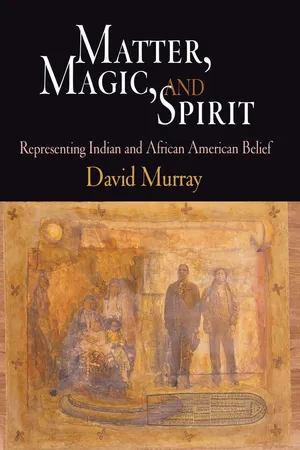
The spiritual and religious beliefs and practices of Native Americans and African Americans have long been sources of fascination and curiosity, owing to their marked difference from the religious traditions of white writers and researchers. Matter, Magic, and Spirit explores the ways religious and magical beliefs of Native Americans and African Americans have been represented in a range of discourses including anthropology, comparative religion, and literature. Though these beliefs were widely dismissed as primitive superstition and inferior to "higher" religions like Christianity, distinctions were still made between the supposed spiritual capacities of the different groups.
David Murray's analysis is unique in bringing together Indian and African beliefs and their representations. First tracing the development of European ideas about both African fetishism and Native American "primitive belief," he goes on to explore the ways in which the hierarchies of race created by white Europeans coincided with hierarchies of religion as expressed in the developing study of comparative religion and folklore through the nineteenth century. Crucially this comparative approach to practices that were dismissed as conjure or black magic or Indian "medicine" points as well to the importance of their cultural and political roles in their own communities at times of destructive change.
Murray also explores the ways in which Indian and African writers later reformulated the models developed by white observers, as demonstrated through the work of Charles Chesnutt and Simon Pokagon and then in the later conjunctions of modernism and ethnography in the 1920s and 1930s, through the work of Zora Neale Hurston, Zitkala Sa, and others. Later sections demonstrate how contemporary writers including Ishmael Reed and Leslie Silko deal with the revaluation of traditional beliefs as spiritual resources against a background of New Age spirituality and postmodern conceptions of racial and ethnic identity.
- 224 pages
- English
- ePUB (mobile friendly)
- Available on iOS & Android
eBook - ePub
About this book
Information
Publisher
University of Pennsylvania PressYear
2013Print ISBN
9780812239966
9780812239966
eBook ISBN
9780812202878
Topic
Teología y religiónSubtopic
Religión comparadaChapter 1
Hierarchies of Race and Religion: Fetishism, Totemism, Manitou, and Conjure
This chapter explores the ways in which ideas of what came to be called primitive religion were informed by underlying assumptions about established hierarchies of religion and race. The increasing systematization of race and of religion through the eighteenth and nineteenth centuries meant that the ability to describe and understand not just what but how other races believed became an important concern. This was important not only to the larger classificatory enterprises of anthropology and comparative religion but also to the more widespread fixing of inferior races on a political and religious scale, which reflected the existing social and racial hierarchies. One way of exploring these hierarchies is to look closely at a number of key terms used to describe forms of belief and trace their changing uses. I begin with the most generally influential term, “fetish,” and then relate this to other terms more specific to America, particularly “totem,” “Manitou,” “conjure,” and “hoodoo,” tracing their careers as concepts, and their relation to the particular racial configurations in America involving Indians and African Americans.
The concepts of fetishism and totemism in particular emerged as products of multiple cultural and linguistic conversions of value, rather than as descriptions of any actual system of indigenous primitive practice or belief, and then became crucial instruments in the development of ideas about primitive religion. In this chapter, after outlining the origins of the idea of fetishism in the eighteenth century, and moving through its employment in the discourses of anthropology and religion in the nineteenth, I focus on its use in the different characterization of Indians and African Americans in America. The development of the idea of totemism, though less documented, has a parallel and to some extent complementary career to that of fetishism in the way that it is adapted and extended by a whole set of discourses beyond anthropology, while becoming most associated in the United States with Native American cultures far distant from its Ojibwa origins. Although linked from the beginning with African fetishism, Native American beliefs were nevertheless progressively distanced in later accounts from what was seen as the base materiality of African practices. I argue that the particular “spirituality” that became associated with Indians and is still evident in New Age versions needs to be seen in relation both to a persistent hierarchy of religious beliefs and to assumptions about the differential mental and spiritual capacities of Indians and African Americans. These combined forces were enough to place African American folk practices, like conjure, below what came to be presented as Indian religion.
The word “fetish” developed out of a term used on the Guinea coast by Portuguese traders and Africans and was applied to a wide range of objects of economic as well as religious value or importance before it was elevated into the concept of fetishism by Charles de Brosses in the eighteenth century. It was then employed through the nineteenth century as a key concept in formulating ideas of a primitive or original form of religious belief that could be contrasted with that of the West. Before this, the false ascription of magical or religious power to objects had been conceptualized in Christian writings through the idea of idolatry, but fetishism reflected a new configuration, which was about civilization and progress as well as Christianity. Enlightenment interests in primitive beliefs began to focus not on questions of true or false worship but on the progression from polytheism to monotheism. The idea of fetishism played an important role here in focusing attention on states of mind rather than on the question of religious validity, which was always implicit in the term “idolatry.”
Though by the late nineteenth century the term was already becoming superseded or rejected in anthropology, the idea of fetishism has continued to have a curious half-life. Its general use to describe a false ascription of special value to some undeserving material thing has made it a useful term in the skeptical questioning of all sorts of objects and systems of value. It is in this role that it was taken up in the discourses of Marxism and psychoanalysis, where, as well as in the area of art criticism, it is mainly found today.1 In the context of religion it represents the importance of a stubborn materiality and that materiality’s relation to the spiritual or transcendent categories claimed by the “higher” religions. Fetishism was to be found in folk belief as well as in the belief of those groups who were the targets of conversion, but as it became systematized in the eighteenth and nineteenth centuries, it took its place as the lowest point in a hierarchy of beliefs, which were, of course, racialized. Contemporary “primitive” people of certain races were lumped with “our” ancestors as examples of a mentality that was mired in materiality and was without the capacity for abstraction and spiritual awareness to be found in advanced peoples.
What this account leaves out, though, and what William Pietz’s genuinely groundbreaking work on the development of the term itself draws attention to is the way that the fetish and fetishism are products of a situation of cross-cultural economic, cultural, and religious exchanges. Fetishism is an idea about materiality that has its own material base, and to understand its persistent role as a point of misrecognition and disavowal, we need therefore to see its full historical dimensions. Pietz insists on the etiology of the term as itself a product of exchange and hybridity.2 The term crosses over from the use of the term feitico (stemming from the Latin facticius) by Portuguese sailors to describe their own culture’s witchcraft or magic, to a pidgin form, fetisso, which seems to have become used to describe something of value, both religious and commercial. The term is then reused by the Portuguese, and then everyone else, to apply to what is falsely described as the particular form of worship of objects found on the Guinea coast, as if it were an African word.
Pietz argues that it is in this space where several different systems of value meet—Christian feudal, African lineage and merchant capital—that the fetish emerges to point to “the capacity of the material object to embody—simultaneously and sequentially—religious, commercial, aesthetic, and sexual values.”3 Pietz’s detailed treatment of the West African origins is invaluable, as are his later accounts of the operation of the term in other colonial contexts and in later Marxist discourse. Nevertheless, his account of the development of the term gives little sense of the more complex racial categories, which involved America as well as Africa, and I want therefore in this chapter to open up the question of the differential and comparative use of races and cultures and show how this affects the use of the idea of fetishism in America. This involves a set of distinctions between the religious practices of Indians and African Americans, which reflected a larger set of key oppositions that includes purity versus pollution or mixedness, and spiritual versus material, which will be explored in the course of the book.
When in 1760 Charles de Brosses published his Du Culte des dieux fétiches, ou parallèle de l’ancienne religion de l’Égypte avec la religion actuelle de Nigritie in Paris, he drew upon a wide range of scholarly and travel writings from Africa and the Americas, as well as from antiquity. As the title suggests, his book was part of a larger comparativist impulse of the time,4 but what was new was the creation of a whole new category and its application across time and across cultures. The word “fetish” in different forms had been present in travel accounts and descriptions since the sixteenth century, when it was used as a description of a number of different objects and practices developing, like the pidgin fetisso, out of the interchanges between Portuguese traders and Africans on the coast of West Africa. The Dutch traveler William Bosman, for instance, describes the Africans, when about to “make offerings to their Idols,” crying out “Let us make Fetiche; by which they express as much, as let us perform our Religious Worship.” These offerings, he says, are made to bring good fortune or inflict evil on others.5
Bosman and other commentators actually acknowledge in their accounts a range of practices and beliefs among the Africans, including a belief in more abstract or overarching deities, but the assumption of the Africans’ limited mental capacities means that the more abstract ideas are often put down to Christian influence, and the Africans are made to represent just the early stages of mental development. John Atkins, in 1734, anticipating de Brosses, describes the first stages of belief, in which, unable to reach above a “material God,” people worshipped the equivalent of “the Fetishes of the Negroes,” namely “Stocks, Stones, Serpents, Calves, Onions, Garlick, &c.”6 This sense of the random and worthless nature of the things that are worshipped is also found in Bosman’s description. “They have a great Wooden Pipe filled with Earth, Oil, Blood, the Bones of dead Men and Beasts, Feathers, Hair; and to be short, all sorts of Excrementitious and filthy Trash, which they do not endeavour to mould into any Shape, but lay it in a confused heap in the Pipe.”7
De Brosses extends this idea of the fetish as the most basic form of belief to other places and peoples and thereby creates the category of fetishism. At first sight, the term as de Brosses uses it might not seem so different from the traditional usage of idolatry to describe the polytheistic worship of false gods. In David Hume’s Natural History of Religion of 1757, for instance, a work from which de Brosses borrowed extensively, Hume rejects the standard Christian view of idolatry as a falling away from an original revelation. In this view, humanity degenerated from an original monotheist belief in the true God to polytheism and worship of heathen gods, animals, and idols. In accounting for this degeneration, Christians saw polytheism, in Frank Manuel’s words, as “a bad habit which had slowly crept up on mankind.”8 Hume, on the other hand, begins with the idea of primitive human beings as locked in the physical and immediate and rejects the idea that we regressed from an original monotheism or original knowledge of the true God. This would be to believe of ancient people that “while they were ignorant and barbarous, they discovered truth, but fell into error as soon as they acquired learning and politeness…. We may as reasonably imagine, that men inhabited palaces before huts and cottages, or studied geometry before agriculture; as assert that the Deity appeared to them as a pure spirit, omniscient, omnipotent and omnipresent, before he was apprehended to be a powerful, though limited being with human passions and appetites, limbs and organs.”9 Underlying Hume’s thinking is the idea that even when humankind has progressed to monotheism, it is still driven by the same needs and fears, rather than by reason. He sees a fluctuation between idolatry and monotheism, between worshipping gods and a single god, rather than a steady progression—what he calls the “flux and reflux of polytheism and theism.”10
Hume’s cool treatment of religious sentiment not as a primary and fundamental part of humanity but as just a stage in humanity’s fitful struggle to overcome fear and to aspire to something more rational is ultimately corrosive of religion’s claim to centrality. As Moshe Halbertal and Avishai Margalit say more generally of Enlightenment critiques, “what the elite religion has done to the folk religions now revenges itself against the elite religion itself. The entire project of religion is now placed under suspicion of being idolatry, or false worship.”11 The fundamental concern with origins during this period carries through into the nineteenth century formulations of what comes to be called the primitive mind. The nature of Christian belief could be interrogated under the cover of an exploration of pagan or primitive belief, while the relation of that discredited conception of religion to Christianity itself could be left deliberately unarticulated.
But if de Brosses’ new formulation of fetishism was just an extension of Hume, what was the added dimension that the term offered that enabled it to be taken up so widely in the next century, and to have led such a strange career thereafter? William Pietz points to what he calls “the untranscended materiality of the fetish.”12 Building on this, my argument is that fetishism, as a theory about misrecognition and the false ascription of value or divinity to worthless things, itself embodies a process of misrecognition and disavowal. In the discourse of fetishism in the nineteenth century and even into the twentieth, there is first an insistence that there could be a primitive mental condition in which objects were worshipped as having power within themselves. Then, as soon as it is asserted, this idea of a belief in material power without spirit is seen as problematic and is replaced by the idea of a spirit behind or within matter, and a consequent denial that pure fetishism could ever have existed. Yet the term and the idea persist, only to be regularly denied. This pattern of disavowal is similar to the mechanism of the fetish in the psychoanalytic tradition, which follows the pattern “I know it isn’t (the woman’s body, the phallus, etc.) but even so….” More relevantly here, perhaps, it is also similar to the operation of religious symbols, which, as Henry Krips puts it, “signal the presence of the divine by the paradoxical device of admitting their own poverty of representation.”13 In other words, it transposes the tensions about representation and materiality that were previously played out within the idea of idolatry.
The Oxford English Dictionary tries to draw a clear distinction as follows: “A fetish differs from an idol in that it is worshipped in its own character, not as the image, symbol or occasional residence of a deity.” The trouble with this distinction is that the definition of “idol” is much more limited than that found in earlier discussions of idolatry, and in fact it is only with the invention of “fetishism” as an end term that “idol” can be restricted like this to describe representations of something else. Within the Christian discourse on idolatry there are two connected but distinct elements. Worship of a false god is wrong, but so is worshipping the image—or what one takes to be the image—of the true God, because the true God is impossible to represent.
We can find a detailed discussion of this in Joseph de Acosta’s early seventeenth-century account of Indian worship. In spite of the original light offered by knowledge of the true God, he tells us, these people have been led astray by false worship, and he is at pains to distinguish between different forms of idolatry, “the one grounded uppon naturall things, the other upon things imagined and made by man’s invention.” The first form, the worship of natural features, such as hills and stones, marked out by singular features is found particularly in Peru, whereas the second is found among the Aztecs and is “more pernicious and hurtfull then that of the Yncas, … for that the greatest part their adoration and idolatrie was employed to Idols, and not to naturall things.”14
The distinction here is between what is made by God and what is made by men, and clearly in this Christian view something made by man cannot be worthy of worship. The worst idolators, then, are “those that worship Images and figures made by the hand of men, which have nothing else in them but to be of wood, stone, or metall, and of such forme as God hath given them.” Acosta’s...
Table of contents
- Cover
- Title
- Copyright
- Contents
- Introduction
- 1. Hierarchies of Race and Religion: Fetishism, Totemism, Manitou, and Conjure
- 2. Superstition and Progress
- 3. Primitivism, Modernism, and Magic
- 4. Black Arts: Conjure and Spirit
- 5. The Return of the Fetish
- Notes
- Bibliography
- Index
- Acknowledgments
Trusted by 375,005 students
Access to over 1.5 million titles for a fair monthly price.
Study more efficiently using our study tools.
Frequently asked questions
Yes, you can cancel anytime from the Subscription tab in your account settings on the Perlego website. Your subscription will stay active until the end of your current billing period. Learn how to cancel your subscription
No, books cannot be downloaded as external files, such as PDFs, for use outside of Perlego. However, you can download books within the Perlego app for offline reading on mobile or tablet. Learn how to download books offline
We are an online textbook subscription service, where you can get access to an entire online library for less than the price of a single book per month. With over 1.5 million books across 990+ topics, we’ve got you covered! Learn about our mission
Look out for the read-aloud symbol on your next book to see if you can listen to it. The read-aloud tool reads text aloud for you, highlighting the text as it is being read. You can pause it, speed it up and slow it down. Learn more about Read Aloud
Yes! You can use the Perlego app on both iOS and Android devices to read anytime, anywhere — even offline. Perfect for commutes or when you’re on the go.
Please note we cannot support devices running on iOS 13 and Android 7 or earlier. Learn more about using the app
Please note we cannot support devices running on iOS 13 and Android 7 or earlier. Learn more about using the app
Yes, you can access Matter, Magic, and Spirit by David Murray in PDF and/or ePUB format, as well as other popular books in Teología y religión & Religión comparada. We have over 1.5 million books available in our catalogue for you to explore.