The seemingly unlimited reach of powerful biotechnologies and the attendant growth of the multibillion-dollar industry have raised difficult questions about the scientific discoveries, political assumptions, and cultural patterns that gave rise to for-profit biological research. Given such extraordinary stakes, a history of the commercial biotechnology industry must inquire far beyond the predictable attention to scientists, discovery, and corporate sales. It must pursue how something so complex as the biotechnology industry was born, poised to become both a vanguard for contemporary world capitalism and a focal point for polemic ethical debate.
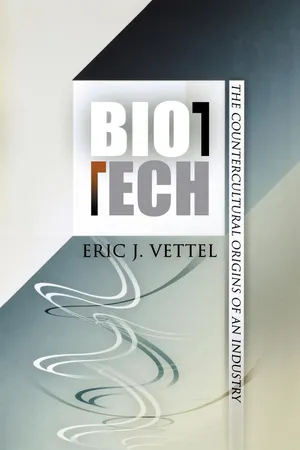
In Biotech, Eric J. Vettel chronicles the story behind genetic engineering, recombinant DNA, cloning, and stem-cell research. It is a story about the meteoric rise of government support for scientific research during the Cold War, about activists and student protesters in the Vietnam era pressing for a new purpose in science, about politicians creating policy that alters the course of science, and also about the release of powerful entrepreneurial energies in universities and in venture capital that few realized existed. Most of all, it is a story about people—not just biologists but also followers and opponents who knew nothing about the biological sciences yet cared deeply about how biological research was done and how the resulting knowledge was used.
Vettel weaves together these stories to illustrate how the biotechnology industry was born in the San Francisco Bay area, examining the anomalies, ironies, and paradoxes that contributed to its rise. Culled from oral histories, university records, and private corporate archives, including Cetus, the world's first biotechnology company, this compelling history shows how a cultural and political revolution in the 1960s resulted in a new scientific order: the practical application of biological knowledge supported by private investors expecting profitable returns eclipsed basic research supported by government agencies.
- 296 pages
- English
- ePUB (mobile friendly)
- Available on iOS & Android
eBook - ePub
About this book
Information
Notes
Preface
1. I do not mean to imply that sociological studies of science are unimportant or lack significance, only that a study that places the organization and output of bioscience research in historical context can be equally productive, even informative for such studies. A substantial body of literature on the sociology of science has accumulated in recent years, and spans a wide spectrum of analytic frameworks. Some have borrowed from E. P. Thompson's celebrated essay on eighteenth-century bread-riots to argue that a particular “moral economy” informed the organization of basic and applied bioscience research in the San Francisco Bay Area. The complex set of relations between bioscientists at all three research universities reveals a set of unstated customs and traditions, or, “moral economies.” Certainly, the language of basic and applied bioscience research emerged out of individual investigator's own efforts to describe their work. But it also emerged because it offered real advantages within a highly competitive research environment (Steven Shapin, “The House of Experiment in Seventeenth-Century England,” Isis 79 (1988), 373–404). Others disregard questions of power in the experimental workplace and instead conduct ethnographies of laboratory life. Commonly referred to as “production-oriented” studies, these historians, philosophers, and sociologists of science have shown quite convincingly a powerful relationship between scientists' experimental behavior and epistemologies of scientific knowledge. For instance, in his study of Drosophila geneticists, Robert Kohler has shown how the organization of laboratory research promotes distinctive workplace cultures, and how this culture in turn shapes experimental outcomes (Robert Kohler, Lords of the Fly (Chicago, 1994]). At the same time, scholars such as Daniel Greenberg have shown how political decisions and public policy shapes the organization of scientific research (Daniel Greenberg, The Politics of Pure Science (New York, 1971). For more studies of the curious sociological underpinnings of science and the scientific community, see Bruno Latour and Steve Woolgar, Laboratory Life: The Social Construction of Scientific Facts (Beverly Hills, 1979); Andrew Pickering, ed., Science as Practice and Culture (Chicago, 1992); and Karen Knorr-Cetina, “Tinkering Toward Success: Prelude to a Theory of Scientific Practice,” Theory and Society 8 (1979), 347–76.
2. Among many articles in Science on the subject of pure and applied research, see Michael Reagan, “Basic and Applied Research: A Meaningful Distinction?” Science, 17 Mar. 1967, 1383–84. For the article that initiated the debate, see R. E. Marshak, “Basic Research in the University and Industrial Laboratory,” Science, 23 Dec. 1966, 1521–22.
3. Albert Einstein, quoted by Reagan, “Basic and Applied: A Meaningful Distinction?” 1383–84. For an example of a comparative study between bioscience disciplines, such as naturalist and molecular biology, see Joel Hagen, “Naturalist, Molecular Biologists, and the Challenges of Molecular Evolution,” Journal of the History of Biology 32 (1999), 321–41.
Chapter 1. The Setting, 1946…
1. Michael Malone, The Big Score (New York, 1985).
2. David Hounshell and John Kenly Smith, Science and Corporate Strategy, Du Pont, 1902–1980 (Cambridge, 1995), 366; Louis Galambos and Jane Sewell, Networks of Innovation (Cambridge, 1995).
3. Stanford Daily, 7 Nov. 1958, 3; Rebecca Lowen, Creating the Cold War University (Berkeley, 1997); Vettel, “Research Life” (Ph.D. diss., 2003), ch. 1.
4. Clark Kerr, The Gold and the Blue: A Personal Memoir of the University of California, 1949–1967, vol. 1 (Berkeley, 2001), 29 and 56–59.
5. Warren Weaver's diary, 14 Nov. 1947, RG 1.2, 205D, box 7, file 49, RAC; Kerr, The Gold and the Blue, 83–84.
6. Richard C. Atkinson, “Robert Gordon Sproul,” California Journal (Nov. 1999), 1; Kerr, The Gold and the Blue, 16–22.
7. Angela Creager, “Wendell Stanley's Dream of a Free-Standing Biochemistry Department at the University of California, Berkeley,” JHB 29 (1996), 331–60.
8. Robert Kohler, From Medical Chemistry to Biochemistry (Cambridge, 1982), 158–65, 288, 334.
9. Creager, “Wendell Stanley's Dream of a Free-Standing Biochemistry Department.”
10. Angela Creager, The Life of a Virus (Chicago, 2002), 47–50.
11. Sally Smith Hughes, The Virus: A History of the Concept (New York, 1977), 89–90; Stanley used this phrase repeatedly in his public correspondence, in BANC, Wendell Stanley Papers, MSS 78/18 c, file: “Correspondence.”
12. Wendell M. Stanley, “Isolation of Crystalline Protein Possessing the Properties of Tobacco-Mosaic Virus,” Science (81 (1935, 644–45; Barclay M. Newman, “Giant Molecules: The Machinery of Inheritance,” Scientific American 158 (1938), 337; George Corner, History of the Rockefeller Institute, 320; Michel Morange, A History of Molecular Biology (Cambridge, 1998), 62–65. Kay, A Molecular Vision of Life, 111.
13. President Sproul to Stanley, 20 Jan. 1947; Office of the Dean of the Graduate Division to President Sproul, 30 July 1946: all in BANC, 420/Bio-chem, Berkeley: Office of the Dean of the Graduate Division, file: Correspondence.
14. Loomis diary, 17 Apr. 1950, box 7, file 49, RG 1.2, 205D, RAC; “All This and 2.0 Too,” Daily Californian, 25 Oct. 1948, 12.
15. President Sproul to Stanley, 20 Jan. 1947; Office of the Dean of the Graduate Division to President Sproul, 30 July 1946: all in BANC, 420/Bio-chem, Berkeley: Office of the Dean of the Graduate Division, file: Correspondence.
Chapter 2. Patronage and Policy
Note to epigraphs: Warren Weaver, “Free Science,” Science and Imagination (New York, 1967), 10–14, quoting Weaver, “Free Science,” New York Times, 1945; Stephen Strickland, The Story of the NIH Grants Program (New York, 1989), 32.
1. For example, see Pnina Abir-Am, “The Discourse of Physical Power and Biological Knowledge in the 1930s: A Reappraisal of the Rockefeller Foundation's ‘Policy’ in Molecular Biology,” Soc. Stud. Sci. 12 (1982), 341–82; Robert Kohier, Partners in Science: Foundations and Natural Scientists, 1900–1945 (Chicago, 1991); John A. Fuerst, Ditta Bartels, Robert Olby, et al., “Responses and Replies to P. Abir-Am: Final Response of P. Abir-Am,” Soc. Stud. Sci. 14 (1984), 225–63; Lily Kay, The Molecular Vision of Life (Oxford, 1993).
2. David Hollinger notices a similar trend, but from a slightly different vantage point: “cultural change [toward scientific autonomy] was a mediated…contingent, historically specific…transition from Protestant culture to pluralism,” due in large part to the increase of Jewish professors in American universities following World War II. (David Hollinger, Science, Jews and Secular Culture [Princeton, 1996], 15, 21).
3. Frederick Rudolph, The American College and University: A History (New York, 1965, reprint), ch. 9; Robert Kohler, “Science, Foundations, and American Universities in the 1920s,” OSIRIS, 2nd series (1987), 137.
4. According to Oliver Zunz, the Rockefeller Foundation served as a centerpiece for America's “institutional matrix.” Zunz, Why the American Century? (Chicago, 1998); Albert F. Schenkel, The Rich Man and the Kingdom: John D. Rockefeller, Jr., and the Protestant Establishment (Minneapolis, 1995); and Peter Collier and David Horowitz, The Rockefellers: An American Dynasty (New York, 1977). For an excellent discussion of the Rockefeller Foundation and its support of the biological sciences at CalTech, see Kay, The Molecular Vision of Life, B. D. Karl and S. N. Katz, “The American Private Philanthropic Foundation and the Public Sphere, 1890–1930,” Minerva 19, no. 2 (summer 1981), 238; and Kohler, “Science, Foundations and the American Universities,” 3.
5. Peter Kuznick, Beyond the Laboratory (Chicago, 1987), 46–48 and ch. 2; Daniel Kevles, The Physicists (Cambridge, 1995), 237–38.
6. Kay, The Molecular Vision of Life, 42–44 and ch. 3; Kohler, “Science, Foundations and the American Universities”; Schenkel, The Rich Man.
7. The Rockefeller Foundation named its new vision, “Science of Man,” and Weaver was a frequent and outspoken advocate of this new direction (Kay, A Molecular Vision of Life, 45–50).
8. Michael Morange, A History of Molecular Biology, trans. M. Cobb, (Boston, 1998), 80–81.
9. Kay, Molecular Vision of Life, 49; Warren Weaver, “Molecular Biology, Origins of the Term,” Science (May 1938), 591–92.
10. Nathan Reingold, ed., The Sciences in the American Context: New Perspectives (Washington, D.C., 1979); Kay, Molecular Vision of Life, 48–50.
11. Warren Weaver (WW) interview of Stanley, Rockefeller Institute, Princeton, 14 Nov. 1947, in RAC, 205 D, 1.2, 205, 7, 49, file: UC, Virus Research (equipment, Wendell M. Stanley), 1947–1950.
12. Evaluation of grant RF 48132, 11/30–12/1/48, 1947–50, in RAC, 205 D, 1.2, 205, 7, 49, file: UC, Virus Research (equipment, Wendell M. Stanley).
13. BVL grant evaluation RF 52114, 20 June 1952; grant RF 48132, 30 Nov. 1948–1 Dec. 1948, both found in RAC, 205D, 1.2, 205, 7, 49, file: UC, Virus Research (Wendell M. Stanley), 1947–1950.
14. Rockefeller Foundation (RF) interviews of Stanley, including 14 Nov. 1947, in RAC, 205D, 1.2, 205, 7, 49, file: UC, Virus Research (equipment, Wendell Stanley), 1947–1950.
15. RF interview of Stanley, 14 Nov. 1947, in RAC, 205D, 1.2, 205, 7, 49, file: UC, Virus Research (equipment, Wendell Stanley), 1947–1950.
16. Stanley to WW, 8 Jan. 1948, in RAC, 205D, 1.2, 205, 7, 49, file: UC, Virus Research (equipment, Wendell Stanley), 1947–1950.
17. Weaver diary entry, 9 Jan. 1948, in RAC, 205D, 1.2, 205, 7, 49, file: UC, Virus Research (equipment, Wendell Stanley), 1947–1950; RS Morison to WW, 30 Jan. 1948, with WW 9 Jan. 1948 memo attached, in RAC, 205D, 1.2, 205, 7, 49, file: UC, Virus Research.
18. WW to Stanley, 10 Feb. 1948, in RAC, 205D, 1.2, 205, 7, 49, file: UC, Virus Research (equipment, Wendell Stanley), 1947–1950.
19. WW to RBF, 8 Mar. 1948, in RAC, 205D, 1.2, 205, 7, 49, file: UC, Virus Research (equipment, Wendell Stanley), 1947–1950.
20. Stanley to WW, 17 Sept. 1948, in RAC, 205D, 1.2, 205, 7, 49, file: UC, Virus Research (equipment, Wendell Stanley), 1947–1950.
21. Weaver's secretary, unknown, 15 Oct. 1948; Stanley to WW, 2 Nov. 1948; Weaver to Stanley, 9 Nov. 1948; WW to President Sproul, 8 Dec. 1948; WW diary entry, 25 Oct. 1950: all in RAC, 205D, 1.2, 205, 7, 49, file: UC, Virus Research (equipment, Wendell Stanley), 1947–1950.
22. Horace Judson, The Eighth Day of Creation (New York, 1979); see also Kay, Molecular Vision of Life.
23. The Rockefeller Foundation's initial positive reviews of the BVL strengthens Lily Kay's argument that Rockefeller patronage helped launch molecular biology, while Pnina Abir-Am's critique also seems appropriate because up-and-coming research programs such as the BVL found that...
Table of contents
- Cover Page
- Title Page
- Copyright Page
- Dedication Page
- Contents
- Preface
- The Setting, 1946…
- Patronage and Policy
- The Promise and Peril of the BVL
- The Ascent of Pure Research
- Research Life!
- A Season of Policy Reform
- Crossing the Threshold
- Cetus: History’s First Biotechnology Company
- Conclusion: An End…
- Notes
- Sources Consulted
- Index
Trusted by 375,005 students
Access to over 1.5 million titles for a fair monthly price.
Study more efficiently using our study tools.
Frequently asked questions
Yes, you can cancel anytime from the Subscription tab in your account settings on the Perlego website. Your subscription will stay active until the end of your current billing period. Learn how to cancel your subscription
No, books cannot be downloaded as external files, such as PDFs, for use outside of Perlego. However, you can download books within the Perlego app for offline reading on mobile or tablet. Learn how to download books offline
Perlego offers two plans: Essential and Complete
- Essential is ideal for learners and professionals who enjoy exploring a wide range of subjects. Access the Essential Library with 800,000+ trusted titles and best-sellers across business, personal growth, and the humanities. Includes unlimited reading time and Standard Read Aloud voice.
- Complete: Perfect for advanced learners and researchers needing full, unrestricted access. Unlock 1.5M+ books across hundreds of subjects, including academic and specialized titles. The Complete Plan also includes advanced features like Premium Read Aloud and Research Assistant.
We are an online textbook subscription service, where you can get access to an entire online library for less than the price of a single book per month. With over 1.5 million books across 990+ topics, we’ve got you covered! Learn about our mission
Look out for the read-aloud symbol on your next book to see if you can listen to it. The read-aloud tool reads text aloud for you, highlighting the text as it is being read. You can pause it, speed it up and slow it down. Learn more about Read Aloud
Yes! You can use the Perlego app on both iOS and Android devices to read anytime, anywhere — even offline. Perfect for commutes or when you’re on the go.
Please note we cannot support devices running on iOS 13 and Android 7 or earlier. Learn more about using the app
Please note we cannot support devices running on iOS 13 and Android 7 or earlier. Learn more about using the app
Yes, you can access Biotech by Eric J. Vettel in PDF and/or ePUB format, as well as other popular books in History & North American History. We have over 1.5 million books available in our catalogue for you to explore.