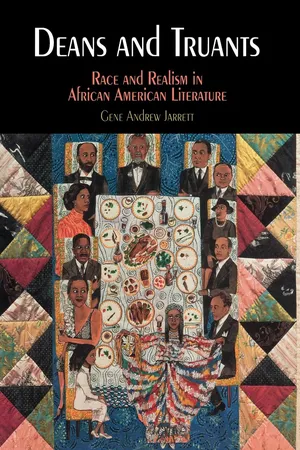
For a work to be considered African American literature, does it need to focus on black characters or political themes? Must it represent these within a specific stylistic range? Or is it enough for the author to be identified as African American? In Deans and Truants, Gene Andrew Jarrett traces the shifting definitions of African American literature and the authors who wrote beyond those boundaries at the cost of critical dismissal and, at times, obscurity. From the late nineteenth century to the end of the twentieth, de facto deans—critics and authors as different as William Howells, Alain Locke, Richard Wright, and Amiri Baraka—prescribed the shifting parameters of realism and racial subject matter appropriate to authentic African American literature, while truant authors such as Paul Laurence Dunbar, George S. Schuyler, Frank Yerby, and Toni Morrison—perhaps the most celebrated African American author of the twentieth century—wrote literature anomalous to those standards.
Jarrett explores the issues at stake when Howells, the "Dean of American Letters," argues in 1896 that only Dunbar's "entirely black verse," written in dialect, "would succeed." Three decades later, Locke, the cultural arbiter of the Harlem Renaissance, stands in contrast to Schuyler, a journalist and novelist who questions the existence of a peculiarly black or "New Negro" art. Next, Wright's 1937 blueprint for African American writing sets the terms of the Chicago Renaissance, but Yerby's version of historical romance approaches race and realism in alternative literary ways. Finally, Deans and Truants measures the gravitational pull of the late 1960s Black Aesthetic in Baraka's editorial silence on Toni Morrison's first and only short story, "Recitatif."
Drawing from a wealth of biographical, historical, and literary sources, Deans and Truants describes the changing notions of race, politics, and gender that framed and were framed by the authors and critics of African American culture for more than a century.
- 232 pages
- English
- ePUB (mobile friendly)
- Available on iOS & Android
eBook - ePub
About this book
Information
Publisher
University of Pennsylvania PressYear
2013Print ISBN
9780812239737
9780812239737
eBook ISBN
9780812202359
Table of contents
- Cover
- Title
- Copyright
- Contents
- Introduction: The Problem of Mrican American Literature
- Chapter 1. “Entirely Black Verse from Him Would Succeed”
- Chapter 2. “We Must Write Like the White Men”
- Chapter 3. “The Conventional Blindness of the Caucasian Eye”
- Chapter 4. “The Impress of Nationality Rather than Race”
- Chapter 5. “A Negro Peoples’ Movement in Writing”
- Chapter 6. “The Race Problem Was Not a Theme for Me”
- Chapter 7. “A World-in-Which-Race-Does-Not-Matter”
- Notes
- Index
- Acknowledgments
Trusted by 375,005 students
Access to over 1.5 million titles for a fair monthly price.
Study more efficiently using our study tools.
Frequently asked questions
Yes, you can cancel anytime from the Subscription tab in your account settings on the Perlego website. Your subscription will stay active until the end of your current billing period. Learn how to cancel your subscription
No, books cannot be downloaded as external files, such as PDFs, for use outside of Perlego. However, you can download books within the Perlego app for offline reading on mobile or tablet. Learn how to download books offline
Perlego offers two plans: Essential and Complete
- Essential is ideal for learners and professionals who enjoy exploring a wide range of subjects. Access the Essential Library with 800,000+ trusted titles and best-sellers across business, personal growth, and the humanities. Includes unlimited reading time and Standard Read Aloud voice.
- Complete: Perfect for advanced learners and researchers needing full, unrestricted access. Unlock 1.5M+ books across hundreds of subjects, including academic and specialized titles. The Complete Plan also includes advanced features like Premium Read Aloud and Research Assistant.
We are an online textbook subscription service, where you can get access to an entire online library for less than the price of a single book per month. With over 1.5 million books across 990+ topics, we’ve got you covered! Learn about our mission
Look out for the read-aloud symbol on your next book to see if you can listen to it. The read-aloud tool reads text aloud for you, highlighting the text as it is being read. You can pause it, speed it up and slow it down. Learn more about Read Aloud
Yes! You can use the Perlego app on both iOS and Android devices to read anytime, anywhere — even offline. Perfect for commutes or when you’re on the go.
Please note we cannot support devices running on iOS 13 and Android 7 or earlier. Learn more about using the app
Please note we cannot support devices running on iOS 13 and Android 7 or earlier. Learn more about using the app
Yes, you can access Deans and Truants by Gene Andrew Jarrett in PDF and/or ePUB format, as well as other popular books in Literature & North American Literary Criticism. We have over 1.5 million books available in our catalogue for you to explore.