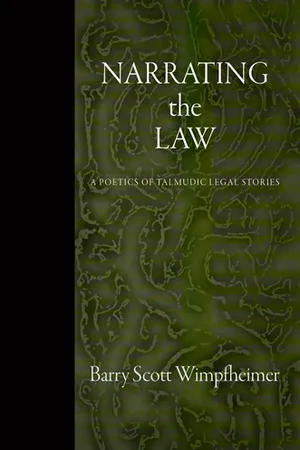
In Narrating the Law Barry Scott Wimpfheimer creates a new theoretical framework for considering the relationship between law and narrative and models a new method for studying talmudic law in particular.
Works of law, including the Talmud, are animated by a desire to create clear usable precedent. This animating impulse toward clarity is generally absent in narratives, the form of which is better able to capture the subtleties of lived life. Wimpfheimer proposes to make these different forms compatible by constructing a narrative-based law that considers law as one of several "languages," along with politics, ethics, psychology, and others that together compose culture. A narrative-based law is capable of recognizing the limitations of theoretical statutes and the degree to which other cultural languages interact with legal discourse, complicating any attempts to actualize a hypothetical set of rules. This way of considering law strongly resists the divide in traditional Jewish learning between legal literature (Halakhah) and nonlegal literature (Aggadah) by suggesting the possibility of a discourse broad enough to capture both. Narrating the Law activates this mode of reading by looking at the Talmud's legal stories, a set of texts that sits uncomfortably on the divide between Halakhah and Aggadah. After noticing that such stories invite an expansive definition of law that includes other cultural voices, Narrating the Law also mines the stories for the rich descriptions of rabbinic culture that they encapsulate.
- 248 pages
- English
- PDF
- Available on iOS & Android
eBook - PDF
About this book
Information
Publisher
University of Pennsylvania PressYear
2011Print ISBN
9780812242997
9780812242997
eBook ISBN
9780812205947
Topic
Theology & ReligionSubtopic
Jewish TheologyTable of contents
- Cover
- Contents
- Introduction
- Chapter 1. Privileging Legal Narrative: Resisting Code as the Image of Jewish Law
- Chapter 2. Deconstructing Halakhah and Aggadah
- Chapter 3. A Touch of the Rabbinic Real: Rabbis and Outsiders
- Chapter 4. Social Dynamics of Pedagogy: Rabbis and Students
- Chapter 5. Torah as Cultural Capital: Rabbis and Rabbis
- Chapter 6. Lengthy Bavli Narratives: A New Theory of Reading
- Conclusion
- Notes
- Bibliography
- Index
- Acknowledgments
Trusted by 375,005 students
Access to over 1.5 million titles for a fair monthly price.
Study more efficiently using our study tools.
Frequently asked questions
Yes, you can cancel anytime from the Subscription tab in your account settings on the Perlego website. Your subscription will stay active until the end of your current billing period. Learn how to cancel your subscription
No, books cannot be downloaded as external files, such as PDFs, for use outside of Perlego. However, you can download books within the Perlego app for offline reading on mobile or tablet. Learn how to download books offline
Perlego offers two plans: Essential and Complete
- Essential is ideal for learners and professionals who enjoy exploring a wide range of subjects. Access the Essential Library with 800,000+ trusted titles and best-sellers across business, personal growth, and the humanities. Includes unlimited reading time and Standard Read Aloud voice.
- Complete: Perfect for advanced learners and researchers needing full, unrestricted access. Unlock 1.5M+ books across hundreds of subjects, including academic and specialized titles. The Complete Plan also includes advanced features like Premium Read Aloud and Research Assistant.
We are an online textbook subscription service, where you can get access to an entire online library for less than the price of a single book per month. With over 1.5 million books across 990+ topics, we’ve got you covered! Learn about our mission
Look out for the read-aloud symbol on your next book to see if you can listen to it. The read-aloud tool reads text aloud for you, highlighting the text as it is being read. You can pause it, speed it up and slow it down. Learn more about Read Aloud
Yes! You can use the Perlego app on both iOS and Android devices to read anytime, anywhere — even offline. Perfect for commutes or when you’re on the go.
Please note we cannot support devices running on iOS 13 and Android 7 or earlier. Learn more about using the app
Please note we cannot support devices running on iOS 13 and Android 7 or earlier. Learn more about using the app
Yes, you can access Narrating the Law by Barry Scott Wimpfheimer in PDF and/or ePUB format, as well as other popular books in Theology & Religion & Jewish Theology. We have over 1.5 million books available in our catalogue for you to explore.