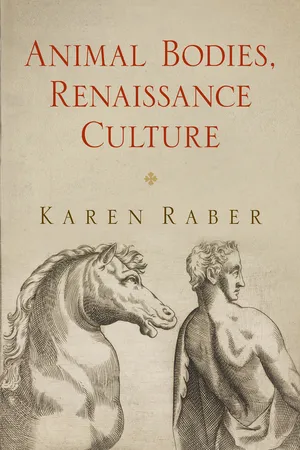
Animal Bodies, Renaissance Culture examines how the shared embodied existence of early modern human and nonhuman animals challenged the establishment of species distinctions. The material conditions of the early modern world brought humans and animals into complex interspecies relationships that have not been fully accounted for in critical readings of the period's philosophical, scientific, or literary representations of animals. Where such prior readings have focused on the role of reason in debates about human exceptionalism, this book turns instead to a series of cultural sites in which we find animal and human bodies sharing environments, mutually transforming and defining one another's lives.To uncover the animal body's role in anatomy, eroticism, architecture, labor, and consumption, Karen Raber analyzes canonical works including More's Utopia, Shakespeare's Hamlet and Romeo and Juliet, and Sidney's poetry, situating them among readings of human and equine anatomical texts, medical recipes, theories of architecture and urban design, husbandry manuals, and horsemanship treatises. Raber reconsiders interactions between environment, body, and consciousness that we find in early modern human-animal relations. Scholars of the Renaissance period recognized animals' fundamental role in fashioning what we call "culture, " she demonstrates, providing historical narratives about embodiment and the cultural constructions of species difference that are often overlooked in ecocritical and posthumanist theory that attempts to address the "question of the animal."
- 248 pages
- English
- ePUB (mobile friendly)
- Available on iOS & Android
eBook - ePub
Animal Bodies, Renaissance Culture
About this book
Information
Publisher
University of Pennsylvania PressYear
2013Print ISBN
9780812245363
9780812245363
eBook ISBN
9780812208597
Chapter 1
Resisting Bodies: Renaissance Animal Anatomies
If we are going to talk of bodies, there is no more fitting place to begin than with early modern medicine’s advances in, and continuing obsession with, anatomy. Andreas Vesalius’s monumental De Humani Corporis Fabrica (1543), published with dozens of carefully created illustrations, inspired decades, even centuries of imitators whose volumes joined Vesalius’s in revealing the secrets of the human body. Jonathan Sawday calls the post-Vesalian period of 1540–1640 “the age of dissection” and the “period of the discovery of the Vesalian body,” a period that can be distinguished by its aura of wonder, as well as it analogical approach to human form.1 Vesalius and his heirs saw themselves exploring the miniature of God’s divine cosmos, extending mankind’s dominion over creation to his own internal landscape. However, that landscape was produced through a process of “partition,” since dissection involved the separation of a coherent whole into its constituent parts, which functioned in tension with the idea that the human individual was an organic whole. This troubling implication of dissection may have eventually been recuperated in the creation of a new scientific order with its unified rational “body” of order, but for early moderns the “dialectic of unity and partition” was a source of constant anxiety, given that the “spatially imagined body … [was] the most common vehicle for the making of social and cosmic metaphors in early modern Europe.”2 In undertaking to confirm the proposition that the human being was a “Microcosm, or little world,” Vesalian anatomy in fact began the process of deconstructing such a model.
For a time, the body’s complex role in post-Vesalian thought was obscured in the critical scholarship by triumphal narratives of individualism, or by retroactive application of Cartesian versions of the mechanistic body.3 In the last decade or so, cultural and literary criticism has rediscovered the human body and plumbed its secrets anew, finding in it the primary locus of Renaissance ideas about interiority, reading it for the somatics of religious experience, analyzing its inspiration of anxiety about integrity versus fragmentation, and making it a central agent in social and political discourse. On the whole, however, this new age of discovery has restricted itself entirely to discussions of the human body, as if human organs, bones, nerves, skin, joints somehow have nothing to do with those of nonhuman animals, and as if the condition of being distinctively human, rather than animal, were unproblematically established a priori in the anatomies under examination.
Anatomies of animals are generally consigned to the prehistory of veterinary medicine, categorized according to a division of professional and academic practices that is the result of exactly the process scholars of human anatomy pretend to expose as an ideologically charged historical fiction. Yet, scholars in early modern animal studies have repeatedly established that in this period the boundary between human and animal was fluid, inconsistent, and fraught with its own anxiety-producing contradictions.4 Marching forward without reference to the context of animal anatomy, scholars newly interested in the human body ignore the many questions their own work raises about how that problematic human-animal boundary influences, or is influenced by, their arguments. If we accept that anatomies created a sense of “inwardness” that grounded human subjectivity, as Michael Schoenfeldt argues, which in turn made possible a sense that the individual was a separated self, do we also imagine that dissecting animals did the same for ideas about animals’ inward selves?5 Did the shift from imagining the human body as porous and open to imagining it as a closed and defined system—one therefore capable of supporting an entire edifice of ideas about individuality—similarly affect the way humans thought about animals? If so, what did an animal individual look like, inside and out?
To illustrate how his method led him to the conclusion that God instilled the rational soul only in mankind, Descartes begins the fifth part of his Discourse on Method with “the motion of the heart and arteries.”6 In fact he advises the reader not versed in anatomy to “take the trouble of having dissected in their presence the heart of some large animal possessed of lungs” to locate the veins, arteries, ventricles of the heart, and other physical attributes that animals and humans share.7 Descartes concludes, however, that the body, a marvelous machine, is animated by “animal spirits,” not by reason. As I pointed out at length in the introduction, even recent critics have fallen into the trap of following his lead in disenfranchising the body by privileging issues of behavior, thought, or sympathy. Early modern critical analysis aimed at saving the animal from Cartesian dualism that ignores Descartes’ own location of anatomy at the root of his method may, as I’ve noted, have overlooked the real remedy to that dualism.8
In this chapter I attempt instead to restore the presence of animals to discussions of anatomies of the body. To do so, I focus first on the imagery used in Vesalian anatomies, especially in their title pages, and on the few examples of animal anatomies from the same period. While dogs, apes, pigs, and other animals were most commonly dissected, through the social and institutional conditions that applied to publication of nonhuman medical treatises, they did not merit full texts themselves. Instead, the only major animal anatomies before the late seventeenth century and the advent of the Royal Society are anatomies of horses. In addition to locating representations of animals in human anatomies, therefore, I also examine in depth two of the most significant animal anatomies published during the century and a half following the appearance of Vesalius’s Fabrica, Carlo Ruini’s Anatomia del Cavallo, Infermitàe Suoi Rimedii (1598), and Andrew Snape’s Anatomy of an Horse (1683).9 Because each of these texts responds directly in some fashion either to the Vesalian model of dissection or to its transformation of scientific discourse, I read them against a variety of human anatomy texts, including Vesalius’s Fabrica, instead of situating them in traditions of horse-leeching or horsemanship and husbandry manuals, as has often been the case. In fact, it is my sense that there is no such thing as “human anatomy,” full stop; animals cannot be banished from the literature of bodily discovery since they undergird that project in ways large and small. Laurie Shannon reminds us that all anatomy is by definition comparative, relying on the fact of what she calls shared “creatureliness”: anatomical methodology relies on a “zoo-analogical conundrum” that led to “a crisis of authority” in Renaissance medical knowledge, which looked less and less to classical and biblical sources, and more to cross-species bodily resemblances.10 The historical trajectory bears out her assertion: from comparisons of humans with animals in medieval question books, where animals were present to demonstrate the superiority of God’s creation in the human form, to Darwinian evolution, which is based specifically in the tradition of comparative anatomy as it was professionalized during the eighteenth and nineteenth centuries, animals remain the ground on which epistemological and ontological understandings of the human body are constructed. The animal in these cases is, however, often indecorous, occasionally resistant toward fictions of bodily compliance evident in human anatomies. The partition-unity dialectic that emerges in animal anatomies is grosser, its implications more difficult to control or alleviate with the usual amelioratory rhetorical and visual devices, especially in the case of the horse anatomies with their enormous, vigorous subjects and their attendant traditions and mythologies. In what follows, I track the persistence of the animal, particularly animal bodies, their occasional coy opacities, even the simple threat posed by their sheer mass to the anatomist’s epistemology.
Animal Comparisons
When Andreas Vesalius published his De Humani Corporis Fabrica, he asserted that its improvement on Galenic anatomy hinged on his experience with the dissection of human bodies, rather than animals; unlike Galen, who was “deceived by his apes” and dogs, Vesalius had verified his own discoveries in dissections of actual human corpses.11 He corrects numerous Galenic errors in the identification of organs, bones, and other structures and advocates an empirical, scientific, intimate, rational approach to the human body over any system that sets classical, textual authority above the individual faculties of observation. For instance, Vesalius first notices that the human breastbone is segmented into three portions, not seven as Galen had argued, an error traced to animal physiology. Describing the membrane that rests beneath the skin, possibly the superficial fascia, Vesalius defends himself against detractors:
Others, even though they have seen me demonstrate that this membrane covers the whole body, are so stupid that they will not admit that this is what Galen refers to very frequently elsewhere … simply because I point to fat … between the skin and this membrane, often as much as three inches thick, and because in man this membrane always stands apart from the skin by the amount of the thickness of the fat. These people, born solely to decorate a professional chair, should have realized that Galen was speaking of his apes and not of man; for in apes no fat intervenes between the membrane and the skin. (2: 144)
Those “decorative people,” other academic anatomists, refuse to dirty their hands with the work of dissection and so remain ignorant of the differences between man and ape. While Vesalius does not discard Galen—indeed, the project of the Fabrica is rather cooperative with Galen’s—he considers those who adhere unquestioningly to Galen’s teachings to be irrelevant aesthetes. If the mantra of anatomists is nosce te ipsum, know thyself, then Vesalius proposes that the self in question must not be approached indirectly or comparatively, but must submit itself directly to the probing gaze and hands of the physician. Indeed, the self that was the subject of scientific knowledge was in part grounded in the whole spatial and conceptual existence of an “inside” to the human that is as much corporeal as it is philosophical or spiritual. It could therefore be assumed that it would be pointless to plumb the depths of animals, which supposedly lack both reason and spirit, for evidence of selfhood.
According to Erica Fudge’s analysis of Bacon and the new science, however, the project was compromised by its inescapably analogical, comparative nature. The premise of the animal experimentation that drove the empirical investigations of the anatomists was the religious goal of knowing God by knowing His works in nature, of which the human body was the most complex, glorious, and revelatory—it was, in effect, the temple of God, of the soul that was a piece of godhead.12 Yet as Fudge points out, “The temple of God is supported by the anatomists’ endeavor to know[,] but as soon as the animal is placed in the debate the temple, based as it is on a notion of the separation of human and animal, crumbles.” Anatomists and the new science inevitably “destroyed the most important myth of all,” namely the myth of absolute difference between human and beast.13 And it was simply impossible to build the temple without animals. Even Vesalius, it turns out, could not function without animals to bolster his work, and he freely refers to dissections of pigs, dogs, apes, and other creatures, at some moments for comparison to explain Galen’s errors, but at others simply as material for insights into the human form. Indeed, at times his own work is as guilty of being “deceived” by animals as was Galen’s: for example, his illustrations of the hyoid and the tongue are animal in origin. It is, it turns out for Vesalius as for other anatomists and scientists, entirely impossible to avoid being a comparatist—but being a comparatist ultimately makes it difficult to assert the human as specially qualified to embody God’s perfection.14
Bacon and presumably other anatomists and scientists experimenting on animals discover an alternate basis for an anthropocentric worldview, suggests Fudge, in the power of the scientist to name what he observes. The ability to call the animal an animal, to see “insides and outsides” at the same time becomes the foundation of the mythmaking that we call science.15 But, as I will argue here, such a triumphalist attitude among anatomists, an attitude that is often expressed most eloquently in the artistic images that decorate their otherwise relatively unpoetic published texts, is not complete or inevitable, nor is the ability to “see inside” the animal any more absolute and unproblematic than is the venture to see inside the human.
Frontispieces and illustrations to anatomy books involved the collaboration of the artist and the scientist, sometimes even establishing the conjunction of these two roles in the skills of the anatomist himself. Vesalius’s Fabrica may have been illustrated by students in Titian’s studio, possibly Stephan van Calcar, who is credited with creating its frontispiece.16 But most historians believe Vesalius also did some of his own illustrating, at the ...
Table of contents
- Cover
- Title
- Copyright
- Contents
- Introduction: Absent Bodies
- Chapter 1. Resisting Bodies: Renaissance Animal Anatomies
- Chapter 2. Erotic Bodies: Loving Horses
- Chapter 3. Mutual Consumption: The Animal Within
- Chapter 4. Animal Architectures: Urban Beasts
- Chapter 5. Working Bodies: Laboring Moles and Cannibal Sheep
- Conclusion: Knowing Animals
- Notes
- Bibliography
- Index
- Acknowledgments
Trusted by 375,005 students
Access to over 1.5 million titles for a fair monthly price.
Study more efficiently using our study tools.
Frequently asked questions
Yes, you can cancel anytime from the Subscription tab in your account settings on the Perlego website. Your subscription will stay active until the end of your current billing period. Learn how to cancel your subscription
No, books cannot be downloaded as external files, such as PDFs, for use outside of Perlego. However, you can download books within the Perlego app for offline reading on mobile or tablet. Learn how to download books offline
Perlego offers two plans: Essential and Complete
- Essential is ideal for learners and professionals who enjoy exploring a wide range of subjects. Access the Essential Library with 800,000+ trusted titles and best-sellers across business, personal growth, and the humanities. Includes unlimited reading time and Standard Read Aloud voice.
- Complete: Perfect for advanced learners and researchers needing full, unrestricted access. Unlock 1.5M+ books across hundreds of subjects, including academic and specialized titles. The Complete Plan also includes advanced features like Premium Read Aloud and Research Assistant.
We are an online textbook subscription service, where you can get access to an entire online library for less than the price of a single book per month. With over 1.5 million books across 990+ topics, we’ve got you covered! Learn about our mission
Look out for the read-aloud symbol on your next book to see if you can listen to it. The read-aloud tool reads text aloud for you, highlighting the text as it is being read. You can pause it, speed it up and slow it down. Learn more about Read Aloud
Yes! You can use the Perlego app on both iOS and Android devices to read anytime, anywhere — even offline. Perfect for commutes or when you’re on the go.
Please note we cannot support devices running on iOS 13 and Android 7 or earlier. Learn more about using the app
Please note we cannot support devices running on iOS 13 and Android 7 or earlier. Learn more about using the app
Yes, you can access Animal Bodies, Renaissance Culture by Karen Raber in PDF and/or ePUB format, as well as other popular books in Literature & English Literary Criticism. We have over 1.5 million books available in our catalogue for you to explore.