When American radio broadcasting began in the early 1920s there was a consensus among middle-class opinion makers that the airwaves must never be used for advertising. Even the national advertising industry agreed that the miraculous new medium was destined for higher cultural purposes. And yet, within a decade American broadcasting had become commercialized and has remained so ever since.
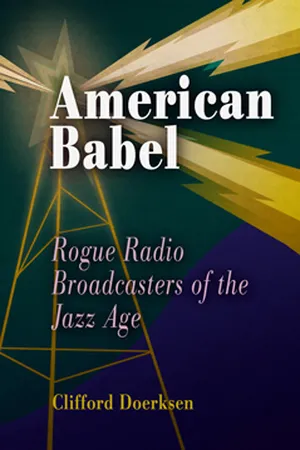
Much recent scholarship treats this unsought commercialization as a coup, imposed from above by mercenary corporations indifferent to higher public ideals. Such research has focused primarily on metropolitan stations operated by the likes of AT&T, Westinghouse, and General Electric. In American Babel, Clifford J. Doerksen provides a colorful alternative social history centered on an overlooked class of pioneer broadcaster—the independent radio stations.
Doerksen reveals that these "little" stations often commanded large and loyal working-class audiences who did not share the middle-class aversion to broadcast advertising. In urban settings, the independent stations broadcast jazz and burlesque entertainment and plugged popular songs for Tin Pan Alley publishers. In the countryside, independent stations known as "farmer stations" broadcast "hillbilly music" and old-time religion. All were unabashed in their promotional practices and paved the way toward commercialization with their innovations in programming, on-air style, advertising methods, and direct appeal to target audiences. Corporate broadcasters, who aspired to cultural gentility, were initially hostile to the populist style of the independents but ultimately followed suit in the 1930s.
Drawing on a rich array of archives and contemporary print sources, each chapter of American Babel looks at a particular station and the personalities behind the microphone. Doerksen presents this group of independents as an intensely colorful, perpetually interesting lot and weaves their stories into an expansive social and cultural narrative to explain more fully the rise of the commercial network system of the 1930s.
- 170 pages
- English
- PDF
- Available on iOS & Android
eBook - PDF
About this book
Information
Publisher
University of Pennsylvania PressYear
2011Print ISBN
9780812238716
9780812238716
eBook ISBN
9780812201765
Table of contents
- Cover
- Title
- Copyright
- Contents
- Preface
- Prelude
- Chapter 1. The Education of Frank Bannister
- Chapter 2. Serving the Masses, Not the Classes
- Chapter 3. Brows High and Fevered
- Chapter 4. "Exit the Jonas Hayseed of 1880"
- Chapter 5. That Doggone Radio Man
- Chapter 6. Wilbur Can Beat the Devil
- Chapter 7. The Dawn of the Golden Age
- Notes
- Index
Trusted by 375,005 students
Access to over 1.5 million titles for a fair monthly price.
Study more efficiently using our study tools.
Frequently asked questions
Yes, you can cancel anytime from the Subscription tab in your account settings on the Perlego website. Your subscription will stay active until the end of your current billing period. Learn how to cancel your subscription
No, books cannot be downloaded as external files, such as PDFs, for use outside of Perlego. However, you can download books within the Perlego app for offline reading on mobile or tablet. Learn how to download books offline
Perlego offers two plans: Essential and Complete
- Essential is ideal for learners and professionals who enjoy exploring a wide range of subjects. Access the Essential Library with 800,000+ trusted titles and best-sellers across business, personal growth, and the humanities. Includes unlimited reading time and Standard Read Aloud voice.
- Complete: Perfect for advanced learners and researchers needing full, unrestricted access. Unlock 1.5M+ books across hundreds of subjects, including academic and specialized titles. The Complete Plan also includes advanced features like Premium Read Aloud and Research Assistant.
We are an online textbook subscription service, where you can get access to an entire online library for less than the price of a single book per month. With over 1.5 million books across 990+ topics, we’ve got you covered! Learn about our mission
Look out for the read-aloud symbol on your next book to see if you can listen to it. The read-aloud tool reads text aloud for you, highlighting the text as it is being read. You can pause it, speed it up and slow it down. Learn more about Read Aloud
Yes! You can use the Perlego app on both iOS and Android devices to read anytime, anywhere — even offline. Perfect for commutes or when you’re on the go.
Please note we cannot support devices running on iOS 13 and Android 7 or earlier. Learn more about using the app
Please note we cannot support devices running on iOS 13 and Android 7 or earlier. Learn more about using the app
Yes, you can access American Babel by Clifford J. Doerksen in PDF and/or ePUB format, as well as other popular books in History & Media & Communications Industry. We have over 1.5 million books available in our catalogue for you to explore.