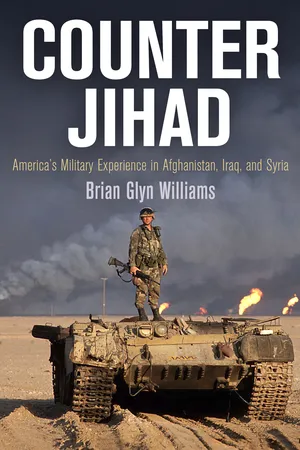
Counter Jihad is a sweeping account of America's military campaigns in the Islamic world. Revising our understanding of what was once known as the War on Terror, it provides a retrospective on the extraordinary series of conflicts that saw the United States deploy more than two and a half million men and women to fight in Afghanistan, Iraq, and Syria. Brian Glyn Williams traces these unfolding wars from their origins in the Soviet invasion of Afghanistan through U.S. Central Command's ongoing campaign to "degrade and destroy" the hybrid terrorist group known as ISIS. Williams takes readers on a journey beginning with the 2001 U.S. overthrow of the Taliban, to the toppling of Saddam Hussein, to the unexpected emergence of the notorious ISIS "Caliphate" in the Iraqi lands that the United States once occupied.
Counter Jihad is the first history of America's military operations against radical Islamists, from the Taliban-controlled Hindu Kush Mountains of Afghanistan, to the Sunni Triangle of Iraq, to ISIS's headquarters in the deserts of central Syria, giving both generalists and specialists an overview of events that were followed by millions but understood by few. Williams provides the missing historical context for the rise of the terror group ISIS out of the ashes of Saddam Hussein's secular Baathist Iraq, arguing that it is only by carefully exploring the recent past can we understand how this jihadist group came to conquer an area larger than Britain and spread havoc from Syria to Paris to San Bernardino.
eBook - ePub
Counter Jihad
America's Military Experience in Afghanistan, Iraq, and Syria
- 400 pages
- English
- ePUB (mobile friendly)
- Available on iOS & Android
eBook - ePub
About this book
Information
Publisher
University of Pennsylvania PressYear
2016Print ISBN
9780812224207
9780812248678
eBook ISBN
9780812293463
CHAPTER 1
Planting the Seeds for a Global Conflict
Our attacks against you will continue as long as U.S. support for Israel continues. It is not fair that Americans should live in peace as long as our [Palestinian] brothers in Gaza live in the worst conditions.
—Osama bin Laden
Leave the Arabian Peninsula defeated and stop supporting the coward Jews in Palestine!
—Saudi-born 9/11 terrorist Abdul Aziz al Omari’s
videotaped warning to America
videotaped warning to America
The Prehistory of 9/11: Israel, the Palestinians, and the Americans
Long before there was the “War on Terror” there was terrorism in the Middle East in the land of Palestine/Israel. The roots of this terrorism go back millennia and involve the biblical kingdom of Israel. The Jewish kingdom of Israel was established by the legendary King David in roughly the year 1000 B.C. King David’s people had migrated perhaps two hundred years earlier from Egypt and fought a long, brutal war for control of a land known to its local population as Canaan.
At the time of the Israelites’ brutal invasion, Canaan was inhabited by indigenous Canaanites and a powerful people from the Greek islands known as the Philistines. The coastal area where the latter people lived was named Philistia or Palestine. After two centuries of warfare, the Israelites defeated the Philistines, conquered Canaanite Jerusalem, and made it the capital of David’s small kingdom. His son Solomon then built a temple in Jerusalem to the Israelites’ one God, Yahweh.
The kingdom of Israel was seen by the Jews as a holy land given to them, and them exclusively, by God. Unfortunately, neighboring empires were not so concerned with the self-proclaimed links between the Jews and the land bequeathed to them by their God and frequently overran it and added it to their empires. Over the centuries, Israel split into two quarreling substates known as Judea and Samaria, which were then conquered by Assyria and Babylon (two empires based in what is today Iraq). Then came the conquering Persians, Alexander the Great, and finally the Romans.
The Jews, strict monotheists, chaffed under pagan Roman rule and heavy taxation and revolted in roughly A.D. 70. The powerful Romans then launched a genocidal campaign against the Jews and destroyed their sacred temple in Jerusalem and renamed the city Aelia Capitolina. More than half a million Jews were killed at this time. Later, in A.D. 135, the rebellious Jews were driven from their homes and killed in the tens of thousands.
In succeeding years, the vast majority of Jews were exiled from the Roman province of Palestine and scattered across the ancient world. Those Jews who lived beyond the borders of their former homeland lived in a condition known as Diaspora (a Greek word roughly meaning “to be scattered from one’s home place”). Under subsequent Roman emperors, Jews were barred from living in Jerusalem, and the land was once again renamed Palestine (i.e., the land of the Philistines).
In the following centuries, the Romans and their successors, the East Romans or Byzantines, converted to the new faith of Christianity. At this time most people living in the region of Palestine also converted to Christianity. These local Christians later adopted Arabic language following the Arabic Muslim conquests and became Christian Arabs. The descendants of these ancient Christians are today known as the Christian Palestinians and live in such towns as Bethlehem. Few Americans are aware that a (declining) portion of the Palestinian Arabs are in fact ancient Christians. There is also an ancient Arab Christian population found in nearby Iraq that was largely destroyed in the aftermath of 2003’s Operation Iraqi Freedom and Christian population in Lebanon, Syria, and Egypt.
In the A.D. 600s, Muslim Arabs poured out of the Arabian desert with their new Islamic faith and conquered the East Roman Christian province of Palestine. They later built one of the first great Muslim religious complexes, the Dome of the Rock Mosque or Al Aqsa (“the Farthest” Mosque), directly on the very site of the Jews’ former Temple Mount, which they also believed was sacred ground. Muslims believed the Prophet Muhammad made a mystical night journey on the horse Buraq from Arabia to the Temple Mount in Jerusalem. From there he ascended to heaven and was told that Muslims should pray five times a day. Jerusalem thus became, along with Mecca and Medina in Arabia, one of the three holy pilgrim sites of Islam. Muslim Arabs have lived in Jerusalem and Palestine alongside the older population of Christians continuously since this time and are called Palestinians.
While many claim that Jews and Muslims have been enemies since this time, history indicates otherwise. During this period, for example, the new Arab Muslim rulers allowed Jews to immigrate back to Jerusalem, and a community was established there. In 1099, however, much of this Jewish community was slaughtered by invading Christian Crusaders from Europe, who considered Jews (whom they blamed for the death of Jesus Christ) to be no better than Muslim infidels. In fact Jews were horribly oppressed in medieval Europe by Christians, who accused them of all sorts of bizarre acts, such as kidnapping Christian babies and sacrificing them in their synagogues or desecrating Christian communion. Superstitious Christian mobs often slaughtered Jews who had been living peacefully in their midst after accusing them of such acts of blasphemy. Fortunately for the Jews, the Christian Crusaders were expelled from Jerusalem by the great Muslim warrior Saladin, and Jews were subsequently allowed to return in small numbers to Jerusalem.
Most Jews, however, remained scattered in the Diaspora in venues ranging from Iraq to England. On the whole, however, diasporic Jews fared much better under Muslim rule than under Christian rule. For example, when Christian Crusaders reconquered most of Spain from the comparatively tolerant Muslims who had ruled it from 711 to 1492, they persecuted Spanish Jews. Most of Spain’s Jewish population fled the Spanish Catholic Inquisition to the greatest Muslim state of the time, the Ottoman Empire. During this period the Ottoman city of Salonika became the greatest Jewish center in the world. This stems in part from the fact that Ottomans, as Muslims, recognized Jews as fellow “Peoples of the Book” (Ahl al Kitab in Arabic, a term that also applied to Christians who followed the Book, the Book being the Torah, the Bible, or the Qur’an). While Jews had to pay a jizya tax similar to the one levied on Christians to avoid military service, they were not oppressed by the Muslims as “idol worshippers” like the recently conquered pagan Zoroastrians of Iran (Persia) or polytheistic Hindus of India were.
As the Jews continued to suffer in Christian countries, Europe began to modernize under secular nation-states in the 1700s. At this time the novel concept of “nationalism” (the notion that every ethnic, linguistic, or tribal group on the earth is a “nation” and has the “natural right” to a national homeland, motherland, or fatherland) began to spread in post-Napoleonic Europe. Napoleon did much to destroy the old empires and principalities of Europe, and this led to the creation of such modern nation-states as Germany (previously Germany had been divided into over a dozen smaller principalities and kingdoms that had different dialects and little common political history).
From western Europe, the novel idea of nationalism began to spread to the mighty Muslim Ottoman Empire, which included most of the Arab, Turkish, and Kurdish Middle East as well as southeastern Europe and North Africa. As the Christian peoples of eastern Europe (Greeks, Serbs, Bulgarians, Romanians, etc.) began to revolt against their Ottoman sultans (emperors) and carve out their own exclusive nation-states, the “bug” of nationalism began to spread among diasporic Jews living uncomfortably in late nineteenth-century Christian Europe. Those Jews living in terrible conditions in places like Russia (where the tsar’s Cossacks frequently attacked them) or even France (which had a prominent case where a Jewish officer was falsely convicted of treason) began to dream of creating a nation-state of their own for their scattered people living in the Diaspora. This would allow them to reconstruct their largely forgotten language of Hebrew, preserve their culture, and avoid discrimination by Christians.
The obvious location for this motherland or homeland would be in the Ottoman province of Palestine, which had been inhabited by Muslim Arabs for roughly thirteen hundred years. Jews who wanted to recreate the ancient biblical kingdom of David’s Israel (a kingdom known in ancient texts as Zion) called themselves Zionists.
In the 1880s, groups of European Zionists approached the Ottoman sultan in Istanbul, Turkey, and requested the right to set up settlements in the province of Palestine. While initially resisting their requests, the sultan ultimately saw in the European Jews an industrious Western people that could use their hard work and capital to modernize this backwater province, so he eventually gave them his blessing to buy land there. Local Ottoman Turkish and Arab landowners then began to sell plots of land to the incoming Jews, particularly on the coast. At this time Christians who supported the emigration of Jews to the Ottoman Empire described Arab Palestine as “a land without a people for a people without a land.” But, as will be seen, the indigenous Arab Palestinian population, which had been living in these lands in some cases since the expulsion of the Jews by the Romans in A.D. 135, certainly did not define Palestine as a “land without a people.”
From this time period until World War I (which took place from 1914 to 1918) Jews immigrated to Ottoman Palestine and bought up land from local Muslim Palestinian and Turkish landowners. At first this process was peaceful, because the local Arabs considered the Jews to be fellow Peoples of the Book and good neighbors. But as more and more Jews with their foreign ways poured into the land, they began to clash with the local Arab villagers and nomadic Bedouin. As World War I drew to a close there were deep tensions between Palestine’s local Arab population and the incoming Jews.
During World War I, the Ottoman Empire fought on the side of the Germans against the British, French, Americans, and Russians and thus ended up on the losing side of the conflict. After the war, the victorious British seized control of the province of Palestine and neighboring Arab lands of Jordan and Iraq from the defeated Ottomans. The British then ruled Palestine from this time period until 1948 and tried desperately to keep the peace between the clashing Jews and Palestinians.
At this time both sides engaged in violence, which led to tit-for-tat killings and acts of terrorism. The Arabs created a terrorist militia known as the Black Hand, while the Jews established two terrorist groups known as the Stern Gang and Irgun. The Black Hand was quickly wiped out by the British, but the Jewish groups went on to blow up the King David Hotel in Jerusalem in 1946 (killing ninety-one people of various nationalities) and carry out the massacre of dozens of Palestinian villagers in 1948 in the village of Deir Yassin.1
Prior to this terrorism, however, during World War II the (predominantly Christian) Germans carried the historic European oppression of Jews to the extreme and killed millions of them during the Holocaust. In the aftermath of the war, stunned American soldiers uncovered vast death camps in Germany and Eastern Europe that exposed the hidden horrors of the Holocaust to the world. At this time, pressure mounted for Britain to give up its colonial possessions in the Middle East, including Palestine, which had grown increasingly violent as more Jews fled there to escape the horrors of the Nazi Holocaust. By this time the population of Jews in Palestine had risen to roughly six hundred thousand while the Palestinian Arabs came to approximately 1.2 million.
In 1947, the British agreed to depart Palestine and allow the newly created United Nations to partition the land evenly between the Jews and the much larger Palestinian Arab population. The eastern half would go to the Palestinian Arabs, while much of the west around the new Jewish coastal city of Tel Aviv would go to the Jews. Unsatisfied with this equal division, the Arabs fatefully rejected the plan. Both sides then prepared for an inevitable war once the British pulled out.
On May 14, 1948, 1,878 years after the destruction of Jerusalem by the ancient Romans, the Jews in Palestine declared the existence of a new state once again to be known as Israel. In response, the neighboring Arab states of Egypt, Jordan, Syria, Iraq, Saudi Arabia, and Lebanon invaded Palestine to drive out the Jews. With their backs once again to the wall, the Jews, who often had better training, morale, and equipment, fought back ferociously and won the Arab-Israeli War of 1948. In the process, they expanded their portion of territory by 40 percent and forced out more than seven hundred thousand defeated Palestinian Arabs from their homes (it should be stated that some of these Palestinians also voluntarily fled the Jews because their leaders told them to). While the new Jewish state did not have an overall policy of ethnic cleansing, its leaders took advantage of ad hoc expulsions of Palestinians and the voluntary flight of others to enlarge the Jewish state’s territory.
The defeated Palestinians were compressed into a small strip of remaining Palestinian territory on the Mediterranean Sea next to Egypt known as the Gaza Strip (an area, named after the ancient Philistine town of Gaza, that is only thirty-four miles long by seven miles wide and is inhabited by two million people) and lands on the western bank of the Jordan River around Jerusalem (the so-called West Bank). Tens of thousands of Palestinian refugees also fled to southern Lebanon, where they lived in grim refugee camps, and to the kingdom of Jordan, where they eventually became citizens. Arabs across the Middle East bemoaned the fate of their fellow Arabs in Palestine and called these tragic events Al Naqba (the Disaster).
While most Westerners are familiar with the term Holocaust or Shoah, few know the term Al Naqba. For their part, the Palestinians have the bitter memory of their lost ancestral graveyards, villages, fields, orchards, places of worship, and homes forever burned in their collective memory. They bemoan the loss of most of their ancestral homeland, Palestine, and for decades fought to regain it. The neighboring Arab states swore to avenge their Palestinian Arab brothers and planned on destroying the new state of Israel, while the exiled Palestinians dreamed of returning to their lost lands.
In 1967, the Israelis fought another war to repel attacking Syrians, Egyptians, and Jordanians and were astoundingly successful. During the war they went on to occupy the Gaza Strip and West Bank (as well as territory from Syria and Egypt) and thus gained direct control of the entire land of Palestine, including the holy city of Jerusalem, which they directly annexed to Israel. Tens of thousands of Palestinians again fled at this time to Jordan and elsewhere. This war was known as the Six-Day War, but Palestinians have a saying, “Israel may have won the war in six days, but they have been fighting the seventh day ever since.”
For Arabs and Muslims across the world the loss of holy Jerusalem, site of the Dome of the Rock, was a tremendous blow, and millions seethed with anger. For the Palestinians it meant much more: it meant the direct occupation of their only remaining free territories in the West Bank and Gaza by their mortal enemies. For the Israelis, it meant gaining control of the capital of their ancient state and site of the Wailing Wall, the last remnant of their great temple to their God, Yahweh.
As their last holdouts were conquered by the new state of Israel, the defeated Palestinians resolved to continue the fight via terrorism to make the Jews’ conquest of their lands costly. In the 1970s the Palestinian terrorist group known as the Palestinian Liberation Organization (PLO) hijacked airplanes and launched terrorist attacks on Jews in Israel proper and those who began to settle in the newly occupied lands of the West Bank and Gaza Strip in large numbers. It became obvious to the Palestinians that the Jewish settlers were trying to create permanent “facts on the ground” by squeezing them out of their last remaining lands in the West Bank and Gaza. In response, the Palestinians fought back with terrorism to make this land grab costly. Perhaps the Palestinians’ most notorious terrorist attack in this period was the killing of eleven Israeli athl...
Table of contents
- Cover
- Half title
- Title
- Copyright
- Dedication
- Contents
- Preface
- Chapter 1. Planting the Seeds for a Global Conflict
- Chapter 2. America Goes to War in Afghanistan
- Chapter 3. Hype: Selling the War on Iraq to the American People
- Chapter 4. The Invasion and Occupation of Iraq
- Chapter 5. Remembering the “Forgotten War” in Afghanistan
- Chapter 6. The New War on ISIS
- Notes
- Index
- Acknowledgments
- Photographs
Trusted by 375,005 students
Access to over 1.5 million titles for a fair monthly price.
Study more efficiently using our study tools.
Frequently asked questions
Yes, you can cancel anytime from the Subscription tab in your account settings on the Perlego website. Your subscription will stay active until the end of your current billing period. Learn how to cancel your subscription
No, books cannot be downloaded as external files, such as PDFs, for use outside of Perlego. However, you can download books within the Perlego app for offline reading on mobile or tablet. Learn how to download books offline
Perlego offers two plans: Essential and Complete
- Essential is ideal for learners and professionals who enjoy exploring a wide range of subjects. Access the Essential Library with 800,000+ trusted titles and best-sellers across business, personal growth, and the humanities. Includes unlimited reading time and Standard Read Aloud voice.
- Complete: Perfect for advanced learners and researchers needing full, unrestricted access. Unlock 1.5M+ books across hundreds of subjects, including academic and specialized titles. The Complete Plan also includes advanced features like Premium Read Aloud and Research Assistant.
We are an online textbook subscription service, where you can get access to an entire online library for less than the price of a single book per month. With over 1.5 million books across 990+ topics, we’ve got you covered! Learn about our mission
Look out for the read-aloud symbol on your next book to see if you can listen to it. The read-aloud tool reads text aloud for you, highlighting the text as it is being read. You can pause it, speed it up and slow it down. Learn more about Read Aloud
Yes! You can use the Perlego app on both iOS and Android devices to read anytime, anywhere — even offline. Perfect for commutes or when you’re on the go.
Please note we cannot support devices running on iOS 13 and Android 7 or earlier. Learn more about using the app
Please note we cannot support devices running on iOS 13 and Android 7 or earlier. Learn more about using the app
Yes, you can access Counter Jihad by Brian Glyn Williams in PDF and/or ePUB format, as well as other popular books in History & Military & Maritime History. We have over 1.5 million books available in our catalogue for you to explore.