Since 2008, the global economic crisis has exposed and deepened the tensions between austerity and social security—not just as competing paradigms of recovery but also as fundamentally different visions of governmental and personal responsibility. In this sense, the core premise of neoliberalism—the dominant approach to government around the world since the 1980s—may by now have reached a certain political limit. Based on the premise that markets are more efficient than government, neoliberal reforms were pushed by powerful national and transnational organizations as conditions of investment, lending, and trade, often in the name of freedom. In the same spirit, governments increasingly turned to the private sector for what were formerly state functions. While it has become a commonplace to observe that neoliberalism refashioned citizenship around consumption, the essays in this volume demonstrate the incompleteness of that image—as the social limits of neoliberalism are inherent in its very practice.
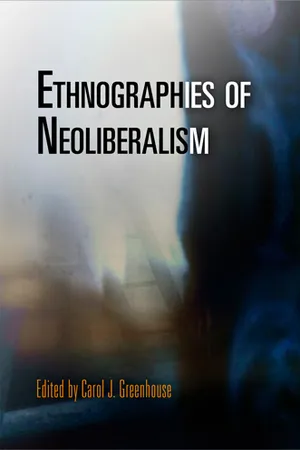
Ethnographies of Neoliberalism collects original ethnographic case studies of the effects of neoliberal reform on the conditions of social participation, such as new understandings of community, family, and gender roles, the commodification of learning, new forms of protest against corporate power, and the restructuring of local political institutions. Carol J. Greenhouse has brought together scholars in anthropology, communications, education, English, music, political science, religion, and sociology to focus on the emergent conditions of political agency under neoliberal regimes. This is the first volume to address the effects of neoliberal reform on people's self-understandings as social and political actors. The essayists consider both the positive and negative unintended results of neoliberal reform, and the theoretical contradictions within neoliberalism, as illuminated by circumstances on the ground in Africa, Europe, South America, Japan, Russia, and the United States. With an emphasis on the value of ethnographic methods for understanding neoliberalism's effects around the world in our own times, Ethnographies of Neoliberalism uncovers how people realize for themselves the limits of the market and act accordingly from their own understandings of partnership and solidarity.
- 321 pages
- English
- PDF
- Available on iOS & Android
eBook - PDF
Ethnographies of Neoliberalism
About this book
Information
Table of contents
- Cover
- Contents
- Introduction
- Part I. State Investments in Insecurity
- Part II. Politics in the Public-Private Divide
- Part III. Markets for Cultural Diversity
- Part IV. Agency and Ambivalence
- Notes
- References
- List of Contributors
- Index
- Acknowledgments
Trusted by 375,005 students
Access to over 1.5 million titles for a fair monthly price.
Study more efficiently using our study tools.
Frequently asked questions
Yes, you can cancel anytime from the Subscription tab in your account settings on the Perlego website. Your subscription will stay active until the end of your current billing period. Learn how to cancel your subscription
No, books cannot be downloaded as external files, such as PDFs, for use outside of Perlego. However, you can download books within the Perlego app for offline reading on mobile or tablet. Learn how to download books offline
Perlego offers two plans: Essential and Complete
- Essential is ideal for learners and professionals who enjoy exploring a wide range of subjects. Access the Essential Library with 800,000+ trusted titles and best-sellers across business, personal growth, and the humanities. Includes unlimited reading time and Standard Read Aloud voice.
- Complete: Perfect for advanced learners and researchers needing full, unrestricted access. Unlock 1.5M+ books across hundreds of subjects, including academic and specialized titles. The Complete Plan also includes advanced features like Premium Read Aloud and Research Assistant.
We are an online textbook subscription service, where you can get access to an entire online library for less than the price of a single book per month. With over 1.5 million books across 990+ topics, we’ve got you covered! Learn about our mission
Look out for the read-aloud symbol on your next book to see if you can listen to it. The read-aloud tool reads text aloud for you, highlighting the text as it is being read. You can pause it, speed it up and slow it down. Learn more about Read Aloud
Yes! You can use the Perlego app on both iOS and Android devices to read anytime, anywhere — even offline. Perfect for commutes or when you’re on the go.
Please note we cannot support devices running on iOS 13 and Android 7 or earlier. Learn more about using the app
Please note we cannot support devices running on iOS 13 and Android 7 or earlier. Learn more about using the app
Yes, you can access Ethnographies of Neoliberalism by Carol J. Greenhouse in PDF and/or ePUB format, as well as other popular books in Social Sciences & Political Ideologies. We have over 1.5 million books available in our catalogue for you to explore.