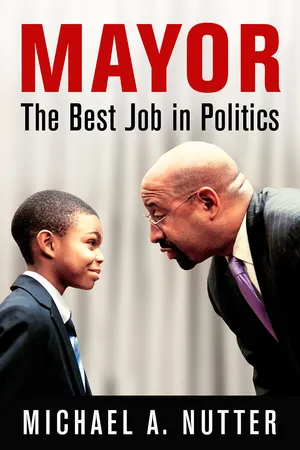
In 2007, after serving almost fifteen years on the Philadelphia City Council, Michael A. Nutter became the ninety-eighth mayor of his hometown of Philadelphia. From the time he was sworn in until he left office in 2016, there were triumphs and challenges, from the mundane to the unexpected, from snow removal, trash collection, and drinkable water, to the Phillies' World Series win, Hurricane Irene, Occupy Philadelphia, and the Papal visit. By the end of Nutter's tenure, homicides were at an almost fifty-year low, high-school graduation and college-degree attainment rates increased significantly, and Philadelphia's population had grown every year. Nutter also recruited businesses to open in Philadelphia, motivating them through tax reforms, improved services, and international trade missions.
Mayor begins with Nutter's early days in politics and ultimate run for mayor, when he formed a coalition from a base of support that set the stage for a successful term. Transitioning from campaigning to governing, Nutter shares his vast store of examples to depict the skills that enable a city politician to lead effectively and illustrates how problem-solving pragmatism is essential for success. With a proven track record of making things work, Nutter asserts that mayoring promises more satisfaction and more potential achievements—for not only the mayor but also the governed—than our fractious political system would have us believe.
Detailing the important tasks that mayoral administrations do, Nutter tells the compelling story of a dedicated staff working together to affect positively the lives of the people of Philadelphia every day. His anecdotes, advice, and insights will excite and interest anyone with a desire to understand municipal government.
- 200 pages
- English
- ePUB (mobile friendly)
- Available on iOS & Android
eBook - ePub
About this book
Information
Publisher
University of Pennsylvania PressYear
2017Print ISBN
9780812250022
9780812250022
eBook ISBN
9780812294873
PART ONE
CHAPTER 1

Where’d You Go to High School?
Philadelphians take great pride in their community and their neighborhoods. I don’t know if this is true of other places because I’ve never lived anywhere else—I was born, raised, and educated, and created all of my trouble, in Philadelphia. It’s not the only place that I’ve ever been, but it is my hometown. I know that many cities claim this title, but we truly are a “city of neighborhoods.” If you meet a Philadelphian somewhere outside of Philadelphia, there are really only two questions that get asked. First, What’s your name? and second, Where’d you go to high school? That second question gives you an answer key to just about everything else you want or need to know.
I grew up at 5519 Larchwood Avenue. My parents moved into the Larchwood Avenue house—a classic, West Philadelphia row house with four bedrooms—in 1956. A year later, when I was born, Philadelphia’s industrial and manufacturing decline was already underway. The city’s population was highest in 1950, and then began to fall as the suburbs grew. Industries and warehouses were leaving the city and unemployment rose, but the high school graduation rate in West Philadelphia did not. My family was the third African American family on our block in 1956. By the time I was around ten years old, there were probably about three white families left on our block, so the neighborhood experienced a pretty rapid turnover. In a “white flight” fueled in part by much easier availability of mortgages for whites, the demographic changed dramatically as whites began to populate the suburbs around Philadelphia. Between 1950 and 1960, Philadelphia’s African American, Latino, and Asian American population increased by 41 percent while its European American population declined by 13 percent. These changes, as well as the degree of racial isolation, were particularly pronounced in North and West Philadelphia, where I lived.
The neighborhood was a middle middle-class place—people were working, but nobody had much money. There was a black-owned grocery store on one end of the block, a white-owned butcher shop, a drug store, and a barber shop on the other end. There were a few bars, too. Every one of the corner properties had a business in it, and these were really the anchors of the neighborhood. Even after the neighborhood changed demographically, many of the non–African American business people stayed, and the mix helped maintain the liveliness of the neighborhood. Larchwood was what we would now refer to as a “mixed use” community, before its time. Larchwood Avenue was a fairly large, two-lane street with parking on both sides, and we played in the street a lot—football, king block, tops, half-ball (stick ball), and other games. The street furnished access to a hospital, so it would never be completely closed off, but we managed play between the cars coming up and down the street anyway. There were some challenging times with gangs and young people and violence in the 1960s and 1970s, but I never felt unsafe on my street.
I believe that a neighborhood and its values often define who we are. Neighbors on my street performed “community service” before that was a term of art. Saturday was the informal neighborhood cleanup day. Most of us had chores. I’d wash down the porch, the steps, and the sidewalk every Saturday before I could play, and a lot of my neighbors were out doing the same thing. It feels as if we had huge snowstorms when I was a kid, or perhaps it was just because I was little. But when I took over the shoveling duties from my father, it was never enough just to do the small part of the sidewalk in front of our house. My father insisted that I shovel all the way to the end of the block, to make a path for the seniors and elderly. I’d help carry groceries or assist older neighbors across the street—we all did that. It was that kind of neighborhood.
The value of respect was very important. This was still an era when any adult on the block was fully empowered and authorized to tell any child to stop doing something. Everybody knew everybody, so there was no running or hiding. My mother had always told me not to walk in the street. One day, when a neighbor was sweeping the sidewalk, I walked in the street to avoid her sweeping, and I got a good talking to when I returned home because one of the neighbors had immediately told my mother what I had done!
The basic rule from my mother did not require that I have a watch, a sundial, or a smartphone: Catalina’s rule was that we had to be on the steps when the street lights come on— and it didn’t necessarily have to be our own steps, but the steps of somebody she knew.
My mom worked for Bell Telephone and my father, Basil, worked for pharmaceutical companies, or sometimes was a plumber, or sometimes didn’t work at all. I have a younger sister, Renee, and my grandmother Edythe lived with us. My mother is a twin, and her sister was married to a fireman, from Engine 11 in South Philly, who worked at the only station where African Americans could work at the time. Her brother Bill, my uncle, went into the military, so my mother was the last one out of the house, and her mother was apparently part of the marriage package.
Politics was not my family business. We were not a deeply political family, and there wasn’t a great deal of political discussion at the dinner table. Parents in the neighborhood were very focused on school and education. Certainly, though, there was some degree of talk about current events and what was going on with this or that elected official in the city.
Although politics was not our family’s stock and trade, I loved American history and government. I had an incredible history teacher at St. Joe’s Prep, Mr. Jerry Taylor, and I always liked the subject. The Watergate hearings were going on one summer during my teens, and I probably knew more about Watergate than any adult around. I watched them as much as I could on our new color television in the living room. I’m not sure why the hearings fascinated me so much. These hearings just seemed to make government, politics, and American history come to life. I was also a little nervous about the Vietnam War draft at this time, too, although the war was winding down, and I remember the barrel and the balls for the draft lottery going around and around. But I found Richard Nixon to be an intriguing character for some reason—such a tangled story of his attempt to cover up shady activity and his lack of honesty with the American public. This made an indelible impression on me about honesty and transparency in government. I had learned about US history in school, and then this drama and slice of history was playing out on television. I think you’d have to go back to the McCarthy House Un-American Activities Committee trials in the 1950s for something comparably riveting, and I don’t think in our times we’ve seen that level of focus, dedication, and indefatigable commitment of elected public officials to our democracy, on either side of the aisle. It captivated me. I knew this was serious.
Many Philadelphians attend their neighborhood high school, but I went to St. Joseph’s Preparatory High School at Seventeenth and Girard, in North Philadelphia. It is the Jesuit high school in Philadelphia, and one of our best schools still today. I had friends in both public and private schools, and we didn’t distinguish much between them. I’d developed an interest in going to military school, partly because I enjoyed a television show on Sundays about kids at a military school, and the back pages of the Philadelphia Inquirer magazine in my childhood would advertise schools such as the Valley Forge and Bordentown military academies. I’d interviewed at both of those schools when my seventh grade teacher, Sister Maureen James, said, “You don’t really want to go to a military school, you want to go to St. Joe’s.” I’d never heard of the Prep, but Sister Maureen was very convincing, and my parents agreed. So I took the summer prep courses and the admissions test, and was admitted for high school.
To get to St. Josephs from my home at Fifty-Fifth and Larchwood, I had to take three different forms of transportation on SEPTA to North Philadelphia—the #56 bus, the El, and either the #2 bus from Center City on Sixteenth Street, or the Broad Street Subway. I was not on the track team, but there was a lot of gang war activity in Philadelphia in the 1970s, and in those years I would ask myself every day, “How fast do I feel I can run?” whether from Broad Street or from Sixteenth Street, to get to Seventeenth and Girard. Frank Rizzo was mayor of Philadelphia at this time, and there were a lot of police–community relations issues in addition to the gang activity. Gangs were identified by streets—the Moon gang, the Barbary Coast, Stiles, or Seybert Street gangs, and so on. There was a lot of concern about traveling and getting around, and navigating gang turf, but mostly no one really bothered the prep school guys wearing jackets and ties.
One of the things I learned early on and firsthand is that the resident of the White House at any given moment makes a huge difference in a city and in our lives. After the 1976 election, Jimmy Carter was president. Actually, he was the first presidential candidate I ever voted for, as I turned eighteen in 1975. President Carter appointed a National Commission on Student Financial Assistance and made college access and affordability a priority. The Middle Income Assistance Acts expanded what we know as the Pell Grant program and subsidized interest on guaranteed student loans. As a consequence of priorities in the White House and legislation in Washington, DC, financial aid skyrocketed for young Americans in my community and all others. My recollection is that every year there was more aid, and colleges had more students of color.
In the aftermath of the riots and other civil rights movements of the 1960s, colleges and universities were also actively, aggressively looking for African American, Latino, and other minority students. All of the parents on Larchwood Avenue were focused on their children going to college, although pretty much none of our parents had gone to college themselves. This was their almost single-minded goal and commitment. The message, reinforced from parents to neighbors to nuns in the schools, was to keep your record clean and stay out of trouble, because then you can go to college. And college was the gateway to a better life. That happened for my cohort of friends, those my age and anyone maybe three or four years older. These older kids we referred to as our “oldheads,” the ones that we looked up to and were occasionally invited to hang out or play in a game with. They were also often our informal mentors.
Virtually everyone on my block in the 1970s went to college. After the 1980 election and the change in presidency to Ronald Reagan, there was a precipitous drop in financial aid for students and especially for students of color, and a precipitous drop in the number of African Americans, Latinos, and other minorities going to college. But in 1975, minorities were highly recruited, and financial aid forged a path for first-generation and lower-income students. That year, I was admitted to the University of Pennsylvania as a biomedical engineering student in the School of Engineering.
CHAPTER 2
How Chemistry 101 and a Disco
Changed My Life
Changed My Life
I have to confess that if I had visited the University of Pennsylvania campus as many times as a student as I did during my eight-year tenure as mayor of Philadelphia, who knows what my future might have been. I might not have been the best or most diligent student, but I had a big ambition, to be a doctor. I wanted to help people.
I came to the University of Pennsylvania from a high school with only 180 seniors in my class, and I went to my first chemistry class at Penn in a Roman-style classroom, with descending stairs and a professor who seemed very far away, a distant speck. The first class was packed—every seat was taken and there were students sitting on the floor and in the aisles.
But Chemistry 101 changed my life forever because it was pretty clear after failing my first few tests that I probably was not going to be a doctor, and it was time to move on. By midsemester in that class, the jam-packed aisles were only a memory: you could sit anywhere you wanted. There were plenty of seats in that chemistry class, that semester.
I graduated in 1979 from the Wharton School, which is the University of Pennsylvania’s business school. Wharton, founded in 1881, was the first collegiate school of business in the world, and it’s one of the most prestigious. How I got to Wharton, however, was a longer saga that, in some ways, first put me on a path to my political future.
It began with my decision to drop that chemistry class. I had several sound reasons for doing this. First, it was clear to me that I was going to fail that course. Second, I’d never intended to be a practicing doctor. I wanted to be an entrepreneur doctor and learn medicine so that I could open a medical devices company and sell and manufacture new products to and for doctors. But I theorized that I had to know and understand medicine in order to create that business. So, in that first course and first semester, I was trying to protect my GPA, and wanted to withdraw before I got an F for the class. Finally, and perhaps most importantly, I remember gazing at the periodic table of elements one day in class and realizing, “I just don’t care enough about this. I’m not going to be a doctor.”
I decided to apply to the Wharton School, on the erroneous assumption that since I was already a student at University of Pennsylvania, I could easily transfer to the business school. My application was rejected, because I hadn’t taken and completed four courses once I withdrew from chemistry. Not only did I not get into Wharton, I attracted unwanted attention from the School of Engineering. They wrote me that they noticed I’d tried to transfer to Wharton, and if I did that again and was rejected, they’d kick me out of the engineering school as well. Welcome to the Ivy League, Mr. Nutter!
When I came back to school in January 1976, I hedged my bets. I applied to Wharton for a second time and also to the School of Arts and Sciences. Wharton rejected me a second time, but the Arts and Sciences school admitted me.
I started taking business and economics courses and decided to be an economics major. But I had a disastrous sophomore year. I had started a job, and was not paying attention or studying nearly enough. I told my mother that college wasn’t going well for me and that I enjoyed work more than school. She said what I thought at the time was a very profound thing: I had swum to the middle of the pool, and I now needed to decide if I would go back to where I started or swim to the other side.
I decided to swim to the other side. I charted out my next few years, and thought about how to get my GPA up and get into Wharton. I was taking six courses a semester to catch up, and also working long hours. By May 1979 I was six courses short of graduation. At this point I’d gotten to know the Wharton School undergraduate dean fairly well and had spent a fair amount of time at the dean’s office. The conversation I now had with the dean was in some respects my first political deal. I proposed to him that I very much wanted to transfer to his school, that I had six courses to complete, and I needed to finish now, in the summer of 1979. I needed special permission from the dean to take three summer courses per semester instead of the maximum of two. The dean agreed—I’d need to get a certain average for all of my summer courses, and if I did, he would approve my transfer to Wharton. I took classes that I needed to take based on the major requirements. I had also calculated for each course what I thought I would or could get grade-wise, estimated any margin of error or slippage, and proceeded to do what I needed to do. I fulfilled the dean’s challenge, our deal was good, and I kept up my part of the bargain.
This meant that almost as I was walking out the door of the University of Pennsylvania, I was finally walking in the door of the Wharton School—from which I did formally graduate, in August 1979.
My collegiate odyssey taught me some valuable lessons, not the least of which c...
Table of contents
- Cover
- Half Title
- Series Page
- Title Page
- Copyright
- Dedication
- Contents
- Prologue. The Best Job in Politics
- Part One
- Part Two
- Part Three
- Conclusion. United Cities of America
- A photo gallery appears between pages 68 and 69
Trusted by 375,005 students
Access to over 1.5 million titles for a fair monthly price.
Study more efficiently using our study tools.
Frequently asked questions
Yes, you can cancel anytime from the Subscription tab in your account settings on the Perlego website. Your subscription will stay active until the end of your current billing period. Learn how to cancel your subscription
No, books cannot be downloaded as external files, such as PDFs, for use outside of Perlego. However, you can download books within the Perlego app for offline reading on mobile or tablet. Learn how to download books offline
Perlego offers two plans: Essential and Complete
- Essential is ideal for learners and professionals who enjoy exploring a wide range of subjects. Access the Essential Library with 800,000+ trusted titles and best-sellers across business, personal growth, and the humanities. Includes unlimited reading time and Standard Read Aloud voice.
- Complete: Perfect for advanced learners and researchers needing full, unrestricted access. Unlock 1.5M+ books across hundreds of subjects, including academic and specialized titles. The Complete Plan also includes advanced features like Premium Read Aloud and Research Assistant.
We are an online textbook subscription service, where you can get access to an entire online library for less than the price of a single book per month. With over 1.5 million books across 990+ topics, we’ve got you covered! Learn about our mission
Look out for the read-aloud symbol on your next book to see if you can listen to it. The read-aloud tool reads text aloud for you, highlighting the text as it is being read. You can pause it, speed it up and slow it down. Learn more about Read Aloud
Yes! You can use the Perlego app on both iOS and Android devices to read anytime, anywhere — even offline. Perfect for commutes or when you’re on the go.
Please note we cannot support devices running on iOS 13 and Android 7 or earlier. Learn more about using the app
Please note we cannot support devices running on iOS 13 and Android 7 or earlier. Learn more about using the app
Yes, you can access Mayor by Michael A. Nutter in PDF and/or ePUB format, as well as other popular books in Politics & International Relations & American Government. We have over 1.5 million books available in our catalogue for you to explore.