At first glance, the Ford Foundation and the black power movement would make an unlikely partnership. After the Second World War, the renowned Foundation was the largest philanthropic organization in the United States and was dedicated to projects of liberal reform. Black power ideology, which promoted self-determination over color-blind assimilation, was often characterized as radical and divisive. But Foundation president McGeorge Bundy chose to engage rather than confront black power's challenge to racial liberalism through an ambitious, long-term strategy to foster the "social development" of racial minorities. The Ford Foundation not only bankrolled but originated many of the black power era's hallmark legacies: community control of public schools, ghetto-based economic development initiatives, and race-specific arts and cultural organizations.
In Top Down, Karen Ferguson explores the consequences of this counterintuitive and unequal relationship between the liberal establishment and black activists and their ideas. In essence, the white liberal effort to reforge a national consensus on race had the effect of remaking racial liberalism from the top down—a domestication of black power ideology that still flourishes in current racial politics. Ultimately, this new racial liberalism would help foster a black leadership class—including Barack Obama—while accommodating the intractable inequality that first drew the Ford Foundation to address the "race problem."
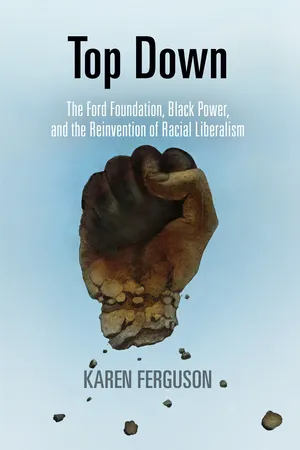
eBook - ePub
Top Down
The Ford Foundation, Black Power, and the Reinvention of Racial Liberalism
- 336 pages
- English
- ePUB (mobile friendly)
- Available on iOS & Android
eBook - ePub
About this book
Information
Publisher
University of Pennsylvania PressYear
2013Print ISBN
9780812245264
9780812245264
eBook ISBN
9780812209037
PART I
_________
Sizing Up the Urban Crisis
Chapter 1
_________
Modernizing Migrants
In 1967, the Ford Foundation’s annual report included a special message from its president, McGeorge Bundy. Writing in the context of what he termed “the terrible riots of 1967,” Bundy’s essay nevertheless put forth a relentlessly positive argument about the nation’s racial future, despite what he acknowledged were the dire facts of its past and present. Among these, he highlighted America’s long and defining history of institutionalized racial exploitation, the white backlash that had met African Americans’ freedom struggle, and the separatism of black power that marked their abandonment of the nation and its liberal promise of equality. Regardless of this dismal record, Bundy pledged that American society would “solve this problem.” “The only possible final outcome,” he claimed, was to emerge on “the far side of prejudice,” to a future in which whites came to “regard as natural the equality” that today “many of … us see only as logical.” “The preachers of hate” both black and white, he wrote, “who seem so much the men of the moment are in fact merely spume on the wave of the past.” They were “temporary” obstructions to the march of progress for black people in a United States whose institutions “will have to be open to all” and in which “Negroes” would “take their share of leadership.”
Bundy based his optimism on the “effort” that the Ford Foundation and other “leaders of good will and peaceful purpose” were willing to take to make his vision come true. “There is nothing automatic about any part of the American Dream,” he told his readers. Instead, those “who want peaceful progress toward equality will have to work for it” with “speed and imagination, as well as steady determination.” Even individuals and institutions, which “have done good work in the past will be found wanting if they do not do still more in the future,” he continued, declaring that his “Ford Foundation expects to be measured by this test.”1
Considering Bundy’s promises from the perspective of a future that is much less than he prophesied despite much steadfast hard work, his vision could be dismissed as liberal bravado masking great uncertainty and fear, especially given the conflict-ridden moment at which he was writing. However, that interpretation would have to ignore the virtually unshakeable worldview, identity, and ethos of the postwar liberal leadership class of which Bundy was a dominant member and the Ford Foundation a dominant institution. Bundy’s conviction about solving the “Negro problem” was consistent not only with the Foundation’s leaders’ long-standing ambition and ethos but also more specifically with their thinking and action on race in the United States. While the race issue did not become a singular focus at the Foundation until Bundy’s presidency, nevertheless the situation of racial minorities in U.S. society had been one of Ford’s central domestic concerns since its emergence as a major philanthropic force in the late 1940s. The “problem” of black assimilation to the mainstream had preoccupied postwar liberals, including those at the Foundation, as a predominant, yet fixable, roadblock to their preeminent goal: the ultimate modernization and flawless operation of the American “system.” The activist, social-engineering ethos of this group that fueled this faith was bolstered by its members’ elitist self-confidence that expert, technocratic management of state and society could lead to the nation’s perfection. McGeorge Bundy’s optimism in 1967 testified to the strength of the establishment creed on which the Ford Foundation was resurrected after the Second World War.
The Foundation and the Postwar Liberal Establishment
A fundamental paradox of the Ford Foundation’s history was that the founder of the greatest philanthropy of the American century was an outspoken critic of institutionalized charity of any sort. The automobile magnate Henry Ford rejected the industrial philanthropy practiced by his forbears, like Andrew Carnegie and John D. Rockefeller, believing instead that his corporate system of mass production for mass consumption, later labeled “Fordism,” had the greatest potential for solving social problems. Nevertheless, Ford felt compelled to create the Foundation in 1936 to shelter his fortune against the Roosevelt administration’s antitrust Revenue Act, which threatened his and his family’s ongoing control of the company through crippling inheritance taxes that would force them to sell their stock in a public offering. What resulted was the “first” Ford Foundation, a regional, family charity that limited itself in its first decades to building hospitals and museums in Michigan, bearing little resemblance to the behemoth it would become.
Henry’s death in 1947, along with the earlier passing of his only child, Edsel, in 1943, would bring about the Foundation’s transformation. Both these men’s enormous fortunes had to be dealt with in order for the Fords to avoid the Internal Revenue Service and for family members to remain at the company’s helm. Consequently, their estates bequeathed what amounted to 90 percent of the company’s holdings to the Foundation in the form of nonvoting company stock, keeping the remaining 10 percent for family members. More important, in order to avoid ongoing scrutiny of the now hugely enriched Foundation from the IRS and Congress, Edsel’s son, Henry II, changed the philanthropy’s very nature, transforming it from a tax shelter serving the family’s charitable pet projects into an independent, arms-length instrument of the public trust and a national and international force commensurate with its vast resources.2
While Henry Ford II faced considerable outside pressure to remake the Ford Foundation in this way, this move also reflected his own proclivities and dramatic postwar changes in American institutional and intellectual life. He played his part in this transformation at Ford Motor Company, a key player in a key postwar industry. After taking over the company in 1945, Henry II revived its dwindling fortunes by being one of the first corporate executives to latch on to systems analysis, a statistical method first used to assess the effectiveness of military weaponry that would soon become a powerful and ubiquitous corporate management tool. To do so, he brought in the so-called Whiz Kids to Ford’s front office, a group that represented the ascendancy of technocratic experts as the key personnel to oversee the large public and private organizations that ran postwar America. This storied group of “organization men” comprised a number of former Air Force specialists, some with strong connections to the Harvard Business School, including Robert McNamara, the future Ford Motor president, U.S. Defense Secretary, and World Bank president. These men’s intersecting university, corporate, military, and government ties epitomized the links between these sectors and the growing consensus among their leaders about the path to American prosperity and power. The younger Henry also forged an accord with organized labor after decades of strife at Ford, thus ending the company’s long-standing anti-unionism. He negotiated landmark postwar contracts with the United Auto Workers’ president Walter Reuther, the quintessential “new man of power” in American labor. Reuther, like Ford, sought higher corporate profits—and hence for Reuther, higher wages and benefits—that labor peace could help bring about. Thus at Ford Motor, Henry II extended the new postwar social consensus about the unlimited potential of corporate capitalism to resolve social conflict and problems in American society.3
Ford’s reliance on university-trained experts, his confidence in empirical research and analysis to solve management problems, his absolute faith in corporate capitalism as a force of good for all, and his drive for conflict resolution and social consensus all reflected the dominant worldview of those at the top of the system that wrought America’s postwar affluence and global dominance. Indeed, he belonged to what sociologist C. Wright Mills called in 1956 the “power elite” and what opponents from both the New Right and New Left of the 1960s would come to label the liberal “establishment.” This was the like-minded and interconnected group of American corporate, government, and military leaders who emerged during and after the Second World War to shepherd the nation’s institutions, including philanthropy, to reflect, manage, and exploit the reality and complexities of worldwide economic and military dominance, Cold War conflict, and corporate ascendancy.4
While members of the establishment often abjured the label when applied to them, and despite the fact that the designation did not come into wide popular use until critics began to use it as a pejorative in the 1960s, it was nevertheless an apt descriptor for this group. Its members did not constitute a secret cabal, even though many of them and their influence were virtually unknown to the public given their behind-the-scenes role in the economy, public affairs, higher education, and the media. Nor did they control politics or policy. In fact, they often faced crippling opposition to their objectives, especially when it came to their aims for American society. They did not even make up a clearly defined social category. Nevertheless, they amounted to a dominant circle of exceptional influence whose ideology shaped a prevalent consensus on American foreign and domestic policy at the height of American world power, from the Second World War until the great anti-establishment rebellions of the Vietnam/black power era. They were not only corporate titans like Henry Ford II but also the leaders of other presiding postwar institutions—corporate law firms, investment banks, elite universities, news media, philanthropies, and think tanks—who often also served, as Robert McNamara and many others did, in executive or advisory roles to presidents and high military command.5
Beyond anything else, this group’s members believed as Henry Ford II did, in corporate capitalism. After all, no one could deny that corporations had supplied and ensured the success of the “arsenal of democracy” that sealed the Allied victory in the Second World War. Why not assume, then, that the system that allowed this success would ultimately be responsible for securing a worldwide Cold War military and ideological triumph for the United States over the Soviet Union and the Communist system? At home, a widespread understanding that the corporate system had facilitated both the mass production and mass consumption that led to the astounding abundance and upward mobility of postwar American society bolstered the establishment’s faith in American capitalism. Establishment members believed that this apparent economic miracle could save the world by lifting everyone out of poverty, thus erasing class conflict and other social differences through a universal, beneficent modernity that would result in world peace. They had no reason to be anything but entirely sincere in these convictions about the greatness of the American way; arguably they were among the most powerful people from the most powerful nation on earth, which had earned that distinction largely by hewing to their model for domestic prosperity and international influence.6
Given this faith in the corporate system, the overarching establishment objective for the postwar period was to create the social, political, and economic conditions that its members believed would best allow the American economy to expand. In doing so, they helped to shape a distinctive postwar liberalism that would dominate American public policy through the Lyndon Johnson era. Unlike earlier generations of elites in the industrial period, including figures like Henry Ford, Sr., leading figures in the postwar establishment, like his grandson, believed in the state as an ally in securing the nation’s economic and social progress. Both the New Deal and the Second World War had taught establishment members that the government had an important role to play in corporate capitalism’s smooth functioning. This belief in a “welfare-market society,” a term used in the late 1940s by liberal public intellectual Walter Lippmann and his young protégé McGeorge Bundy, emerged largely through observing or, more likely for members of the establishment, participating in the war effort.7 They had learned of the benefits of Keynesian pump priming through the system of wartime, publicly funded military contracts that cohered as the military-industrial complex during the seemingly endless crisis of the Cold War. They came to understand the importance of state-sponsored social security to the mass consumption that undergirded the postwar economy. Extending the connection between the government and the corporation, the Cold War bolstered the conviction of establishment members that American foreign policy should work actively to extend this American way throughout the world; indeed it was America’s international duty to do so. At home, most of them supported the labor peace and economic benefits that would result from more widely distributed wealth if they treated with organized labor on its wage and benefit demands. Politically, they prized the social harmony that they believed would accrue from the meliorist social engineering possible in an expert-managed society free from political interference from below. They sought what historian Arthur Schlesinger, Jr., called the “vital center” that their welfare capitalism suggested, and they disdained any form of what they considered political extremism. Unsurprisingly, they eschewed any taint of Communism, but they also hated the demagoguery of the right. For them the right-wing populism of figures like Joseph McCarthy (who, in his antiliberal vendetta, often targeted members of the establishment in his witch hunt) demonstrated the dangerous irrationality of the masses and the disruptive social conflict inherent in mass politics.8
This group of expert managers and social engineers supplanted the older “Eastern” establishment of Mayflower-descended bluebloods and Gilded Age industrialists and their progeny, although a significant minority straddled both old and new elites. The postwar establishment was relatively plural and meritocratic—although virtually lily-white and all male—and its members would work to make it even more diverse in decades to come, at least compared to the hermetically sealed circle of Boston/Philadelphia/New York WASP “society” that had preceded it. A sampling from the inner circle of the quintessential establishment president, John F. Kennedy, gives a sense of this diversity. It included public school-educated Californians like Robert McNamara and descendants of working-class Jewish immigrants like MIT economist and modernization theorist Walt Rostow, as well as the Boston Brahmin, Harvard dean, and future Ford Foundation president, McGeorge Bundy. Thus this postwar formation constituted an aristocracy of talented men: some had worked their way into the establishment, and all had distinguished themselves in more than one of the key settings of the American century. This meritocracy reflected how aptitude and expertise had begun to supplant ancestry for the postwar establishment—an essential shift at the top for the effective functioning of the expansive institutions that now drove the nation.9
With the understanding that they were the best and brightest, and presumably the only ones with the know-how and talent to manage America effectively, establishment members regarded themselves as the guardians of the national interest. Given the enormous wealth at their disposal, as well as their collective identity as the clearheaded and expert stewards of the public good, this group sought private means in order to intervene independently in American society. In doing so, establishment members followed the lead of Gilded Age industrialists by using philanthropy as their activist instrument, remaking the first generation of industrial foundations—Rockefeller, Carnegie, etc.—to serve their postwar aims. Even more exciting was the prospect of an astronomically enriched Ford Foundation remade to their specifications.10
A brief narrative of the Foundation’s postwar renaissance gives a sense of how completely it was the creation and tool of a diverse yet interconnected group of powerful men. In 1948, Henry Ford II began the Foundation’s transformation by appointing a study committee and advisory panel to oversee the reorganization of the Foundation; this panel consisted of two nonfamily-member trustees: Donald K. David, dean of the Harvard Business School and recently appointed director of Ford Motor; and Karl T. Compton, president of MIT and a director of the Rockefeller Foundation. David and Compton chose H. Rowan Gaither, Jr., to oversee the reorganization. Gaither was a San Francisco lawyer who had government experience both in the New Deal and as the assistant director of the wartime Radiation Laboratory at MIT under Compton, where Gaither coordinated government and military contracts and liaised between academic science and industry in the development of radar, a transformative wartime technology. Gaither had recently become the president of the newly created RAND Corporation as it moved to become the most influential policy think tank of the...
Table of contents
- Cover
- Title Page
- Copyright
- Dedication
- Contents
- Introduction
- Part I: Sizing Up the Urban Crisis
- Part II: Transforming the Ghetto
- Part III: Cultivating Leadership
- Epilogue: The Diminishing Expectations of Racial Liberalism
- Notes
- Index
- Acknowledgments
Trusted by 375,005 students
Access to over 1.5 million titles for a fair monthly price.
Study more efficiently using our study tools.
Frequently asked questions
Yes, you can cancel anytime from the Subscription tab in your account settings on the Perlego website. Your subscription will stay active until the end of your current billing period. Learn how to cancel your subscription
No, books cannot be downloaded as external files, such as PDFs, for use outside of Perlego. However, you can download books within the Perlego app for offline reading on mobile or tablet. Learn how to download books offline
Perlego offers two plans: Essential and Complete
- Essential is ideal for learners and professionals who enjoy exploring a wide range of subjects. Access the Essential Library with 800,000+ trusted titles and best-sellers across business, personal growth, and the humanities. Includes unlimited reading time and Standard Read Aloud voice.
- Complete: Perfect for advanced learners and researchers needing full, unrestricted access. Unlock 1.5M+ books across hundreds of subjects, including academic and specialized titles. The Complete Plan also includes advanced features like Premium Read Aloud and Research Assistant.
We are an online textbook subscription service, where you can get access to an entire online library for less than the price of a single book per month. With over 1.5 million books across 990+ topics, we’ve got you covered! Learn about our mission
Look out for the read-aloud symbol on your next book to see if you can listen to it. The read-aloud tool reads text aloud for you, highlighting the text as it is being read. You can pause it, speed it up and slow it down. Learn more about Read Aloud
Yes! You can use the Perlego app on both iOS and Android devices to read anytime, anywhere — even offline. Perfect for commutes or when you’re on the go.
Please note we cannot support devices running on iOS 13 and Android 7 or earlier. Learn more about using the app
Please note we cannot support devices running on iOS 13 and Android 7 or earlier. Learn more about using the app
Yes, you can access Top Down by Karen Ferguson in PDF and/or ePUB format, as well as other popular books in History & North American History. We have over 1.5 million books available in our catalogue for you to explore.