In the last three decades, a brand of black conservatism espoused by a controversial group of African American intellectuals has become a fixture in the nation's political landscape, its proponents having shaped policy debates over some of the most pressing matters that confront contemporary American society. Their ideas, though, have been neglected by scholars of the African American experience—and much of the responsibility for explaining black conservatism's historical and contemporary significance has fallen to highly partisan journalists. Typically, those pundits have addressed black conservatives as an undifferentiated mass, proclaiming them good or bad, right or wrong, color-blind visionaries or Uncle Toms.
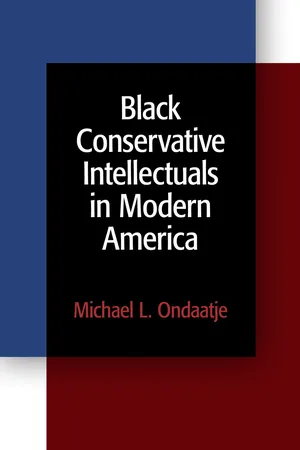
In Black Conservative Intellectuals in Modern America, Michael L. Ondaatje delves deeply into the historical archive to chronicle the origins of black conservatism in the United States from the early 1980s to the present. Focusing on three significant policy issues—affirmative action, welfare, and education—Ondaatje critically engages with the ideas of nine of the most influential black conservatives. He further documents how their ideas were received, both by white conservatives eager to capitalize on black support for their ideas and by activists on the left who too often sought to impugn the motives of black conservatives instead of challenging the merits of their claims. While Ondaatje's investigation uncovers the themes and issues that link these voices together, he debunks the myth of a monolithic black conservatism. Figures such as Supreme Court Justice Clarence Thomas, the Hoover Institution's Thomas Sowell and Shelby Steele, and cultural theorist John McWhorter emerge as individuals with their own distinct understandings of and relationships to the conservative political tradition.
- 232 pages
- English
- ePUB (mobile friendly)
- Available on iOS & Android
eBook - ePub
Black Conservative Intellectuals in Modern America
About this book
Information
Chapter 1
Profiles of an Intellectual Vanguard
During the 1980s and 1990s, a relatively small group of right-wing African American intellectuals—supported by the networks and institutions of the New Right—defined the parameters of contemporary black conservative thought. Derided by progressive critics for lacking racial and cultural authenticity, these intellectuals frequently hit back by writing in personal and political terms about their dual heritage as African Americans. On the one hand, the black conservatives emphasized humble origins—the fact that many of them had grown up poor in black communities before “making it”—to establish their authority to speak to the myriad problems confronting African Americans. But they also drew on the rhetorical traditions of black America, reconfiguring them with the U.S. constitutional tradition and neoclassical economics, to construct something resembling their own distinctive canon. Examination of the personal histories and the nature and content of the thought of the most influential of these intellectuals is essential in the quest for broader conclusions about the phenomenon they represent.
The words “canon” and “phenomenon” imply something monolithic, when, in reality, contemporary black conservatism was more complex and multifaceted than either supporters or critics recognized. Just as there were ideas and opinions that united the cohort, so there were variations and crosscurrents that divided them. Some black conservatives were serious intellectuals; others were media pundits. Some deployed empirical evidence to advance arguments; others relied almost entirely on individual experience. Some were libertarians beholden to complex free-market theory and philosophically opposed to government; others emphasized morality and, in some instances, the need for government to enforce it. Some believed in politics and the importance of engaging the black community; others eschewed politics and spoke of, but never with or to, that community. Some yearned for the death of race and the dawn of a color-blind America; others expressed antipathy toward integration and assimilation, celebrating a golden age of black achievement before civil rights.
Clearly, these intellectuals did not simply offer “a sickeningly familiar neo-conservatism in blackface,”1 as some charged. That being the case, the question of what each intellectual did offer—and why—becomes central to a more comprehensive and sophisticated appreciation of black conservatism itself. If the black conservatives were not products of the same school or students of the same teacher, but pointed to a variety of influences that helped shape their views, what were these influences and how diverse were the views they subsequently embraced? By drawing together threads of information about the various intellectuals and giving a coherence to personal narratives that have only been presented in snippet form in the past, the medium of biography allows for a new and more complex addition to scholarship on this powerful current in American society.
Any discussion of the major black conservative thinkers of the past three decades must take as its starting point Clarence Thomas, for he, more than any other individual, personified the rise of black conservatism during this period. Described by one commentator as “perhaps the only Supreme Court Justice who might be recognized in the check-out line at the Giant,”2 Thomas became, upon appointment to the bench in 1991, one of the most divisive figures in national life.3 Of course, this black conservative might not be considered an “intellectual” in the traditional academic sense; however, many of his pre–Supreme Court writings on race and class displayed an intellectual flavor and, in the 1980s, were critical in popularizing contemporary black conservative thought. But while Thomas the “public figure” has been the focus of a torrent of analysis and opinion, sophisticated treatments of the political philosophy of Thomas the “conservative legal intellectual” have remained scarce.
Perhaps part of the reason for this reluctance to engage Thomas’s philosophy was that it was so fraught with internal inconsistencies, making it difficult to pin down and explain. On the one hand, for example, Thomas condemned affirmative action for placing the interests of groups before individuals.4 He also charged that the policy stamped minorities with a badge of inferiority that “may cause them to develop dependencies or to adopt an attitude that they are entitled to preferences.”5 Yet Thomas claimed to identify with Malcolm X, a leader whose popularity with blacks stemmed largely from his emphasis on the power of the collective.6 Moreover, racial preferences did not appear to have harmed Thomas himself. In yet another paradoxical display, he once conceded that, if not “for affirmative action programs, God only knows where I would be today. These laws and their proper application are all that stand between the first 17 years of my life and the second 17 years.”7
Consistency appeared to elude the Justice in other areas too. As a member of the administrations of Reagan and Bush, Thomas firmly insisted “the Constitution be interpreted in a colorblind fashion,” since apparently “it was futile to talk of a colorblind society unless this constitutional principle is first established.”8 But there was another Clarence Thomas who openly questioned the value of pursuing such a society, seeing color-blindness as impossible in a country where “blacks will never be seen as equal to whites.”9 Too often, a commitment to color-blindness, he believed, sent a message to African Americans that black institutions—and thereby black people—were inferior. For this reason, Thomas attacked the 1954 Brown v. Board of Education decision—which abolished segregation in public schools—as being based on “dubious social science evidence.” “Black children,” he argued, “gain nothing from simply sitting next to whites and can do quite well in their own schools.”10
Thomas’s ideas were often credited to Booker T. Washington.11 This was not surprising, since—like Washington—Thomas had declared that the issue “is economics—not who likes you,” imploring blacks to eschew government and do for themselves.12 But unlike Washington, who preached a collectivist message of economic empowerment for the black community, the Justice’s idea of racial salvation was predicated, almost entirely, on an appeal for more individual effort in the service of self and family. An admirer of Ayn Rand’s libertarian tracts The Fountainhead and Atlas Shrugged, Thomas warned his son that he would “personally hunt you down and kick your behind from one end of America to the other” if he ever heard any “whining about how you can’t make it because you are black.”13 While perceiving “a mean callous world out there . . . still very much filled with discrimination,”14 this black conservative went on, contradictorily, to reject the view that racism continued to inhibit black social mobility, offering his own life experiences as evidence for his claim.
Thomas’s past—his life and work—offers the key to understanding what can only be described as an enigmatic worldview. Born into the segregated world of rural Georgia in 1948, Thomas wrote frequently of a childhood marred by racial poverty and hardship. Raised by his sharecropper grandfather in a house without indoor plumbing, he claimed to have worked the land, struggling to “survive under the totalitarianism of segregation, not only without the active assistance of government but with its active opposition.”15 It was in these early years, Thomas later recalled, that his hostility to state intervention developed: since government was the problem, not the solution, for Southern blacks, economic self-reliance seemed the best—indeed, the only—way forward.16
Schooled by nuns at a small segregated Catholic school in Savannah, Thomas briefly contemplated life as a priest before being accepted to study liberal arts at Holy Cross, a Jesuit college in Massachusetts.17 If his Catholicism had already consigned him to outsider status in the Southern black community, Thomas’s voyage into higher education in the North would set him even further apart. Admitted to Holy Cross as part of a special scholarship program set up for African Americans in the wake of Martin Luther King’s assassination, he flirted with political radicalism for a time, donning the beret of the Black Panther Party and declaring himself a disciple of Malcolm X.18 Yet, as one commentator noted, “in an era when Malcolm X’s autobiography was on the school’s freshman reading list and torn fatigues and berets were the fashion, it was easy to confuse style with substance.”19 In Thomas’s case, style appeared to trump substance. According to one former classmate, the future Supreme Court Justice’s penchant for iconoclasm and controversy was already well known: he was always “seeking out isolated, idiosyncratic positions where, characteristically, he could be alone.”20
Despite modest academic results at Holy Cross, Thomas was accepted to Yale Law School as part of an aggressive affirmative action program to increase black student representation.21 But stung by a succession of personal failures early on in his tenure,22 he began to feel “stigmatized rather than helped by race-conscious aid” and to suspect resentment on the part of white faculty at his presence in the classroom.23 The personal uncertainty that plagued Thomas during these years led him to reject affirmative action and was arguably the catalyst for his subsequent conversion to conservative politics.24 Abandoning his commitment to “radical social justice” in only his second year at Yale, the new Clarence Thomas declared his intention to work in private practice to earn “a lot of money.”25 This about-face turned out to be his making.
Thomas was employed in a number of high-profile government and legal positions upon graduation in 1974.26 Yet visibility in the conservative movement eluded him until the Fairmont Conference in 1980. Having wandered for so long “in the desert of political and ideological alienation,” he arrived at the conference “bubbling, bursting with excitement,” relieved finally to have “found a home” among like-minded African Americans.27 Dazzling the luminaries of the New Right with his uncompromisingly conservative approach to black issues, Thomas was soon profiled in the Washington Post in an article that served as a virtual “advertisement for employment in the new administration” of Ronald Reagan.28 This article would be the first of many about Clarence Thomas and mark the beginning of his rapid ascent into the highest echelons of American society.
Appointed in 1981 to the high-ranking position of Assistant Secretary for Civil Rights in the Department of Education, Thomas was soon promoted to chair the Equal Employment Opportunity Commission (EEOC), supervising until 1990 the entire federal effort to curb prejudice in the workplace. He dramatically transformed the culture of the EEOC, shifting the burden of proof from employers to employees in discrimination suits and rejecting group remedies to workplace inequity. He also abandoned the use of timetables and numeric goals, which allowed companies greater flexibility in the hiring of minorities, even though he himself had been a beneficiary of these mandates.29 Indeed, by the mid-1980s, Thomas had become linked with the broader onslaught against civil rights occurring under Reagan and developed into a fully fledged ideologue of the New Right.30 Courting a close political relationship with George Bush in the election year of 1988, he poured all his energy into the Republican campaign, assuming special responsibility for promoting the presidential hopeful’s credentials with African Americans.31 Thomas’s efforts were duly rewarded. After a brief stint at the U.S. Court of Appeals (for the District of Columbia) to gain “some experience,” President Bush appointed him to the Supreme Court, insisting he was “the best qualified man for the job on the merits.”32
How was Thomas’s climb from rural poverty to the heart of American judicial power to be explained? The new Justice offered his own interpretation. “Only in America,” Thomas exclaimed, on the day Bush nominated him to the Supreme Court, could a person from such humble origins have risen to a position of such eminence. He continued: “As a child, I could not dare dream that I would ever see the Supreme Court—not to mention to be nominated to it. Indeed, my most vivid childhood memory of a Supreme Court was the ‘impeach Earl Warren’ signs that lined Highway 17 near Savannah. I didn’t quite understand who this Earl Warren fellow was, but I knew he was in some kind of trouble. I thank all those who have helped me along the way and who helped me to this point and this moment in my life, especially my grandparents, my mother, and the nuns—all of whom were adamant that I grow up to make something of mysel...
Table of contents
- Cover
- Title
- Copyright
- Contents
- Introduction
- 1. Profiles of an Intellectual Vanguard
- 2. Affirmative Action Dilemmas
- 3. Partisans of the Poor?
- 4. Visions of School Reform
- Conclusion
- Notes
- Index
- Acknowledgments
Trusted by 375,005 students
Access to over 1.5 million titles for a fair monthly price.
Study more efficiently using our study tools.
Frequently asked questions
Yes, you can cancel anytime from the Subscription tab in your account settings on the Perlego website. Your subscription will stay active until the end of your current billing period. Learn how to cancel your subscription
No, books cannot be downloaded as external files, such as PDFs, for use outside of Perlego. However, you can download books within the Perlego app for offline reading on mobile or tablet. Learn how to download books offline
We are an online textbook subscription service, where you can get access to an entire online library for less than the price of a single book per month. With over 1.5 million books across 990+ topics, we’ve got you covered! Learn about our mission
Look out for the read-aloud symbol on your next book to see if you can listen to it. The read-aloud tool reads text aloud for you, highlighting the text as it is being read. You can pause it, speed it up and slow it down. Learn more about Read Aloud
Yes! You can use the Perlego app on both iOS and Android devices to read anytime, anywhere — even offline. Perfect for commutes or when you’re on the go.
Please note we cannot support devices running on iOS 13 and Android 7 or earlier. Learn more about using the app
Please note we cannot support devices running on iOS 13 and Android 7 or earlier. Learn more about using the app
Yes, you can access Black Conservative Intellectuals in Modern America by Michael L. Ondaatje in PDF and/or ePUB format, as well as other popular books in Politica e relazioni internazionali & Conservatorismo e liberalismo. We have over 1.5 million books available in our catalogue for you to explore.