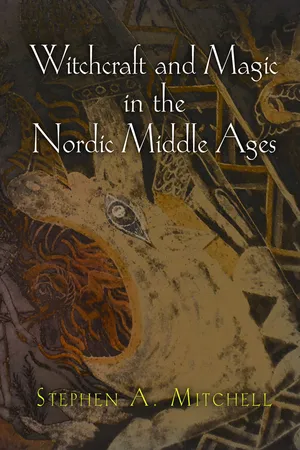
Stephen A. Mitchell here offers the fullest examination available of witchcraft in late medieval Scandinavia. He focuses on those people believed to be able—and who in some instances thought themselves able—to manipulate the world around them through magical practices, and on the responses to these beliefs in the legal, literary, and popular cultures of the Nordic Middle Ages. His sources range from the Icelandic sagas to cultural monuments much less familiar to the nonspecialist, including legal cases, church art, law codes, ecclesiastical records, and runic spells.
Mitchell's starting point is the year 1100, by which time Christianity was well established in elite circles throughout Scandinavia, even as some pre-Christian practices and beliefs persisted in various forms. The book's endpoint coincides with the coming of the Reformation and the onset of the early modern Scandinavian witch hunts. The terrain covered is complex, home to the Germanic Scandinavians as well as their non-Indo-European neighbors, the Sámi and Finns, and it encompasses such diverse areas as the important trade cities of Copenhagen, Bergen, and Stockholm, with their large foreign populations; the rural hinterlands; and the insular outposts of Iceland and Greenland.
By examining witches, wizards, and seeresses in literature, lore, and law, as well as surviving charm magic directed toward love, prophecy, health, and weather, Mitchell provides a portrait of both the practitioners of medieval Nordic magic and its performance. With an understanding of mythology as a living system of cultural signs (not just ancient sacred narratives), this study also focuses on such powerful evolving myths as those of "the milk-stealing witch," the diabolical pact, and the witches' journey to Blåkulla. Court cases involving witchcraft, charm magic, and apostasy demonstrate that witchcraft ideologies played a key role in conceptualizing gender and were themselves an important means of exercising social control.
What sort of information is useful for the study of medieval witchcraft? More to the point, perhaps, what sort of evidence is not? Church statutes, amulets, court records, runic inscriptions, pictorial representations of witches, and so on all have their parts to play. Interpreting bygone cultures clearly requires us to have access to “data,” the information-laden detritus that history capriciously bequeaths to us. Having collected it, scholars grandly organize these materials into what we trust are sensible taxonomies and refer to the results with all-too-obvious high hopes as “databases” and the like. And as we sift for meaningful patterns in what are more realistically called our “data middens,” mounds of serendipitously preserved intelligence, what images of magic and witchcraft precipitate out?
Frankly, the very randomness of our information can create peculiar pictures. To take an example from our own world, how might a future group of scholars, many millennia from now, understand the state of Christianity in the twenty-first century if their “data midden” consisted solely of several fundamentalist hymnals, assorted Orthodox icons, a collection of papal bulls, a Christmas wreath, a recording of the Missa Luba, Thomas Aquinas’s Summa Theologica, a well-preserved cathedral, a King James translation of the Bible, a U.S. dollar bill with the legend “In God We Trust,” Anton LaVey’s The Satanic Bible, and a decorated Easter egg? Would our future colleagues not be tempted to force some contrived interpretation on these diverse and eclectic materials, torturing them into a harmonious narrative that might make sense to them (and appear to be consistent with the data), but strike any living observer today as absurd?
An impossible example? Perhaps, but the problem it presents very much resembles our situation in dealing with aspects of spiritual life in medieval Scandinavia. In the case of the present study, the resources available to us are not unlike the situation faced by our hypothetical future students of twenty-first-century Christianity in that, like them, we are dealing with a chorus composed of many different voices, with a far less centrally harmonized libretto in the pre-Christian era. Studies of medieval popular culture, and medieval popular religion in particular, frequently note different sociological layers—generally bifurcated into elite versus nonelite. Even this view, which sees, as one scholar summarizes it, “two distinct cultures, the one clerical and bookish, the other popular, oral and customary, the first accessible through traditional intellectual and spiritual categories, the second mainly through cultural anthropology and comparative religions,” fails to appreciate adequately the complexity of the systems under discussion.1 How then do the religious systems and demographics of medieval Scandinavia impinge on our—and its—understanding of witchcraft?
The Cultures, the Sources, and the Method
Given the monolithic stereotype of Scandinavia, it is important to underscore the rich diversity of the medieval Nordic world, an area that spanned much of Northern Europe, including Greenland, Iceland, and the Faroes, of course, but also Shetland and parts of insular and coastal Scotland; it also included modern-day Norway, Denmark, and Sweden, and Gotland to be sure, but also parts of coastal Finland and other areas around the Baltic littoral, and extended south into modern Germany. Complex not only in geography but also in cultural terms, late medieval Scandinavia possessed both Alpine and maritime economies, rich farmlands, mines, courts, international trading centers, remote valleys, and isolated farms, and the people, foreign-born and native, speakers of various Germanic, Finnic, and Balto-Slavic dialects, to go with them.2
In brief, the political history of Scandinavia in the later Middle Ages can be characterized as one in which a period of growing Norwegian influence becomes one of rapidly expanding Danish hegemony, followed by a century-long effort by Sweden-Finland to free itself from this arrangement, a feat finally managed in the 1520s.3 By the late thirteenth century, a muscular Norway had control of Iceland, Greenland, the Faroes, Shetland, and Orkney and wrestled with Scotland over its continued possession of the Hebrides—it is indicative of the period that King Hákon Hákonarson died in Orkney in 1263, following a mostly inconclusive invasion of Scotland over the very issue of the Hebrides. Marriages arranged between the various Scandinavian royal houses led to the birth of Magnus Eriksson, son of the powerful Swedish duke, Erik Magnusson, and Ingibj
rg, the daughter of King Hákon of Norway.
Magnus thus technically became king of Sweden and Norway throughout much of the fourteenth century, followed by a brief period during which Sweden was governed by Albrecht von Mecklenburg. Growing German influence, especially from cities like Lübeck through their role in the Hanseatic League, was an important factor in many of the political, linguistic, and cultural developments of late medieval Scandinavia, rivaled in significance only by the mid-fourteenth-century arrival of the Black Death. Through dynastic marriage arrangements, political upheavals, and a series of deaths, claims to all three Nordic crowns could be made toward the end of the fourteenth century by Margarethe of Denmark, under whose influence the so-called Union of Kalmar was forged in 1397, in theory creating a united political entity of Scandinavia under a single monarch. The history of the fifteenth century is largely framed by the struggles of Sweden-Finland to wrest its independence from the Danish crown, something finally accomplished under Gustav Vasa’s leadership in 1523.4
The impignoration to Scotland of Orkney in 1468, followed in 1469 by the similar mortgaging of Shetland, further diminished the Danish empire and removed from the Nordic world the last vestiges of its former possessions in the British Isles. By the end of the medieval period, the Nordic world thus consisted of a Swedish-Finnish kingdom and a still very impressive Danish kingdom, including Norway, Iceland, and the Faroes. Although certain provinces were hotly contested, especially border areas such as Skåne and Bohuslän, for the most part these areas did not take their present places on the political map until the seventeenth century; Gotland, traditionally a broadly autonomous region within the Swedish orbit, fell to Denmark in 1361 and did not come under Swedish rule again until 1645.5
Trade ensured lively communications between such increasingly important Nordic emporia as Bergen, Copenhagen, and Stockholm, and their Dutch, British, German, and other Baltic counterparts.6 With the conversion to Christianity came the rapid growth of a church infrastructure and religious houses, and Scandinavia too took its place among the recently converted in venerating local saints—for example, Saint Knútr and Saint Knútr Lavard in Denmark; Saint Magnús in Orkney; Saint Þorlákr in Iceland; Saint Óláfr in Norway; Saint Sigfrid, Saint Botvid, and Saint Erik in Sweden; and Saint Henry in Finland—as well the remarkable Saint Birgitta of Sweden (1303–37), who was officially canonized.7 The image of daily life that emerges from, for example, the original and translated (and almost always also transformed) literature of the Nordic Middle Ages is extremely rich and can give modern readers a vibrant sense of that world.8
For all the diversity apparent in the Nordic world, there exists a modern tendency to divide its population along simple lines into a ruling elite, on the one hand, and an unlettered peasantry, on the other, institutional versus noninstitutional entities (also often vicarial representatives for Christian and pagan, one suspects, and a host of other dyads necessary for the description of medieval Scandinavia, such as noninsular and insular). Although not without its advantages, this view of the Middle Ages tends to assume, for example, that a medieval fisherman believed in and practiced magic, whereas a monk did not. In all likelihood, both of them did.
This elite versus nonelite model of the medieval world has been criticized and challenged in recent years, and instead of a simple bifurcation between clerical and lay, elite and popular, and so on we should bear in mind that a more nuanced and synthetic image comes by envisioning individuals in terms of their relation to a number of factors, not just those two poles.9 The results provide a more rounded and realistic view of lived lives and do not automatically slot individuals into proscribed behaviors, allowing us to see from our materials that priests, princes, and wealthy merchants, for example, were just as capable of a “magical worldview” as farmers, laborers, and prostitutes.10
In fact, the Nordic world is rich in resources for the student of medieval popular culture, perhaps especially where witchcraft is concerned: a wide array of nonnormative texts provide insights into how the image of the witch was constructed in the Scandinavian world, providing opportunities for us to see realities that go beyond condemnations of magic and its practitioners by authors representing church and state.11 Broadly speaking, we look to either material objects, such as paintings and talismans, or narratives, that is, texts and monuments in one sense or another, for our knowledge. About all of these materials—laws, literature, historical chronicles, synodal statutes, letters, skaldic poems, sermons, charms, prayers, the visual arts—the same questions need to be asked: not just when and where they were written, but also for whom, to what purpose, under what sponsorship, and so on. Among the documents most influential in shaping attitudes toward witchcraft, of course, were those authored by, for, and within the church. Prohibitions against witchcraft and magic were developed and promulgated first and foremost by this tissue-thin—if deeply influential—segment of society, together with secular authorities, and it is overwhelmingly their views that inform standard visions of medieval Nordic witchcraft. But in addition to these institutional images of witchcraft, it is important to keep in mind opportunities to discover additional perspectives and attitudes, ones that reflect the full spectrum of society, not just its apex of educated elites.12
Despite modern assumptions about the uniform vision that Christianity had of witchcraft, ecclesiastical works are no more monolithic than other forms of narratives. Hagiographies, spiritual literature in the vernacular, homilies, miracle collections, prayer books, synodal statutes, and penitentials collectively suggest trends in medieval thinking about magic and witchcraft among learned ecclesiastics but do not present a uniform impression. For their part, legal texts represent an area with considerable overlap between church and state: the reticulation between these two poles of authority was great at the time the materials were codified, and many of the medieval Nordic law codes specifically include sections relating to religious life (e.g., kyrkobalker).13
An attractive nuisance I hope to have avoided in working with these materials is the assumption that the more official the source of our information, the more its data should be trusted. Scholarship has found this caution to be especially true of such presumed gateways to truth as court documents, whether ecclesiastical or secular, to which a modern audience naturally attaches significant probative value.14 In addition to these official narratives, a diverse network of unofficial sources of information exists, a designation not intended to deny the influence of the church, either direct or indirect, on the materials. Paramount among these sources are the Icelandic sagas, to which may be added a wide array of other resources, including runic inscriptions and other ...
Table of contents
Cover
Half title
Title
Copyright
Dedication
Contents
Preface
Introduction
Chapter 1. Witchcraft and the Past
Chapter 2. Magic and Witchcraft in Daily Life
Chapter 3. Narrating Magic, Sorcery, and Witchcraft
Chapter 4. Medieval Mythologies
Chapter 5. Witchcraft, Magic, and the Law
Chapter 6. Witchcraft, Sorcery, and Gender
Epilogue: The Medieval Legacy
Notes
Works Cited
Index
Acknowledgments
Trusted by 375,005 students
Access to over 1.5 million titles for a fair monthly price.
Study more efficiently using our study tools.
Frequently asked questions
Yes, you can cancel anytime from the Subscription tab in your account settings on the Perlego website. Your subscription will stay active until the end of your current billing period. Learn how to cancel your subscription
No, books cannot be downloaded as external files, such as PDFs, for use outside of Perlego. However, you can download books within the Perlego app for offline reading on mobile or tablet. Learn how to download books offline
Perlego offers two plans: Essential and Complete
Essential is ideal for learners and professionals who enjoy exploring a wide range of subjects. Access the Essential Library with 800,000+ trusted titles and best-sellers across business, personal growth, and the humanities. Includes unlimited reading time and Standard Read Aloud voice.
Complete: Perfect for advanced learners and researchers needing full, unrestricted access. Unlock 1.5M+ books across hundreds of subjects, including academic and specialized titles. The Complete Plan also includes advanced features like Premium Read Aloud and Research Assistant.
Both plans are available with monthly, semester, or annual billing cycles.
We are an online textbook subscription service, where you can get access to an entire online library for less than the price of a single book per month. With over 1.5 million books across 990+ topics, we’ve got you covered! Learn about our mission
Look out for the read-aloud symbol on your next book to see if you can listen to it. The read-aloud tool reads text aloud for you, highlighting the text as it is being read. You can pause it, speed it up and slow it down. Learn more about Read Aloud
Yes! You can use the Perlego app on both iOS and Android devices to read anytime, anywhere — even offline. Perfect for commutes or when you’re on the go. Please note we cannot support devices running on iOS 13 and Android 7 or earlier. Learn more about using the app
Yes, you can access Witchcraft and Magic in the Nordic Middle Ages by Stephen A. Mitchell in PDF and/or ePUB format, as well as other popular books in History & European Medieval History. We have over 1.5 million books available in our catalogue for you to explore.