In the year 726 C.E., the Byzantine emperor Leo III issued an edict declaring images to be idols, forbidden by Exodus, and ordering all such images in churches to be destroyed. Thus commenced the first wave of Byzantine iconoclasm, which ran its violent course until 787, when the underlying issues were temporarily resolved at the Second Council of Nicaea. In 815, a second great wave of iconoclasm was set off, only to end in 842 when the icons were restored to the churches of the East and the iconoclasts excommunicated.
The iconoclast controversies have long been understood as marking major fissures between the Western and Eastern churches. Thomas F. X. Noble reveals that the lines of division were not so clear. It is traditionally maintained that the Carolingians in the 790s did not understand the basic issues involved in the Byzantine dispute. Noble contends that there was, in fact, a significant Carolingian controversy about visual art and, if its ties to Byzantine iconoclasm were tenuous, they were also complex and deeply rooted in central concerns of the Carolingian court. Furthermore, he asserts that the Carolingians made distinctive and original contributions to the whole debate over religious art.
Images, Iconoclasm, and the Carolingians is the first book to provide a comprehensive study of the Western response to Byzantine iconoclasm. By comparing art-texts with laws, letters, poems, and other sources, Noble reveals the power and magnitude of the key discourses of the Carolingian world during its most dynamic and creative decades.
- 497 pages
- English
- PDF
- Available on iOS & Android
eBook - PDF
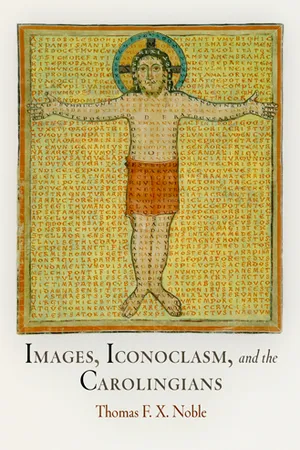
Images, Iconoclasm, and the Carolingians
About this book
Information
Table of contents
- Cover
- Contents
- Introduction
- CHAPTER ONE: Art, Icons, and Their Critics and Defenders Before the Age of Iconoclasm
- CHAPTER TWO: Byzantine Iconoclasm in the Eighth Century
- CHAPTER THREE: Art and Art Talk in the West in the First Age of Iconoclasm
- CHAPTER FOUR: The Franks and Nicaea: Opus Caroli Regis
- CHAPTER FIVE: Tradition, Order, and Worship in the Age of Charlemagne
- CHAPTER SIX: The Age of Second Iconoclasm
- CHAPTER SEVEN: Art and Argument in the Age of Louis the Pious
- CONCLUSION
- NOTES
- BIBLIOGRAPHY
- INDEX
- ACKNOWLEDGMENTS
Trusted by 375,005 students
Access to over 1.5 million titles for a fair monthly price.
Study more efficiently using our study tools.
Frequently asked questions
Yes, you can cancel anytime from the Subscription tab in your account settings on the Perlego website. Your subscription will stay active until the end of your current billing period. Learn how to cancel your subscription
No, books cannot be downloaded as external files, such as PDFs, for use outside of Perlego. However, you can download books within the Perlego app for offline reading on mobile or tablet. Learn how to download books offline
Perlego offers two plans: Essential and Complete
- Essential is ideal for learners and professionals who enjoy exploring a wide range of subjects. Access the Essential Library with 800,000+ trusted titles and best-sellers across business, personal growth, and the humanities. Includes unlimited reading time and Standard Read Aloud voice.
- Complete: Perfect for advanced learners and researchers needing full, unrestricted access. Unlock 1.5M+ books across hundreds of subjects, including academic and specialized titles. The Complete Plan also includes advanced features like Premium Read Aloud and Research Assistant.
We are an online textbook subscription service, where you can get access to an entire online library for less than the price of a single book per month. With over 1.5 million books across 990+ topics, we’ve got you covered! Learn about our mission
Look out for the read-aloud symbol on your next book to see if you can listen to it. The read-aloud tool reads text aloud for you, highlighting the text as it is being read. You can pause it, speed it up and slow it down. Learn more about Read Aloud
Yes! You can use the Perlego app on both iOS and Android devices to read anytime, anywhere — even offline. Perfect for commutes or when you’re on the go.
Please note we cannot support devices running on iOS 13 and Android 7 or earlier. Learn more about using the app
Please note we cannot support devices running on iOS 13 and Android 7 or earlier. Learn more about using the app
Yes, you can access Images, Iconoclasm, and the Carolingians by Thomas F. X. Noble in PDF and/or ePUB format, as well as other popular books in History & European Medieval History. We have over 1.5 million books available in our catalogue for you to explore.