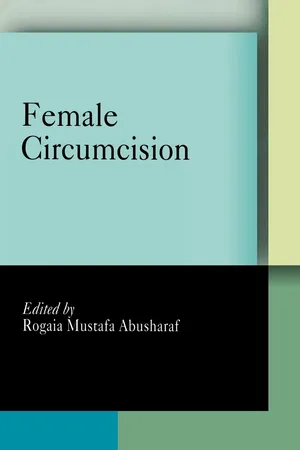
Bolokoli, khifad, tahara, tahoor, qudiin, irua, bondo, kuruna, negekorsigin, and kene-kene are a few of the terms used in local African languages to denote a set of cultural practices collectively known as female circumcision. Practiced in many countries across Africa and Asia, this ritual is hotly debated. Supporters regard it as a central coming-of-age ritual that ensures chastity and promotes fertility. Human rights groups denounce the procedure as barbaric. It is estimated that between 100 million and 130 million girls and women today have undergone forms of this genital surgery.
Female Circumcision gathers together African activists to examine the issue within its various cultural and historical contexts, the debates on circumcision regarding African refugee and immigrant populations in the United States, and the human rights efforts to eradicate the practice. This work brings African women's voices into the discussion, foregrounds indigenous processes of social and cultural change, and demonstrates the manifold linkages between respect for women's bodily integrity, the empowerment of women, and democratic modes of economic development.
This volume does not focus narrowly on female circumcision as a set of ritualized surgeries sanctioned by society. Instead, the contributors explore a chain of connecting issues and processes through which the practice is being transformed in local and transnational contexts. The authors document shifts in local views to highlight processes of change and chronicle the efforts of diverse communities as agents in the process of cultural and social transformation.
- 296 pages
- English
- ePUB (mobile friendly)
- Available on iOS & Android
eBook - ePub
About this book
Information
Topic
Ciencias socialesSubtopic
AntropologíaChapter 1
Introduction: The Custom in Question
I do not wish them to have power over men; but over themselves.
—Mary Wollstonecraft, A Vindication of the Rights of Woman, 1792
When the sign heralding the promising waters arrives-the sighting of flying fish beyond the prow of the boat-the crewman facing forward ought to be the first to see them.
—Toni Morrison, Playing in the Dark, 1992
Changing traditions and behaviors that have such long histories is not easy. When one does not understand a problem it is not easy to appreciate it. If you do not understand your health, you cannot appreciate the problems of female genital cutting, and if you do not continue to educate people they will not understand. All we are seeking is knowledge. Knowledge will change people’s attitudes.
—Mansata, former female circumciser in the Gambia, 2000
Bolokoli, khifad, tahara, tahoor, qodiin, irua, hondo, kuruna, negekorsigin, and kene-kene are a few of the terms used in local African languages to denote a set of cultural practices collectively known as female circumcision. These practices, which are fervently adhered to by some ethnic and national groups, “are differentially embedded in specific institutional and social structures” (Kratz 1994: 346). In each context, there is marked variation in prevalence, in the type of surgery performed, and in the rituals associated with it. Even within the same geographic locality, the nature of the practice, its justifications, and the age at which it is performed differ vastly by ethnicity and class. For instance, among the Yoruba of southwestern Nigeria, 90 percent of adults remain determinedly committed to the perpetuation of female circumcision, whereas in another section of the same ethnic group, the Ijebus, this tradition, which was formerly widespread in the community, has been unreservedly rejected (WHO 1996).
Generations of supporters of these contested practices espouse a wide range of ideas about why female circumcision constitutes an important part of their cosmology and worldview. These practices, which others often contemplate with horror and trepidation, are exalted and sanctified through the very language used to refer to them. Most of the local terms translate as ritual purification. To followers, these operations are, first and foremost, important events constituting “a domain of cosmological fixity: the changes they encompass are a recalibration of local detail to the grand order of things” (Herzfeld 2001: 209).
No one has been able to identify the origin of female circumcision with any accuracy, and explanations of its genesis and growth remain highly speculative. One prevalent belief, which was widely held by some European travelers, saw the practice as an ancient Egyptian invention and explained its adoption in other localities as a product of cultural diffusion. For example, Karim and Ammar showed how “Aetius (A.D. 502–575) quoted with approval the Egyptian custom of the amputation of the clitoris before it grows large chiefly about the time when the girl is marriageable” (Karim and Ammar 1965: 3). However, the ascription of the practice to ancient Egypt remains highly controversial in historical scholarship.
An alternative, yet equally ubiquitous supposition on the question of origin has identified Islam as the incontestable source of the practice. This assumption is clear in David Gollaher’s argument that “In the world of Islam, female circumcision has long been acknowledged as a rightful counterpart to male circumcision” (Gollaher 2000: 191). Linking female circumcision to Islamic philosophy and instruction has proven quite dubious. If Islam is indeed the foundation of female circumcision, how can we explain the persistence of the tradition among non-Muslim peoples who embrace it with equal ardor and enthusiasm? Conversely, how can we account for the fact that the great majority of adherents in some Muslim societies do not carry out any form of female genital excision? Contrary to the facile correlation of Islam and female circumcision evidenced in Esther K. Hicks’s Infibulation: Female Mutilation in Islamic Northeast Africa (1996), extensive ethnographic studies and demographic reports have demonstrated that people across religious affiliations share the notion that female circumcision is an act of cleanliness and self-control. When the Islamic jurist Jamal Badawi was asked about the existence of authentic texts in the primary sources of Islam which require female circumcision for religious reasons, his reply was unequivocal: “no mention of female circumcision is to be found in the Qur’an either directly or indirectly. There is no known Hadith which requires female circumcision” (Badawi 2000: 2). Since the Qur’an (the scripture believed to be revealed to the Prophet Muhammad) and the Hadith (the teachings of the Prophet) are the two most important sources for all aspects of jurisprudence and social regulation, the absence of female circumcision from these texts and teachings demonstrates that the various views surrounding the practice are matters of interpretation. These competing interpretations are not to be equated with incontrovertible religious edicts. Several leading Muslim jurists have confirmed that there should be no conjecture or speculation about the fact that these practices preceded Christianity and Islam, and that, whatever their origin may be, the call for ending these harmful operations should be loud and clear. The Religious Leaders’ Symposium, held in Gambia in 1998, was a step in the direction of a public repudiation of the practice; the Arusha Declaration on Harmful Traditional Practices urged religious leaders to take concrete steps to strengthen their commitment to educating, sensitizing, and convincing their followers to end female circumcision by forming coalitions for this purpose (see IAC Newsletter 28, December 2000: 16).
While female circumcision is, for the most part, carried out in Africa, it exists among other ethnic communities in India, Malaysia, the Arabian Peninsula, and Indonesia (Aldeeb 2001). It is estimated that over 130 million girls and women have undergone genital excision and at least two million per year are expected to go through the practice (WHO 1999). Rising tides of migration have altered the geographical distribution of female circumcision dramatically and prompted momentous debates on tolerance, asylum-seeking and refugee-determination systems, and multiculturalism. Tom Hundley of the Chicago Tribune commented that until a few years ago, female circumcision was thought to be a Third World problem, but now, because of shifting immigration flows, the practice has appeared in Europe, especially in Italy, France, Britain, and the Scandinavian countries. Health authorities in Italy estimated that 40,000 women of African origin, mostly Somalis, have undergone the practice and 5000 young girls are currently at risk. The Centers for Disease Control and Prevention estimated that, in the United States alone, more than 150,000 women and girls of African origin have already been cut or might have the operation performed on them (Hundley 2002). On the medical front, health care providers are starting to learn about circumcised female bodies. An article featured in the Philadelphia Inquirer reported: “After years of unprecedented African immigration North American health professionals are seeing growing numbers of women who have undergone the controversial practice of female genital mutilation. Doctors have been confronting difficult births, unusual gynecologic problems and ethical quandaries, complicated by their own emotions as they try to relate to patients who consider ritual mutilation normal and proper” (McCullough 1999: 1). The rise of immigration from circumcision-practicing societies to the United States, Canada, Australia, and Western Europe led one observer to aver: “The custom of female circumcision could no longer be considered the possession of any people or continent” (Williams 1997: 498).
Local customs determine which kind of genital surgery girls undergo. The major types of surgical operations are grouped by the World Health Organization (WHO) into three categories (WHO 1998: 5–6). If the clitoris is entirely or partially removed, the operation is termed a clitoridectomy. In excision, the clitoris and part of or all of the labia minora, the inner lips of the vagina, are excised. The most drastic form of genital surgery is infibulation, in which the clitoris and labia minora are removed and then the labia majora, the outer lips of the vagina, are stitched together to cover the urethral and vaginal entrances and a new opening is created for the passage of urine and menstrual blood. Trained or untrained midwives, traditional healers, barbers, and occasionally doctors or nurses perform these surgeries. The consequences of these practices are unquestionably grave. In addition to the immediate risks of bleeding, shock, and sepsis and the longer-term risks of infertility, infection, and obstructed labor, there is an increasing concern in medical circles that unsterilized instruments may be spreading the AIDS virus, particularly when group circumcisions are performed. In her essay “Traditions Against Health: The Struggle for Change,” the Sierra Leonian activist Olayinka Koso-Thomas wrote: “In most African countries, as well as in many other parts of the world, certain traditions, which have been kept intact for generations, have had serious effects on the health of the population. The continuation of one of these traditions remains baffling to those who understand its consequences, feel its impact on their lives, and suffer from its application” (Koso-Thomas 1995: 122).
Numerous groups in Africa today are grappling with these practices, which have proven harmful to women and girls, in an attempt to end them once and for all. Increasingly, female circumcision is becoming a focus of eradication programs throughout those African communities in which it is practiced. The well-informed efforts of African men and women to extirpate female circumcision are an obvious sign of significant social transformations that testify to new and emerging forms of internal self-criticism and cultural change. Organizations have adopted comprehensive strategies to persuade people to abandon the practice by articulating this initiative in culturally acceptable terminology and by employing legal, medical, political, and economic means to foster women’s political representation and ability to partake in decision making processes. Today the Comité National de Lutte contre la Pratique de l’Excision in Burkina Faso, the National Association of Nigerian Nurses and Midwives, the Babiker Badri Scientific Association for Women’s Studies in the Sudan, the National Research Network in Senegal, the National Union of Eritrean Youth, the Seventh Day Adventist Church in Kenya, the Egyptian Task Force, and the Maendeleo Ya Wanawake Organization in Kenya, in addition to 26 active branches of the Inter-African Committee on Traditional Practices Affecting the Health of Women and Children, are all addressing this highly sensitive issue. However, these organizations are well aware that female circumcision cannot be targeted for eradication in isolation from other equally pressing problems affecting the welfare of individuals and communities.
Perennial Debates
Language
Any meaningful discussion dealing with the question of female circumcision should heed the importance of terminology. As David Palmer argues, “language is the stage on which consciousness makes its historical entrance and politics is scripted” (Palmer 1990: 3). Attention to language is vital to understanding the political and ideological debates that surround the subject of circumcision. As the chapters in this volume make clear, the debates on what terms to use to describe these practices extend well beyond words. These practices, which have commanded the attention of Christian missionaries, colonial governments, human rights activists, health providers, and feminists, have come to be widely known as female genital mutilation (FGM). The joint statement issued in April 1997 by WHO, UNICEF, and UNFPA defined the practice as follows: “Female genital mutilation comprises all procedures involving partial or total removal of the external female genitalia or other injury to the female genital organs whether for cultural or other non-therapeutic reasons” (WHO/UNICEF/UNFPA 1997: 6). The Technical Working Group of the World Health Organization agreed that the adoption of Female Genital Mutilation (FGM) as a standard term for these practices is essential for research, training, planning, policy making, and formulating appropriate legislation at all levels (WHO 1996: 5). Participants stressed that the term FGM should include the physical, psychological, and human rights aspects of the practice (WHO 1998). Some nongovernmental organizations have chosen to adopt female genital cutting (FGC), a medical term which appears to be more neutral and sensitive to local beliefs.
Terminology cannot be isolated from the political discourse from which it emanates, or from devising suitable approaches to end the practice. In this collection, the contributors use the terms female circumcision, female genital mutilation, and/or female genital cutting, depending on their preferred practice. The term circumcision is used because it translates directly into African languages and because researchers have found that using FGM alienates those who still support the practice and must be persuaded to relinquish it. After all, these practitioners are the most important players in any effort aiming at obliterating the practice from society. Contributors who choose to use female genital mutilation explain how terminology figured in their particular experiences in the field with shifting attitudes within local communities; this matter is especially salient in Mohamud, Radney, and Ringheim’s discussion of the Alternative Rites of Passage program in Kenya and Abdel Hadi’s analysis of the abandonment of the practice in Deir El Barsha, a village in rural Egypt.
Beyond the diversity of terminology used in this volume, the question remains: Is female circumcision a vicious act of mutilation and injury, or a virtuous act of purity and rectitude? Two opposing views dominate current debates, one authorizing cultural accommodation and the other advocating the observance of universal standards of human rights. The former view has been widely vilified for sanctioning violence under the guise of culture, and the latter has been reproved for its ethnocentric stance toward cultural rights. The fundamental ideas embedded in these divergent viewpoints toward the practice deserve consideration.
Cultural Accommodation
Both practitioners and scholars endorsing accommodation of cultural difference and the “free exercise of culture” proclaim that reducing the ritual to a crime, as missionary, colonial, and feminist discourses have done, reflects the inability to “read and to see and to hear female genital mutilation as a series of complex social practices and signifiers which circulate in many other practices and signifiers to produce mutable and mutating and mutual social texts” (Fraser 1995: 338). Anthropologists have made significant contributions illuminating the motives for these rituals and the cultural contexts within which female circumcision is carried out (e.g., Boddy 1998; Gruenbaum 2001; Nhlaop 2000; Shweder 2002). Insofar as a culture is a “society’s repertory of behavioral, cognitive, and emotional patterns” (Harris 1971: 137), it is self-evident that decisions affecting people’s lives are not taken at random. In the words of Michael Ignatieff, “Increasing the freedom of people to exercise their rights depends on close cultural understandings of the frameworks that often constrain choice” (Ignatieff 2001: 72). Indeed, awareness of the body of knowledge, capabilities, and habits associated with female circumcision is key to the comprehension of its persistence across time and locales. Understanding the reasons behind these practices, however, does not imply that we should close our eyes to the effects of the practice on women’s bodies. Rather, such knowledge helps us understand why this rite has met with the approval of its adherents for thousands of years.
In one of the touchstone studies on female circumcision, Woman, Why Do You Weep? the Sudanese physician Asma El Dareer began with these words: “I was circumcised in 1960, at the age of 11 years. I remember every detail of that operation, and that the worst part was when the wound became infected and I had to be given five injections of penicillin by the operator, a qualified nurse. From that time, I began to think, to wonder why girls are circumcised and to learn more about it” (El Dareer 1983: iii). The multiplicity of reasons advanced to explain why female circumcision is practiced all underscore the centrality of these practices in the formation of social identities across practicing communities. Why, then, do women subject themselves and their daughters to this unmistakably harmful tradition? To chart an episteme or a configurational interpretation of these practices, we must analyze the particular contexts within which such practices come to be accepted and upheld (Abusharaf 1998, 2001; Shweder 2002).
Many decades ago, Ruth Benedict argued that in all studies of social custom, the crux of the matter is that the behavior under consideration must pass through the needle’s eye of social acceptance, and only viewing history in its widest sense can give an account of these acceptances and rejections (Benedict 1934: 232). Despite the austere nature of this ritual, its practitioners have attached important symbolic qualities to it. Not only have they come to accept the practice, but they also cling to it with conviction. From the standpoint of adherents, the performance of tahara invites an abundance of exultation, happiness, and joy. Such enthusiasm and devotion are rationalized on several grounds and supported by explanations that help spell out why this contested tradition continues to enjoy such a strong hold on people in many societies today. Supporters attest to its significance in defining and reinforcing ethnicity. Because the justifications of the practice as a vehicle for making ethnic boundaries are forcefully engraved in the consciousness of the community, few could acknowledge the legitimacy of anti-circumcision messages. In a study unraveling the magnitude of the practice and characteristics of practitioners in West Africa, Diop et al. have unearthed complex factors linking circumcision to ethnicity. The authors stated, “Consideration of numerous characteristics suggests that those that are most significant in Burkina Faso are Islamism and ethnicity (specifically the Mossi). The probability of being circumcised is three times higher among the Mossi and twice as high for Muslim girls. In Mali, the practice is nearly universal, but the probability of being circumcised is highest for the Bambara/Malinke ethnic group. All ethnic groups in the Kassena-Nankana District of northern Ghana practice FGC” (Diop et al. 2001: 1–2).
Common rationalizations for the continuation of the practice include its role in shaping and defining feminine sexuality and gender, aesthetics, tradition, and religiosity, through which “cultural meanings are renewed and recreated on a stage as wide as society itself” (Diamond 1989: 150). In spite of the continued physical suffering that envelopes genital excision, it remains a powerful celebration of, and homage to, what is desirable and considered befitting in specific communities. As I have argued elsewhere (Abusharaf 2001), not only have these supporters discounted the severe nature of the surgery, but they also continue to stress its symbolism and metaphoricity. Suffering and pain, they confirm, subside in the face of joy and pride, which form emotional attachments among girls who undergo the practice together as initiates, as well as between themselves and their sponsors and spectators. This process, as several studies on ritual symbolism indicate, represents the alphabet of gender conditioning. According to Audrey Richards, the importance of symbolism in ritual secures a kind of emotional compromise, which satisfies the majority of the individuals who compose a society and support its major institutions (Richards 1982: 169). Female circumcision, analogous to other rites of initiation, can be seen as a way to metamorphose “the physical body into a sort of social filter able to contain within a social form, biological forces and libidinal energies that lie beneath” (Turner 1995: 168). It is clear that this practice is entangled in an ideological web of social relations in a given community of practitioners. This conception not only illuminates the ways in which ideology shapes practices, but also contributes to comprehension of how emotional ties to specific rituals take hold and prosper. In the course of the elaborate festivities and the rites associated with genital alterations, pain and suffering are appropriated and employed as techniques for cr...
Table of contents
- Cover
- Title
- Copyright
- Contents
- 1. Introduction: The Custom in Question
- Part I: Local Contexts and Current Debates
- Part II: African Campaigns to Eradicate Female Circumcision
- Part III: Debates in Immigrant-Receiving Societies
- Notes
- List of References
- List of Contributors
- Index
- Acknowledgments
Trusted by 375,005 students
Access to over 1.5 million titles for a fair monthly price.
Study more efficiently using our study tools.
Frequently asked questions
Yes, you can cancel anytime from the Subscription tab in your account settings on the Perlego website. Your subscription will stay active until the end of your current billing period. Learn how to cancel your subscription
No, books cannot be downloaded as external files, such as PDFs, for use outside of Perlego. However, you can download books within the Perlego app for offline reading on mobile or tablet. Learn how to download books offline
Perlego offers two plans: Essential and Complete
- Essential is ideal for learners and professionals who enjoy exploring a wide range of subjects. Access the Essential Library with 800,000+ trusted titles and best-sellers across business, personal growth, and the humanities. Includes unlimited reading time and Standard Read Aloud voice.
- Complete: Perfect for advanced learners and researchers needing full, unrestricted access. Unlock 1.5M+ books across hundreds of subjects, including academic and specialized titles. The Complete Plan also includes advanced features like Premium Read Aloud and Research Assistant.
We are an online textbook subscription service, where you can get access to an entire online library for less than the price of a single book per month. With over 1.5 million books across 990+ topics, we’ve got you covered! Learn about our mission
Look out for the read-aloud symbol on your next book to see if you can listen to it. The read-aloud tool reads text aloud for you, highlighting the text as it is being read. You can pause it, speed it up and slow it down. Learn more about Read Aloud
Yes! You can use the Perlego app on both iOS and Android devices to read anytime, anywhere — even offline. Perfect for commutes or when you’re on the go.
Please note we cannot support devices running on iOS 13 and Android 7 or earlier. Learn more about using the app
Please note we cannot support devices running on iOS 13 and Android 7 or earlier. Learn more about using the app
Yes, you can access Female Circumcision by Rogaia Mustafa Abusharaf in PDF and/or ePUB format, as well as other popular books in Ciencias sociales & Antropología. We have over 1.5 million books available in our catalogue for you to explore.