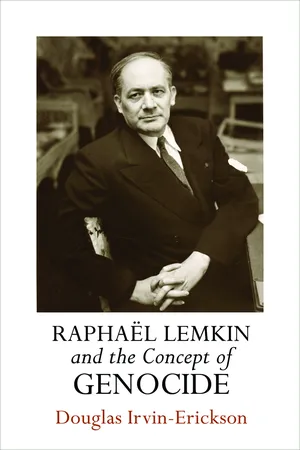
Raphaël Lemkin (1900-1959) coined the word "genocide" in the winter of 1942 and led a movement in the United Nations to outlaw the crime, setting his sights on reimagining human rights institutions and humanitarian law after World War II. After the UN adopted the Convention on the Prevention and Punishment of the Crime of Genocide in 1948, Lemkin slipped into obscurity, and within a few short years many of the same governments that had agreed to outlaw genocide and draft a Universal Declaration of Human Rights tried to undermine these principles.
This intellectual biography of one of the twentieth century's most influential theorists and human rights figures sheds new light on the origins of the concept and word "genocide," contextualizing Lemkin's intellectual development in interwar Poland and exploring the evolving connection between his philosophical writings, juridical works, and politics over the following decades. The book presents Lemkin's childhood experience of anti-Jewish violence in imperial Russia; his youthful arguments to expand the laws of war to protect people from their own governments; his early scholarship on Soviet criminal law and nationalities violence; his work in the 1930s to advance a rights-based approach to international law; his efforts in the 1940s to outlaw genocide; and his forays in the 1950s into a social-scientific and historical study of genocide, which he left unfinished.
Revealing what the word "genocide" meant to people in the wake of World War II—as the USSR and Western powers sought to undermine the Genocide Convention at the UN, while delegations from small states and former colonies became the strongest supporters of Lemkin's law—Raphaël Lemkin and the Concept of Genocide examines how the meaning of genocide changed over the decades and highlights the relevance of Lemkin's thought to our own time.
- 319 pages
- English
- PDF
- Available on iOS & Android
eBook - PDF
Raphaël Lemkin and the Concept of Genocide
About this book
Information
Table of contents
- Cover
- Contents
- Introduction
- Chapter 1. Youth, 1900–1932
- Chapter 2. The League of Nations Years, 1933–1939
- Chapter 3. Writing Axis Rule in Occupied Europe, 1939–1944
- Chapter 4. Axis Rule in Holocaust and Genocide Studies
- Chapter 5. The Nuremberg Years, 1944–1946
- Chapter 6. The United Nations Years, 1946–1948
- Chapter 7. The Final Years, 1948–1959
- Conclusion. The Crime of Crimes
- Notes
- Index
- Acknowledgments
Trusted by 375,005 students
Access to over 1.5 million titles for a fair monthly price.
Study more efficiently using our study tools.
Frequently asked questions
Yes, you can cancel anytime from the Subscription tab in your account settings on the Perlego website. Your subscription will stay active until the end of your current billing period. Learn how to cancel your subscription
No, books cannot be downloaded as external files, such as PDFs, for use outside of Perlego. However, you can download books within the Perlego app for offline reading on mobile or tablet. Learn how to download books offline
Perlego offers two plans: Essential and Complete
- Essential is ideal for learners and professionals who enjoy exploring a wide range of subjects. Access the Essential Library with 800,000+ trusted titles and best-sellers across business, personal growth, and the humanities. Includes unlimited reading time and Standard Read Aloud voice.
- Complete: Perfect for advanced learners and researchers needing full, unrestricted access. Unlock 1.5M+ books across hundreds of subjects, including academic and specialized titles. The Complete Plan also includes advanced features like Premium Read Aloud and Research Assistant.
We are an online textbook subscription service, where you can get access to an entire online library for less than the price of a single book per month. With over 1.5 million books across 990+ topics, we’ve got you covered! Learn about our mission
Look out for the read-aloud symbol on your next book to see if you can listen to it. The read-aloud tool reads text aloud for you, highlighting the text as it is being read. You can pause it, speed it up and slow it down. Learn more about Read Aloud
Yes! You can use the Perlego app on both iOS and Android devices to read anytime, anywhere — even offline. Perfect for commutes or when you’re on the go.
Please note we cannot support devices running on iOS 13 and Android 7 or earlier. Learn more about using the app
Please note we cannot support devices running on iOS 13 and Android 7 or earlier. Learn more about using the app
Yes, you can access Raphaël Lemkin and the Concept of Genocide by Douglas Irvin-Erickson in PDF and/or ePUB format, as well as other popular books in Politics & International Relations & Social Science Biographies. We have over 1.5 million books available in our catalogue for you to explore.