In the face of an uncertain and dangerous world, Americans yearn for a firm moral compass, a clear set of ethical guidelines. But as history shows, by reducing complex situations to simple cases of right or wrong we often go astray.
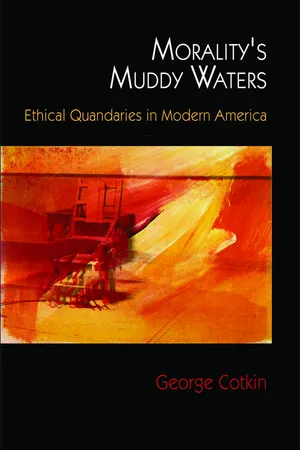
In Morality's Muddy Waters, historian George Cotkin offers a clarion call on behalf of moral complexity. Revisiting several defining moments in the twentieth century—the American bombing of civilians during World War II, the My Lai massacre, racism in the South, capital punishment, the invasion of Iraq—Cotkin chronicles how historical figures have grappled with the problem of evil and moral responsibility—sometimes successfully, oftentimes not. In the process, he offers a wide-ranging tour of modern American history.
Taken together, Cotkin maintains, these episodes reveal that the central concepts of morality—evil, empathy, and virtue—are both necessary and troubling. Without empathy, for example, we fail to inhabit the world of others; with it, we sometimes elevate individual suffering over political complexities. For Cotkin, close historical analysis may help reenergize these concepts for ethical thinking and acting. Morality's Muddy Waters argues for a moral turn in the way we study and think about history, maintaining that even when answers to ethical dilemmas prove elusive, the act of grappling with them is invaluable.
- 272 pages
- English
- ePUB (mobile friendly)
- Available on iOS & Android
eBook - ePub
About this book
Information
Chapter One
The Problems of Evil
An image in the New York Times in the spring of 1945 shows a crate recently discovered by American soldiers near the Nazi extermination camp at Buchenwald.1 In it are thousands of wedding bands ripped from the fingers of victimized Jews before the Nazis exterminated them by gas, starvation, or overwork. These rings, symbols of commitment and caring, had been reduced by the Nazis to objects for their own aggrandizement. More graphic images from this time refuse to let us rest easily in the face of atrocity. Think here of the oft-reprinted pictures of bodies of dead Jews, stacked as if in woodpiles, or of emaciated Jews, among the living-dead, wondering with hollow-eyed disbelief at the miraculous nature of their own survival. A relative of mine, serving with the United States Army, was among those who liberated one of these death camps. He was shaken to the core of his being by what he had seen. It stained the remainder of his days, and he was always a bit “off,” distracted, unable to sink roots.
Should we call what he witnessed evil? If so, how can we explain it? Evil strikes me as the proper term for Nazi totalitarianism, for Stalin’s purges, for the genocide of too many ethnic groups since, and even for the use of conventional and atomic bombs against civilian targets during World War II. These events should be understood as evil—as affronts to our moral imagination.2 Many of the moral moments that will be discussed in this book pivot on the hard ground of evil. But, as we shall see, even when evil is called by name, solutions to it remain clouded by ambiguity. Morality demands that we respond to evil, but it does not tell us exactly what to do. Oftentimes, various forms of evil are forced to duel with one another; we opt for the lesser of two evils, finding ourselves with “dirty hands” rather than with a clear moral victory.
Some readers may chafe at talk of evil as too tinged with religious overtones or weighted by heavy metaphysical baggage. It resists explanation and therefore obfuscates reality or explains away horror—all dangers, to be sure. But as novelists concerned with the human condition know full well, evil is in the sinews of our existence. In Cormac McCarthy’s novels, in the character of the Judge in Blood Meridian (1985), evil towers over the landscape, dancing and howling with delight as the rivers run blood-red. In a more contemporary setting in No Country for Old Men (2005), Anton Chigurh is a man devoted to his vocation of murder with a strange sense of duty and a total lack of compassion. Think, too, of the well-known character Hannibal Lecter, in Thomas Harris’s novel The Silence of the Lambs (1988). Lecter delights in murdering and then consuming his victims. The FBI needs his brilliant mind to help them track down a serial killer. Neophyte FBI agent Clarice Starling apparently believes that psychological explanations for human behavior can reveal Lecter’s essential motivations. Lecter quickly disabuses her of this notion. “Nothing happened to me, Officer Starling. I happened. You can’t reduce me to a set of influences. You’ve given up good and evil for behaviorism, Officer Starling. You’ve got everybody in moral dignity pants—nothing is ever anybody’s fault. Look at me, Officer Starling. Can you stand to say to me I’m evil? Am I evil, Officer Starling?”3
Philosopher Hannah Arendt had seen evil actions, and she knew that evil takes various forms. But she wavered over the years about how to conceptualize it. While the embers of the crematoria were still aglow, she set about her grim, near-ten-year task of charting and understanding the evil of her time, in the slim hope that her work might prevent its virulent reappearance. I begin with Arendt because she devoted much of her intellectual and philosophical life to tracking down this scourge, bringing it to judgment in the court of thought, and gauging its complexities.
Arendt in Germany
As a German-born Jew, twenty-six-year-old Arendt witnessed the emergence of Nazi evil. Before she devoted years to thinking about the problem of evil, she had fought it. Her Berlin apartment became a temporary stopping place for anti-Nazi activists fleeing Hitler’s terror. She worked in archives to compile a list of anti-Semitic statements to document the spiraling hatred against Jews in Germany, for use at a Zionist congress to be held that summer in Prague. Then Arendt’s subversive work came to a quick end. In spring 1933 she was arrested, questioned, and imprisoned for eight days. The arresting officer, however, treated her with fatherly concern: He allowed her to purchase cigarettes prior to her interrogation, and he promised to get her released. Miraculously, he did arrange for her freedom. In an interview thirty years later, Arendt recalled the police officer as a man with an “open, decent face,” a “charming fellow!” However benevolent her captor, Arendt could predict her fate in Germany. Along with her mother, she quickly fled, first to Prague, then to Geneva, eventually to Paris, and finally to a permanent home in the United States in 1941.4
Americans Facing Evil
Arendt was hardly the only one in America after World War II to contend with the problem of evil. Popular fiction widely vetted the issue. Meyer Levin sought to confront the will to evil and its aftermath. In his bestselling novel Compulsion (1956), he examined the notorious case of Nathan Leopold and Richard Loeb. Two brilliant Chicago teens, Leopold and Loeb in 1924 murdered another teenager in cold blood, as a callous expression of their free will. To what degree, Levin wondered, might this will to power, this affinity with evil, be within all of us? As Levin recalled, he had even felt the tantalizing seduction of evil at one point in his life. During World War II, he realized he could rape a defenseless German woman and rationalize it away as revenge for what the Nazis had done.5 But he chose not to.
In his later work, Levin became obsessed with Anne Frank and the murderous machinery that had condemned the young woman to death. Her purity and talent stood as a beacon, but, he cautioned, she should not become merely a naïve symbol of human goodness. Instead, we must never forget to focus on the evil that was done to her.6
Richard Wright, in his 1953 novel The Outsider, allows his protagonist, Cross Damon, a chance for a life free from tradition, morality, and commitments to others. Damon’s status as a newly minted superman allows him to kill with apparent impunity and lack of regret. Freedom goes to his head, and he fails to realize, until it is too late, that it brings with it responsibilities both to oneself and to others.7 The concept of unchecked freedom suffuses Wright’s novel, but radical evil as a genetic trait comes to define another bestselling work of the period, William March’s The Bad Seed (1954). Outwardly charming and bright, Rhoda Penmark is a child serial killer, apparently lacking any sense of limits or conscience for her actions. When her caring mother discovers that her own mother was a serial killer, she realizes her child has inherited the “bad seed.”8 This depiction of a serial killer as a sort of genetic development served as yet another explanation for radical evil. Soon after the war, in a similar manner, British historian Hugh Trevor-Roper argued that Hitler’s evil was demonic, almost beyond explication, akin to a genetic anomaly, something that simply occurred.9
Contemporary theologian Reinhold Niebuhr pondered issues of evil, sin, and free will in almost all of his writing. He viewed human existence as tragic; men and women created evil when they chose to think of themselves as all-knowing, dominating, infinite creatures. Such hubris, such a lack of a sense of limitation, struck Niebuhr as the essence of evil.10 As he put it in the preface to one of his many books, “Christianity’s view of history is tragic insofar as it recognizes evil as an inevitable concomitant of the highest spiritual enterprises.”11 Evil came with the territory of being human, but it had to be fought at each and every turn.
In his journal politics, Dwight Macdonald, a free-spirited writer and close friend of Arendt, exploded with moral outrage against the evils revealed by the concentration camps and atomic bombs. Trying to comprehend the Nazi “death factories,” Macdonald remarked that “reality has now caught up with Kafka’s imagination.” This was an apt literary allusion. In Kafka’s short story The Penal Colony, a modern torture machine etches onto the body of the victim a history of his presumed crimes. Macdonald shivered at how he now lived in Kafka’s universe, in a world run “amok.”12 The sum total of insanity and evil afoot was exacerbated by the stunning reality of the atomic bomb: no “good,” he wrote, “can be extracted from the Evil” of atomic weapons. Any rationalization for the use of the bomb, Macdonald declared, “reveals how inhuman our normal life has become.”13 Our traditional ways of thinking had, quite simply, been rendered obsolete by the death camps and atomic bombs.
A new world, drenched with evil, confronted Lewis Mumford as well. A well-known urban and architectural critic, Mumford had lost a son in action in Italy during World War II. After the explosion of two atomic bombs in Japan, he became convinced that millions more sons, and perhaps the human race, would soon forfeit their lives to nuclear madness. In a series of impassioned books and essays, Mumford confronted the evil of nuclear weapons: “The end of the world,” he announced, was not “apocalyptic hyperbole.”14 Barbarism, disintegration, genocide, irrationality, depravity, and nihilism, for Mumford, became the signposts of a new and frightening evil.15 Others agreed. In such apocalyptic times, one had to struggle, lest—as Norman Cousins famously wrote in the Saturday Review of Literature immediately after the Hiroshima bomb had been dropped—we surrender to the conviction that “modern man is obsolete.”16
Too often we think of the postwar years in America, when Arendt composed her work on evil, as awash in confidence and consumerism, lulled into mundane conformity by sock hops and madcap television comedy shows. Some historians have argued that the Nazi crimes against the Jews were largely absent from the consciousness of Americans during this period. Yet even in the most optimistic and upbeat books of the postwar years, evil threatens to crash the party. In the bestseller Peace of Mind (1948), Rabbi Joshua Loth Liebman admitted at the outset that “we are endowed with explosive energies as ruthless and amoral as the atomic bomb.” He noted, too, that ours is an “age of fierce turmoil and harrowing doubts.” He desperately wanted, through a combination of psychology and religion, to wean individuals away from anger, anxiety, and hatred, and to deposit them in a safe haven of happiness. Responding to the horrors of the Holocaust, Liebman based his therapeutic ideals on tolerance, love, balance, and forgiveness.17 But more was needed. Arendt first had to excavate the ruins of Nazi totalitarianism in order to comprehend what had happened.
Writing Origins of Totalitarianism
Almost immediately after arriving in the United States in 1941, and for the next eight years, Arendt labored on her study of totalitarianism. In the midst of composition, she learned more about the extent of the Nazi horror. By the time she completed the work, she faced the growing specter of Senator Joseph McCarthy’s fanatical anti-communist campaign.18 Beginning in the 1930s, and continuing into the late 1940s, consideration of the new phenomenon of totalitarianism had become something of an academic cottage industry. Some of these works began when the threat of the Nazi state first appeared on the European continent; the focus of later studies shifted to understanding the nature of the Soviet state and the People’s Republic of China. Such worries of course, connected to the realities of the Cold War, which, as historian Leo P. Ribuffo has remarked, “was awash in moral judgments.”19 But the historian Abbott Gleason notes in his bravura study of totalitarianism that Cold War concerns were not central to Arendt’s project. She wanted to get to the heart of the matter—to grasp the whys and hows of the rise of the totalitarian state, despite its illogic and fevered madness.20
Arendt’s Origins of Totalitarianism describes how changes beginning in the late nineteenth century set the stage for totalitarianism. The work has a breathtaking structure, proposing to demonstrate how anti-Semitism and imperialism, along with the decline of the nation-state, somehow became an incubus of totalitarianism. At times, the work seemed to escape the bounds of historical analysis and enter into what sociologist Philip Rieff termed a “theology of politics.” Rieff recognized that Arendt’s book, despite its thick shellac of historical material, was riveted on the spiritual life—the fall of humanity, the appearance of a new form of evil in the world—without a glance at any potential for redemption.
Before focusing on these thorny moral and theological issues, a brief analysis of the argument made by The Origins of Totalitarianism is in order. For while Arendt worked hard to present a coherent and wide-ranging historical narrative, her analysis remains confusing. Too often, she lumps together disparate entities or tosses off an ill-considered judgment. No matter how riddled with gaffes, Arendt’s text remains a testament to a mind struggling to find moral bearings in a world adrift in evil.21
Arendt maintains that the nation-state, whatever its problems in the late nineteenth century, at least offered Jews a modicum of protection. Jews flourished by serving these states as bankers and middlemen, part of an emerging cosmopolitan bourgeoisie. But at the same time, their role in helping bring about the modern social order would paradoxically imperil them.22 New forces had been unleashed with the development of imperialism. In a narrative that leaves numerous logical gaps, Arendt posits imperialism as having created models of exploitation and criminality that define totalitarian states. Imperialism also fed into racial doctrines that appealed to mobs and elites, especially in new forms of pan-tribalism. Finally, in the wake of the destruction of World War I and the evolution of the mob into the mass (united only by shared feelings of alienation and superfluity), totalitarian movements arose.
The allure of totalitarianism, in Arendt’s view, lay in its seductive promises to the masses. By the postwar 1920s, after years of witnessing the declining value of craft skill...
Table of contents
- Cover
- Title
- Copyright
- Contents
- Preface
- Introduction
- 1 The Problems of Evil
- Part I. In Times of War
- Part II. In Times of Peace
- Part III. Present Problems
- Notes
- Index
Trusted by 375,005 students
Access to over 1.5 million titles for a fair monthly price.
Study more efficiently using our study tools.
Frequently asked questions
Yes, you can cancel anytime from the Subscription tab in your account settings on the Perlego website. Your subscription will stay active until the end of your current billing period. Learn how to cancel your subscription
No, books cannot be downloaded as external files, such as PDFs, for use outside of Perlego. However, you can download books within the Perlego app for offline reading on mobile or tablet. Learn how to download books offline
Perlego offers two plans: Essential and Complete
- Essential is ideal for learners and professionals who enjoy exploring a wide range of subjects. Access the Essential Library with 800,000+ trusted titles and best-sellers across business, personal growth, and the humanities. Includes unlimited reading time and Standard Read Aloud voice.
- Complete: Perfect for advanced learners and researchers needing full, unrestricted access. Unlock 1.5M+ books across hundreds of subjects, including academic and specialized titles. The Complete Plan also includes advanced features like Premium Read Aloud and Research Assistant.
We are an online textbook subscription service, where you can get access to an entire online library for less than the price of a single book per month. With over 1.5 million books across 990+ topics, we’ve got you covered! Learn about our mission
Look out for the read-aloud symbol on your next book to see if you can listen to it. The read-aloud tool reads text aloud for you, highlighting the text as it is being read. You can pause it, speed it up and slow it down. Learn more about Read Aloud
Yes! You can use the Perlego app on both iOS and Android devices to read anytime, anywhere — even offline. Perfect for commutes or when you’re on the go.
Please note we cannot support devices running on iOS 13 and Android 7 or earlier. Learn more about using the app
Please note we cannot support devices running on iOS 13 and Android 7 or earlier. Learn more about using the app
Yes, you can access Morality's Muddy Waters by George Cotkin in PDF and/or ePUB format, as well as other popular books in History & North American History. We have over 1.5 million books available in our catalogue for you to explore.