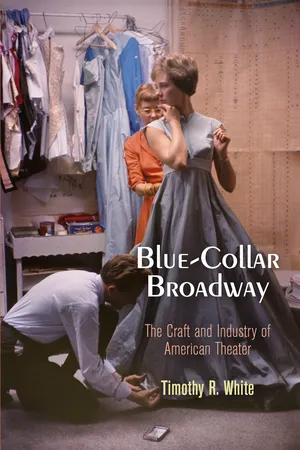
Behind the scenes of New York City's Great White Way, virtuosos of stagecraft have built the scenery, costumes, lights, and other components of theatrical productions for more than a hundred years. But like a good magician who refuses to reveal secrets, they have left few clues about their work. Blue-Collar Broadway recovers the history of those people and the neighborhood in which their undersung labor occurred.
Timothy R. White begins his history of the theater industry with the dispersed pre-Broadway era, when components such as costumes, lights, and scenery were built and stored nationwide. Subsequently, the majority of backstage operations and storage were consolidated in New York City during what is now known as the golden age of musical theater. Toward the latter half of the twentieth century, decentralization and deindustrialization brought the emergence of nationally distributed regional theaters and performing arts centers. The resulting collapse of New York's theater craft economy rocked the theater district, leaving abandoned buildings and criminal activity in place of studios and workshops. But new technologies ushered in a new age of tourism and business for the area. The Broadway we know today is a global destination and a glittering showroom for vetted products.
Featuring case studies of iconic productions such as Oklahoma! (1943) and Evita (1979), and an exploration of the craftwork of radio, television, and film production around Times Square, Blue-Collar Broadway tells a rich story of the history of craft and industry in American theater nationwide. In addition, White examines the role of theater in urban deindustrialization and in the revival of downtowns throughout the Sunbelt.
- 288 pages
- English
- ePUB (mobile friendly)
- Available on iOS & Android
eBook - ePub
About this book
Information
Chapter 1
“Second-Hand Rose”
The Stage Before the Broadway Brand
IT WAS 1875, and Mathias Armbruster did not know any better. He did not know that scenery shops should be in New York City, nor did he know that painted backdrops for the commercial stage were supposed to be crafted with a “Broadway” pedigree. He did not know these truisms of the commercial stage because they were not yet true—not in Columbus, Ohio, and not in 1875. It was in this city and this year that Armbruster founded his scenic studio, which grew into a major national supplier of theatrical components, especially painted backdrops. By the turn of the twentieth century, Armbruster boasted that his was the second-largest scenery firm in the United States. If the reality of his shop fell a bit short of this claim, it was not by much. A German immigrant trained in landscapes, perspective painting, and feather-brush strokes, Armbruster made good in the business by crafting the “wing, drop and border type of setting” used by minstrel and vaudeville shows. Ordering via mailed letters and sketches from across the nation, countless stock theater impresarios and minstrel managers bought components from the firm over its impressive seventy-five-year history.1
Armbruster first made his mark during an era that can be described as pre-Broadway, when a concentrated swath of New York City was not yet synonymous with most commercial theater in the United States. Especially during the 1870s, when Armbruster opened for business, the theatrical craft and construction trades were notably free of the cultural and economic monopolies that would tie them so tightly to New York City within a few short decades. This city was already America’s uncontested theater capital, and the play agents and brokers of Union Square certainly wielded awesome power nationally. New York City shops, however, were not yet building theatrical components for national consumption. Manhattan Business Listings from the 1870s, 1880s, and 1890s consistently name fewer than fifty theater-related firms or craftspeople, most in costuming or costume supply. There were only one or two scenery contractors listed in this entire era, and none stands out as a notable supplier for Broadway shows or national tours. Compared to the amount of theatrical activity happening in New York City, and especially compared to the number of national touring companies launching from that city, the number of firms working in costuming, scenery, painting, and other theater-related trades seems paltry.2
In a Gilded Age nation of tremendous economic and theatrical dynamism, why were there so few third-party contractors? Also, if New York City was the uncontested theatrical capital of the nation beginning in the 1870s, and most theater historians agree that it was, why were proprietors such as Armbruster not opening in Manhattan rather than in Columbus?
The answers to these and other questions lay in the limited craft and construction demands of nineteenth-century theater. Prior to the 1880s, commercial shows, both within New York City and without, succeeded with far fewer crafted components than did their twentieth-century counterparts.3 Stock theater troupes stayed put within their home playhouses for entire seasons at a time, sometimes touring in the summers. Peppering the American landscape prior to 1870, these troupes met most of their component needs through a surprisingly simple strategy: storage. With many dozens of painted backdrops and costumes stored in-house and with audiences expecting familiar “classics” each season, it was relatively easy for the actor-managers who ran these institutions to fill their stages with components they already owned.4
Even after the Civil War, when a new business model called the “combination company” gradually supplanted stock as the primary vehicle for commercial theater in the United States, demands for crafted components remained comparatively limited. Combination companies did not stay in residence at home theaters as stock players did, performing a repertory or mix of plays. On occasion after the 1820s and with greater frequency after 1860, combination shows came together for one play or musical only. Combination companies were a temporary fusion of performers, costumes, scenery, and stage crew, hastily pulled together by producers during rehearsals and then disbanded just as quickly when the show closed. The historian Alfred Bernheim said it best when contrasting stock to combination companies, writing that “where the stock company is a continuous producing organization, the combination company is ephemeral. It is created for a specific purpose and it vanishes into nothingness when that purpose is fulfilled.”5 Despite the obvious similarities between these more modern vehicles for commercial theater and the union-crafted, laboriously constructed productions of the twentieth century, combination companies did not kick U.S. demand for crafted components into high gear, at least not initially.
As they first existed in the mid-nineteenth century, combination companies were still part of a preindustrialized commercial theater. Craftspeople in scenic painting and costuming were more likely to be on the payroll of a leading producer than to be a union member, and actors routinely supplied their own costumes. Gas-lamp lighting kept even the most well-worn or dog-eared scenery and costumes safe from the harsh glare of audience scrutiny, and the culture of theatrical classics and revivals made it possible for stages and actors to be dressed in the same old components year after year.6 Through all of this history, neither markets nor culture mandated that mass quantities of Manhattan-built components travel with combination companies.
During the last twenty years of the nineteenth century, however, this was precisely what craftspeople began to supply and what audiences began to demand. For myriad reasons, finely crafted stage components, especially those built in Manhattan, became de rigueur for touring shows to be successful. Much of this had to do with the advent of electrified stage lighting, which rapidly raised the bar on the quality of stage components during the 1880s. These were also the years when the Broadway brand grew stronger within the theatergoing economy, enabling producers to advertise their shows not as “direct from New York”7 but as “direct from Broadway.” The aggressive business strategies of the Theatrical Syndicate and the Shubert brothers at the turn of the twentieth century were another major part of this equation. So too was realist playwriting, a significant contributing factor in the rising monopoly of Manhattan’s theater-related firms over most of American stagecraft. Last but certainly not least, photography modernized in ways that raised the value of the components seen, and photographed, on New York stages.
By the early twentieth century, theatergoers from across the nation demanded and received lavish “Broadway” productions during their visits to New York City and also through elaborate national tours arriving in their hometowns. These productions were a far cry from the charming muslin backdrops of Armbruster’s studio in Columbus, Ohio. Their components were far more elaborate than any painted drop to have ever emerged from Mathias Armbruster’s cavernous, sun-lit painting room. Most important, these productions came from and were defined as “Broadway.” Though it was culture that bound so many American theatergoers to the Broadway brand, it was craft that made this brand possible on a national scale. Crafted components were also a defining feature of the new Times Square neighborhood, which developed rapidly after 1900 as a theatrical district. In these ways, even though Broadway producers ascended to the throne of America’s commercial theater through the ephemeral power of culture, it was ultimately craft that enabled them to stay there.
Stock Theater Components
It is no exaggeration to say that the theatrical components of the stock era, when measured by the standards of modern Broadway, were a hot mess. They ranged from new construction to threadbare and from exacting specificity to dubious relevance. They were sewn, painted, and hammered by expert professionals in some cases but more often by rank amateurs. Measured by the expectations for the nineteenth-century theater, however, the components of the stock era were wonderfully efficient. They were only as fine and as specific as they needed to be and not a stitch more. Most were worn, hung, displayed, and utilized time and again until the end of their life cycle, well used and well loved like a toddler’s blanket.
Guiding this subculture of storage and reuse were three defining features of crafted stage components in the age of stock theater, prior to the 1880s. First, the prevalence of repertory, melodrama, and oft-performed classics on American stages made the patterns of component reuse eminently practical and sensible. These patterns were so efficient, in fact, that many actor-managers could get a show up on its feet without making any payments whatsoever to third-party contractors or the proprietors of rehearsal studios. The second defining feature of the stock era was its limited stage lighting, which kept the bar relatively low on component quality and craftsmanship for most of the nineteenth century. Third, the disparate geography of commercial theater in this era made patterns of storage and reuse far more attractive than they would be at the turn of the twentieth century. By that time much more of America’s commercial theater had been crammed onto the island of Manhattan, where storage space came at a premium.
It is a well-established fact of nineteenth-century theater that stock stages were dominated by repertory, “classics” such as Shakespeare, and melodramas with plots and characters nearly indistinguishable from one to the other. New shows did appear on stages nationwide every season, but few of them strayed far from familiar plotlines, characters, and settings. Whether one paid to see Augustin Daly’s stock company as it toured in Denver or Laura Keene in stock in San Francisco, the shows available were quite similar. Scholars and enthusiasts alike have chronicled this history well, mapping out a landscape of distinguished stock houses, traveling minstrels, and touring “stars,” both English and American-born. All of these varied vehicles for theater served up melodrama or classics in one form or another. The minstrels may have been parodying Shakespeare, with shows such as Hamlet & Egglet, but as the scholar Lawrence Levine has cleverly pointed out, “people cannot parody what is not familiar.”8
Whatever their muse, theatrical companies of all stripes performed the same or similar shows with such frequency that their use of recycled and stored costumes was a given. By definition, a costume acquired for repertory would be saved for the following season, unless it was entirely specific to some horrible flop of a play. Most costumes were not specific at all, however, so they tended to go right into storage. If Juliet’s dress was good enough for Romeo and Juliet audiences in 1869, it was certainly good enough for the same actress in the same part in 1870.
Similar incentives existed for saving melodrama costumes, which were tailored to “types” or “lines” within a group of actors. Character lines such as “ingenue, female,” “juvenile, male,” “aging comic, male,” and “comic old hag” pigeonholed actors into the well-worn slots of melodrama and enabled actor-managers to costume them with relative ease. Since most melodramas featured precisely these types of broad, recognizable characters, costumes could be stored and accumulated according to characters rather than plays.
Character lines made costuming such a cinch that it was an afterthought of theatrical decision making and mostly the responsibility of actors themselves. It was the actor who had to cobble together or rustle up an appropriate costume when a new show went into rehearsal, and it was the actor who had to dive into storage racks when cast in a part from the company’s repertory. Given that actors, not producers or third-party contractors, bore most of the responsibility for concocting costumes in the 1860s and 1870s, it is not surprising that these costumes were notoriously inconsistent. One newspaper wag in New Orleans, complaining about glaring costume anachronisms of an 1873 production of Macbeth, suggested that they were “of every age and nation except the right ones.”9 Other examples from the shabby end of the costuming spectrum include the antics of Otis Skinner as a young actor.
At least as he explains it in his memoir, Skinner was a bit of a costuming shirker during his early career in the 1870s. Skinner wrote, “I was taught how to . . . transform a frock coat into a military uniform by pasting disks of gilt paper on the buttons, and pinning strips of yellow braid on the shoulders for epaulets.” He also related a story of a “dress shirt famine” backstage when he had to use a paper cuff to create a makeshift collar. On another occasion Skinner needed a “whiskered face” to play “an Irish cutthroat” and had to make do with “fine-cut tobacco pasted to my jowls, [which] formed convincing looking mutton chop whiskers.” Skinner went on to explain, however, that “the only trouble was that they slowly disintegrated during the evening, and I was left, after a scene of assault upon the heroine, with nothing on either jaw but a dark brown smear.”10 If these were the costuming behaviors of a celebrated performer, later picked up by the decorated Augustin Daly Players, one can easily imagine the makeshift tawdriness of the costumes for lesser actors, bit performers, and one-line members of the ensemble.
On the opposite end of the spectrum, there is evidence of lavishly crafted costumes, custom-built couture gowns, and even batches of costumes sent over from the finest fashion houses of London and Paris. Such grandeur in costuming, however, was the exception rather than the rule. It tended to be available only in America’s leading theatrical cities, such as Chicago and New York, and was always advertised prominently. No matter of course, such costumes were championed and advertised in ways that speak to their rarity. For Imre Kiralfy’s 1888 “spectacular” at the Academy of Music in New York, the impresario advertised “costumes specially designed by Wilhelm of London, manufactured by Mons. Landolft, of Paris, Mr. Fischer of London, and Messrs. Eaves and Madame Cranna, of New York.”11 While Mr. Kiralfy’s show demonstrates that costumes could get star billing on occasion, it is safe to say that in the age of stock theater, the number of polished, finely crafted, or lavish costumes was trifling compared to those that were tattered, dog-eared, and just sad, tired little things in general. There is little evidence that this bothered most actors, who worked in an industry for which secondhand costumes were the norm, before newly crafted pieces became standard issue for each new show. Fanny Brice, singing “Second-Hand Rose,” may have famously lamented her secondhand clothes decades later, but most late nineteenth-century performers did not seem to have been perturbed by their hand-me-downs.
During decades of repertory, melodrama, minstrelsy, and other theatrical forms that painted time and place in broad strokes, backdrops and other stage scenery were almost as makeshift as costumes were. The dictum “the play’s the thing” rang true, and scenic components were, more often than not, the bastard stepchildren of the theater. When they could get away with it, the actor-managers in charge of stock theater companies ordered the same tired, old backdrops to be dusted off and unfurled. They rarely portrayed the settings of plays with any sort of precision. Audiences seem to have tolerated the sort of glaring period inaccuracies and anachronisms that make twenty-first-century reviewers seethe. While these practices may seem to have been rather mundane details of an age when theater buildings had copious storage spaces, they were far more profound than this.
Stored and reused backdrops kept stock theater companies in the black. If new costumes became necessary, an actor-manager could lean on his actors to go get them on their own time and their own dime. If a new backdrop was necessary, however, even the most enterprising member of the team could not produce one on his or her own. It would need to be painted by skilled craftspeople, perhaps at Armbruster Scenic Studio in Columbus, Ohio. If stock companies had been forced to pay for a new backdrop for each of their new shows, most would have sunk faster than a stock portfolio on Black Tuesday. Thankfully the mo...
Table of contents
- Cover
- Half title
- Title
- Copyright
- Dedication
- Contents
- Introduction
- 1. “Second-Hand Rose”: The Stage Before the Broadway Brand
- 2. “A Factory for Making Plays”: Broadway’s Industrial District
- 3. “Sing for Your Supper”: Theater-Related Craft Work in Radio, Film, and Television
- 4. “Oh, What a Beautiful Mornin’ ”: Show Construction at Mid-Century
- 5. “Sunrise, Sunset”: The Decline of Broadway Craft and the Rise of Regional Theaters
- 6. “Every Day a Little Death”: Times Square After the Collapse of a Theatrical Production Center
- 7. “When the Money Keeps Rolling in You Don’t Ask How”: Broadway Craft in a Globalized Industry
- Notes
- Index
- Acknowledgments
Trusted by 375,005 students
Access to over 1.5 million titles for a fair monthly price.
Study more efficiently using our study tools.
Frequently asked questions
Yes, you can cancel anytime from the Subscription tab in your account settings on the Perlego website. Your subscription will stay active until the end of your current billing period. Learn how to cancel your subscription
No, books cannot be downloaded as external files, such as PDFs, for use outside of Perlego. However, you can download books within the Perlego app for offline reading on mobile or tablet. Learn how to download books offline
Perlego offers two plans: Essential and Complete
- Essential is ideal for learners and professionals who enjoy exploring a wide range of subjects. Access the Essential Library with 800,000+ trusted titles and best-sellers across business, personal growth, and the humanities. Includes unlimited reading time and Standard Read Aloud voice.
- Complete: Perfect for advanced learners and researchers needing full, unrestricted access. Unlock 1.5M+ books across hundreds of subjects, including academic and specialized titles. The Complete Plan also includes advanced features like Premium Read Aloud and Research Assistant.
We are an online textbook subscription service, where you can get access to an entire online library for less than the price of a single book per month. With over 1.5 million books across 990+ topics, we’ve got you covered! Learn about our mission
Look out for the read-aloud symbol on your next book to see if you can listen to it. The read-aloud tool reads text aloud for you, highlighting the text as it is being read. You can pause it, speed it up and slow it down. Learn more about Read Aloud
Yes! You can use the Perlego app on both iOS and Android devices to read anytime, anywhere — even offline. Perfect for commutes or when you’re on the go.
Please note we cannot support devices running on iOS 13 and Android 7 or earlier. Learn more about using the app
Please note we cannot support devices running on iOS 13 and Android 7 or earlier. Learn more about using the app
Yes, you can access Blue-Collar Broadway by Timothy R. White in PDF and/or ePUB format, as well as other popular books in History & North American History. We have over 1.5 million books available in our catalogue for you to explore.