In the contemporary world the meeting of Buddhism and Islam is most often imagined as one of violent confrontation. Indeed, the Taliban's destruction of the Bamiyan Buddhas in 2001 seemed not only to reenact the infamous Muslim destruction of Nalanda monastery in the thirteenth century but also to reaffirm the stereotypes of Buddhism as a peaceful, rational philosophy and Islam as an inherently violent and irrational religion. But if Buddhist-Muslim history was simply repeated instances of Muslim militants attacking representations of the Buddha, how had the Bamiyan Buddha statues survived thirteen hundred years of Muslim rule?
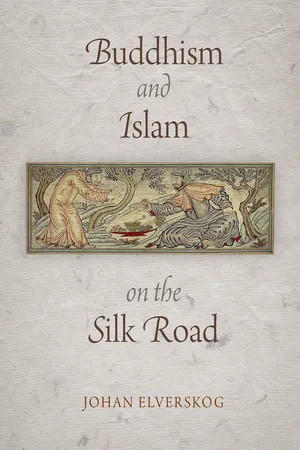
Buddhism and Islam on the Silk Road demonstrates that the history of Buddhist-Muslim interaction is much richer and more complex than many assume. This groundbreaking book covers Inner Asia from the eighth century through the Mongol empire and to the end of the Qing dynasty in the late nineteenth century. By exploring the meetings between Buddhists and Muslims along the Silk Road from Iran to China over more than a millennium, Johan Elverskog reveals that this long encounter was actually one of profound cross-cultural exchange in which two religious traditions were not only enriched but transformed in many ways.
- 352 pages
- English
- ePUB (mobile friendly)
- Available on iOS & Android
eBook - ePub
Buddhism and Islam on the Silk Road
About this book
Information
CHAPTER ONE

Contact
O ye who believe! Eat not up your property among yourselves in vanities: but let there be amongst you traffic and trade by mutual good-will.
—Qur’an 4:29
The wise man trained and disciplined
Shines out like a beacon-fire.
He gathers wealth just as a bee
Gathers honey, and it grows.
Shines out like a beacon-fire.
He gathers wealth just as a bee
Gathers honey, and it grows.
Like an ant-hill higher yet.
With wealth so gained the layman can
Devote it to his people's good.
He should divide his wealth in four.
With wealth so gained the layman can
Devote it to his people's good.
He should divide his wealth in four.
One part he may enjoy at will,
Two parts he should put to work,
The fourth he should set aside,
A reserve in times of need.
Two parts he should put to work,
The fourth he should set aside,
A reserve in times of need.
—Sigālaka Sutta, Dīgha Nikāya
A BUDDHIST STUDIES JOKE has it that the Dharma in the West should not be called the Middle Way, but the Upper Middle Way.1 Indeed, the seeming preponderance of wealthy Euro-American Buddhists, who are able to escape the daily grind by jetting off for a meditation retreat on Maui, has become a stock figure of ridicule in American popular culture.2 The joke, of course, lies in the contradiction between the image of a Buddhist monk who has renounced all worldly possessions and the pampered, jet-set Buddhist. Yet is there really such a contradiction between being both Buddhist and wealthy?
If one looks at the question historically the answer is no. From the very beginning and throughout the millennia it has always been the rich and powerful who have kept the Dharma in business. For some this may seem incongruous. Wealth, power, and violence are the very things Buddhism supposedly rejects. Indeed, it is this absence that most often sets the Dharma apart in the contemporary religious marketplace. Buddhism is namely the one tradition that seemingly transcends all the things that generally give religion a bad name. Yet, as noted in the introduction, this view of Buddhism is a selective reading of Buddhist doctrine and history.
Thus if one were so inclined it would be very easy to dredge up the seamier underbelly of the Dharma. For example, one can readily point out Buddhism's misogyny.3 Or in contradistinction to the standard claims of Buddhist peacefulness one can look at its history of violence as evidenced in the following command given by the Fifth Dalai Lama to his Buddhist death squads:4
[Of those in] the band of enemies who have despoiled the duties entrusted to them:
Make the male lines like trees that have had their roots cut;
Make the female lines like brooks that have dried up in winter;
Make the children and grandchildren like eggs smashed against rocks;
Make the servants and followers like heaps of grass consumed by fire;
Make their dominion like a lamp whose oil has been exhausted;
In short, annihilate any traces of them, even their names.5
To find such Kurtzean images connected with the Dalai Lama may be jarring to some; however, the fact of the matter is that Tibetan history accords less with the popular Western image of Shangri-La and more with the religious chaos and violence of Reformation and post-Reformation Europe.6 Yet in looking for such examples of Buddhist violence one need not venture into the past, as is clear from the ongoing civil war in Sri Lanka.7
Thus contrary to the popular understanding Buddhism is not innately above and beyond the horrors found in the other “world religions.” In fact precisely for this reason scholars have in recent years reveled in exposing some of these less-than-savory aspects of the Dharma. But this scholarship has not had much of a trickle-down effect on popular perceptions. Buddhism still retains its aura of being as pure as the driven snow. Whether this is true or not, however, is not the point to be argued here. Rather, the point is simply to reveal how the popular vision of the Dharma potentially shapes or distorts the story of what happened when Buddhism came into contact with Islam.
Such misconceptions are not the only thing to bear in mind as we begin unraveling this history. It is important to note two other points as well. The first is that Buddhism is not one teaching, school, or tradition. Rather, as with any religion it developed over time into an array of widely divergent and competing schools of thought. By the time of Islam's appearance in South Asia the Dharma had in fact broken off into three radically different traditions: the Nikaya schools, the Mahayana, and Tantric Buddhism. Muslims thus did not come into contact with a monolithic “Buddhism,” but with a wide array of Buddhists with diverse beliefs and practices.
Similarly, no one unified group comprised “Muslims.” What it meant to be a Muslim was very much under debate at the time Islam came into contact with the Dharma. Indeed it is vital to recognize that most of the ideas and practices that we today identify as “Islam” were articulated only in the ninth and tenth century. Thus Islam as it was understood and practiced before then was something different, and in approaching the history of Buddhist-Muslim interaction it is important to keep such realities in mind. In particular, we need to recognize that Buddhism and Islam were not two monolithic and static entities crashing into one another. Rather, both religions were diverse and ever-developing traditions that were not only grappling with their own internal theological developments, but also trying to understand the world outside their own particular communities.
In addition to keeping these larger realities in mind we also need to take into consideration the issue of economics. Whether religious traditions want to recognize it or not, the fact is that as with any social institution, a community of faith cannot survive without financial support. Indeed, as history has repeatedly shown, only those traditions that successfully raise capital survive. Those that do not receive money inevitably disappear. For example, of the sixteen Nikaya schools of early Buddhism only one survives, the Theravada, which is now practiced largely in Sri Lanka and Southeast Asia. In approaching the issue of Buddhism and Islam we therefore cannot overlook the interrelationship between religions and the economic systems that support them. And this is especially important in regard to the Dharma. Although the linkage between Islam and the world of trade is rather well known, it is less so with Buddhism.8 Namely, with its ultimate quest being the overcoming of desire, the Dharma is often seen as being antithetical to, or at least unconcerned with, the everyday realities of making money. This is a mistake.
The Buddha, or perhaps more aptly his disciples who codified his teachings, were astute theoreticians of economic realities. The Dharma is thus intimately tied into the changing socioeconomic world of early India and it is precisely on this account that Buddhism resonated most with the new, urban trading class. They were the ones who supported the Dharma and fostered its spread on the trade routes across Asia. Buddhism thus came to be—much as it is today—the religion of choice for the urban, cosmopolitan elite. It would in many ways hold this position for nearly a millennium. Only then would it be challenged by Islam, a new religion also supported by an urban cosmopolitan elite operating within the expansive economic regime of the Caliphate.
The Economy of Salvation
Having been told in various media—from texts to statues, paintings to film—the life story of the Buddha is well known. He was born Siddhartha Gautama, the son of a king who ruled a territory that is now in southern Nepal. His birth involved several miracles and so his father summoned his priests in order to interpret these portentous omens. They in turn declared the child would either be a renouncer and great religious teacher, or else a powerful king and world conqueror. Fearful that his son would not continue in the family business of politics, and instead follow some half-naked and dreadlocked guru, the king ordered Siddhartha to never leave the palace. His father also spoiled him rotten. Siddhartha had everything a boy and young man could ever want: toys, food, chariots, and women. But Siddhartha was curious, and one night with the help of his manservant he snuck out of the palace. What he saw shocked him, especially the sight of a sick man, an old man, and a corpse. Only then did he realize that this was his and everyone else's fate. He wondered what could be done about it.
At that point he saw a renouncer, someone who was trying to answer this question, and he decided to follow the religious path. Abandoning his father's palace he studied with various teachers over the next several years but none of their ideas or practices really answered the big question: the meaning of life. He therefore decided to go it alone. While sitting in meditation under a large banyan tree he had three visions. The first was about the nature of time as evidenced in all his previous births; the second revealed the nature of space as witnessed in his visit to the six realms of existence (gods, demi-gods, humans, animals, hungry ghosts, hell). Then finally he had the ultimate realization of enlightenment: no-self. The Buddha encapsulated this new wisdom in the Four Noble Truths:
1. There is suffering
2. Suffering comes from desire
3. Nirvana is the solution
4. Nirvana can be achieved by means of the Eight-fold Buddhist Path.
Siddhartha preached this Dharma for the next forty years.
The biography of the Buddha is a wonderful story. It is another issue entirely, however, whether it has any historical validity. The truth of the matter is that we know virtually nothing about the historical Buddha, not even when he lived.9 This fact, however, does not mean that the biography is meaningless. Quite the opposite. By means of parables and metaphors it encapsulates the entirety of the Buddha's teaching, its cosmology, doctrines, and communal structures. For example, the initial prophecy of the two paths the Buddha could take in life explains the two interdependent components of the Buddhist community: the religious specialists who renounce the world, and those who live in the world and support them. The Buddha's imprisonment and debauched early life is, of course, a parable of desire, the material world, and the cycle of saṃsāra that enlightenment enables one to transcend.
The biography of the Buddha is therefore not history, but myth. These two different realities may or may not intersect, but nevertheless each still creates meaning. In this regard one can also note that as the Dharma changed over time so too did the Buddha's biography. The Buddha's crass abandonment of his pregnant wife when he set out on his religious quest, for example, did not sit well with later family-values-type Buddhists and this episode was thus re-envisioned. The Buddha still left his wife, a central component of the story that could not be changed, but he did so in a loving and compassionate way. Moreover, the child she carried in her womb remained there until the moment of the Buddha's enlightenment, thereby linking forever the birth of his son with the Dharma.10 Whether his wife or any woman would want to be pregnant for six years was of not much concern since as with most religions Buddhism was very much a man's world and such women's issues were beside the point.
Yet what were the concerns of the Buddha? What was the environment or historical context that not only shaped him, but also that he was engaging or challenging with his teachings? What was he responding to? What was he reinterpreting? The fact that we do not know precisely when the Buddha lived certainly hinders our attempt at answering these questions. In fact one scholar has recently lamented, “an adequately detailed and historically sensitive account of just what the critique enunciated by early Buddhism meant within the larger intellectual and cultural history of the subcontinent remains an important desideratum for Indological scholarship.”11 And although this may indeed be the case, we are not wholly ignorant of the historical context in which the Dharma was formed.
Most notably we know that during this period of time (600-300 B.C.E.), the so-called “axial age,” India was undergoing enormous changes politically, economically, culturally, and technologically.12 All of these intertwined developments had a profound impact on not only the structure and nature of Indian society, but also on how people understood the very nature of human experience. It was within this changing milieu that the Buddha and others like him, such as the Hindu Upanisadic thinkers and the Jains, were trying to answer the big questions about the meaning of life. And in this regard the Buddha's fundamental idea that everything changes well captured the tenor of the times.
One such change involved the nature of political structures. As reflected in the Buddha's biography and the nature of his father's kingdom, India at the time was supposedly divided into small lineage-based republics (map 1).13 These small republics, however, were gradually being challenged, and ultimately they were defeated and absorbed into more complex kingdoms. While these kingdoms were still ruled by families, these larger entities were also inevitably becoming more genealogically diffuse. As a result these new states needed more abstract ideologies of legitimacy than the earlier clan-based political structures.14 Moreover, in order to maintain these new states the ruling elite needed not only ideological innovations, but also a greater resource base with which to finance the structures that sustained this new entity. In particular, the court needed to pay their burgeoning bureaucracies, and also their armies.

Map 1. Sixteen “great countries” of India at time of Buddha.
Coincidentally these demands arose at the same time that iron was introduced into India. The ability to forge iron led to two major innovations. The first was ...
Table of contents
- Cover Page
- Title Page
- Copyright Page
- Dedication Page
- Contents
- Introduction
- Chapter One: Contact
- Chapter Two: Understanding
- Chapter Three: Idolatry
- Chapter Four: Jihad
- Chapter Five: Halal
- Conclusion
- Notes
- Index
- Acknowledgments
Trusted by 375,005 students
Access to over 1.5 million titles for a fair monthly price.
Study more efficiently using our study tools.
Frequently asked questions
Yes, you can cancel anytime from the Subscription tab in your account settings on the Perlego website. Your subscription will stay active until the end of your current billing period. Learn how to cancel your subscription
No, books cannot be downloaded as external files, such as PDFs, for use outside of Perlego. However, you can download books within the Perlego app for offline reading on mobile or tablet. Learn how to download books offline
Perlego offers two plans: Essential and Complete
- Essential is ideal for learners and professionals who enjoy exploring a wide range of subjects. Access the Essential Library with 800,000+ trusted titles and best-sellers across business, personal growth, and the humanities. Includes unlimited reading time and Standard Read Aloud voice.
- Complete: Perfect for advanced learners and researchers needing full, unrestricted access. Unlock 1.5M+ books across hundreds of subjects, including academic and specialized titles. The Complete Plan also includes advanced features like Premium Read Aloud and Research Assistant.
We are an online textbook subscription service, where you can get access to an entire online library for less than the price of a single book per month. With over 1.5 million books across 990+ topics, we’ve got you covered! Learn about our mission
Look out for the read-aloud symbol on your next book to see if you can listen to it. The read-aloud tool reads text aloud for you, highlighting the text as it is being read. You can pause it, speed it up and slow it down. Learn more about Read Aloud
Yes! You can use the Perlego app on both iOS and Android devices to read anytime, anywhere — even offline. Perfect for commutes or when you’re on the go.
Please note we cannot support devices running on iOS 13 and Android 7 or earlier. Learn more about using the app
Please note we cannot support devices running on iOS 13 and Android 7 or earlier. Learn more about using the app
Yes, you can access Buddhism and Islam on the Silk Road by Johan Elverskog in PDF and/or ePUB format, as well as other popular books in History & Asian History. We have over 1.5 million books available in our catalogue for you to explore.