"Heterosexuality, this novel forthrightly claims, is a poor substitute for passionate love between men—and heterosexuality's historical emergence in the nineteenth century is consequently, Cecil Dreeme laments, a grave misfortune."—Christopher Looby, from the Introduction
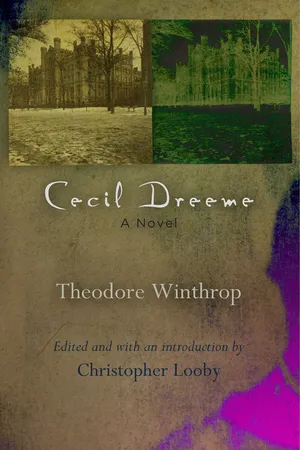
Freshly returned to New York City from his studies abroad, unmoored by news of the apparent suicide of his accomplished childhood friend Clara Denman, and drawn in spite of himself toward the sinister man-about-town Densdeth, Robert Byng is unsettlingly adrift in the city of his birth. Things take an even stranger turn once he finds lodgings in the Gothic halls of Chrysalis College in lower Manhattan. There he meets the mysteriously reclusive Cecil Dreeme, brilliant artist and creature of the night. In Dreeme, Byng finds a friend unlike any he has known before. But is Cecil the man he claims to be, and can their friendship survive the dangers they will soon face together?
Issued posthumously in 1861, Cecil Dreeme was the first published novel of Theodore Winthrop, who has the unfortunate distinction of being one of the first Union officers killed in the line of duty during the Civil War. Newly edited by Christopher Looby, it is a very queer book indeed.
- 256 pages
- English
- ePUB (mobile friendly)
- Available on iOS & Android
eBook - ePub
Cecil Dreeme
About this book
Information
NOTES

INTRODUCTION
1. Henry Blake Fuller, “A Legacy to Posterity,” leaf 20 (entry for Jan. 10, 1875). Henry Blake Fuller Papers, Newberry Library, Chicago. Series 4, Box 9, Folder 294. My thanks to Joseph Dimuro for drawing my attention to this passage.
2. Henry Blake Fuller, Bertram Cope’s Year, ed. Joseph Dimuro (Peterborough, Ontario: Broadview Press, 2010). Originally published in 1919.
3. Nathaniel Hawthorne, The Blithedale Romance (New York: Penguin, 1983), 53.
4. Margaret J. M. Sweat, Ethel’s Love-Life: A Novel (New York: Rudd and Carleton, 1859), 92, 82, 92. For a brilliant reading of the vagaries of desire in Ethel’s Love-Life see Dorri Beam, “Transcendental Erotics, Same-Sex Desire, and Ethel’s Love-Life,” in Toward a Female Genealogy of Transcendentalism, ed. Jana L. Argersinger and Phyllis Cole (Athens: University of Georgia Press, 2014), 327–47. An earlier version of this essay appeared in ESQ 57 (2011): 1–27.
5. In an excellent discussion of this novel Axel Nissen calls Cecil Dreeme “a paradigmatic example of romantic friendship fiction,” even “the ultimate fiction of romantic friendship.” Axel Nissen, Manly Love: Romantic Friendship in American Fiction (Chicago: University of Chicago Press, 2009), 57–88 (quotations at 58). Other valuable critical discussions of Cecil Dreeme include Robert K. Martin, “Knights-Errant and Gothic Seducers: The Representation of Male Friendship in Mid-Nineteenth-Century America,” in Hidden from History: Reclaiming the Gay and Lesbian Past, edited by Martin Duberman, Martha Vicinus, and George Chauncey Jr. (New York: New American Library, 1989), 162–89, and Michael Millner, “The Fear Passing the Love of Women: Sodomy and Male Sentimental Citizenship in the Antebellum City,” Arizona Quarterly 58, 2 (Summer 2002): 19–52.
6. For the “invention” of homosexuality and heterosexuality, see, among many other works, Jonathan Ned Katz, The Invention of Heterosexuality (New York: Dutton, 1995); Siobhan Somerville, Queering the Color Line: Race and the Invention of Homosexuality in American Culture (Durham, N.C.: Duke University Press, 2000); and Hanne Blank, Straight: The Surprisingly Short History of Heterosexuality (Boston: Beacon Press, 2012).
7. Michel Foucault, The History of Sexuality, Vol. 1: An Introduction, translated by Robert Hurley (New York: Vintage, 1990), 43.
8. Peter Coviello, Tomorrow’s Parties: Sex and the Untimely in Nineteenth-Century America (New York: New York University Press, 2013), 20.
9. Foucault, The History of Sexuality, 75ff.
10. See, among many other general sources, Kim M. Phillips and Barry Reay, Sex Before Sexuality: A Premodern History (Cambridge: Polity Press, 2011).
11. Katz, The Invention of Heterosexuality, 10; Blank, Straight, xiv.
12. Judith Butler has described in several places what she calls “heterosexual melancholy,” the way that normative heterosexuality is constituted via the prohibition of same-sex desires—desires whose loss is neither acknowledged nor mourned, thus instituting and maintaining heterosexuals as perpetual melancholics. See Butler, Gender Trouble: Feminism and the Subversion of Identity (New York: Routledge, 1990), 70; see also Butler, Bodies That Matter: On the Discursive Limits of “Sex” (New York: Routledge, 1993), 235. One way to gloss my argument about Cecil Dreeme would be to say that the novel offers a startling premonition of heterosexual melancholy.
13. William Congreve, The Way of the World and Other Plays, edited by Eric S. Rump (London: Penguin Books, 2006), 380.
14. Adam Goodheart, “In Death, a Young Author Is Born,” Opinionator, New York Times (June 19, 2011). http://opinionator.blogs.nytimes.com/2011/06/19/in-death-a-young-author-is-born/?_php=true&_type=blogs&_r=0. Accessed Aug. 31, 2015.
15. This language appears on a website, “NYU and the Village: An Urban University in Bohemia,” presented by the NYU Archives and Fales Library of the NYU Division of Libraries. www.nyu.edu/library/bobst/collections/exhibits/bobst/washsq/voices/cd.html. Accessed Aug. 31, 2015.
16. Julian Hawthorne, Confessions and Criticisms (Boston: Ticknor, 1887), 176.
17. Hawthorne, Confessions and Criticisms, 180. He adverts to the story’s “morbidness” once more at p. 181.
18. Theodore Winthrop, Edwin Brothertoft (Boston: Ticknor and Fields, 1862), 106. Further page references will be given parenthetically.
19. Theodore Winthrop, John Brent (Boston: Ticknor and Fields, 1862), 34. Further page references will be given parenthetically.
20. Theodore Winthrop, “Love and Skates,” Atlantic Monthly 9, no. 51 (January 1862): 70–85 and 9, no. 52 (February 1862): 223–40; also reprinted in Theodore Winthrop, Life in the Open Air, and Other Papers (Boston: Ticknor and Fields, 1863), 123–215 (quotation at 181). Further page references will be to the latter version and will be given parenthetically.
21. Eve Kosofsky Sedgwick, Between Men: English Literature and Male Homosocial Desire (New York: Columbia University Press, 1992), 16 et passim; Sedgwick, Epistemology of the Closet, updated with a new preface (Berkeley: University of California Press, 2008), 188–89.
22. Oliver Wendell Holmes, “The Stereoscope and the Stereograph,” Atlantic Monthly 3, no. 20 (June 1859): 738–48. See also Holmes, “The American Stereoscope,” Image: Journal of Photography of the George Eastman House 1, no. 3 (March 1952), 1 (repr. from Philadelphia Photographer, Jan. 1869); Edward W. Earle, ed., Points of View, the Stereograph in America: A Cultural History (Rochester, N.Y.: Visual Studies Workshop Press, 1979).
23. Roland Barthes, Image-Music-Text, translated by Stephen Heath (New York: Hill and Wang, 1978), 159.
24. Roland Barthes, S/Z: An Essay, translated by Richard Miller (New York: Hill and Wang, 1975), 15.
25. There is another image in the text that appears to want to give out this secret, too: the image of the wine that “had two flavors” because it was made from grapes that seemed to have been “drinking two kinds of sunshine all the long afternoons of ripe midsummer,” the direct sunlight hitting them from above and also the reflected “sunshine shining back from the glassy bay its vineyard overhung” (148–49).
BIOGRAPHICAL SKETCH OF THE AUTHOR
This biographical sketch first appeared as “Theodore Winthrop,” Atlantic Monthly 8, no. 46 (Aug. 1861): 242–51.
1 George W...
Table of contents
- Cover
- Title Page
- Copyright
- Contents
- Introduction: Cecil Dreeme and the Misfortune of Sexuality
- Editor’s Note
- Biographical Sketch of the Author
- I. Stillfleet and His News
- II. Chrysalis College
- III. Rubbish Palace
- IV. The Palace and Its Neighbors
- V. Churm Against Densdeth
- VI. Churm as Cassandra
- VII. Churm’s Story
- VIII. Clara Denman, Dead
- IX. Locksley’s Scare
- X. Overhead, Without
- XI. Overhead, Within
- XII. Dreeme, Asleep
- XIII. Dreeme, Awake
- XIV. A Mild Orgie
- XV. A Morning with Densdeth
- XVI. Emma Denman
- XVII. A Morning with Cecil Dreeme
- XVIII. Another Cassandra
- XIX. Can This Be Love?
- XX. A Nocturne
- XXI. Lydian Measures
- XXII. A Laugh and a Look
- XXIII. A Parting
- XXIV. Fame Awaits Dreeme
- XXV. Churm Before Dreeme’s Picture
- XXVI. Towner
- XXVII. Raleigh’s Revolt
- XXVIII. Densdeth’s Farewell
- XXIX. Dreeme His Own Interpreter
- XXX. Densdeth’s Dark Room
- Notes
Trusted by 375,005 students
Access to over 1.5 million titles for a fair monthly price.
Study more efficiently using our study tools.
Frequently asked questions
Yes, you can cancel anytime from the Subscription tab in your account settings on the Perlego website. Your subscription will stay active until the end of your current billing period. Learn how to cancel your subscription
No, books cannot be downloaded as external files, such as PDFs, for use outside of Perlego. However, you can download books within the Perlego app for offline reading on mobile or tablet. Learn how to download books offline
Perlego offers two plans: Essential and Complete
- Essential is ideal for learners and professionals who enjoy exploring a wide range of subjects. Access the Essential Library with 800,000+ trusted titles and best-sellers across business, personal growth, and the humanities. Includes unlimited reading time and Standard Read Aloud voice.
- Complete: Perfect for advanced learners and researchers needing full, unrestricted access. Unlock 1.5M+ books across hundreds of subjects, including academic and specialized titles. The Complete Plan also includes advanced features like Premium Read Aloud and Research Assistant.
We are an online textbook subscription service, where you can get access to an entire online library for less than the price of a single book per month. With over 1.5 million books across 990+ topics, we’ve got you covered! Learn about our mission
Look out for the read-aloud symbol on your next book to see if you can listen to it. The read-aloud tool reads text aloud for you, highlighting the text as it is being read. You can pause it, speed it up and slow it down. Learn more about Read Aloud
Yes! You can use the Perlego app on both iOS and Android devices to read anytime, anywhere — even offline. Perfect for commutes or when you’re on the go.
Please note we cannot support devices running on iOS 13 and Android 7 or earlier. Learn more about using the app
Please note we cannot support devices running on iOS 13 and Android 7 or earlier. Learn more about using the app
Yes, you can access Cecil Dreeme by Theodore Winthrop, Christopher Looby in PDF and/or ePUB format, as well as other popular books in Literature & LGBT Literary Collections. We have over 1.5 million books available in our catalogue for you to explore.