Site, Sight, Insight presents twelve essays by John Dixon Hunt, the leading theorist and historian of landscape architecture. The collection's common theme is a focus on sites, how we see them and what we derive from that looking. Acknowledging that even the most modest landscape encounter has validity, Hunt contends that the more one knows about a site and one's own sight of it (an awareness of how one is seeing), the greater the insight. Employing the concepts, tropes, and rhetorical methods of literary analysis, he addresses the problem of how to discuss, understand, and appreciate places that are experienced through all the senses, over time and through space.Hunt questions our intellectual and aesthetic understanding of gardens and designed landscapes and asks how these sites affect us emotionally. Do gardens have meaning? When we visit a fine garden or designed landscape, we experience a unique work of great complexity in purpose, which has been executed over a number of years—a work that, occasionally, achieves beauty. While direct experience is fundamental, Hunt demonstrates how the ways in which gardens and landscapes are communicated in word and image can be equally important. He returns frequently to a cluster of key sites and writings on which he has based much of his thinking about garden-making and its role in landscape architecture: the gardens of Rousham in Oxfordshire; Thomas Whately's Observations on Modern Gardening (1770); William Gilpin's dialogues on Stowe (1747); Alexander Pope's meditation on genius loci; the Désert de Retz; Paolo Burgi's Cardada; and the designs by Bernard Lassus and Ian Hamilton Finlay.
- 208 pages
- English
- ePUB (mobile friendly)
- Available on iOS & Android
eBook - ePub
About this book
Information
Publisher
University of Pennsylvania PressYear
2016Print ISBN
9780812248005
9780812248005
eBook ISBN
9780812292749
Topic
ArchitectureSubtopic
Urban Planning & LandscapingChapter 1
The Lie of the Land
This essay goes beyond issues of site, sight, and insight to explore the sleight of hand by which landscape architects reformulate the topography of the places they make.
It is all too easy to imagine perfectly clean environments that are not attractive at all. By contrast, it is quite possible to appreciate landscapes that, from the environmental point of view, leave a lot to be desired.
—Bernard Lassus
THE LIE OF the land is topography, how it lies across the land—including the base materials of its fundamental geology and what has happened to the land in the course of different climatic and cultural responses to it, including its historical associations. But it is also that designed land “lies” or tells untruths about itself, by virtue of whatever landscape architects do to it—grading, introduction of new materials (plants, buildings), and the invention of historical associations that do not belong there.1 My argument is that all designed landscapes can do both: they utilize the given materials, tell truth, and yet also, through falsehood or untruths, enlarge or animate the site where they intervene. (And it should be noted that all cultures at various times perform that intervention differently—as I can suggest later.) My further argument is that all landscape design needs to declare itself: a design that is not noticed is not a good design. The frequent complaint about Capability Brown is that you couldn’t see any difference between his work and “common fields,” and those folk who think Central Park is just “nature” are likely to miss the point of good design. Designs are art, and need to be acknowledged as such—exactly what lies behind one of Bernard Lassus’s remarks on what we might expect from landscape designs.2 We do not read a novel or see a movie without registering that it is a fiction or an invented narrative. And I see no reason why landscape architecture should try to get under that radar.
There have been moments clearly when the need to acknowledge topography is primary: when Alphonse Alphand in the later nineteenth century wrote his historical account of garden history to introduce Les promenades de Paris, he was assuming that a designer must consider a site undisturbed by human intervention; so he insisted that the designer needed to study the site, since the place, its geology and its topography, had a historical hinterland. “Le relief du terrain est la première chose à étudier . . . surtout quand le terrain est nu. Elle doit indiquer . . . le movement des vallées, determiner le lit des rivières, l’emplacement des pièces d’eau, c’est-à-dire les parties capitales du plan” (the lie of the land is the first thing to study . . . above all when the terrain is bare; notably indicating the shape of valleys, determining the beds of river, water features, which is to say the central elements of the [proposed] plan). Alphand continued by listing the natural accidents of the site, which might determine the principal aspects of the new design; however, he also noted that reworking the earth “pour composer un relief de fantasie est un mauvais système qui aboutit, presque toujours, à une deception, après d’énormes dépenses” (to compose a plan out of one’s fancy is a bad system that will almost always deceive and incur enormous expenses: p. xlix). He may well have been thinking of an earlier landscape architect, Jean-Marie Morel, also trained as an engineer, like himself, at the École des Ponts et Chaussées. Morel, the first designer to be called a landscape architect (“architecte-paysagiste”), was an expert at “identifying, interpreting, and recording” the components of landscape,3 and his analysis of landforms was based upon his engineer’s instinct and his knowledge of the processes of the natural world. But neither Alphand nor Morel produced anything that was not clearly and visibly an artifact; not fantasies, but fictions.
All insertions into the material world by landscape architects work in two ways: either they simply take the land that is given to them—its geology, its topography, what has happened to it in the course of different cultural responses to it, and thus also its historical associations; or they rework what is given, ignoring some of things they find there in order to promote their own imaginative response. Much more likely, there will be a mix of these two modes. That is what Alexander Pope argued in the 1730s when he wrote his “Epistle to Burlington” and clearly showed that genius loci is both the very materials of the site and what a designer (a different genius) makes of its materials by intervening on the site.
These insertions or reworkings derive from, or rely upon, a whole world of human experience. Not all of which, these days at least, comes from the land itself (I am not talking about Paleolithic gardeners who probably knew little about anything except the earth beneath their feet). Today, insertions by landscape architects come rather from a conspectus of ideas about land acquired from the need to respond to how people like to behave, from social and legal administration, but also from other unlegislated ideas—from painting, writing, and even other, earlier landscapes (some of which may be designed, others not). This last, both literally and metaphorically, may be called “travel”: it was J. B. Jackson who argued that “tourism is a desire to know more about the world in order to know more about ourselves.”4 He meant actual travel, seeing more of the world; but it also meant what we might call “armchair traveling” of various sorts (not just reading guidebooks). Indeed, the word and the concept of “land” itself morphed, by the early eighteenth century, from the simple materials of the earth into the word “landscape,” a Germanic-Dutch word that meant either a political unit of administration (that is, knowing how the world functioned) or what a Dutch or Flemish painter would see in the land and depict.
One of the useful analogies used recently by landscape critics is that of the palimpsest, the various layers on a site that are there already or can be installed there by the designer. Our response to sites has therefore to be palimpsestial.5 And palimpsests connect us also to the “lie” or possible untruths that can be entertained; for both the literal palimpsest or parchment, on which different texts have been inscribed, and the palimpsest that the French critic Gérard Genette discusses in his book Palimpsests: Literature in the Second Degree, where any text may extend itself into a myriad of paratexts that gloss or implicitly comment upon it, are a complex tissue of truths and not always compatible.
Writers who use or invoke palimpsests are consciously narrative beings, and our narratives are derived from a world of contacts—things we know directly, or things we collect indirectly from “travel.” Some of these stories may be true, some may be wonderful fabrications, often manipulated deliberately or because memory plays tricks with us. And all of these involve “references” or allusions to the palimpsest of our lives. That said, no landscape architecture that I know exists independently of what humans know or want for themselves in the world; we all have memories and knowledge, and these are things that have come to us from a variety of places we know and from ideas that circulate for us—in movies, texts, paintings, and so on. Thus I want to insist that landscape too has contexts beyond the immediate physical materials of a site; these days we rarely stay in the same place all our lives, and even if we are born and live wholly in one place and never go elsewhere, we will undoubtedly know that place hugely and intimately from a careful understanding of what goes on there and from what people know of elsewhere. But generally we range and are curious while doing so.
Now here we must confront the issue of what contexts are apt, appropriate, or socially acceptable when we make landscapes, for obviously there will be contexts that we do not want drawn into the world of landscape architecture: we do not, for example, tolerate cruelty, ugliness, or chemical weapons. We don’t make deliberately ugly places (true, these days we all have different notions of the ugly). But then every culture has different ideas about these things—which makes (for me) a nonsense of thinking that a landscape architect can work just anywhere. Nor, of course, can we include everything in any one design—it must simplify, must edit the world of our contexts. So contexts outside a site and contexts inside a site are the stuff that shapes design.
Let me postpone for a while elaborating on these theoretical propositions and look briefly at six pieces of landscape architecture from different periods of its history. In each, I want (i) to show how the landscaper responds to the land itself at the point when he (it was in those eras always a “he,” I’m afraid) gets to intervene in it, and (ii) to suggest that the designer of the site, while he or she may use its geology, its topography, or its plant materials, more largely depends upon ideas from outside the site; these ideas change or reenvisage what the site holds by involving its visitors in responding to the new place. Hence my motto or caption for all this approach, as announced in the title of this book, is Site—Sight—Insight.6 By site I mean the place for which a design is intended; by sight I mean how people look at it in its unmediated state, and afterward how visitors see it; by insight I mean how both designers and the site’s users, or sometimes (alas) simply “consumers,” respond to its ideas and feelings, what could be termed an “ambient” landscape.7 Each of these sites is informed by the given terrain, by what its landscapers or engineers can do to it, and by whatever ideas they or their clients expect of their work. So what informs these sites is a mixture, even a dialogue between, physical facts and materials and what the French call mentalité, sometimes very local, sometimes very wide ranging.
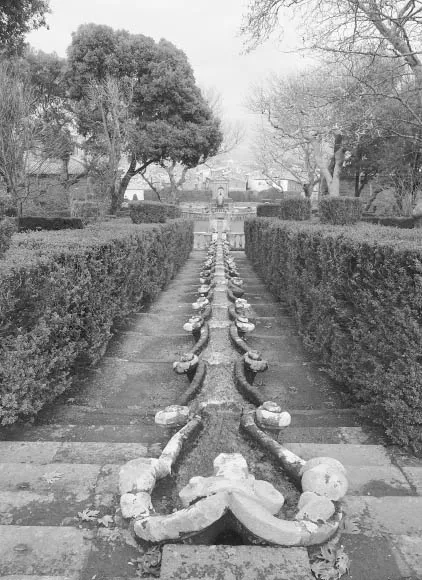
1. Villa Lante, Bagnaia. Photograph by Emily T. Cooperman.
The site of the sixteenth-century Villa Lante, near Viterbo in Italy, is on a hillside, with water gathered in the hills behind it and captured in a reservoir to be used for the hydraulic effects within the garden (Figure 1). The hillside affords cool breezes, and the water refreshes, during the summer months. The engineering and hydrology create both a series of terraces and a succession of wonderful fountains as the water descends through the gardens, and these are graced with statues, a dining table, fountains, and a pair of little casinos decorated with images of other villas. We have therefore a site that is both natural—the water, the slope, the descending waters, and what the designers have achieved for it—but also peopled with an anthology of classical, biblical, and local references. The garden itself is juxtaposed to an adjacent hunting park as well as the wilder Apennines behind: thus we see at a glance how the garden itself arises out of, literally from, the topography, and how different treatments of that land have produced different ratios of control between the terraces and fountains, the river gods and Pegagus, on the one hand, and the more relaxed parkland, on the other, though that is also furnished with fountains among its pathways. Both garden and park are also registered as being in the middle, between the mountains above and the town below it, into which the waters flow.
The garden of Vaux-le-Vicomte, designed by André Le Nôtre, is composed of two slopes that meet at a canalized river that flows through the valley. Terraces descend from the chateau itself and on the far side of the canal rise into forests for hunting (Figure 2). But the river was canalized as it entered the grounds and recovers its river-ness as it leaves it—thus abstracting, formalizing the river so that its significance could be appreciated, or giving to natural features a sense of their forms. The garden is then marked with varied classical imagery, river gods in niches fronting the canal and a huge statue of Hercules set against the forest and looking down upon the gardens (recalling one of his mythical labors when he stole the golden apples from the Garden of the Hesperides).
Rousham in Oxfordshire also has a river, but in its path it has simply eroded the hillside as it wanders across the water meadows on the way to Oxford (Figure 3). The gardens that descend to that river occupy an irregular shape of land, into which two landscapers, Charles Bridgeman in the 1720s and then in 1739 William Kent, worked to enhance the site with statues, a temple and a pyramid, seats, a series of grottoes that descend the Vale of Venus where the goddess presides, theaters (a green theater-like stage by Bridgeman, later naturalized by Kent), and a wonderful single line of arcades that Kent borrowed from the temple of Fortune at Palestrina (a Genette-like palimpsest gesture). Kent especially plays with the Oxfordshire locality, alluding to Italy and yet slyly registering how much must be changed in the particular topography and culture ...
Table of contents
- Cover
- Half title
- Title
- Copyright
- Dedication
- Contents
- Foreword
- Preface
- 1 The Lie of the Land
- 2 Near and Far, and the Spaces in Between
- 3 Stourhead Revisited and the Pursuit of Meaning in Gardens
- 4 Thomas Whately’s Observations on Modern Gardening
- 5 John Ruskin, Claude Lorrain, Robert Smithson, Christopher Tunnard, Nikolaus Pevsner, and Yve-Alain Bois Walked into a Bar . . .
- 6 Folly in the Garden
- 7 Jardins: Reflections on the Human Condition
- 8 Between Garden and Landscape
- 9 Ekphrasis: Déjà Vu All Over Again
- 10 Preservation in the Sphere of the Mind: Duration and Memory
- 11 “ARCH, n. an architectural term. A material curve sustained by gravity as rapture by grief”
- Afterword. From Literature to Landscape
- Notes
- Index
Trusted by 375,005 students
Access to over 1.5 million titles for a fair monthly price.
Study more efficiently using our study tools.
Frequently asked questions
Yes, you can cancel anytime from the Subscription tab in your account settings on the Perlego website. Your subscription will stay active until the end of your current billing period. Learn how to cancel your subscription
No, books cannot be downloaded as external files, such as PDFs, for use outside of Perlego. However, you can download books within the Perlego app for offline reading on mobile or tablet. Learn how to download books offline
Perlego offers two plans: Essential and Complete
- Essential is ideal for learners and professionals who enjoy exploring a wide range of subjects. Access the Essential Library with 800,000+ trusted titles and best-sellers across business, personal growth, and the humanities. Includes unlimited reading time and Standard Read Aloud voice.
- Complete: Perfect for advanced learners and researchers needing full, unrestricted access. Unlock 1.5M+ books across hundreds of subjects, including academic and specialized titles. The Complete Plan also includes advanced features like Premium Read Aloud and Research Assistant.
We are an online textbook subscription service, where you can get access to an entire online library for less than the price of a single book per month. With over 1.5 million books across 990+ topics, we’ve got you covered! Learn about our mission
Look out for the read-aloud symbol on your next book to see if you can listen to it. The read-aloud tool reads text aloud for you, highlighting the text as it is being read. You can pause it, speed it up and slow it down. Learn more about Read Aloud
Yes! You can use the Perlego app on both iOS and Android devices to read anytime, anywhere — even offline. Perfect for commutes or when you’re on the go.
Please note we cannot support devices running on iOS 13 and Android 7 or earlier. Learn more about using the app
Please note we cannot support devices running on iOS 13 and Android 7 or earlier. Learn more about using the app
Yes, you can access Site, Sight, Insight by John Dixon Hunt in PDF and/or ePUB format, as well as other popular books in Architecture & Urban Planning & Landscaping. We have over 1.5 million books available in our catalogue for you to explore.