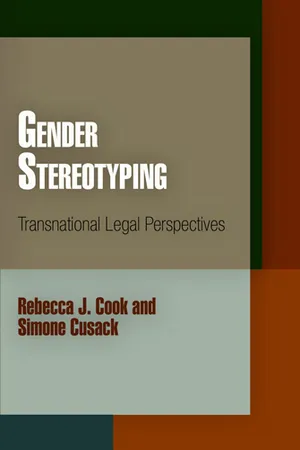
Drawing on domestic and international law, as well as on judgments given by courts and human rights treaty bodies, Gender Stereotyping offers perspectives on ways gender stereotypes might be eliminated through the transnational legal process in order to ensure women's equality and the full exercise of their human rights.
A leading international framework for debates on the subject of stereotypes, the Convention on the Elimination of All Forms of Discrimination against Women, was adopted in 1979 by the UN General Assembly and defines what constitutes discrimination against women. It also establishes an agenda to eliminate discrimination in all its forms in order to ensure substantive equality for women. Applying the Convention as the primary framework for analysis, this book provides essential strategies for eradicating gender stereotyping. Its proposed methodology requires naming operative gender stereotypes, identifying how they violate the human rights of women, and articulating states' obligations to eliminate and remedy these violations.
According to Rebecca J. Cook and Simone Cusack, in order to abolish all forms of discrimination against women, priority needs to be given to the elimination of gender stereotypes. While stereotypes affect both men and women, they can have particularly egregious effects on women, often devaluing them and assigning them to subservient roles in society. As the legal perspectives offered in Gender Stereotyping demonstrate, treating women according to restrictive generalizations instead of their individual needs, abilities, and circumstances denies women their human rights and fundamental freedoms.
- 289 pages
- English
- PDF
- Available on iOS & Android
eBook - PDF
About this book
Information
Table of contents
- Cover
- Contents
- Foreword
- Table of Cases
- Table of Treaties, Legislation, and Other Relevant Instruments
- Introduction
- Chapter One: Understanding Gender Stereotyping
- Chapter Two: Naming Gender Stereotyping
- Chapter Three: State Obligations to Eliminate Gender Stereotyping
- Chapter Four: Gender Stereotyping as a Form of Discrimination
- Chapter Five: The Role of the Women’s Committee in Eliminating Gender Stereotyping
- Chapter Six: Moving Forward with the Elimination of Gender Stereotyping
- Appendix A: The Convention on the Elimination of All Forms of Discrimination against Women
- Appendix B: The Optional Protocol to the Convention on the Elimination of All Forms of Discrimination against Women
- Notes
- Select Bibliography
- Annotated List of Websites
- Index
- Acknowledgments
Trusted by 375,005 students
Access to over 1.5 million titles for a fair monthly price.
Study more efficiently using our study tools.
Frequently asked questions
Yes, you can cancel anytime from the Subscription tab in your account settings on the Perlego website. Your subscription will stay active until the end of your current billing period. Learn how to cancel your subscription
No, books cannot be downloaded as external files, such as PDFs, for use outside of Perlego. However, you can download books within the Perlego app for offline reading on mobile or tablet. Learn how to download books offline
Perlego offers two plans: Essential and Complete
- Essential is ideal for learners and professionals who enjoy exploring a wide range of subjects. Access the Essential Library with 800,000+ trusted titles and best-sellers across business, personal growth, and the humanities. Includes unlimited reading time and Standard Read Aloud voice.
- Complete: Perfect for advanced learners and researchers needing full, unrestricted access. Unlock 1.5M+ books across hundreds of subjects, including academic and specialized titles. The Complete Plan also includes advanced features like Premium Read Aloud and Research Assistant.
We are an online textbook subscription service, where you can get access to an entire online library for less than the price of a single book per month. With over 1.5 million books across 990+ topics, we’ve got you covered! Learn about our mission
Look out for the read-aloud symbol on your next book to see if you can listen to it. The read-aloud tool reads text aloud for you, highlighting the text as it is being read. You can pause it, speed it up and slow it down. Learn more about Read Aloud
Yes! You can use the Perlego app on both iOS and Android devices to read anytime, anywhere — even offline. Perfect for commutes or when you’re on the go.
Please note we cannot support devices running on iOS 13 and Android 7 or earlier. Learn more about using the app
Please note we cannot support devices running on iOS 13 and Android 7 or earlier. Learn more about using the app
Yes, you can access Gender Stereotyping by Rebecca J. Cook,Simone Cusack in PDF and/or ePUB format, as well as other popular books in Law & Discrimination Law. We have over 1.5 million books available in our catalogue for you to explore.