The Black Death of 1348-50 devastated Europe. With mortality estimates ranging from thirty to sixty percent of the population, it was arguably the most significant event of the fourteenth century. Nonetheless, its force varied across the continent, and so did the ways people responded to it. Surprisingly, there is little Jewish writing extant that directly addresses the impact of the plague, or even of the violence that sometimes accompanied it. This absence is particularly notable for Provence and the Iberian Peninsula, despite rich sources on Jewish life throughout the century.
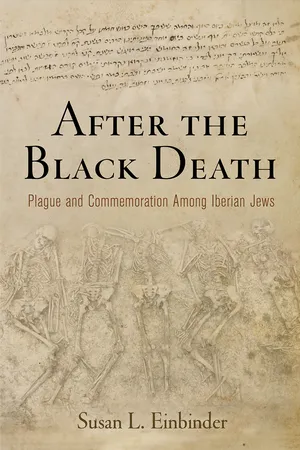
In After the Black Death, Susan L. Einbinder uncovers Jewish responses to plague and violence in fourteenth-century Iberia and Provence. Einbinder's original research reveals a wide, heterogeneous series of Jewish literary responses to the plague, including Sephardic liturgical poetry; a medical tractate written by the Jewish physician Abraham Caslari; epitaphs inscribed on the tombstones of twenty-eight Jewish plague victims once buried in Toledo; and a heretofore unstudied liturgical lament written by Moses Nathan, a survivor of an anti-Jewish massacre that occurred in Tàrrega, Catalonia, in 1348.
Through elegant translations and masterful readings, After the Black Death exposes the great diversity in Jewish experiences of the plague, shaped as they were by convention, geography, epidemiology, and politics. Most critically, Einbinder traces the continuity of faith, language, and meaning through the years of the plague and its aftermath. Both before and after the Black Death, Jewish texts that deal with tragedy privilege the communal over the personal and affirm resilience over victimhood. Combined with archival and archaeological testimony, these texts ask us to think deeply about the men and women, sometimes perpetrators as well as victims, who confronted the Black Death. As devastating as the Black Death was, it did not shatter the modes of expression and explanation of those who survived it—a discovery that challenges the applicability of modern trauma theory to the medieval context.
- 240 pages
- English
- ePUB (mobile friendly)
- Available on iOS & Android
eBook - ePub
About this book
Information
Publisher
University of Pennsylvania PressYear
2018Print ISBN
9780812225228
9780812250312
eBook ISBN
9780812295214
Chapter 1
Before the Plague: Anti-Jewish Violence and the Pastoureaux
THIS BOOK TREATS the Black Death, but it starts almost three decades earlier, during the summer of 1320, when Jewish communities in Provence and Aragon faced attacks by a mix of roving and local forces identified as “Shepherds,” or Pastoureaux. Launched under the banner of a popular crusading movement, these attacks were characterized by excessive violence and heavy Jewish casualties. Christian chronicles, letters, and archives document the movement of crusading bands from Normandy toward Paris, south toward papal Avignon and over the Pyrenees into Aragon. These accounts are generally terse, but they emphasize the lawlessness of the attackers and fears of popular revolt that they inspired among the chroniclers and the men whose views they shared and sought to represent. Occasionally, a chronicler resorts to hyperbole, as in Jean de Saint-Victor’s description of embattled Jews who exhaust their stock of projectiles and hurl their children over the walls.1 By contrast, Jewish sources are scarce, even among the traditional forms of liturgical commemoration that often preserve some memory of anti-Jewish violence. However, while dozens of verse laments (qinot) mark the roughly contemporary anti-Jewish attacks known as the Rindfleisch massacres in Germany, for Pastoureaux violence, there are two—perhaps.
Over the years, scholars have disagreed over the reliability of Jewish liturgical poetry as a historical source. Yet, whether they have related to the qinah genre as documentary testimony, as an affective (literary) supplement to the historical record, or something in between, they have largely agreed that the liturgical lament records and reflects the direct shock of historical trauma. This chapter challenges this notion, beginning with some historical background and then turning to two Hebrew laments associated with Pastoureaux violence. How do these laments commemorate traumatic violence? I argue that liturgical representations of violence and trauma are not “memory” in the conventional sense, traumatic or otherwise. Rather, the liturgical lament attempts to unify and regulate communal responses to catastrophic events, reclaiming individual loss for a public domain. The second half of this chapter expands the question of traumatic response to other sources. Stray bits of testimony suggest the presence of disruptive grief and institutional efforts to address it among victims and perpetrators. These efforts I consider, along with the question of perpetrator trauma, a subject rarely, if ever, raised in discussions of medieval anti-Jewish violence.2 Together, these questions and considerations create a baseline for the chapters to follow, which treat Jewish commemorative responses to the Black Death in the same general region that saw the depredations of the Pastoureaux. One of the claims of this book is that the Black Death did not lead to a dramatic rupture with existing conventions for commemorating collective trauma or catastrophe. This first chapter therefore performs an important task by asking what traditional commemorative genres looked like just before the Black Death, and as they would have been activated in the wake of mass violence and loss.
“Trauma” is a word that has acquired popular as well as technical currency, and even its technical (medical, legal, and psychological) meaning has shifted over time. For the purposes of this book, it may be defined generally as a delayed reaction to abnormal or violent events, a reaction that the theoretical literature characterizes by amnesia, intrusive behaviors, flashbacks, dissociative disorders, and somatized symptoms of distress. How much what is commonly swept under the rubric of trauma refers to a universal response to catastrophic events, and how much to a more culturally, geographically, and temporally limited phenomenon is a question implied throughout this and later chapters.3 In modern times, the term has proved highly expansive, especially as it has been linked to themes of subjectivity ensnared in Foucauldian grids of power and state, technology and industrialization, slow and sudden violence.4 Although one psychologist describes trauma as a “conception of the self, a certain life narrative,” it is not at all obvious that this perspective makes sense beyond Western contexts and modern times.5 What we know about Pastoureaux-related attacks against Jewish communities, as well as how those communities responded to them, permits us to probe the limits of contemporary trauma models for understanding medieval episodes of intercommunal violence and collective catastrophe. How did medieval Jews and Christians experience and make sense of anti-Jewish violence in the decades preceding the Black Death? In certain respects, I will argue, the medieval example challenges core assumptions of contemporary “trauma theory.” I concentrate where the theory is weak, first in the assumption of continuity between individual and collective trauma, and then in the leveling of distinction between victim and perpetrator.
When Philip V of France announced plans for a new crusade in 1319, it was not at all evident that he intended to go. Lifting their banners, the men and women who began to assemble in small groups headed initially for Avignon and Paris, meant to hold him to his word. The chroniclers refer to them as “shepherds” (pastoureaux, pastorelli), a term perhaps intended to convey contempt more than sociological fact. Nonetheless, legend soon attributed their inspiration to a young shepherd’s vision, and shepherding imagery signaled the crusading ambitions of the early bands.6 The Shepherds’ corollary objective was to purify the kingdom of corruption, a goal that did not initially target Jews but wealthy Christian officials and clerics. Indeed, as William Jordan has noted, Jews had only recently been readmitted to France after their expulsion by Philip’s father in 1306. For the small numbers who returned, their timing could not have been worse. Years of famine and pestilence added to the economic hardships bred of war and relentless taxation; restricted to lending for survival, Jews were an easy target for desperate Christian locals. Jordan attributes the brutality of Pastoureaux attacks, with more than a hundred casualties in Toulouse, to popular resentment over a renewed Jewish presence.7 David Nirenberg’s extensive analysis, which concentrates on Aragon, emphasizes antiroyalist motives: the Jews, under direct protection of the Crown, were a visible extension of royal policies and repression.8
More recently, Georges Passerat has retraced the French itinerary of the Pastoureaux, seeking to identify the participants as well as the victims in anti-Jewish attacks.9 For Aragon, Jaume Riera i Sans has also tried to disaggregate the ranks of Pastoureaux bands and identify perpetrators, local supporters, and victims; his analysis balances the savage attack on the Jews of Montclus with the relatively pacific movement of the Pastoureaux through other towns.10 Riera traces the Shepherds’ origins to Gascony, noteworthy not only because of a Gascon predisposition to anti-Frenchness (which would support a reading of antiroyalist motives in French lands) but because Gascony had expelled its Jews permanently in 1287. Thus, by 1320, whatever Gascons felt about Jews was not based on current experience or neighbors. At the same time, the expulsion was not in the distant past: in fact, recent scholarship has treated the Gascon expulsion as a laboratory for the large-scale English expulsion that followed three years later.11 In turn, these early expulsions provided a precedent for King Philip IV of France, who ordered the mass expulsion of French Jews in 1306.
Although they wrought considerable havoc in France and Provence, the Pastoureaux had relatively little success attacking Jewish communities in Aragon. Only Montclus, with several hundred casualties, suffered a serious assault.12 Historians have detailed the flight of the attackers and their pursuit by royal agents, several dozen exemplary executions, and ongoing legal exertions to retrieve looted property. They have noted the flood of remissions granted most of the municipalities and authorities accused of negligence or active participation in the violence and looting. The royal obsession with cash—Jaume II’s and Philip the Tall’s—made financial penalties appealing; the remissions demonstrate that royal motives were more about preserving royal possessions and authority than any sympathy for Jews. Nonetheless, whatever royal motives were in Aragon, Jewish pleas for tax relief in the aftermath of the Pastoureaux attacks were granted swiftly, especially in the fall and winter of 1320, while the communities were encouraged to rebuild.
All of the old and new studies have exhaustively combed the chronicles, royal registers, and papal correspondence. The moving story of Baruch, a survivor of the Toulouse massacre who converted under duress, is another important testimony; Baruch was deposed by the inquisitor Jacques Fournier (later Pope Benedict XII).13 Riera has added new archival material to argue that the crusader peasants were largely nonviolent and received as such in most localities. Certainly, the chroniclers’ distaste for populist uprisings colors their accounts and echoed the haste with which Pope Jean XXII disowned the would-be crusaders. Still, Riera’s attempt to recuperate the Shepherds, which joins a number of important studies on peasant revolts and popular crusades, has been unique for its sympathetic perspective.14 The problem is not that we lack solidarity with peasants but that these peasants murdered Jews.
Complicating matters further, as already suggested, they were not entirely peasants. Modern historians treat the label “Pastoureaux” as metaphor, a theological identification for participants and a dismissive stereotype for the chroniclers.15 Although conveniently deemed outsiders later, when it was time for someone to blame, the attackers were a mix of crusaders and local folk who must have known their victims. In Montclus, they include “des alcaids, un justicier, dos lloctinents de justícia, el guarda de la sal, tres battles locals, 4 notariis.”16 In Lézat, the local butcher and a handful of townsmen and nobles joined the fray.17 Royal officials who failed to protect Jewish lives and property were punished,18 but many of the actual rioters fled quickly, some across borders. Those who were prosecuted were men who could not activate local networks of support.19 Where they did find support, it appears not merely in several accounts of local mobs freeing jailed attackers but also, for instance, in the refusal of local residents to bid on the impounded goods of men arrested for participation in violence and looting.20
The dearth of Jewish sources on the Pastoureaux is striking. Three chronicle accounts, by Solomon ibn Verga, Samuel Usque, and Joseph haCohen, are the work of Spanish exiles. They were written in the 1550s, far removed in time and place from the events that they describe; their sources are unknown. Scholars rightly relate to them with caution. The authors jumble chronologies and places, invoking biblical topoi and inflating enemy forces and Jewish casualties. All three of the early modern chroniclers view earlier events through the prism of their own post-expulsion experience, much as later twentieth-century historians would read their chronicles through a Holocaust warp. Strangely, more conventional forms of Jewish testimony do not survive. There are almost no commemorative liturgical texts, no references to fast days or sumptuary restrictions, and no legal disputes or inquiries that offer glimpses of the shattered rhythms and relationships of daily and ritual life. Two colophons to legal manuscripts identify the son of a victim and another contemporary figure to the violence; these documents are treated below.
The brief span of time between the attacks in Toulouse (June 15) and the attack in Montclus (July 7) marked the Jewish fast days of the Seventeenth of Tamuz and the Ninth of Av—marked on the tenth of Av in 1320 because the ninth fell on a Saturday.21 The penitential liturgies for these fast days have historically attracted laments connected to local and general Jewish tragedies, and we might logically expect manuscript liturgies from Aragon and Provence to preserve responses to the violence of 1320. It would be a monumental task to find them. No database catalogs piyyutim by such categories, and the generic tropes of tragedy resist classification by event. My early efforts in this direction were not very profitable. Of two laments by an otherwise unknown poet, Solomon b. Joseph of Avalon (in Burgundy), one has been linked to the Pastoureaux attacks.22 A second lament, by the poet Emanuel, I have identified from a Provençal liturgy. These are the Jewish commemorative records closest to the experience of Pastoureaux-related violence; thus it would be reasonable to assume that their representation of events tells us something about Jewish responses, official or otherwise, to the attacks on their communities. Let us look, then, at how these laments represent individual and collect...
Table of contents
- Cover
- Half title
- Title
- Copyright
- Contents
- Introduction
- Chapter 1. Before the Plague: Anti-Jewish Violence and the Pastoureaux
- Chapter 2. Emanuel ben Joseph: Trauma and the Commemorative Lament
- Chapter 3. Abraham Caslari: A Jewish Physician on the Plague
- Chapter 4. Stones of Memory: The Toledo Epitaphs
- Chapter 5. Bones and Poems: Perpetrators and Victims
- Appendix. The Toledo Plague Epitaphs: Translations
- Notes
- Bibliography
- Index
- Acknowledgments
Trusted by 375,005 students
Access to over 1.5 million titles for a fair monthly price.
Study more efficiently using our study tools.
Frequently asked questions
Yes, you can cancel anytime from the Subscription tab in your account settings on the Perlego website. Your subscription will stay active until the end of your current billing period. Learn how to cancel your subscription
No, books cannot be downloaded as external files, such as PDFs, for use outside of Perlego. However, you can download books within the Perlego app for offline reading on mobile or tablet. Learn how to download books offline
Perlego offers two plans: Essential and Complete
- Essential is ideal for learners and professionals who enjoy exploring a wide range of subjects. Access the Essential Library with 800,000+ trusted titles and best-sellers across business, personal growth, and the humanities. Includes unlimited reading time and Standard Read Aloud voice.
- Complete: Perfect for advanced learners and researchers needing full, unrestricted access. Unlock 1.5M+ books across hundreds of subjects, including academic and specialized titles. The Complete Plan also includes advanced features like Premium Read Aloud and Research Assistant.
We are an online textbook subscription service, where you can get access to an entire online library for less than the price of a single book per month. With over 1.5 million books across 990+ topics, we’ve got you covered! Learn about our mission
Look out for the read-aloud symbol on your next book to see if you can listen to it. The read-aloud tool reads text aloud for you, highlighting the text as it is being read. You can pause it, speed it up and slow it down. Learn more about Read Aloud
Yes! You can use the Perlego app on both iOS and Android devices to read anytime, anywhere — even offline. Perfect for commutes or when you’re on the go.
Please note we cannot support devices running on iOS 13 and Android 7 or earlier. Learn more about using the app
Please note we cannot support devices running on iOS 13 and Android 7 or earlier. Learn more about using the app
Yes, you can access After the Black Death by Susan L. Einbinder in PDF and/or ePUB format, as well as other popular books in Literature & European Medieval History. We have over 1.5 million books available in our catalogue for you to explore.