In Varieties of Sovereignty and Citizenship, scholars from a wide range of disciplines reflect on the transformation of the world away from the absolute sovereignty of independent nation-states and on the proliferation of varieties of plural citizenship. The emergence of possible new forms of allegiance and their effect on citizens and on political processes underlie the essays in this volume.The essays reflect widespread acceptance that we cannot grasp either the empirical realities or the important normative issues today by focusing only on sovereign states and their actions, interests, and aspirations. All the contributors accept that we need to take into account a great variety of globalizing forces, but they draw very different conclusions about those realities. For some, the challenges to the sovereignty of nation-states are on the whole to be regretted and resisted. These transformations are seen as endangering both state capacity and state willingness to promote stability and security internationally. Moreover, they worry that declining senses of national solidarity may lead to cutbacks in the social support systems many states provide to all those who reside legally within their national borders. Others view the system of sovereign nation-states as the aspiration of a particular historical epoch that always involved substantial problems and that is now appropriately giving way to new, more globally beneficial forms of political association. Some contributors to this volume display little sympathy for the claims on behalf of sovereign states, though they are just as wary of emerging forms of cosmopolitanism, which may perpetuate older practices of economic exploitation, displacement of indigenous communities, and military technologies of domination. Collectively, the contributors to this volume require us to rethink deeply entrenched assumptions about what varieties of sovereignty and citizenship are politically possible and desirable today, and they provide illuminating insights into the alternative directions we might choose to pursue.
eBook - ePub
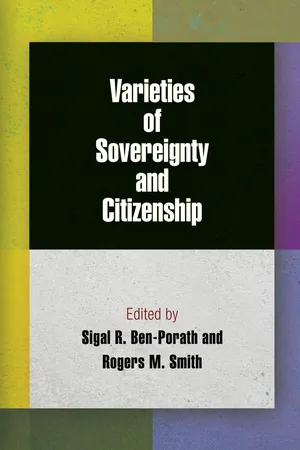
Varieties of Sovereignty and Citizenship
- 352 pages
- English
- ePUB (mobile friendly)
- Available on iOS & Android
eBook - ePub
Varieties of Sovereignty and Citizenship
About this book
Information
Publisher
University of Pennsylvania PressYear
2012Print ISBN
9780812244564
9780812244564
eBook ISBN
9780812207484
Notes
Introduction
1. Leo Gross, “The Peace of Westphalia, 1648–1948,” American Journal of International Law 42:1 (1948): 20, 34, 37.
2. Ibid., 41.
3. John Torpey, The Invention of the Passport: Surveillance, Citizenship, and the State (New York: Cambridge University Press, 1999), 93–121.
4. Yasemin Nuhoglu Soysal, The Limits of Citizenship: Migrants and Postnational Membership in Europe (Chicago: University of Chicago Press, 1995), 1. See also, e.g., David Jacobson, Rights Across Borders: Immigration and the Decline of Citizenship (Baltimore: Johns Hopkins University Press, 1996).
5. See, e.g., David Held, Democracy and the Global Order: From the Modern State to Cosmopolitan Governance (Stanford, Calif.: Stanford University Press, 1995); Daniele Archibugi and David Held, eds., Cosmopolitan Democracy: An Agenda for a New World Order (Boston: Polity, 1995).
6. Peter H. Schuck, “Membership in the Liberal Polity: The Devaluation of American Citizenship,” Georgetown Immigration Law Journal 3 (1989): 1–18.
7. Peter H. Schuck, “The Re-evaluation of American Citizenship,” in Nation-State: Immigration in Western Europe and the United States, ed. Christian Joppke, 191–230 (New York: Oxford University Press, 1998).
8. Linda Bosniak, The Citizen and the Alien: Dilemmas of Contemporary Membership (Princeton, N.J.: Princeton University Press, 2006), 124–26.
9. Elizabeth F. Cohen, Semi-Citizenship in Democratic Politics (New York: Cambridge University Press, 2009), 126–27.
10. David Miller, On Nationality (Oxford: Oxford University Press, 1995); Jeremy Rabkin, Law Without Nations? (Princeton, N.J.: Princeton University Press, 2005), The Case for Sovereignty (Washington, D.C.: AEI Press, 2004),
11. Aihwa Ong, Flexible Citizenship: The Cultural Logics of Transnationality (Durham, N.C.: Duke University Press, 1999), 19.
Chapter 1. Sovereignty Out of Joint
I would like to thank Rogers Smith and the Penn DCC Program for creating and sustaining a wonderful intellectual environment, and participants in the Faculty Seminar for helpful comments.
1. As Anna Tsing puts it, even the strongest states have only ever enjoyed “partial” sovereignty (“Subcontracting Sovereignty,” this volume).
2. Karl Marx, Capital, vol. 1 (New York: International, 1967), 80.
3. Edmund Husserl, The Crisis of European Sciences and Transcendental Phenomenology, trans. David Carr (Evanston, Ill.: Northwestern University Press, 1970), 299.
4. Charles Tilly, “Reflections on the History of European State-Making,” in The Formation of National States in Western Europe, ed. Charles Tilly (Princeton, N.J.: Princeton University Press, 1975), 38.
5. Anne-Marie Slaughter, A New World Order (Princeton, N.J.: Princeton University Press, 2004); Robert Goodin, “World Government Is Here!” this volume.
6. Arjun Appadurai, “Deep Democracy: Urban Governmentality and the Horizon of Politics,” Public Culture 14:1 (2002): 21–47.
7. Wendy Brown, “Sovereignty and the Return of the Repressed,” in The New Pluralism: William Connolly and the Contemporary Global Condition, ed. David Campbell and Morton Schoolman, 251–52 (Durham, N.C.: Duke University Press, 2008); Michael Hardt and Antonio Negri, Empire (Cambridge, Mass.: Harvard University Press, 2000).
8. Michael Mandelbaum, The Case for Goliath: How America Acts as the World’s Government in the 21st Century (New York: Public Affairs, 2005).
9. David Miller, “The Idea of Global Citizenship,” this volume.
10. Michael Blake, “Immigration, Causality, and Complicity,” this volume; Anna Stiltz, “Why Does the State Matter Morally?” this volume.
11. Appadurai, “Deep Democracy,” 24.
12. John Arquilla and David Ronfeldt, The Advent of Netwar (Santa Monica, Calif.: RAND, 1996), 4–6.
13. In Foreign Policy’s annual “Failed States Index,” for example, there are almost three times as many states seen to be at risk for failure (38) than are seen to be stable (13). Foreign Policy, “Failed States Index 2011,” http://www.foreignpolicy.com/failedstates.
14. State building is colloquially, but inaccurately, referred to as “nation building.” I use the former term.
15. Husserl, Crisis, 299.
16. Michel-Rolph Trouillot, Silencing the Past: Power and the Production of History (Boston: Beacon, 1995), 22–24, 29.
17. Charles Tilly, Coercion, Capital, and European States, AD 990–1992 (Oxford: Blackwell, 1992).
18. Linda Colley, Britons: Forging the Nation, 1707–1837 (New Haven, Conn.: Yale University Press, 1992).
19. Tilly, Coercion, 104.
20. This assumption is reasonable, given that observers in the nineteenth century understood the European state to be an imperial one, including separate and unequal populations in the colonies. James Mill, for example, termed Indian history as “an entire, and highly interesting, portion of the British history” (cited in Ranajit Guha, Dominance Without Hegemony: History and Power in Colonial India [Cambridge, Mass.: Harvard University Press, 1997], 79). Indicating how much the idea of sovereign statehood coincided with imperial expansion, let us recall that in gaining independence, Haiti named itself the “Empire of Haiti” and invaded its neighbor, now the Dominican Republic, in 1801 (before independence) and 1822.
21. The term state failure event is the coinage of the Political Instability Task Force, referring to one of the following: ethnic war, revolutionary war, adverse regime change (e.g., a coup), genocide.
22. Neta Crawford, Argument and Change in World Politics: Ethics, Decolonization, and Humanitarian Intervention (Cambridge: Cambridge University Press, 2002); Daniel Philpott, Revolutions in Sovereignty: How Ideas Shaped Modern International Relations (Princeton, N.J.: Princeton University Press, 2001).
23. There are accounts that attribute the demise of empire to voluntary decisions on the part of the imperial powers to give up their colonies. The implication is twofold: first, there is nothing inherently unstable about empire; second, resistance in the colonized world was not a significant force. See, for example, Niall Ferguson, Empire: The Rise and Demise of the British World Order and the Lessons for Global Power (New York: Basic, 2003).
24. Raymond Aron, Peace and War: A Theory of International Relations (New York: Doubleday, 1966), 373.
25. Robert Jervis, The Meaning of the Nuclear Revolution: Statecraft and the Prospect of Armageddon (Ithaca, N.Y.: Cornell University Press, 1989).
26. This trend has been decried by Edward Luttwak, who has called for war to be “given a chance” in the sense that if wars run their course, a more stable order may result; “Give War a Chance,” Foreign Affairs 78:4 (1999): 36–44.
27. John Herz, The Nation-State and the Crisis of World Politics (New York: David McKay, 1976); Basil Liddell Hart, The Revolution in Warfare (New Haven, Conn.: Yale University Press, 1946).
28. McGeorge Bundy, Danger and Survival: Choices About the Bomb in the First Fifty Years (New York: Random House, 1988), 161–76.
29. Morton Kaplan, “United States Foreign Policy in a Revolutionary Age,” in The Revolution in World Politics, ed. Morton Kaplan (Princeton, N.J.: Princeton University Press, 1962), 431.
30. Hans Morgenthau, “The Four Paradoxes of Nuclear Strategy,” American Political Science Review 58:1 (1964): 23–35.
31. Quoted in Marc Trachtenberg, “A Wasting Asset: American Strategy and the Shifting Nuclear Balance, 1949–1954,” International Security 13:3 (1988–89): 5–49, 37.
32. Henry Kissinger, Nuclear Weapons and Foreign Policy (New York: Harper, 1957), 131.
33. See Steven Kull, Minds at War: Nuc...
Table of contents
- Cover
- Title
- Copyright
- Contents
- Introduction
- I. War, Sovereignty, and Plural Citizenships
- II. Immigration, Sovereignty, and Plural Citizenships
- III. On Cosmopolitan Alternatives
- List of Contributors
- Notes
- Index
Trusted by 375,005 students
Access to over 1.5 million titles for a fair monthly price.
Study more efficiently using our study tools.
Frequently asked questions
Yes, you can cancel anytime from the Subscription tab in your account settings on the Perlego website. Your subscription will stay active until the end of your current billing period. Learn how to cancel your subscription
No, books cannot be downloaded as external files, such as PDFs, for use outside of Perlego. However, you can download books within the Perlego app for offline reading on mobile or tablet. Learn how to download books offline
Perlego offers two plans: Essential and Complete
- Essential is ideal for learners and professionals who enjoy exploring a wide range of subjects. Access the Essential Library with 800,000+ trusted titles and best-sellers across business, personal growth, and the humanities. Includes unlimited reading time and Standard Read Aloud voice.
- Complete: Perfect for advanced learners and researchers needing full, unrestricted access. Unlock 1.5M+ books across hundreds of subjects, including academic and specialized titles. The Complete Plan also includes advanced features like Premium Read Aloud and Research Assistant.
We are an online textbook subscription service, where you can get access to an entire online library for less than the price of a single book per month. With over 1.5 million books across 990+ topics, we’ve got you covered! Learn about our mission
Look out for the read-aloud symbol on your next book to see if you can listen to it. The read-aloud tool reads text aloud for you, highlighting the text as it is being read. You can pause it, speed it up and slow it down. Learn more about Read Aloud
Yes! You can use the Perlego app on both iOS and Android devices to read anytime, anywhere — even offline. Perfect for commutes or when you’re on the go.
Please note we cannot support devices running on iOS 13 and Android 7 or earlier. Learn more about using the app
Please note we cannot support devices running on iOS 13 and Android 7 or earlier. Learn more about using the app
Yes, you can access Varieties of Sovereignty and Citizenship by Sigal R. Ben-Porath, Rogers M. Smith, Sigal R. Ben-Porath,Rogers M. Smith in PDF and/or ePUB format, as well as other popular books in Politics & International Relations & Civics & Citizenship. We have over 1.5 million books available in our catalogue for you to explore.