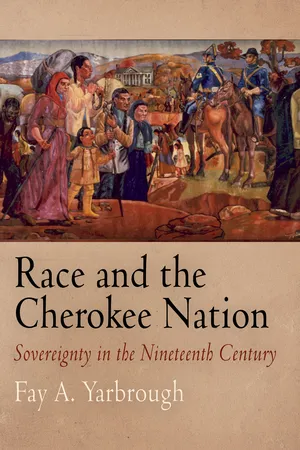
"We believe by blood only," said a Cherokee resident of Oklahoma, speaking to reporters in 2007 after voting in favor of the Cherokee Nation constitutional amendment limiting its membership. In an election that made headlines around the world, a majority of Cherokee voters chose to eject from their tribe the descendants of the African American freedmen Cherokee Indians had once enslaved. Because of the unique sovereign status of Indian nations in the United States, legal membership in an Indian nation can have real economic benefits. In addition to money, the issues brought forth in this election have racial and cultural roots going back before the Civil War.
Race and the Cherokee Nation examines how leaders of the Cherokee Nation fostered a racial ideology through the regulation of interracial marriage. By defining and policing interracial sex, nineteenth-century Cherokee lawmakers preserved political sovereignty, delineated Cherokee identity, and established a social hierarchy. Moreover, Cherokee conceptions of race and what constituted interracial sex differed from those of blacks and whites. Moving beyond the usual black/white dichotomy, historian Fay A. Yarbrough places American Indian voices firmly at the center of the story, as well as contrasting African American conceptions and perspectives on interracial sex with those of Cherokee Indians.
For American Indians, nineteenth-century relationships produced offspring that pushed racial and citizenship boundaries. Those boundaries continue to have an impact on the way individuals identify themselves and what legal rights they can claim today.
- 200 pages
- English
- ePUB (mobile friendly)
- Available on iOS & Android
eBook - ePub
About this book
Information
Publisher
University of Pennsylvania PressYear
2013Print ISBN
9780812240566
9780812240566
eBook ISBN
9780812290172
Chapter 1
A Moment of Inclusion
Molley
The Cherokees early applied racial labels to distinguish themselves from “others” living in the Nation. In 1824, the Cherokee Council passed a resolution to conduct a census of the Nation that included racial labels. The Council instructed census takers to count all males and females, subdivided by age groups; “the number of male negro slaves, and the number of female negro slaves”; as well as “the number of white men married to cherokee [sic] women; and the number of Cherokee men married to white women.”1 The language of the act authorized by Cherokee officials recognized three specific groups as the potential lawful residents of the Nation: Cherokees, “negro” slaves, and whites intermarried with Cherokees. And, indeed, the census data demonstrate that individuals were enumerated as Cherokees, intermarried whites, or black slaves.2 The Cherokees could have employed other categories for counting the residents of the Nation that did not reference racialized labels: by citizenship status (obtained by birth or adoption), by free or enslaved status, or solely by age and gender. Instead, they adopted the language of race: by 1824, the Cherokee Nation was already immersed in a racialized view of the world.
The racialized categories prescribed by the legislation authorizing the census were relatively new to the Cherokee Nation, which was in the process of constructing racial meaning. Formerly, Cherokees conceived of a world inhabited by Cherokee clan members and nonmembers, which included other indigenous groups both friendly and hostile, European colonists, imported African slaves, and free Africans.3 The story of the slave woman Molley and her descendants highlights the centrality of clan membership to Cherokee identity. Moreover, her story shows that during the late eighteenth century, Cherokee ideas about race and identity were still fluid. Circumstances surrounding Molley’s entrance into the Cherokee Nation reveal the basic organization of Cherokee society and the traditional understanding of the concepts of adoption, slavery, and interracial marriage among the Cherokees. Elements of Molley’s story reflect the tenacity of traditional Cherokee practices but also hint at the legislative changes that were taking place, spurred by the presence of a growing population of individuals without traditional clan identities in the Nation.
Molley arrived in the Cherokee Nation prior to the Revolutionary War under curious and tragic circumstances.4 Molley’s owner, Sam Dent, was a white trader who had married a Cherokee woman from the Deer clan. By “beating and otherwise mistreating” her during her pregnancy, Dent killed his wife. The Deer clan demanded satisfaction. One of the benefits of clan membership among the Cherokee Indians was protection: others would not harm you because they risked retaliation from your clan. Clan members were obligated to avenge each other’s deaths.5 Thus, Dent knew that failure to appease the Deer clan would cost him his life. Dent bought the slave girl Molley in Georgia and offered her to the Deer clan as a replacement for his dead wife. After a town council meeting, the clan agreed to accept Molley and her future descendants as members of the clan and Nation. Sam Dent escaped retribution, and the Deer clan emancipated Molley and gave her a new name, Chickaua, symbolizing her integration into the clan and Nation.6 Chickaua and her descendants became full and equal members of the Cherokee Nation with all of the rights, privileges, and protections associated with clan affiliation despite her former status as a slave and her African ancestry.
Molley’s story might not have been preserved were it not for nineteenth-century legal attempts to return Molley and her descendants to slavery. Apparently, prior to the legal activity that precipitated a legal pronouncement of Molley’s status, Molley and her sons had lived unmolested as members of the Cherokee Nation for more than four decades. By 1833 a Molley Hightower claimed Chickaua, formerly Molley, and her descendants as Hightower’s slave property. Hightower presented a bill of sale from Sam Dent to Hightower’s father, who had also been an Indian trader living in the vicinity of Molley and her children. Hightower petitioned the Nation to hand over her slave property. Members of the Deer clan responded swiftly. They asked the Cherokee Council to prevent the “oppressive and illegal wrong attempted to be practiced on our Brother and Sister by the Hightowers in carrying into slavery two of whom have ever been and considered native Cherokees.”7 Not only did the clan recognize Molley and her children as full and free members of the Cherokee Nation, the clan defended her legal rights as a Cherokee and argued for her continued enjoyment of liberty and freedom. Other prominent Cherokees also certified the circumstances of Molley’s entrance into the Nation and adoption into the tribe. They further stated that she and her sons Isaac and Edward had resided in the Nation and “enjoyed the liberty of freedom.”8 The Deer clan, as well as other members of the Cherokee Nation, supported Molley’s claims to freedom and legitimate membership in the Nation.9
The legal documents also describe a transformation: Molley, an African-descended slave, had become, in the language of other Deer clan members, a “native” Cherokee. Late in the eighteenth century and early in the nineteenth century, then, Cherokees had a fairly broad understanding of Cherokee identity that was not tied to race or status but to clan. Molley, an unfree black person, could become Cherokee as a member of the Deer clan. Moreover, the Nation recognized Molley as Cherokee legally because of her own behavior and her acceptance by the larger Cherokee community. In other words, there was a performative and public component to Cherokee identity. Petitioners for Molley’s freedom noted her and her children’s continued residence in the Nation and other Cherokees’ acknowledgment of the family’s free status. This understanding of the nature of Cherokee identity demonstrates that Cherokees had not yet racialized social identities based on descent. Molley’s lack of Cherokee ancestry did not exclude her from Cherokee identity, nor did her African ancestry. Further, Molley could move not only from slavery to freedom but from “black” to “Cherokee.”
Molley’s story also provides a point of entry for an exploration of Cherokee marriage practices: her owner, Sam Dent, was a white man who married a Cherokee woman. Just what was his status, and that of other intermarried white men, in the Cherokee Nation? More generally, what form did marriage between Cherokees take? As stated earlier, clan membership was determined through matrilineal descent. Basing social structures on matrilineal clans customarily had led to a lack of regulation of marriage by Cherokee authorities: early Cherokees had few rites or ceremonies marking marriage, as well as no notion of contract or betrothal.10 In an 1825 act that is one of the few references to the codified legal regulation of marriage between native Cherokees, the Council limited all men, be they white noncitizens or native Cherokee citizens, to only one legal wife.11 Historian John Phillip Reid offers a summary of the informal, unwritten legal provisions that governed marriages between Cherokees.12 According to Reid, “Cherokee marriage was not binding on either husband or wife.”13 Thus, Cherokees had no legal restrictions on adultery or fornication, which permitted a kind of gender equality because women were allowed the same sexual freedom as men.14 Husbands and wives could separate at any time because clan law had simplified divorce by establishing rules about property, kinship, and the clan membership of children.15 Polygamy was apparently legal, as the 1819 and 1825 laws prohibiting it only for white men and then for all men attest.16 Cherokee citizens understood and accepted all of these early statutes as settled law. Hence, the Cherokee constitution could omit laws regulating marriage between citizens, and Cherokee leaders did not find it necessary to codify them in subsequent legislation.
The image of traditional marriage between Cherokees that emerged for many Americans at the time was one of promiscuity, infidelity, and polygamy. Some scholars might argue that the ease of divorce in the Cherokee Nation deterred polygamy, but the operation of matrilineally determined clans offers a more satisfactory explanation.17 The usual benefits of polygamy, such as using multiple wives as an indicator of wealth, to create ties to leaders, to permit women to share household labor, to produce many offspring, and to vary sexual partners, did not apply in the Cherokee Nation. Upon marriage, Cherokee women maintained their own property rights and clan affiliations did not change. Thus, the husband did not suddenly become a member of the ruling clan through marriage; he remained a member of his clan. The husband moved into his wife’s home, which was located in a female-centered household in which sisters or other female relatives shared labor. Any offspring from the union were members of their mother’s clan; Cherokee children did not traditionally have an identity as their father’s children. The simplicity of divorce meant that a Cherokee man could easily vary his sexual partners. The matrilineal nature of clan relationships often eliminated the impetus to form polygamous unions. Of course, what explanations of Reid and others, based on the operation of clans, do not account for are those Cherokee men who did have multiple wives. Through polygamous marriage Cherokee men might solidify alliances with several other clans. Cherokee men may also have achieved status not through their economic support of their wives but from the male’s own ability to attract numerous mates. And Cherokee sisters or female cousins might all choose to wed one male to lessen their shared household burdens. In the end, however, clan considerations probably lessened the extent to which polygamous marriage occurred in the Cherokee Nation.
The Cherokee Nation’s attempt to gain America’s recognition as a legitimate and sovereign nation by imitating white legal protections for women and marriage prompted the passage of the acts on marriage. By passing these acts the Nation revealed American influences on Cherokee jurisprudence: to prevent Cherokee women from being taken advantage of sexually and discarded by white men who only sought entree to the tribe and its resources; to mimic white marriage patterns; to place white men’s marriages to Cherokee women on equal footing with white men’s marriages to white women; to stabilize unions; and to minimize a perception of sexual promiscuity among Cherokee Indians. Americans had interpreted the Cherokee society’s lack of a legalized system for marriage as indicative of a culture with no binding form of marriage to restrain rampant sexual activity.
Nineteenth-century Cherokee marriage laws called for the adoption into the Nation, but not into a specific clan, of all white men who married Cherokee women.18 Unlike earlier practices during the colonial period, which would seem to have permitted white men to choose or refuse formal adoption into the tribe, the newer marriage laws demanded that all white men who married Cherokee women become citizens. The Cherokees did not adopt these intermarried white men in the traditional manner, however; there is little evidence that the intermarried white men exchanged their names for Cherokee names or became members of specific clans. Further, the intermarried whites received rights in the Cherokee Nation, but not the full rights of those native citizens. For instance, intermarried whites did not draw annuity funds, nor could they hold high political office.19 In contrast, intermarried white men gained rights to virtually limitless land in the Cherokee Nation through their marriages because Cherokees owned land communally and permitted individual Nation members to improve as much land as he or she was able. For propertyless, poor white men, the lure of land was surely enticing. White women also married into the Nation and gained some citizenship rights, but the Cherokee legislature did not delineate the procedures for these unions with the same specificity as for intermarried white men. The frequency with which Cherokee women chose white men as husbands combined with the new legal provisions regarding intermarried whites would translate into an expanding population of Cherokee citizens who were not Cherokee racially or culturally.
As construed under the Cherokee Nation’s legislation granting citizenship to intermarried white men, marriages between white men and Cherokee women, in particular, affected the entire Cherokee Nation by introducing new citizens to the tribe. All of them lacked clan affiliations, except perhaps a few who were adopted into a clan. White men, as the children of non-Cherokee mothers, lacked clan relationships. The mixed-race children of Indian and white unions developed ties with their white fathers and other white family members, strengthening the bonds between the Cherokee community and whites in the United States. The influx of white men into the Cherokee Nation changed not only the physical complexion of the tribe but its legal and political practices as well. For instance, Cherokee legislators adopted some American understandings of property and inheritance laws so that white men could leave property to their Cherokee children.20 This shift was a revolutionary change in thinking for a traditionally matrilineal society in which children inherited property and clan identity through their mothers.
Cherokee Nation lawmakers provided for the continuance of the practices of matrilineal inheritance of property and female property ownership despite the introduction into the citizenry, through intermarriage, of white men who pushed American ideas about women’s relationship to property. An 1819 act stipulated that Cherokee women retained their property rights upon marrying white men and that a white man could not dispose of his Cherokee wife’s property without her consent.21 This legislation continued long-standing Cherokee tradition that women maintained property rights even during marriage and flew in the face of American law that did not offer similar recognition of women’s right to own and control property while legally wed.22 Should a white man abandon his Cherokee wife without good reason, he forfeited Cherokee citizenship and had to pay a settlement determined by the Cherokee Committee and Council for breach of marriage. The Nation intended these provisions to foil the practice of marrying Cherokee women solely to gain access to their property or Cherokee citizenship.
The concerns of Cherokee lawmakers mirrored those of white officials, who also noted that white men sought Indian wives to obtain land and property. In 1817 Hugh Montgomery, writing to William Rabun, governor of Georgia, to collect a fee for reporting such offenders, observed that “others (if possible) More Lax in their Morrels & Still Less Delicate in their taste will [Kiss] a Squaw for the privallage of their Land & Range, he then becomes a Landlord and he has his Croppers, Tenants, & Hirelings &c. &c.”23 Thirteen years later, however, Montgomery moderated his position because of the supposedly civilizing effect on Cherokee society of interactions between Cherokees and whites. He found that those Cherokees of mixed Indian and white ancestry were much further “developed” than their counterparts of Cherokee descent alone.24 The changing land situation may have helped persuade Montgomery that white men residing on Indian land could have a positive influence on Indian society. As land became increasingly settled and scarce in states such as South Carolina, North Carolina, Georgia, Tennessee, and Kentucky, white men turned their sights on Indian territories where tribes seemed to own more land than...
Table of contents
- Cover
- Title Page
- Copyright
- Dedication
- Contents
- List of Maps and Tables
- Introduction
- 1. A Moment of Inclusion: Molley
- 2. Racial Ideology in Transition: Shoe Boots
- 3. The 1855 Marriage Law: Racial Lines Harden
- 4. The Civil War: A Missed Opportunity
- 5. The Cherokee Freedmen’s Story: The Boles Family
- 6. Indian Slavery and Memory: Interracial Sex from the Slaves’ Perspective
- 7. The Fight for Recognition Continues: Lucy Allen
- Appendix
- Notes
- Index
- Acknowledgments
Trusted by 375,005 students
Access to over 1.5 million titles for a fair monthly price.
Study more efficiently using our study tools.
Frequently asked questions
Yes, you can cancel anytime from the Subscription tab in your account settings on the Perlego website. Your subscription will stay active until the end of your current billing period. Learn how to cancel your subscription
No, books cannot be downloaded as external files, such as PDFs, for use outside of Perlego. However, you can download books within the Perlego app for offline reading on mobile or tablet. Learn how to download books offline
Perlego offers two plans: Essential and Complete
- Essential is ideal for learners and professionals who enjoy exploring a wide range of subjects. Access the Essential Library with 800,000+ trusted titles and best-sellers across business, personal growth, and the humanities. Includes unlimited reading time and Standard Read Aloud voice.
- Complete: Perfect for advanced learners and researchers needing full, unrestricted access. Unlock 1.5M+ books across hundreds of subjects, including academic and specialized titles. The Complete Plan also includes advanced features like Premium Read Aloud and Research Assistant.
We are an online textbook subscription service, where you can get access to an entire online library for less than the price of a single book per month. With over 1.5 million books across 990+ topics, we’ve got you covered! Learn about our mission
Look out for the read-aloud symbol on your next book to see if you can listen to it. The read-aloud tool reads text aloud for you, highlighting the text as it is being read. You can pause it, speed it up and slow it down. Learn more about Read Aloud
Yes! You can use the Perlego app on both iOS and Android devices to read anytime, anywhere — even offline. Perfect for commutes or when you’re on the go.
Please note we cannot support devices running on iOS 13 and Android 7 or earlier. Learn more about using the app
Please note we cannot support devices running on iOS 13 and Android 7 or earlier. Learn more about using the app
Yes, you can access Race and the Cherokee Nation by Randal Hall in PDF and/or ePUB format, as well as other popular books in History & North American History. We have over 1.5 million books available in our catalogue for you to explore.