Augustine, bishop of Hippo between 395 and 430, and his fellow bishops lived and worked through massive shifts in politics, society, and religion. Christian bishops were frequently asked to serve as intellectuals, legislators, judges, and pastors—roles and responsibilities that often conflicted with one another and made it difficult for bishops to be effective leaders. Expectations of Justice in the Age of Augustine examines these roles and the ways bishops struggled to fulfill (or failed to fulfill) them, as well as the philosophical conclusions they drew from their experience in everyday affairs, such as oath-swearing, and in the administration of penance.
Augustine and his near contemporaries were no more or less successful at handling the administration of justice than other late antique or early medieval officials. When bishops served in judicial capacities, they experienced firsthand the complex inner workings of legal procedures and social conflicts, as well as the fallibility of human communities. Bishops represented divine justice while simultaneously engaging in and even presiding over the sorts of activities that animated society—business deals, litigations, gossip, and violence—but also made justice hard to come by.
Kevin Uhalde argues that serving as judges, even informally, compelled bishops to question whether anyone could be guaranteed justice on earth, even from the leaders of the Christian church. As a result, their ideals of divine justice fundamentally changed in order to accommodate the unpleasant reality of worldly justice and its failings. This philosophical shift resonated in Christian thought and life for centuries afterward and directly affected religious life, from the performance of penance to the way people conceived of the Final Judgment.
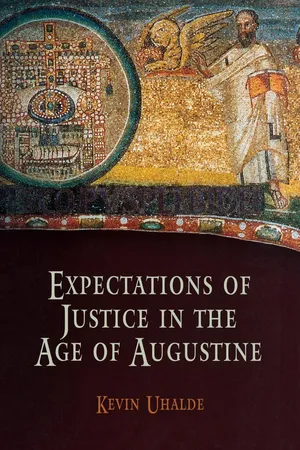
- 248 pages
- English
- ePUB (mobile friendly)
- Available on iOS & Android
eBook - ePub
Expectations of Justice in the Age of Augustine
About this book
Information
Publisher
University of Pennsylvania PressYear
2013Print ISBN
9780812239874
9780812239874
eBook ISBN
9780812203035
1
Calumny: Well-Known Reasons Why Justice Fails
Christians experienced justice the same as everyone else in the ancient and medieval worlds. For ordinary people, this meant that the laws that protected them could also cause them injury if the laws were manipulated by crafty people, perverted by corrupt officials, or bungled by inept judges. For administrators of justice, including lawmakers and judges in the church, the empire, and the successor kingdoms of Western Europe, this meant that traditional means of legal reform (usually the addition of new laws to the old) also contributed to the complexity of the law. By tracing the history of calumny and calumny reform through later Roman legislation and early medieval canon law, it is possible to see how Christian leaders came to terms with the limits of their own ability to offer security and the hope of justice to ordinary Christians.
Judicial Culture
As members of an elite culture that valued education in rhetoric and the law, many bishops during the fourth through the sixth centuries carried legal experience with them into office as a token, as one attribute among many, of their cultural background.1 Priscus of Lyon (573–585/589), for example, served in the household of King Guntram before becoming a bishop. He was remembered in his epitaph as a man,
Progenie clams felix generosus opimus
Mentis et arbitrio iustitiaque potens
Indulsit prudens mixto moderamine causis
Iurgia componens more sereniferi
Concomis et dignus regisque domesticus et sic
Promeruit summo mente placere Deo.
In descent, brilliant, fortunate, noble, rich;
With force of intellect in both judgment and justice,
He was indulgent in lawsuits, adept at tacking rudder,
Resolving quarrels with a settling manner;
He was his king’s courteous and worthy servant, and so
He showed himself with utmost concern worthy of satisfying God.2
But alongside this elite culture, of which legal acumen or rhetorical polish might be an attribute, the law had a culture all its own. Within that culture, most working bishops soon would come to distinguish between an ideology centered on the triumph of justice and procedures intended to absorb the shock of its failure.
Historians have devoted much attention to late antique and early medieval bishops, meticulously mapping their careers and their interactions with other elites wherever possible, most notably in Gaul.3 Others have focused their efforts differendy: Claude Lepelley, for example, celebrated the rediscovery of the bishop as a “private person,” a theme that runs through his and Claire Sotinel’s edited volume L’évêque dans la cité du IVe au Ve siècle: image et autorité.4 With experts drawing on prosopography, epigraphy, archaeology, cultural and legal anthropology, the sociology of elites, and textual criticism, the scholarship on bishops is rich and diverse, perhaps on the verge of sprawling. One persistent element in our understanding of bishops, however, deserves more critical attention: the new and improved bishops as a group, according to the scholarly literature, enjoyed virtual autonomy in crafting their image to fit the social, political, and religious terrain of the emerging postclassical world, even though as individuals they were less successful at crafting the terrain to their liking. That is, we can see that bishops during this period deliberately worked at defining what it meant to be a bishop, both for their own understanding and for laypeople’s understanding. No doubt the payoff of their efforts in terms of the social or political clout they enjoyed was contingent on a range of circumstances. Indeed, the bishops who succeeded both in mastering their environment and in generating respect for their authority most famously did so, in the words of Neil McLynn, only by “hectic improvisation.”5
Even this, though, assumes that bishops generally were in control of their professional faculties most of the time. In short, bishops appear to have controlled what it meant to be a bishop. What about when they were not in control? The American documentary filmmaker Errol Morris once told an interviewer from the New Yorker that he constructs all his films around “the idea that we’re in a position of certainty, truth, [and] infallible knowledge, when actually we’re just a bunch of apes running around.” Our approach to bishops and their professional conduct does not need to be as zoological as that. All the same, there is traction to be gained by setting our wheels down in the deep, well-worn ruts of administrative failure, for surely bishops learned as much through failure and disruption as through plan and design. We know the law sometimes failed bishops, just as it does everyone. By necessity, then, they learned to cope with both the failure and success of justice through the course of their professional and religious lives. Bishops’ experience with the rules and procedures of secular law would determine the appearance of medieval canon law, the vocabulary of ecclesiastical administration, and even the formulation of heresy, as Caroline Humfress has shown.6
But the influence of endemic administrative and judicial failure went deeper than vocabulary, forms, and techniques. Legal culture — in particular formal devices such as rules of evidence and various testamentary oaths and judicial reform — introduced bishops to another, older, and less controllable culture: a culture of judicial uncertainty, where the possibility of failure and triumph hung more or less evenly in the balance. It became the responsibility of the church and its leaders to explain what difference they made to this balance. As we shall see in this chapter, doing so was an uphill battle. Outside the church, justice ruined innocent people. Groundless accusations, slander, forged or missing evidence, anonymous denunciations, procedural violations: these were the means by which malicious people worked the system to their advantage. Sometimes the law did not seem capable of delivering justice — certainly not to all people equally. “If the transgressor of the law be of the monied class, it is not likely that he pays the penalty of his wrongdoing,” complained a Greek who had so detested the unfairness of Roman justice that he settled permanendy among Attila’s Huns, where the historian Priscus of Panium claimed to have found him in 449. If, on the other hand, the transgressor “should be poor and ignorant of how to handle the business,” the man continued, “he endures the penalty according to the law — if he does not depart life before his trial. For the course of these cases is long protracted, and a great deal of money is expended on them. Probably the most grievous suffering of all is to obtain the rights of the law for pay. No one will even grant a court to a wronged man unless he lays aside some money for the judge and his attendants.”7 Priscus was quick to defend both the cost and pace of imperial justice; he claims to have done this so persuasively that the renegade even shed tears over the excellent design of Roman laws. Still, though the Greek conceded the good intent of the laws’ designers, he suggested that good intentions did not translate necessarily into good practice. At this moment, an interruption required Priscus to abandon the conversation. The renegade did not join Priscus and his companions on their return to the empire, so he seems to have remained unpersuaded in the end.
Late Roman emperors in fact sustained a campaign against the abuses that had driven this citizen to live among the Huns, abuses they sometimes addressed collectively under the rubric calumny (calumnia). This was a technical term, meaning false accusation, but its usage in literary and legal sources, both secular and ecclesiastical, was often much broader and took in whatever might threaten the judicial system and foster uncertainty over its ability to deliver justice.8 Emperors attacked malicious informers, corrupt judges, and inefficient bureaucrats all with equal fervor, if unequal punishments. In large part the campaign was rhetorical, part of what Jill Harries has called a general “culture of criticism” among late antique emperors and their legislators, which, we shall see, directly influenced the administration of justice within the Christian church as well. This campaign was a mode of imperial authority, and is by no means proof that justice actually had become more corrupt or emperors more honest.9
However, while we can appreciate the campaign against calumny as a facet of legal culture and as a rhetorical posture on the part of emperors and kings, it existed in neither a juridical nor a political vacuum.10 The following points are well known to historians working with documentary evidence from the earlier empire; we should keep them in the front of our minds when turning to episcopal justice in the West, where the testimony of both papyrus and stone is sparse when it comes to the law. First of all, the legislation tapped a real problem in contemporary society. Indirect evidence that calumny caused popular anxiety is abundant, and direct evidence sporadic from throughout this period. Second, the mechanisms that rulers and their jurists put in place in order to prevent injustice sometimes actually discouraged people from seeking justice, repelling them either by its cumbersome procedures or by its severe sanctions. Most of those people could choose instead to use a limited but viable range of alternatives to imperial courts — arbitration, oath-swearing, magical devices, or violence, for example — and they did so readily. Third, the mechanisms for controlling false accusations in imperial courts even influenced some of these alternative sources of justice. In episcopal courts, for example, secular rules of evidence applied not only in the civil disputes bishops might arbitrate but also in purely religious affairs. Procedural regulations simultaneously defined and limited what bishops were able to do; thus they limited what laypeople could expect from episcopal justice.
Finally, the legal culture of the later empire — its forms, its mechanisms, and its professed concern for its own shortcomings — affected bishops from the late fourth century onward, at the same time that they found themselves unable to fulfill all the expectations of their followers. Even bishops gifted with the most brilliant minds for theological speculation, debate, and theorizing had little choice but to dirty their hands in the practice of justice. They were professionally obliged to deliver both salvation and justice to Christian men and women. So how, their followers asked, could the offer of salvation be fixed and certain while the promise of justice appeared to twist in the winds of calumny? Although no easy answers were forthcoming, we can follow the earnest attempts some bishops made at relieving the burden of uncertainty.
Juridical Solutions: Roman Law
The concept of calumny provided rulers with an inexhaustible opportunity to voice their concern over institutional corruption and the uncertainty that troubled their citizens. The threat of falsehood lurked in every relationship, every contract, and every trial. Wealthy people lost their property because of false accusations; the poor were oppressed or became slaves; and just people suffered from unjust accusations.11 Meanwhile, legislators railed against calumny, virtually without rest.12 The “culture of criticism,” in Jill Harries’ apt phrase, which supplied a context and vocabulary to late Roman calumny legislation, thrived on the uncertainty inherent in judicial process. Under the law, calumny covered false accusations as well as vexatious litigation — groundless lawsuits, that is, with little or no chance of succeeding, pursued in order to catch off guard, wear down, or simply perturb an opponent.
A PROBLEM CATEGORIES CANNOT CONTAIN
In the Theodosian Code, which made its official debut in the Roman Senate on 25 December 438, accompanied by twenty-eight successive acclamations of the emperors as “destroyers of informers, destroyers of calumnies,”13 rules pertaining to calumny cropped up in various legal categories. It is precisely this slippage that makes calumny an important historical subject, for it reveals a dilemma that sometimes confused the academic interests of jurists and exceeded the professional interests of judges. Nothing had changed a century later. Gallo-Roman legal experts in the late fifth century, probably bishops, compiled a collection of Roman laws for the Visigothic court, a collection commonly known as the “Breviary of Alaric.” Their lengthy gloss (interpretatio) of a decree by Arcadius and Honorius from 398 was effectively a checklist of calumnious incidents that numerous late Roman decrees had addressed separately. Calumniators here included those who initiated cases on another’s behalf without written permission, who renewed closed cases, who fraudulently claimed property on behalf of the government so that innocent people could not enjoy peace, and who made false accusations. What all these offenders shared in common was that they “dared to stir the minds of the emperors to wrath.”14 Once an imperial official detected calumny in a criminal case, he was immediately to terminate the case for good, lest the “innocence and security of another be terrorized.”15 When the calumny involved a false accusation in a criminal court, the accuser would be tried in a special proceeding; convicted calumniators suffered infamy and deportation.16
Beyond whatever deterrent effect these sanctions might have had, however, and ...
Table of contents
- Cover
- Title
- Copyright
- Contents
- Introduction
- 1. Calumny: Well-Known Reasons Why Justice Fails
- 2. “Judge Like God”: What Bishops Claimed to Expect of Themselves
- 3. Christian Oaths: A Case Study in Practicality over Doctrine
- 4. Mercy Not Justice: How Penance Became a Worthy Act of Self-Incrimination
- Conclusion
- List of Abbreviations
- Notes
- Bibliography
- Index
- Acknowledgments
Trusted by 375,005 students
Access to over 1.5 million titles for a fair monthly price.
Study more efficiently using our study tools.
Frequently asked questions
Yes, you can cancel anytime from the Subscription tab in your account settings on the Perlego website. Your subscription will stay active until the end of your current billing period. Learn how to cancel your subscription
No, books cannot be downloaded as external files, such as PDFs, for use outside of Perlego. However, you can download books within the Perlego app for offline reading on mobile or tablet. Learn how to download books offline
Perlego offers two plans: Essential and Complete
- Essential is ideal for learners and professionals who enjoy exploring a wide range of subjects. Access the Essential Library with 800,000+ trusted titles and best-sellers across business, personal growth, and the humanities. Includes unlimited reading time and Standard Read Aloud voice.
- Complete: Perfect for advanced learners and researchers needing full, unrestricted access. Unlock 1.5M+ books across hundreds of subjects, including academic and specialized titles. The Complete Plan also includes advanced features like Premium Read Aloud and Research Assistant.
We are an online textbook subscription service, where you can get access to an entire online library for less than the price of a single book per month. With over 1.5 million books across 990+ topics, we’ve got you covered! Learn about our mission
Look out for the read-aloud symbol on your next book to see if you can listen to it. The read-aloud tool reads text aloud for you, highlighting the text as it is being read. You can pause it, speed it up and slow it down. Learn more about Read Aloud
Yes! You can use the Perlego app on both iOS and Android devices to read anytime, anywhere — even offline. Perfect for commutes or when you’re on the go.
Please note we cannot support devices running on iOS 13 and Android 7 or earlier. Learn more about using the app
Please note we cannot support devices running on iOS 13 and Android 7 or earlier. Learn more about using the app
Yes, you can access Expectations of Justice in the Age of Augustine by Kevin Uhalde in PDF and/or ePUB format, as well as other popular books in History & Roman Ancient History. We have over 1.5 million books available in our catalogue for you to explore.