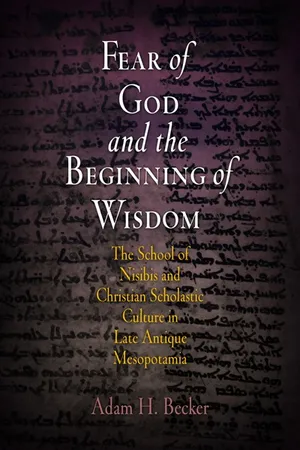
The School of Nisibis was the main intellectual center of the Church of the East in the sixth and early seventh centuries C.E. and an institution of learning unprecedented in antiquity. Fear of God and the Beginning of Wisdom provides a history both of the School and of the scholastic culture of the Church of the East more generally in the late antique and early Islamic periods. Adam H. Becker examines the ideological and intellectual backgrounds of the school movement and reassesses the evidence for the supposed predecessor of the School of Nisibis, the famed School of the Persians of Edessa. Furthermore, he argues that the East-Syrian ("Nestorian") school movement is better understood as an integral and at times contested part of the broader spectrum of East-Syrian monasticism.
Becker examines the East-Syrian culture of ritualized learning, which flourished at the same time and in the same place as the famed Babylonian Rabbinic academies. Jews and Christians in Mesopotamia developed similar institutions aimed at inculcating an identity in young males that defined them as beings endowed by their creator with the capacity to study. The East-Syrian schools are the most significant contemporary intellectual institutions immediately comparable to the Rabbinic academies, even as they served as the conduit for the transmission of Greek philosophical texts and ideas to Muslims in the early 'Abbasid period.
eBook - ePub
Fear of God and the Beginning of Wisdom
The School of Nisibis and the Development of Scholastic Culture in Late Antique Mesopotamia
- 320 pages
- English
- ePUB (mobile friendly)
- Available on iOS & Android
eBook - ePub
Fear of God and the Beginning of Wisdom
The School of Nisibis and the Development of Scholastic Culture in Late Antique Mesopotamia
About this book
Information
Publisher
University of Pennsylvania PressYear
2013Print ISBN
9780812239348
9780812239348
eBook ISBN
9780812201208
Topic
Theology & ReligionSubtopic
Ancient HistoryChapter 1
Divine Pedagogy and the Transmission of the Knowledge of God: The Discursive Background of the School Movement
Therefore every scribe who has been trained for the kingdom of heaven is like the master of a household who brings out of his treasure what is new and what is old. (Mt 13:52)
Thoughtful Christians will concede that, although theology has an essential function, theological discourse does not necessarily depend on a clear-cut conception of the cosmic framework on the part of a religious actor. Discourse involved in practice is not the same as that involved in speaking about practice. It is a modern idea that a practitioner cannot know how to live religiously without being able to articulate knowledge.1
A pedagogical understanding of the human being’s place in the world is apparent throughout East-Syrian literature. A feature of the Cause of the Foundation of the Schools that strikes the reader immediately is its schematization of all human history into a long series of schools. Such a set of metaphors and motifs corresponds to the East-Syrian school movement as an underlying ideology that would have maintained and been maintained by the social institutions of the schools.2 However, while this pedagogical ideology was perpetuated through, for example, the School of Nisibis by its various rules and its community life, its origins lie outside the East-Syrian schools. It may seem counter-intuitive, but I would argue that what might be referred to as the pedagogical model was in existence before there were actual Syriac schools, and that in time the model was reinforced and found a easier fit within the East-Syrian school movement. In other words, Syriac Christians were talking about schools before they existed, and it was only later that, in a sense, the metaphor became reality. To be sure, this pedagogical model was not static. It developed and was transformed at the same time as the institutions it both affected and reflected.3
In a sense, certain aspects of the East-Syrian pedagogical understanding of Christianity were always there in potential in various receptacles such as tradition and Christian literature. When the conditions of theology, economics, and monastic development, for example, were right, this seed took root. The purpose of this chapter is to delineate the background of this pedagogical model and demonstrate how it was employed in understanding conversion to Christianity.
Pedagogical Imagery in the Syriac Milieu
A pedagogical ideology existed within Christianity from the very beginning. Early Christians borrowed ways of talking about themselves from the institutional discourses of the Greco-Roman world. Christianity could be characterized variously as a new nation (éthnos) or polity (polīteîa), a kind of family, the “true” Israel, or a school among the many philosophies of the day.4 Even in the first century, Philo and Josephus describe Judaism as a having “schools of thought (Gr. hairéseis),”5 and the Gospels present Jesus and his followers as a teacher (rabbi) and his students (disciples).6 Christian discipleship was metaphorically and concretely a pedagogical relationship, something easily lost in the all too familiar term “disciple.” This pedagogical notion is readily apparent exegetically already in second-temple Jewish literature. For example, regarding Adam’s naming of the animals, Philo writes:
So Moses says that God brought all the animals to Adam, wishing to see what appellations he would assign to them severally. Not that He was in any doubt—for to God nothing is unknown—but because He knew that He had formed in mortal man the natural ability to reason of his own motion, that so He Himself might have no share in faulty action. No, He was putting man to the test, as a teacher does a pupil, kindling his innate capacity, and calling on him to put forth some faculty of his own.7
Numerous examples can be provided from the second-temple Jewish background to this material. In negotiating a comfortable relationship with the dominant Hellenistic culture of which it was part, second-temple Jewish culture had to find a fit with paideia, that is, the traditional Greek and later Roman form of forming elite adult males, and paideia in turn would affect Jewish cultural self-understanding. Early Christians took up many of the techniques of dealing with cultural difference that second-temple Jewish intellectuals had already developed, such as the subversive reversal and elevation implicit in the notion of “barbarian wisdom,” which can be found in the Christian idea that Greek culture and learning could be trumped by the simple philosophy of Aramaic-speaking fishermen. Furthermore, from early on, the Jesus movement set itself up as a counter to the so-called wisdom of this world (e.g., 1 Cor 1–2).
The pedagogical model is present in the Christian appropriation of the term haíresis (originally meaning “school of thought”) from the ancient classroom to talk about those who were theologically aberrant.8 This model is also apparent in the fact that many ecclesiastical documents were referred to as “teaching.”9 At times this pedagogical model reflected the actual social reality of the writers of the documents in which it appears. For example, Christian Greek writers of the second and third centuries, such as Justin Martyr, Clement of Alexandria, and Origen, were engaged in intellectual activity in the mold of ancient philosophers and so understood Christianity in pedagogical terms.10 Their peers, the so-called Gnostics, such as Valentinus, also maintained study circles and at the same time a notion of Jesus as instructor.11 David Brakke has suggested that one of the great shifts in ecclesial models was the changeover from an “academic” Christianity to a “catholic” Christianity in the fourth century under Athanasius, Bishop of Alexandria.12 Furthermore, this pedagogical understanding of Christianity was part of the immense project of accommodating classical culture in which Christian intellectuals from Clement of Alexandria to Basil of Caesarea were engaged. Thus, by the time of Theodore of Mopsuestia, who will be addressed in more detail in a later chapter, casting God in the role of pedagogue would have seemed a natural thing to do.
The earliest Syriac sources attest to an understanding of Christianity as a form of learning.13 This is apparent explicitly in the imagery that is often employed in the sources, but also implicitly in the understanding of the human being’s relationship with God as imitative. Thus the strong emphasis on the imitation of Christ in some of the earliest Syriac literature, including the famous twin motif in texts such as the Acts of Thomas, corresponds with the pedagogical model. Self-identification with the bridegroom, such as we find in the line from Aphrahat’s sixth Demonstration from the mid-fourth century (“The solitary [īḥīdāyā] from the bosom of his father gives pleasure to all the solitaries [īḥīdāyē]”14), is analogous to the mimetic understanding of learning common in antiquity.
Some of the earliest explicit examples in Syriac literature of the tendency to employ pedagogical terms can be found in the Peshitta. Simple instances are provided by the common use of the word yullphānā, meaning “learning” or “teaching,” and a number of other cognate words based on the same Syriac root, which serve as key pedagogical terms in later texts, such as the Cause. While many of these usages are not particularly striking, some certainly would have been suggestive to a reader with a mind for pedagogy. For example, in Exodus 18 Jethro warns Moses that he is going to wear himself out resolving all the disputes of the people. In the middle of Jethro’s advice to Moses, the Hebrew text reads, ‘You should represent the people before God” (Ex 18:19),15 while the Peshitta has, “You, be a teacher to the people from God.”
Michael Weitzman has argued that the corruption of the Hebrew Vorlage of the Peshitta version of Chronicles compelled the translator (s) of this text “to guess and so reveal his attitudes.”16 Weitzman relies on this Syriac version of Chronicles in his attempt to resolve the question of the origins of the Peshitta, whether Jewish or Christian. Following Weitzman’s method, we might also look at pedagogical terminology in the Peshitta of Chronicles. There are a number of examples where the translator has added pedagogical terminology.17
1 Chr 5:1218
MT Joel the chief, Shapham the second, Jannai, and Shaphat in Bashan . . .
P Joel went out at their head, and he was judging them and teaching them the scri...
Table of contents
- Cover
- Title
- Copyright
- Contents
- Preface
- Note on Transliteration, Spelling, and Terminology
- Chronology
- Introduction
- 1. Divine Pedagogy and the Transmission of the Knowledge of God: The Discursive Background of the School Movement
- 2. The School of the Persians (Part 1): Rereading the Sources
- 3. The School of the Persians (Part 2): From Ethnic Circle to Theological School
- 4. The School of Nisibis
- 5. The Scholastic Genre: The Cause of the Foundation of the Schools
- 6. The Reception of Theodore of Mopsuestia in the School of Nisibis
- 7. Spelling God’s Name with the Letters of Creation: The Use of Neoplatonic Aristotle in the Cause
- 8. A Typology of the East-Syrian Schools
- 9. The Monastic Context of the East-Syrian School Movement
- Conclusion: Study as Ritual in the Church of the East
- Notes
- Bibliography
- Index
- Acknowledgement
Trusted by 375,005 students
Access to over 1.5 million titles for a fair monthly price.
Study more efficiently using our study tools.
Frequently asked questions
Yes, you can cancel anytime from the Subscription tab in your account settings on the Perlego website. Your subscription will stay active until the end of your current billing period. Learn how to cancel your subscription
No, books cannot be downloaded as external files, such as PDFs, for use outside of Perlego. However, you can download books within the Perlego app for offline reading on mobile or tablet. Learn how to download books offline
Perlego offers two plans: Essential and Complete
- Essential is ideal for learners and professionals who enjoy exploring a wide range of subjects. Access the Essential Library with 800,000+ trusted titles and best-sellers across business, personal growth, and the humanities. Includes unlimited reading time and Standard Read Aloud voice.
- Complete: Perfect for advanced learners and researchers needing full, unrestricted access. Unlock 1.5M+ books across hundreds of subjects, including academic and specialized titles. The Complete Plan also includes advanced features like Premium Read Aloud and Research Assistant.
We are an online textbook subscription service, where you can get access to an entire online library for less than the price of a single book per month. With over 1.5 million books across 990+ topics, we’ve got you covered! Learn about our mission
Look out for the read-aloud symbol on your next book to see if you can listen to it. The read-aloud tool reads text aloud for you, highlighting the text as it is being read. You can pause it, speed it up and slow it down. Learn more about Read Aloud
Yes! You can use the Perlego app on both iOS and Android devices to read anytime, anywhere — even offline. Perfect for commutes or when you’re on the go.
Please note we cannot support devices running on iOS 13 and Android 7 or earlier. Learn more about using the app
Please note we cannot support devices running on iOS 13 and Android 7 or earlier. Learn more about using the app
Yes, you can access Fear of God and the Beginning of Wisdom by Adam H. Becker in PDF and/or ePUB format, as well as other popular books in Theology & Religion & Ancient History. We have over 1.5 million books available in our catalogue for you to explore.