Corporate governance, the internal policies and leadership that guide the actions of corporations, played a major part in the recent global financial crisis. While much blame has been targeted at compensation arrangements that rewarded extreme risk-taking but did not punish failure, the performance of large, supposedly sophisticated institutional investors in this crisis has gone for the most part unexamined. Shareholding organizations, such as pension funds and mutual funds, hold considerable sway over the financial industry from Wall Street to the City of London. Corporate Governance Failures: The Role of Institutional Investors in the Global Financial Crisis exposes the misdeeds and lapses of these institutional investors leading up to the recent economic meltdown.
In this collection of original essays, edited by pioneers in the field of fiduciary capitalism, top legal and financial practitioners and researchers discuss detrimental actions and inaction of institutional investors. Corporate Governance Failures reveals how these organizations exposed themselves and their clientele to extremely complex financial instruments, such as credit default swaps, through investments in hedge and private equity funds as well as more traditional equity investments in large financial institutions. The book's contributors critique fund executives for tolerating the "pursuit of alpha" culture that led managers to pursue risky financial strategies in hopes of outperforming the market. The volume also points out how and why institutional investors failed to effectively monitor such volatile investments, ignoring relatively well-established corporate governance principles and best practices.
Along with detailed investigations of institutional investor missteps, Corporate Governance Failures offers nuanced and realistic proposals to mitigate future financial pitfalls. This volume provides fresh perspectives on ways institutional investors can best act as gatekeepers and promote responsible investment.
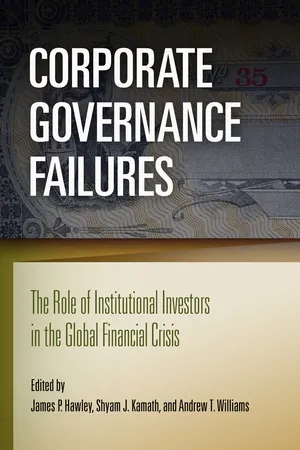
eBook - ePub
Corporate Governance Failures
The Role of Institutional Investors in the Global Financial Crisis
- 352 pages
- English
- ePUB (mobile friendly)
- Available on iOS & Android
eBook - ePub
Corporate Governance Failures
The Role of Institutional Investors in the Global Financial Crisis
About this book
Information
Publisher
University of Pennsylvania PressYear
2011Print ISBN
9780812243147
9780812243147
eBook ISBN
9780812204643
Chapter 1
Introduction
James P. Hawley, Shyam J. Kamath, and Andrew T. Williams
Background
In late 2008 and early 2009, the subject of financial risk was widely debated and discussed among academics and practitioners, in the business press and on blogs, and among the general public, as well as in the U.S. Congress and parliaments abroad. Yet some of us were struck by how little serious attention (indeed, how little attention of any sort) was being paid to the relation of corporate governance to financial risk, especially the role (or lack thereof) of large institutional investors who have dominated corporate governance activities globally over the past two decades or so.
Institutional investors (public and private pension funds, mutual funds, and, in some countries, banks) have long since become the majority holders of not only public equity but other asset classes as well (e.g., bonds, hedge fund and private equity investments, real estate).1 In prior work two of us (Hawley and Williams) have characterized these large investors as “universal owners” (UOs) because they have come to own a representative cross section of the investable universe, having broadly diversified investments across equities and increasingly all other asset classes.2 One consequence of UOs dominating the global investment universe is that their financial and long-term economic interests come to depend on the state of the entire global economy. This contrasts with earlier periods of financial history (especially in common law countries where institutional investors were the rare exception rather than the rule prior to the 1970s) that were dominated by less diversified individual and family owners. Additionally, UOs have come to be the conduits for the majority of the working and retired populations’ savings and investments in many countries, also a historically unprecedented development. Since UOs have broadly diversified financial and economic interests (and indeed, the majority of them are fiduciaries to individual pension fund beneficiaries and retirement investors), it would be logical and, in our view, a fiduciary obligation to closely monitor the behavior of the firms they own. During the past few decades such monitoring became more common of individual firms but of individual firms only. Such monitoring was especially directed at firms with poor corporate governance and poor (relative to their benchmarked peers) economic and financial performance.
In fact, growing corporate governance activism since the late 1980s and early 1990s by some UOs (mostly public pension funds, trade union funds, and some freestanding large investors, e.g., TIAA-CREF in the United States, USS and Hermes in the United Kingdom) has indeed led them to monitor and attempt to change the way in which firms operate (through focus on proxy voting processes, staggered boards of directors, division of CEO from board chair, top executive pay linked to clear performance standards). Varying by country, corporate governance activist UOs have achieved some significant reforms—putting a reform agenda both before the investing public and on the table of the political process while having some impact on how firms’ governance structures operate.
In spite of this sea change in both ownership and firm-specific monitoring and corporate governance actions, missing was a program among almost all UOs prior to the financial crisis, and often in its early days as well, which would have monitored the various warning signs of financial danger and then developed actions to mitigate damage, both to their own portfolios and systemically. Additionally, the three editors of this volume came to ask ourselves whether, and if so to what extent, the various ways large UOs operated might have, unwittingly, contributed to the financial crisis itself, not necessarily as a primary cause, but as a potentially important factor. In our discussion with various UOs, with academics, policy analysts, and others, we concluded that the time was ripe for a candid discussion of these questions.
Thus, we organized a by-invitation-only meeting of academics, policy analysts, and UOs for a candid, off-the-record two-day conference entitled “Institutional Investors, Risk/Return, and Corporate Governance Failures: Practical Lessons from the Global Financial Crisis.”3 All but one of the chapters in this book are revisions of presentations at that conference. An additional chapter was solicited from a participant in the conference who has written widely on risk and who has had a long career as a self-described “risk quant” (Robert Mark).
We described the background of the conference as follows in our call for papers:
The current financial crisis has, as part of its origins, a variety of corporate governance failures. Most obvious are misaligned compensation arrangements that incentivized extreme risk (while not punishing failure). Less examined is the role of large, supposedly sophisticated institutional investors (universal owners) in the crisis. Their role is likely one of unconscious commission as well as of omission. Commissions include, for example, both direct and indirect exposure to extremely complex financial instruments (e.g., credit default swaps) through investment in hedge funds and private equity funds, as well as more traditional equity investment in large financial institutions. In particular, the pursuit of “alpha” often coupled with leverage to magnify returns may have led institutional investors to pursue investment strategies that proved to be particular risky, and significantly contributed to the growth of these risky markets. Omissions include, for example, neither having nor considering having a risk monitoring system in place to monitor such investments based on what are now relatively well-established corporate governance principles and best practices.
The objective of the conference was to investigate the role of corporate governance failures, gaps, oversights, and missed opportunities leading up to and during the current global financial crisis as well as to consider and develop proposals to mitigate these failures in the future.
The problem may have been that institutional investors accepted high returns in the financial sector without adequately investigating the basis for the returns and asking the question about whether they were sustainable or might pose systemic risk. There may be an important parallel to the over-performers of the late 1990s, Enron, WorldCom, and so on, that were much admired for their performance, but where performance was built on an unsustainable business model, often not adequately transparent. Additionally, there has not typically been concern for systemic risk, which has resulted from the piling on of multiple firm, sector, and financial instrument risk.
Also, the apparent acceptance of a significant degree of lack of transparency, especially in the financial sector and among the majority of alternative investments, violated a core concept of corporate governance advocated by universal owners and others: that transparency is critical to accountability, which in turn is critical to a well-governed firm in relation to its owners. Transparency, accountability, and good governance generally add value. Lack of these was toxic.
In addition to considering the widespread failure of most mainstream investors, government agencies, and central banks to both foresee, and when warning flags were raised (e.g., by the Bank for International Settlements in 2006) to heed, these warnings, the conference focused specifically on what has become known as “responsible investment” (RI). Emerging in 2005–2006, RI brought together a variety of larger and smaller institutional owners, fund managers, and consultants under the umbrella of the Principles for Responsible Investment (PRI), a United Nations–initiated offshoot. As of February 2010, the PRI had nearly 200 end asset owner signatories (e.g., California Public Employee Retirement System or CalPERs) with a collective net worth of about $5 trillion, while total assets of all signatories (including almost 370 investment managers, e.g., TIAA-CREF, Blackrock) was about $21 trillion as of spring 2009. (With the growth of equity markets since then, the early 2010 value is likely about $23–24 trillion.) The key element of the PRI is that each signatory agrees to incorporate environmental, social, and governance (ESG) factors into their investment practices. This can take the form of negative exclusion from a fund’s portfolio of firms that do not meet a fund’s definition of ESG standards. It can also take the form of positive screening of a portfolio to include only or be weighted toward those investments that meet the fund’s defined ESG standards. And finally, it can take the form of using various corporate governance tools and techniques to influence firms to report on and raise their environmental or social or governance standards. It can also include mixing these three forms of ESG monitoring, governance actions, and positive or negative screening.
What is striking about almost all PRI signatories is that none of them, either in private or in public as far as we know or could determine, prior to the global financial crisis had considered the issue of financial crisis any more than their mainstream counterparts. They had neither risk screens nor analysis nor corporate governance activities directed at the financial sector (including the shadow financial sector) that might have mitigated or signaled impending crisis. The conference, organized in coordination with some of the largest global PRI members and co-convened with the PRI, was an attempt to begin an examination of this huge gap in responsible investment theory and practice, one not captured by the ESG categories, yet obviously underlying any investment strategy and philosophy. If we had to sum up the point with one word, it would be “economic,” specifically financial: thus, we might want to add to ESG an E for economic, making it EESG factors that need to be considered and integrated in investment and governance standards.
Prior to 2009, the critical missing element in almost all corporate governance practices, the practitioner and academic literature, various national corporate governance codes, law, and international corporate governance discussion forums (e.g., at the International Corporate Governance Network meetings) has been any link between governance and financial risk. Governance has been conceived too narrowly. Underlying this narrow conception was the fact that financial risk analysis itself had been relegated to the investment side of fund operations. Yet risk analysis has overwhelming viewed risk through the too narrow and established lenses of modern portfolio theory (MPT, of which more below) and macroeconomic general equilibrium theory whose models traditionally excluded financial (crisis) variables.
There was much discussion at the conference of what underlies financial sector and systemic risk, particularly MPT and its core assumption of the efficient market hypothesis (EMH). While there was no agreement as to what degree, if any, MPT—due to its widespread adoption—contributed to the financial crisis, there was agreement that once markets became stressed or failed, MPT ceased to work as understood, and may have had perverse consequences. Often discussed were three levels of risk: firm, sector, and system. Only firm-level risk has been addressed by corporate governance analysis and actions. There was general agreement that the failure to address sector (especially financial sector) and systemic risk had been a large failure and needed to be rectified.
The point was also made that the lessons of the turn-of-the-century (Enron, WorldCom, the dot-com bubble) had not been fully or even partially learned from and acted on. There are a variety of similarities between the two crises, although the Enron bubble was far less systemically destructive. Foremost among the parallels are that gatekeepers were compromised and conflicted and massively failed to keep the gates closed. A major lacuna was that those supposedly sophisticated investors (UOs and other large institutional investors) did not recognize or act on gatekeeper failure; indeed, they relied on external gatekeepers (e.g., rating agencies) again in the second crisis. In addition to this failure, institutional investors engaged in a mostly illusory search for “alpha,” achieving above-market returns over a sustained period without harming the majority of a UO’s investment portfolio, including looking at the degree to which the alpha entities (e.g., hedge funds, private equity, real estate) and leveraged instruments (e.g., credit default obligations, credit default swaps) may have unwittingly contributed to crisis.
As of this writing, few UOs have made public statements about how they have corrected or are attempting to correct the mistakes of the past few years in terms of the relation between various levels of risk and corporate governance, although in private this discussion has occurred among at least some large institutional investors. There are some exceptions regarding public statements. For example, TIAA-CREF, the giant U.S. college teachers’ pension and mutual fund, issued a statement in February 2010 stressing the importance of corporate governance in relation to assessing risk, and where appropriate and possible, its mitigation. In particular, the statement stressed the importance of effective monitoring, explicitly arguing that, “for universal owners, the ‘Wall Street Walk’ or simply selling stock in the face of inadequate performance is not the most attractive option.” Long-term and diversified owners (UOs) “believe strong corporate governance helps reduce investment risk and ensures that shareholder capital is used effectively.”4
There has been one notable exception worth highlighting concerning systemic risk among mainline global corporate governance activists: a focus on climate change as a major (albeit nonfinancial) systemic risk factor. Since about 2005 major governance activists have incorporated climate risk (and opportunity) into their corporate governance activities and, to a far more limited degree, into their investment activities, establishing, for example, “green-tech” subfunds.
In order to provide the proper frame of reference for the discussions, the questions, as laid out in our original proposal for the conference and discussed at the conference, were as follows:
1. Corporate governance: How did corporate governance failures (over-sights, failure of risk analysis, etc.) contribute to the current global financial crisis? How much can realistically be expected from a robust form and execution of “good investment governance”? What specifically was and should be the role of large, universal-owner-type institutions in such governance?
• What is the role of governance in executive remuneration and compensation? Specifically, what are incentives for failure and short-term risk taking? How can misaligned compensation plans be corrected?
• What is the role of good investment governance in the investment decision and allocation process?
• What forms might good investment governance take?
• How might governance monitoring interact with investment decisions? Should they interact?
2. Financial institutions: Some financial institutions were deeply affected by the crisis (i.e., Citigroup and AIG) and others were less affected. Are there lessons to be learned by looking at their governance structures prior to the crisis and investigating their board and management responses to the crisis?
3. Systemic risk: Can and should institutional investors effectively identify and monitor for systemic risk?
• Can this role be played by institutional investors individually or is there need for some industry-wide entity that analyzes potential sources of systemic risk? What might entrepreneurial activity look like to provide value-added analysis? Is there a potential market for this? Is the early 1990s market in the U.S. for corporate governance analysis a parallel here?
4. Alternative investments, alpha: What role did the search for alpha play in the crisis and what role did institutional investors play in the pursuit of alpha? Did organizations monitor these investments on the governance side on the same basis as they did on the equity side? Should organizations? Can they?
• Were risks analyzed for various forms of securitization and collateralized debt obligations (CDOs)? What information was known, and what was asked for? What models were used to evaluate borrower-specific, sector-specific, and systemic risks?
• Were there failures in the governance structure of institutional investors themselves that might have prevented them from perceiving the housing and other credit bubbles or that prevented them from acting on their perceptions?
• Were outperforming investment sectors and specific investment entities subject to the same corporate governance standards that under-performing firms and sectors have been? (In other words, was there a corporate governance double standard in effect?)
• What was the role, if any, of endowments (e.g., Yale, Harvard, etc.) in pushing the envelope on returns? Are there different fiduciary standards and obligations between endowments, on the one hand, and pension funds and investment retirement accounts, on the other? Should there be?
5. Alternative investments: Real estate, infrastructure, and commodities: What role did the expansion of real estate, infrastructure, and commodity investment by large institutional owners play in the crisis? (See also question 4 above.)
6. Role of gatekeepers: What was the role of accounting, financial reporting, rating agencies, consultants, and regulation in the global financial crisis? What should have been the role of universal owners in relation to these gatekeeping functions? What should be changed going forward? Who watches the watchers remains a central focus.
• How much can be expected from institutional investors and corporate governance practices compared with governmental regulation? What should be the role of public policy advocacy on the part of institutional investors and owners?
• Can this advocacy role be played by individual institutional investors or should industry wide entities take on this task? Both?
7. Responsible investment: Do the perspectives of the movement for RI with its emphasis on corporate governance have roles to play in mitigating and minimizing the next crisis or in assisting the recovery from this one? How can effective alignment of the long-term interests of most institutional investors and financial institutions be achieved? What should be the role of governmental regulation in this alignment and the prevention of such crises?
• What is or should be the role of ultimate beneficiaries and investors vis-à-vis universal owners and other institutional investors? How is or should this role be related to RI? What role could or should legal or regulatory changes have?
• Do the S (social) and E (environmental) factors in RI play a role in risk reorientation? If so, how and what does or might that role look like?
We elucidate the participants’ discussions of these major themes and the major points that were raised in the presentations in the sections that follow.
Major Themes: Participants’ Cross-Discussion
This section offers a brief summary of the major topics discussed at the conference after the presentations. Most of these themes are reflected in the chapters in this book. There was a range of opinion expressed regarding most of these issues, and there was a unifying sentiment that these topics are of utmost importance to the relation of corporate governance and risk. One of the goals of the conference was to pinpoint and highlight areas that participants...
Table of contents
- Cover
- Title Page
- Copyright
- Contents
- 1 Introduction
- 2 Beyond Risk: Notes Toward a Responsible Investment Theory
- 3 The Quality of Corporate Governance Within Financial Firms in Stressed Markets
- 4 Chasing Alpha: An Ideological Explanation of the Catastrophic Failure in the U.K.’s Financial Services Industry
- 5 Corporate Governance, Risk Analysis, and the Financial Crisis: Did Universal Owners Contribute to the Crisis?
- 6 Great Expectations: Institutional Investors, Executive Remuneration, and “Say on Pay”
- 7 Against Stupidity, the Gods Themselves Contend in Vain: The Limits of Corporate Governance in Dealing with Asset Bubbles
- 8 Real Estate, Governance, and the Global Economic Crisis
- 9 The Sophisticated Investor and the Global Financial Crisis
- 10 The Role of Investment Consultants in Transforming Pension Fund Decision Making: The Integration of Environmental, Social, and Governance Considerations into Corporate Valuation
- 11 Funding Climate Change: How Pension Fund Fiduciary Duty Masks Trustee Inertia and Short-Termism
- Notes
- List of Contributors
- Index
- Acknowledgments
Trusted by 375,005 students
Access to over 1.5 million titles for a fair monthly price.
Study more efficiently using our study tools.
Frequently asked questions
Yes, you can cancel anytime from the Subscription tab in your account settings on the Perlego website. Your subscription will stay active until the end of your current billing period. Learn how to cancel your subscription
No, books cannot be downloaded as external files, such as PDFs, for use outside of Perlego. However, you can download books within the Perlego app for offline reading on mobile or tablet. Learn how to download books offline
Perlego offers two plans: Essential and Complete
- Essential is ideal for learners and professionals who enjoy exploring a wide range of subjects. Access the Essential Library with 800,000+ trusted titles and best-sellers across business, personal growth, and the humanities. Includes unlimited reading time and Standard Read Aloud voice.
- Complete: Perfect for advanced learners and researchers needing full, unrestricted access. Unlock 1.5M+ books across hundreds of subjects, including academic and specialized titles. The Complete Plan also includes advanced features like Premium Read Aloud and Research Assistant.
We are an online textbook subscription service, where you can get access to an entire online library for less than the price of a single book per month. With over 1.5 million books across 990+ topics, we’ve got you covered! Learn about our mission
Look out for the read-aloud symbol on your next book to see if you can listen to it. The read-aloud tool reads text aloud for you, highlighting the text as it is being read. You can pause it, speed it up and slow it down. Learn more about Read Aloud
Yes! You can use the Perlego app on both iOS and Android devices to read anytime, anywhere — even offline. Perfect for commutes or when you’re on the go.
Please note we cannot support devices running on iOS 13 and Android 7 or earlier. Learn more about using the app
Please note we cannot support devices running on iOS 13 and Android 7 or earlier. Learn more about using the app
Yes, you can access Corporate Governance Failures by James P. Hawley, Shyam J. Kamath, Andrew T. Williams, James P. Hawley,Shyam J. Kamath,Andrew T. Williams in PDF and/or ePUB format, as well as other popular books in Business & Corporate Finance. We have over 1.5 million books available in our catalogue for you to explore.