In 1492 the Spanish humanist Antonio de Nebrija proclaimed that "language has always been the companion of empire." Taking as his touchstone a wonderfully suggestive sonnet that Garcilaso de la Vega wrote in 1535 from the neighborhood of ruined Carthage in North Africa, Richard Helgerson examines how the companionship of language and empire played itself out more generally in the "new poetry" of sixteenth-century Europe. Along with his friend Juan Boscán, Garcilaso was one of the great pioneers of that poetry, radically reforming Spanish verse in imitation of modern Italian and ancient Roman models. As the century progressed, similar projects were undertaken in France by Ronsard and du Bellay, in Portugal by Camões, and in England by Sidney and Spenser. And wherever the new poetry emerged, it was prompted by a sense that imperial ambition—the quest to be in the present what Rome had been in the past—required a vernacular poetry comparable to the poetry of Rome.But, as Helgerson shows, the new poetry had other commitments than to empire. Though imperial ambition looms large in Garcilaso's sonnet and others, by the end of the poem Garcilaso identifies not with Rome but with the Carthaginian queen Dido, one of empire's legendary victims. And with this startling shift, which has its counterpart in poems from all over Europe, comes one of the most important departures the poem makes from its apparent imperial agenda.Addressing these rival concerns as they arise in a single sonnet, Richard Helgerson provides a masterful and multifaceted image of one of the most vital episodes in European literary history.
eBook - PDF
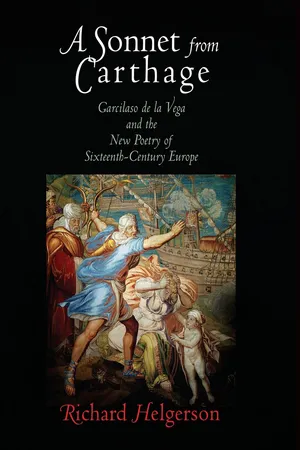
A Sonnet from Carthage
Garcilaso de la Vega and the New Poetry of Sixteenth-Century Europe
- 140 pages
- English
- PDF
- Available on iOS & Android
eBook - PDF
A Sonnet from Carthage
Garcilaso de la Vega and the New Poetry of Sixteenth-Century Europe
About this book
Information
Publisher
University of Pennsylvania PressYear
2015Print ISBN
9780812240047
9780812240047
eBook ISBN
9780812292367
Table of contents
- Cover
- A Sonnet from Carthage
- Title
- Copyright
- Dedication
- Contents
- Preface: Diagnosis for an Essay
- Part I: A Sonnet from Carthage
- Part II: Garcilaso's Tunisian Poems: A Bilingual Anthology
- Bibliography
- Acknowledgments
Trusted by 375,005 students
Access to over 1.5 million titles for a fair monthly price.
Study more efficiently using our study tools.
Frequently asked questions
Yes, you can cancel anytime from the Subscription tab in your account settings on the Perlego website. Your subscription will stay active until the end of your current billing period. Learn how to cancel your subscription
No, books cannot be downloaded as external files, such as PDFs, for use outside of Perlego. However, you can download books within the Perlego app for offline reading on mobile or tablet. Learn how to download books offline
Perlego offers two plans: Essential and Complete
- Essential is ideal for learners and professionals who enjoy exploring a wide range of subjects. Access the Essential Library with 800,000+ trusted titles and best-sellers across business, personal growth, and the humanities. Includes unlimited reading time and Standard Read Aloud voice.
- Complete: Perfect for advanced learners and researchers needing full, unrestricted access. Unlock 1.5M+ books across hundreds of subjects, including academic and specialized titles. The Complete Plan also includes advanced features like Premium Read Aloud and Research Assistant.
We are an online textbook subscription service, where you can get access to an entire online library for less than the price of a single book per month. With over 1.5 million books across 990+ topics, we’ve got you covered! Learn about our mission
Look out for the read-aloud symbol on your next book to see if you can listen to it. The read-aloud tool reads text aloud for you, highlighting the text as it is being read. You can pause it, speed it up and slow it down. Learn more about Read Aloud
Yes! You can use the Perlego app on both iOS and Android devices to read anytime, anywhere — even offline. Perfect for commutes or when you’re on the go.
Please note we cannot support devices running on iOS 13 and Android 7 or earlier. Learn more about using the app
Please note we cannot support devices running on iOS 13 and Android 7 or earlier. Learn more about using the app
Yes, you can access A Sonnet from Carthage by Richard Helgerson in PDF and/or ePUB format, as well as other popular books in Literature & European Literary Criticism. We have over 1.5 million books available in our catalogue for you to explore.