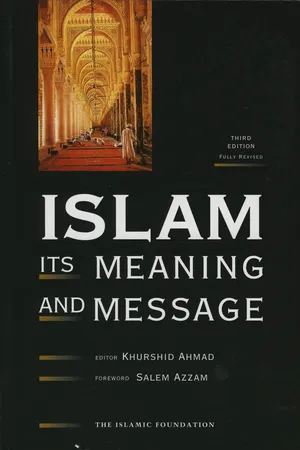
This book provides a window into the world of Islam. It covers the whole spectrum of its beliefs, values, social principles, cultural institutions, and contemporary problems. Edited by Khurshid Ahmad, this book brings together leading Muslim scholarship and covers ideology, culture, the concept of worship, social justice, women in Islam, political theory in Islam, and the objectives of the Islamic economic order. It also discusses what Islam gave to humanity, the Western world and its challenges to Islam, and Islam and the crisis of the modern world.
- 284 pages
- English
- ePUB (mobile friendly)
- Available on iOS & Android
eBook - ePub
Islam: Its Meaning and Message
About this book
Information
Topic
Theology & ReligionSubtopic
Islamic TheologyPART I
The Islamic Outlook On Life
1
Islam: The Essentials*
‘ISLAM’ is an Arabic word. It means the act of resignation to God. The root word is SLM, pronounced ‘salm’ which means peace from which comes the word ‘aslama’ which means he submitted, he resigned himself. Al-Islam or Islam is the religion which brings peace to mankind when man commits himself to God and submits himself to His will. According to the Holy Book revealed to Muḥammad (peace and blessings of God be on him), this is the only true religion professed by all Prophets from Adam to Muḥammad, the Last Prophet. A ‘Muslim’ is one who resigns himself to God and thereby professes the faith of al-Islam. A Muslim therefore believes in all the Prophets and makes no distinction between one and the other. He also believes that God has sent His prophets to all corners of the earth to preach the same religion, that His message stopped coming after the last revelations received by the last Prophet Muḥammad (peace and blessings of God be on him), and that the message received by the last Prophet is the most comprehensive and the final form of God's message to Man.
FAITH, ACTION AND REALIZATION
In order to be a true ‘Muslim’ three things are necessary: Faith, Action according to that faith and the realization of one's relation to God as a result of action and obedience.
Faith which is described in the Qur'ān, the Holy Book of Islam, as Īmān consists in believing that Allah (God) alone is worthy of worship
and that Muḥammad (peace be on him) is the Messenger of Allah, and in bearing witness to the above statement. This implies:
1. True existence is that of Allah alone; Man and the entire creation exist only because Allah wills them to exist.
2. As there cannot be two sources of creation, as Allah alone is the creator, everything comes from Him and goes back to Him; hence the entire creation including Man is the manifestation of Allah's power and glory and hence of His qualities or attributes.
3. The relation between Man and Allah is that of a servant and the Master. As Man owes his very existence to Allah, to worship anything else is to commit the gravest of sins.
4. The above three aspects of Faith in Allah are realized by Man only when he responds to the Message of Allah and this is possible when Man believes in Muḥammad (peace be on him) as the messenger of Allah.
5. As a messenger he is the last and the greatest, about whom all the early messengers have predicted and who thus completes the process of revelation.
6. He is therefore the Perfect Ideal for Mankind, the perfect servant of Allah and hence the most complete and the ideally balanced manifestation of the attributes of Allah.
7. To believe in him is to believe in all the other prophets of Allah.
8. To believe in him is also to believe that the Qur'ān contains all the revelations sent to mankind through him, that these revelations provide guidance to us and that we should worship Allah by following these revelations according to the method prescribed for us by Muḥammad (peace be on him) and hence in accordance with his sayings and practice, known as Ḥadīth or Sunnah.
9. To believe in him is also to believe in the carriers of this message, the angels, who are described in the Qur'ān as functionaries.
Action, described in Arabic by the word ‘amal, is the manifestation in actuality how far we are true servants of God. As action needs rules and regulations according to which we organise our individual and social behaviour, the revelations and the actual physical embodiment of these revelations in the action of the Prophet (peace be on him) provide both the basis and the structure of the Law of human conduct, known as Sharī'ah. Besides Īmān (faith) which provides the central pillar that sustains the whole structure, the four other pillars in the four corners are: Prayer (ṣalāt); Fasting (ṣawm); Charity (zakāt); Pilgrimage (Ḥajj).
A Muslim has to pray five times a day, before sunrise, between mid-day and afternoon, in the afternoon, immediately after sunset and between the time when the twilight is over and just before dawn. It means he cannot be forgetful of his dependence of Allah and derives sustenance and new initiatives and strength through this remembrance.
He fasts for one lunar month in a year, every day from dawn till sunset, the month of Ramaḍān. Physically he does not eat, drink or smoke or have sexual intercourse. Spiritually he abstains from all evil thoughts, actions and sayings. In other words he tries to realize his true self by striving to realize within himself some aspects of the divine character.
Charity (Zakāt) implies that everything that he seems to possess belongs to Allah and therefore anyone in need has a share in it and he should willingly and gladly help individuals and society when they are in need. As mankind has never been free from some kind of need, an annual amount is prescribed out of one's income and savings.
Pilgrimage to Makka implies Man's temporary suspension of all worldly activities and his realization of himself as a naked soul in front of Allah alone. This also symbolises the unity of the Muslim Ummah and the oneness of Mankind.
All these four are intimately tied up with all other aspects of man's individual and social behaviour. By following them and thereby living a life of complete dedication to the Will of Allah, a man becomes a true Muslim.
A Muslim is one whose outlook on life is permeated with this consciousness. He is committed to the values of life given by the Qur'ān and the Sunnah. He tries to live according to the guidance given by God and His Prophet and he strives to promote the message of Islam through his word and actions. This striving is known as Jihād which means a striving and a struggle in the path of God. It consists in exerting one's self to the utmost in order to personally follow the teachings of Islam and to work for their establishment in society. Jihād has been described in the Qur'ān and the Sunnah as the natural corollary of these pillars of faith. Commitment to God involves commitment to sacrifice one's time, energy and wealth to promote the right cause. It may be necessary at times to give one's life in order to preserve Truth. Jihād implies readiness to give whatever one has, including his life, for the sake of Allah.
This striving in the path of Allah with Īmān (faith) as the guiding light and the scheme of ‘amal (action) as the system and structure has the following implications:
1. Man is accountable to Allah for all that he does. Allah will judge him on the Last Day of Judgement and send him either to Heaven, a stage of existence which leads to further blessings, or to Hell, a stage of suffering and punishment.
2. This implies that Man's life does not end with his death in this world. He has life after death.
3. Therefore all human action should be organised in such a manner that he may not suffer in life after death.
4. This organization of action in this world implies the organization of all facets of human existence, individual and collective, hence educational, economic, political and social. Sharī'ah provides the guidelines, the rules of external conduct.
5. This means Man is free in his will, choice and action.
Realization of man's relation to Allah is a spiritual aspect known in Arabic as iḥsān: which the Prophet Muḥammad (peace be on him) explained in the following way: ‘You should worship Allah as if you are seeing Him, for He sees you though you do not see him’ (Bukhārī and Muslim). It means that all action should be performed with Allah in your vision. If that is not possible always you must realize that Allah is seeing you. This realization is regarded as the basis of true devotion. It signifies that man has identified his will with the Will of God and has brought it, at least as far as he is concerned, completely in tune with the Divine Will. Consequently, he begins to like what is liked by his Lord and to abhor what is disapproved by Him. Man, then, not only avoids evils which God does not like to be spread on the earth, but uses all his energy to wipe them off the surface of the earth. Similarly he is not content merely with adorning himself with the virtues which God likes, but also engages himself in an unceasing struggle to propagate and establish them in the world. Man comes nearest to God by excelling in this process of identification of man's will with the Divine Will. This enables him to develop the divine spark within him and to illuminate his entire being with that. The most complete example of the realization is that of the Prophet (peace be on him). Through constant remembrance of Allah, through Man's Love of God and the Prophet, through obedience to the commandments of Allah and His Prophet (peace be on him), and through constant struggle to promote good and forbid evil Man may attain nearness to Allah. Contact with and guidance from those who attain this nearness help the rest of mankind to attain this nearness or to be alive in spirit and hence to perform individual and collective action not mechanically but with whole-hearted devotion and for the sake of Allah alone. This realization is the basis of piety. This piety is the source of righteousness which is regarded by Islam as the core of just action. Persons who, through Īmān, ‘amal and i$hBsān become living symbols of truth represent the reform movement established by the Prophet (peace be upon him) to reconstruct human life and bring it in accord with Divine Guidance. Such persons constantly remind the rest of Mankind of the true significance of Man's submission to the Will of Allah. And a society which realises these values in its collective life would be the ideal society which Islam wants to establish for the ultimate welfare (Falāh) of Man.
MAN AS THE REPRESENTATIVE OF GOD ON EARTH
According to Islam, when faith, action and realization are in perfect harmony, Man manifests the fact that he is the vicegerent of God on Earth. Though Man derives everything from Allah, he is the most complete manifestation of the attributes of Allah and as such he is Allah's representative on Earth. The entire creation is potentially under his dominion. Therefore Islam does not set any limit to Man's knowledge, authority and power except the fundamental limit that they are all derived and hence Man is not self-sufficient. Allah may take away his power whenever He wishes. Islam, therefore, teaches the sanctity of human personality, confers equal rights on all without any distinction of colour, sex or language and subjects the highest and the humblest, the richest and the poorest, the king and the commoner to the sovereignty of Allah and at the same time gives Man the highest imaginable initiative to proceed in the path of self-realization, hence the wielding of God's authority on the Creation.
GOD, PROPHETHOOD, THE QUR'ĀN AND THE SUNNAH
Islam therefore enjoins Man to:
1. believe that God is One, Omniscient and Omnipresent; He begetteth not, nor is He begotten;
2. believe further that Man is the vicegerent of God on Earth and has freedom of choice;
3. believe also that as he has freedom of choice he may go astray and therefore needs guidance from time to time so that he may know how to realize his own true greatness and that is why God sent His messengers from Adam to Muḥammad (peace be on them) and completed this process during the life of Muḥammad (peace be on him);
4. act on this message which is preserved in purity without any adulteration in the Qur'ān which asks Man to follow the Prophet (peace be on him) as his supreme ideal;
5. know and act upon that ideal preserved in collection of sayings of the Prophet (peace be on him) and the reports of his actions – the Sunnah or the traditions of the Prophet.
ISLAM AND OTHER RELIGIONS
Islam does not deny Truth to other religions but says that later followers adulterated that Truth by their own inventions and that was why God sent the Prophet Muḥammad (peace be on him) to purify God's religion. Each religion manifests some aspect of the same Truth, but the emphasis may differ according to the need of Man of that period or age or race. Islam is the religion for all and as it is the most comprehensive manifestation of that Truth, it provides a complete way and a perfect equilibrium.
The second fact about this relationship with other religions is the chronology stated in the Qur'ān. Islam is in the line of all religions whose Prophets belonged to the family of Abraham. The Judaic tradition that started with Abraham's son Ishāq (Isaac) came to an end with Jesus who was the last Prophet in that family tree. Muḥammad (peace be on him) was the descendant of the other son of Ibrāhīm (Abraham), Ismā'īl (Ishmael). Prophets in other lines among the descendants of Adam have been hinted at but not referred to except Nūh (Noah) as examples in the Qur'ān. But, as the Qur'ān clearly states that there is not a single human habitation on the face of this earth where a Prophet has not emerged and where God has not sent His messenger to guide people, a Muslim cannot deny Truth to religions not belonging to this tradition. All that he can point out is the adulteration of that Truth, the mixing up of the Word of God and the word of man, its non-preservation in its original form.
* This introductory statement on the Essentials of Islam has been prepared under the auspices of the Islamic Foundation, Englan...
Table of contents
- Cover
- Title Page
- Copyright
- Contents
- Foreword Salem Azzam
- Preface to the Second Edition
- Preface to the Third Edition
- Acknowledgements
- Contributors
- Part I: The Islamic Outlook on Life
- Part II: The Prophet and the Qur’ān
- Part III: The Islamic System
- Part IV: Islam and the World
- A Short Bibliography on Islam
- Index
Trusted by 375,005 students
Access to over 1.5 million titles for a fair monthly price.
Study more efficiently using our study tools.
Frequently asked questions
Yes, you can cancel anytime from the Subscription tab in your account settings on the Perlego website. Your subscription will stay active until the end of your current billing period. Learn how to cancel your subscription
No, books cannot be downloaded as external files, such as PDFs, for use outside of Perlego. However, you can download books within the Perlego app for offline reading on mobile or tablet. Learn how to download books offline
Perlego offers two plans: Essential and Complete
- Essential is ideal for learners and professionals who enjoy exploring a wide range of subjects. Access the Essential Library with 800,000+ trusted titles and best-sellers across business, personal growth, and the humanities. Includes unlimited reading time and Standard Read Aloud voice.
- Complete: Perfect for advanced learners and researchers needing full, unrestricted access. Unlock 1.5M+ books across hundreds of subjects, including academic and specialized titles. The Complete Plan also includes advanced features like Premium Read Aloud and Research Assistant.
We are an online textbook subscription service, where you can get access to an entire online library for less than the price of a single book per month. With over 1.5 million books across 990+ topics, we’ve got you covered! Learn about our mission
Look out for the read-aloud symbol on your next book to see if you can listen to it. The read-aloud tool reads text aloud for you, highlighting the text as it is being read. You can pause it, speed it up and slow it down. Learn more about Read Aloud
Yes! You can use the Perlego app on both iOS and Android devices to read anytime, anywhere — even offline. Perfect for commutes or when you’re on the go.
Please note we cannot support devices running on iOS 13 and Android 7 or earlier. Learn more about using the app
Please note we cannot support devices running on iOS 13 and Android 7 or earlier. Learn more about using the app
Yes, you can access Islam: Its Meaning and Message by Khurshid Ahmad in PDF and/or ePUB format, as well as other popular books in Theology & Religion & Islamic Theology. We have over 1.5 million books available in our catalogue for you to explore.