![]()
1
HIJRA AND JIHAD
Asma’u’s early years
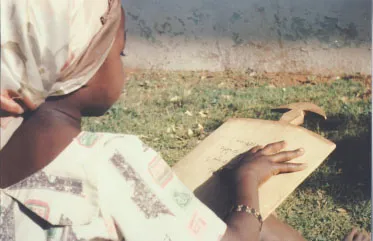
At the turn of the century, 1799/1800, when the events that would lead to the establishment of the Sokoto Caliphate (1808) began to take shape, Asma’u was five years old. As was the custom for children at this age, she had just begun attending the village school in Degel. The school was inside the large compound of her father, Usman ɗan Fodio, a renowned scholar and head of the community of Fulanis in the region known as Toronkawa, those who had migrated eastward from Futa Toro. Later, he was consistently, and with reverence, referred to as ‘the Shehu’. The school’s low walls and floor mats, where the children sat, defined the classroom for Asma’u and the other girls and boys in the class. They used wooden writing boards and black vegetable ink to practice writing out words from the Qur’an, from whose 114 chapters Muslims try to memorize as many verses as they can. When the teacher judged that she had learned to read the words correctly, and that she understood their meaning, they would be carefully rinsed off the board into a basin. The water, now considered holy because infused with the words of God, would be collected for later, medicinal use. Then she would proceed with a new set of verses to write and commit to memory. Asma’u’s teacher was Hadija, her eldest sister. Dressed in home-spun robes, like all women and girls in the region, Hadija led the boys and girls in the daily prayers as well as in instruction. Together they performed the afternoon rituals while, simultaneously, the community was also praying – the women privately in their own rooms, the men and older boys in the open air mosque outside the compound, and the children inside their school.
Fig. 2 Learning to read the Qur’an. (Photo: Jean Boyd, 1982)
In 1800 the Shehu had nine children, and he took a keen personal interest in the education of each of them.1 Several of them, including Hadija and Asma’u, went on to memorize the entire Qur’an. So it would not have been unusual for the Shehu, on his return from the mosque, to catch sight of his daughter Asma’u, call to her, and spend time chatting with her at the entrance to his room. He would have examined her writing board, read the words aloud for her and then listened attentively while she recited the words back to him, slowly and precisely. They would have talked about her concerns, comfortable in one another’s company; then he would have blessed her, and sent her back to the womenfolk for the midday meal. Asma’u’s mother, the Shehu’s first wife and also his cousin, Maimuna, had recently died, leaving Asma’u in the care of his second and third wives, both of whom lived to see this child become a legend in her own lifetime.
The community in which Asma’u was being raised was a Sufi community. Its leader, the Shehu, modeled his life and urged others to model their lives, as far as possible, on the Sunna, the exemplary life of the Prophet Muhammad. Knowing this clarifies many things in the unfolding of the story of Asma’u – to begin with, her name. The Prophet’s beloved grandsons were not in fact twins, but it became customary among Muslims to give to twins the names Hassan and Hussein (the feminine forms are Hassana and Hussaina). In the Fodio family, Asma’u was born a twin, and her brother was duly named Hassan but, instead of the name Hussaina, the Shehu chose for her the name Asma’u. This reminded people of the historical Asma, daughter of Abubakar, the Prophet’s close friend and Islam’s first caliph. That Asma had been heroic in aiding the Prophet and Abubakar as they prepared their escape from persecution in Makka to the relative security of Yathrib (later renamed Madina). Her legacy is one of kindness, honour, courage, and devotion. Puzzling at first, the Shehu’s choice of this name for his daughter is explained by the fact that she was born during a time when he was deeply immersed in mystical Sufi devotions. Asma’u’s descendants assume that in the course of these devotions a special insight intimated to him, even before she came into the world, a sense of Asma’u’s historical importance. Undoubtedly, the circumstances surrounding the naming of Asma’u had deep significance for all in the community. It was an indication from the Shehu that she would be actively involved in the struggle to secure and serve Islam in her time and place.
The Shehu said his aim was the revival of the Sunna in the surrounding region, known as Hausaland, for its majority population. His teaching was targeted not at non-Muslims but at people who professed to be Muslims while practising a syncretic form of religion in which Islamic and pre-Islamic (both animist and polytheistic) traditions were mingled. The Shehu’s intention in promoting the Sunna was to reform local understanding of Islam among the people to whom he took his message – the Fulani and other pastoralists who roamed the savannah with their herds, the Hausa farmers, the elite of the city and marketplaces, and the officials of the local ruler’s court. He aimed to be courteous in approach, aware that being confrontational would provoke rejection. The Shehu’s son, Muhammad Bello, an eyewitness, said: 2
You should know that whenever the Shehu was about to go out to the people I used to see him stop just inside the house for a short while, say some words and then proceed. I asked him about this and he replied, ‘I am renewing my determination and I am making a promise to God that my intention towards him will be pure. Also I am asking God to open the eyes of those gathered here to the things which I will tell them. And in spite of this I again renew my determination when I sit down and I remember the promise which I have made.’
(Infak, p. 6)
When he went to them he greeted them in a voice that everyone could hear. His face was relaxed and his manner gentle; then he said, ‘Listen!’ He never grew tired of explaining and never grew impatient with anyone who failed to understand. After he had called to the waiting crowd with a loud greeting that all could hear, he made his explanations plainly in a quieter voice and in the language of the people who had come to listen, whether in Fulfulde, Hausa, or Tamachek.3
One of his criticisms concerned the absence among these people of educational opportunities for women. Although there were urban Hausa scholars in the region at the time, not all had a rounded understanding of Islam, and others ignored Islam’s egalitarian approach to the acquisition of knowledge, which included the need to educate not only women, but also any individuals of slave status. The Shehu said:
Most of our… educated men leave their wives, their daughters and their captives morally abandoned, like beasts, without teaching them what God prescribes should be taught them and without instructing them in the articles of the Law which concern them. Thus, they leave them ignorant of the rules regarding ablutions, prayer, fasting, business dealings and other duties which they have to fulfill, and which God commands that they should be taught.
Men treat these beings like household implements which become broken after long use and which are then thrown out on the rubbish-heap. This is an abominable crime! Alas! How can they thus shut up their wives, their daughters and their captives, in the darkness of ignorance, while daily they impart knowledge to their students? In truth they act out of egoism, and if they devote themselves to their pupils, that is nothing but hypocrisy and vain ostentation on their part.
Their conduct is blameworthy, for to instruct one’s wives, daughters and captives is a positive duty, while to impart knowledge to students is only a work of supererogation, and there is no doubt but that one takes precedence over the other.
A man of learning is not strictly obliged to instruct pupils unless he is the only person in the country competent to fulfill this office; in any case he owes in the first place his care to the members of his family, because they have priority over everyone else.
Muslim women! Do not listen to the speech of those who are misguided and who sow the seed of error in the heart of another; they deceive you when they stress obedience to your husbands without telling you of obedience to God and His Messenger (May God show him bounty and grant him salvation), and when they say that the woman finds her happiness in obedience to her husband.
They seek only their own satisfaction, and that is why they impose upon you tasks which the Law of God and His Prophet never especially assigned to you. Such are – the preparation of foodstuffs, the washing of clothes, and other duties which they like to impose upon you, while they neglect to teach you what God and the Prophet have prescribed for you. 4
As for the Fulani clans who were nomadic herders, the Shehu told them frankly that they were wrong if they believed that being a Fulani was the same as being a Muslim, that the two were not in any way synonymous. He explained that Islam had nothing to do with ethnicity; no matter whether one happened to be a Hausa or a Fulani, a Nupe or a Tuareg. He said: ‘Religion comes from God and anyone who follows it is my brother.’ The Shehu shared the mother tongue of the pastoralists, but he did not, as they did, believe that their social values were superior to those of others. He challenged their assertions, and spent twenty-five years in regular excursions from Degel to the rural areas to teach and preach to whoever welcomed his presence – Fulani pastoralists and Hausa farmers alike – but he always declined to dwell even for a single night within the city walls of Alƙalawa. The city was ruled by a chief or sarki who sought to silence the Shehu’s preaching. Instead, the Shehu would camp under a tree outside the city – although no longer standing, this tree was still there until the end of the twentieth century.
What the Shehu said to the Fulani and the Hausas is preserved in a collection of his Fulfulde poetry in the private archive of Waziri Junaidu and his successors (cited hereafter as Waziri Junaidu mss.). In it the Shehu is forthright in his condemnation of non-Islamic behaviour:
These are what I mean by the paganism practised by many Fulani, the evidence is clear. Consider how they manage circumcision. It is quite wrong. They frighten the children by saying if they cry they will be known as cry-babies. They gather them together in remote areas and do not allow them to return home to their mothers until they have recovered. This may please them but it doesn’t please the Prophet.
They permit young men to wear necklaces like women and to plait their hair. They see fit to allow a man who is wooing a girl to be alone with her. They humiliate their wives, when it comes to divorce, by speaking ill of them. Some refuse to divorce their wives no matter how much the wives have suffered. They do not teach their wives nor do they allow them to be educated. Their women behave indecorously when they go to draw water at the well. Some women tell tales about a co-wife to their husbands thus transgressing what God has said. All these things stem from ignorance. They are not the Way of the Prophet.
(Waziri Junaidu mss.)
The Hausa village farmers and urban dwellers likewise practised customs that the Shehu condemned. The list was long: farmers deliberately miscounted their bundles of grain, beans and onions at harvest time so they would not have to pay the obligatory alms-tax (zakah); weavers cheated their customers by concealing faulty work, rulers illegally took a share of a person’s inheritance; some appeased spirits by throwing cotton buds into a heap of stones at the roadside; others wrote words from the Qur’an on impure material. The Shehu said: ‘They congregate in great numbers at certain rocks. There they are, putting stones on them and yet from their speech you would take them to be Muslims.’ He also condemned practices that were prevalent in the nearby kingdom of Gobir. These practices were co-ordinated by a female court official who was the sister of the sarki:
I will tell you what I mean by their paganism – the practice of gathering for bori dancing to induce spirit possession. They go to wizards or to those who call up spirits and even boast of knowing the jinns and understanding what they say.
(Waziri Junaidu mss.)
Although the Sarki of Gobir is not directly mentioned in this critique, the allusion to him was evident.
Degel, where the Shehu lived, was at the far end of the territory of Gobir ruled from Alƙalawa. It was not a fortified village. The Shehu and his people were unarmed, living with their families and their very few possessions. They had about twenty transport mounts but no armed cavalry or lances, no protective chainmail or ox-hide shields, nor drums or trumpets. Nevertheless, the Shehu was viewed as an increasing threat by a succession of the rulers of Gobir. In 1802 the chief, Nafata, reneged on previous assurances to the contrary by announcing in the Gobir marketplaces that the Shehu’s disciples and followers were henceforth forbidden to preach and invite conversions to Islam. Further, those who had not been born Muslims were ordered to recant, and the wearing of turbans was banned because they distinguished people as Muslims associated with the Shehu’s Islamic community in Degel.
Nafata was succeeded as sarki by Yunfa, who intensified these restrictions by initiating a campaign of attacks on the Shehu’s followers in Gobir. The Shehu responded in February 1803 with a declaration warning Muslims that they should not rise against an unbelieving ruler unless they had enough power to do so. However, if they found that they could not practise their religion or that their safety and well-being were in danger, they must migrate to where there was security. The situation as it developed was portending a defensive jihad, the only sort of warfare formally permitted in Islam. News of these plans drew a swift response from Yunfa, the last Sa...