Based on valuable material from authentic tafasir in Arabic and Urdu, the book provides a thematic study of Surah al-Fatihah. A commendable work, meeting the mindset and intellectual needs of the English-speaking young generation of Muslims in the West.
The word Allah is used with the highest frequency in the Holy Qur’ān. It is the personal name of the Creator of the Universe. The root of this word is ALH and by adding al it becomes Allah – the proper noun. However, there is another opinion, which according to Al-Qāmūs is the correct one, whereby Allah is a nonderivated noun.
Words that derive from this Arabic root have the following meanings, which illustrate some of the attributes of Allah (swt).
2. Meanings
The word Allah has five meanings. These were discussed by Sayyid Maudūdī extensively and also mentioned in Mufradāt by Imām Rāghib al-Iṣfahānī.
A. To be bewildered or perplexed
No one is able to perceive and comprehend the exact nature and personality of Allah. The human mind has always remained astonished and bewildered about Him. The Holy Qur’ān says:
There is nothing whatever like unto Him, and He is the One Who hears and sees (all things).
(al-Shura 42: 11)
In order to know Allah, the Prophet (peace be upon him) advised us to ‘reflect on the creation of Allah and not to think about His personality’ (Ibn ‘Abbās – al-Targhīb wa al-Tarhīb).
B. To get satisfaction or to find comfort from someone’s company or by seeking his protection.
It is only when a person establishes a true relationship with Allah that he attains satisfaction and contentment.
Those who believe and whose hearts find satisfaction in the remembrance of Allah: for without doubt in the remembrance of Allah do hearts find satisfaction.
(al-Ra‘d 13: 28)
C. To have intense attachment and love for somebody or something.
All creatures love their creator. Allah being the Supreme Creator infuses the feeling of affection and love among His creation. In the Holy Qur’ān Allah says:
But those of faith are overflowing in their love for Allah.
(al-Baqarah 2: 165)
D. To be hidden or to remain concealed.
It is obvious that Allah cannot be seen or perceived by anyone:
No vision can grasp Him. But His grasp is over all vision: He is above all comprehension.
(al-An‘ām 6: 103)
Although we cannot perceive Allah, as mentioned above, Allah is very close to us. Allah says:
For We are nearer to him than (his) jugular vein.
(Qāf 50: 16)
E. To worship someone
The person who deserves to be worshipped should be the One who can fulfil the needs of the worshipper and give him satisfaction. It is only Allah who provides all the necessary provisions for all his creatures to survive and He is the One who fulfils their needs and gives them satisfaction. Thus, He is the One who should be worshipped.
All these meanings have a logical relationship with each other. The concept of Allah evokes intense love and awe that compels the entire universe to bow down before Him in submission. As He is the sole Creator he should be worshipped exclusively and obeyed without reservation. Worship without obedience is the negation of His Sovereignty. His remembrance is the source of satisfaction and comfort. He is the sole Sovereign, the Mightiest, the Greatest and His Rule should override all human affairs.
The word Allah is unique and almost incapable of translation into any other language. The English word “God” with a capital “G” does not convey the array of meanings outlined above. Allah is the personal name of the Ultimate Reality in this Universe. Thus, there cannot be any plural of this word in the way “God” becomes “gods”; nor has it a feminine form as “goddess” or “goddesses”.
3. Tawḥīd
The Oneness of Allah (Tawḥīd) is the central theme of the Qur’ān. The name Allah is used exclusively for the Supreme Being who created the heaven and the earth and everything in this Universe. Arabs before the revelation of the Holy Qur’ān also considered Allah in this sense. Their worship of deities stemmed from their belief that such deities had some influence in the affairs of Allah. The Holy Qur’ān repudiates this idea vehemently. The Holy Qur’ān also categorically refutes duality (the ancient Persian concept that there is one God of Good and another God of Evil) and the Christian concept of Trinity. The Sovereignty of Allah demands that His Rules and Commands be enforced upon the entire Universe including mankind. The submission of man to His Rule and to His Will and the readiness to live in compliance with His Commands is Islam.
4. Other Attributes
According to a ḥadīth the Holy Prophet (peace be upon him) said:
Verily, there are ninety-nine names of Allah, whosoever recites them shall enter Paradise.
(Bukhārī and Muslim)
These names are collectively known as al-Asmā’ al-Ḥusnā (the most beautiful names) and some are mentioned in the Holy Qur’ān in the following verses: al-Baqarah 2: 255; al-Ḥadīd 57: 1–3 and al-Ḥashr 59: 22–24. These Names express Attributes of Allah. They lead us to the proper understanding of our relationship with our Creator. They also provide a focal point to contemplate upon His Attributes and, thus, fashion our lives accordingly. However, the most repeated attributes of Allah (swt) are the Merciful (al-Raḥīm) and the Most Compassionate One (al-Raḥmān). They express the immensity of Divine Mercy for everything that is in the Universe.
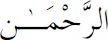
Al-Raḥmān
Al-Raḥīm
1. Meanings
These are the most repeated attributes of Allah, glorified be He, and form the part of Bismillāh with which all Sūrahs (chapters) of the Holy Qur’ān except Sūrah al-Tawbah (Chapter 9) begin.
Both words are derived from the root rahima meaning to show mercy. The pattern of the noun formation denotes the intensity of the quality of mercy. Thus, these attributes of Almighty Allah are often translated as the Most Merciful, Most Compassionate, Beneficent, Most Gracious or Mercy Giving. However, these translations do not convey the full meaning of the terms nor do they distinguish between the subtle differences in the meaning of al-Raḥmān and al-Raḥīm.
The difference in their meanings is explained very well by Amīn Aḥsan Iṣlāḥī in his Tafsīr. The following summarises his thoughts:
In the Arabic language words, although derived from the same root, have different shades of meaning depending on the measure of the word formation. Thus whereas Raḥmān denotes upsurge, overflow, outburst and passion, Raḥīm denotes permanence, continuity, and everlasting qualities of Mercy.
Hence, al-Raḥmān is the One whose Mercy is overflowing. There is an outburst of His Compassion, and there is an upsurge of His Kindness, whereas al-Raḥīm is the One whose Mercy is continuous, permanent and never ceases. The creation of the Universe is the result of the upsurge of His Mercy and the continuity of His Mercy is evoked in His sustaining the entire Universe.
2. Usage
The word al-Raḥmān is applicable to that person who has engulfed everything with his mercy. Thus, it is used exclusively for Allah, Sublime is He, whereas Raḥīm can be used for others. Thus, this attribute is also used for our most blessed Prophet in the Holy Qur’ān:
Now has come unto you a Messenger from amongst yourselves: it grieves him that you should perish; ardently anxious is he over you: to the Believers is he most kind and merciful.
(al-Tawbah 9: 128)
Some commentators are of the opinion that al-Raḥmān, like Allah, is the personal name of the Creator. This view is supported by the following verse:
Say: “Call upon Allah, or call upon Raḥmān: by whatev...
Table of contents
Cover Page
Title Page
Copyright
Dedication
Transliteration Table
Contents
Foreword
Preface
1 Allah
2 Al-Raḥmān, al-Raḥīm
3 Ḥamd
4 Rabb
5 ‘Ālam
6 Mālik, Malik
7 Dīn
8 ‘Ibādah
9 Isti‘ānah
10 Hudā
11 Al-Ṣirāt al-Mustaqīm
12 Ni‘mah
13 Ghaḍab
14 Ḍalāl, Ḍalālah
Bibliography
Dictionaries and Concordance
Reference Books and Monographs
Index of Terms
Trusted by 375,005 students
Access to over 1.5 million titles for a fair monthly price.
Study more efficiently using our study tools.
Frequently asked questions
Yes, you can cancel anytime from the Subscription tab in your account settings on the Perlego website. Your subscription will stay active until the end of your current billing period. Learn how to cancel your subscription
No, books cannot be downloaded as external files, such as PDFs, for use outside of Perlego. However, you can download books within the Perlego app for offline reading on mobile or tablet. Learn how to download books offline
We are an online textbook subscription service, where you can get access to an entire online library for less than the price of a single book per month. With over 1.5 million books across 990+ topics, we’ve got you covered! Learn about our mission
Look out for the read-aloud symbol on your next book to see if you can listen to it. The read-aloud tool reads text aloud for you, highlighting the text as it is being read. You can pause it, speed it up and slow it down. Learn more about Read Aloud
Yes! You can use the Perlego app on both iOS and Android devices to read anytime, anywhere — even offline. Perfect for commutes or when you’re on the go. Please note we cannot support devices running on iOS 13 and Android 7 or earlier. Learn more about using the app
Yes, you can access Key to al-Fatiha by Abdur Rashid Siddiqui in PDF and/or ePUB format, as well as other popular books in Theology & Religion & Islamic Theology. We have over 1.5 million books available in our catalogue for you to explore.