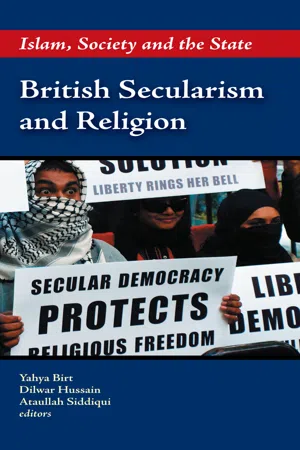
This book provides an in-depth deliberation upon the now unsettled relationship between religion and politics in contemporary Britain, with some emphasis upon the case of Islam, which is now at the centre of the debate. Combining theological reflections and academic and policy perspectives, this topical collection includes contributions from Ted Cantle, Sunder Katwala, Maleiha Malik and Tariq Modood, among others.
eBook - ePub
British Secularism and Religion
Islam, Society and State
- 118 pages
- English
- ePUB (mobile friendly)
- Available on iOS & Android
eBook - ePub
About this book
Information
Topic
Theology & ReligionSubtopic
Islamic TheologyPart I
Theological Perspectives
Chapter 1

Islam, Secularity and the Culture of Critical Openness
A Muslim Theological Reflection
A Muslim Theological Reflection
Abdullah Sahin
This chapter attempts to develop an Islamic perspective on contemporary Western democratic secularity in which diverse Muslim communities constitute an important part of its religious and cultural plurality. After a discussion of the historical and contemporary dynamics that inform today’s Muslim self-understanding, the chapter argues for a new Muslim culture of engagement to develop Islamically-meaningful responses to the challenges posed by secular modernity. The chapter further argues that secularity, defined here as a political principle integral to democratic inclusion, may accommodate – in a just manner – the diversity of cultures, value systems and faith traditions that make up modern plural society. On the other hand, it is argued that secularism, defined here as an ideological position that confines faith strictly to the personal sphere of life, neither reflects the reality of contemporary Western societies nor is compatible with Islam. By exploring the political theology of Islam, I argue that while secularism thus defined remains incompatible with Islam, secularity as democratic inclusion does not necessarily conflict with Islamic teachings. The chapter develops the position that Muslim social and legal theory should remain central to a serious reflection on Islam and secularity – particularly with reference to the principle of the common or public good (maslaha), and the fundamental hermeneutic strategy underpinning it, namely, that of discerning the intent and projected horizon of wider meanings behind the Divine Will (maqasid and ta‘lil al-ahkam). My overall argument is that critical openness, a necessary precondition for meaningful dialogue within multicultural societies, requires that Muslim communities reassess their role in secular democratic politics in terms of their faith tradition. Similarly, critical openness also entails that, in its encounter with non-Western faith traditions, the modalities of the accommodation that the secular state makes should be carefully reconsidered.
Towards a Muslim culture of engagement
There are several interrelated historical and contemporary dynamics that inform the diversity of Muslim self-expression today. The Muslim tradition is an internal dynamic guiding the lives of many Muslims in the modern world. This tradition contains layers of historically-contingent interpretation and appropriation of core Muslim values that are cumulatively derived from the Qur’an and Prophetic tradition (sunna). A major external dynamic influencing contemporary Muslim self-understanding is what was once known as the struggle between ‘Islamdom’ and ‘Christendom’, which, after a profound secularisation process, has come to be termed as the ‘Islam–West conflict’. Furthermore, these dynamics came to be mediated by the rise of national and transnational Muslim movements of political resistance and religious renewal that have played a significant role in the formation of contemporary Muslim identity politics. It should be noted that the radicalism in the religious discourses of these movements has been shaped by their strong opposition to European colonisation of the Muslim world, the effects of subsequent decolonisation, the democratic deficit in many Muslim societies, and the current round of proxy and direct military interventions in the Muslim world. This radicalism has in turn resulted in the emergence of European-style nation-states without, in many cases, the accompaniment of a robust indigenous secular and democratic political culture. More recently, the terrorist attacks of 9/11 and 7/7 among others, as well as the ongoing conflict in the Middle East, have also significantly shaped how Muslims see themselves and how they are perceived in today’s increasingly globalised world.
The spectrum of Muslim responses to such internal and external dynamics has been complex and varied. However, two mutually-exclusive broad patterns of response may, nevertheless, be discerned: a strong reactionary traditionalist perspective and an equally categorical secularist-modernist position. While the first tendency reduces Islam and the plurality of its historical expression to a monolithic ideology, constructed in opposition to what is perceived to be an invading and engulfing enemy, the latter attempts to make sense of Islam solely within the horizon of a particular Western apprehension of religion as confined to the private lives of individuals. Above all, our current context of Islam–West conflict has itself been a serious factor behind the emergence of such bipolar oppositions and uni-dimensional mind-sets.
Both of these perspectives have largely failed to develop a rigorous dialectical engagement with the profound processes of change facing the worldwide Muslim community (umma). Any meaningful engagement with the challenges posed by change depends upon the intellectual competence to revisit core Muslim values confidently in the light of ever-changing life conditions. An important factor behind the original historical rise of Muslim civilisation can be attributed to the deliberate nurture of such a competence for engagement within the overall framework of core Muslim values. This encouraged the early Muslims to value independent inquiry and to adopt a critically open attitude. Ijtihad, or independent reasoning, is the main intellectual concept that embodies these values and that refers to the dynamic and reflective process informing righteous conduct in all aspects of life. As such, the philosophy, science and wisdom of the ancient world – be it from Persia, India or Greece – was diligently collected, carefully studied and creatively re-interpreted by medieval Muslim scholarship. Their overall guiding principle was the central teaching of Islam – tawhid, literally the Oneness of God – which also supported the principle of the unity and interconnectedness of humanity, and thus of human knowledge, despite the vast cultural diversity from Spain to China to which they were exposed.
Such broad values of open enquiry and curiosity provided fertile conditions for the creative crosspollination of ideas and cultures to take place. As such, the development of distinctive Islamic approaches to administration, governance and culture was being constantly reinterpreted and negotiated. Thus, this early Islamization, contrary to some contemporary misconceptions, was a demotic and synthetic process that accommodated diversity, expressed within a unifying Islamic framework of meaning that received wide assent outside of mere creedal affiliation. In short, this Islamization supported a polyglot civilization not a monolithic faith. It may be admitted that qualities such as critical openness, independent inquiry and the accommodation of difference may sound distinctly modern to our ears and are sometimes depicted as achievements exclusive to Western secular democracy. Indeed, for some contemporary observers, like Mohammed Arkoun (2002), such qualities remain amongst what is ‘unthought’ in contemporary Islamic thinking. However, it may be observed that Arkoun’s overall position reflects the above-mentioned categorical secularist-modernist perspective by which the Islamic worldview is taken to be a medieval relic that survives abnormally in the modern world, providing ample material for various deconstructionist experiments. However, these qualities are, above all, an important part of the human condition that are potentially available to any given society either to nurture or suppress. In its formative period, Islam, by endorsing openness, enquiry and tolerance, produced a just and balanced society that allowed people of different cultures, races and faiths to integrate into the Muslim commonweal while preserving their own dignity and ways of life.
However, once this culture of engagement was no longer nurtured, the result was a dramatic decline in the civilizational forces within Muslim polities. And it should be pointed out that the reification of dynamic core Muslim values into monolithic and authoritarian structures of power emerged long before the encounter with Western colonialism and secular modernity.
It is true that Muslims have been subjected to large-scale foreign invasions in the past such as the sacking of the Muslim powerhouse of intellectual engagement – Abbasid Baghdad – by the Mongols in 1258, which was significant also in putting an end to the first long-lasting and unified polity in the eastern Muslim world. Internally, the increasing sectarian strife and the spread of mystical views of Gnostic bent had begun to obscure core Muslim teachings. However, none of these challenges proved to be decisive enough to create a break with the values of cultural engagement. Thus, even under these deteriorating conditions, Muslim culture could still produce creative minds like al-Ghazali (d.1111) and Ibn Taymiyya (d.1328) that engaged critically with the inherited tradition and came up with meaningful Islamic responses to the challenges facing their societies. It is revealing too that they were more concerned with the decline in the Muslim culture of engagement than with the external military threats to Muslim rule. Ibn Taymiyya (1991, 1993, 1997), who called for tolerance and acceptance of diverse interpretations concerning the application of shari‘a, argued forcefully that only through the adoption of a critical methodology could one judge the trustworthiness of inherited tradition and the soundness of reasoned argument. He was convinced that only a radical hermeneutics – discussed in greater detail below – would reveal that reason and revelation were complementary and, most importantly, would ensure ways of discerning values and principles from the core Islamic sources and its diverse traditions under conditions of dramatic change so that each generation of Muslims might continue to be guided by them. As such Ibn Taymiyya demonstrated that Muslim culture, in its post-formative period, could still be creative in nurturing minds capable of exercising ijtihad.
Yet, during the period of rapid colonial and post-colonial modernisation, the voices for critical openness could not prevent a deep rupture within the modern Muslim psyche: linguistic, cultural and intellectual bridges of continuity with the cumulative Muslim tradition were not adequately maintained. Social theorists would argue too that, even under comparatively less stressful conditions, modernisation created a similar rupture in Europe with the religiously-based medieval Western tradition. However, even so, the Judeo-Christian tradition still contributed substantially to this long historical process of self-differentiation and social and institutional transformation that occurred in Western Europe. Today Muslims are still in the process of making sense of the imported ideas of modernity and its superimposed institutions upon Muslim polities. While the impulse for renewal and reform has not vanished, critical openness hardly thrives today. Rather the challenge of the West in the last two centuries has largely allowed the reactionary traditionalist Muslim trend to predominate. It advocates a retreat into the comforts of a glorious reified past instead of reconnecting with the culture of engagement so that Muslims may face their problems with realism. The phenomenon of double alienation has emerged: Muslims no longer feel comfortable within their own traditional cultures nor have they as yet integrated their core values with the best of what modernity, Western or otherwise, has to offer (Shayegan 1992).
Islam and Western secular democracy: dialogue or confrontation?
Despite strong contextual differences with their co-religionists in the Muslim world, the Muslim settlers in post-war Europe were not divorced from the unfolding narrative described previously. Besides being multi-ethnic and multilingual and often having strong rural roots in the Muslim world, the biggest factor for the European diaspora was its minority status, living in the midst of highly-secularised, multicultural societies. Some have full citizenship but even so are also often subject to socioeconomic inequalities, discrimination and political suspicion, particularly after 9/11. While Western secular democratic states are undeniably more just and free than the more authoritarian political status quo in the Muslim world, a robust Islamic culture of engagement is, as yet, largely absent in the diaspora. This relatively low level of intellectual engagement has clearly influenced the way Muslim communities have publicly positioned themselves within secular multicultural politics and the way the secular state perceives the personal and collective identities that Muslims express. My own empirical research (Sahin 2005) carried out among British Muslim youth found that they are intensely affected by the phenomenon of double alienation, which has led to what I would describe as an increasingly widespread foreclosed and depersonalised Muslim religiosity which can hardly facilitate positive faith development or provide them with the confidence to communicate effectively with the religious and cultural plurality around them.
In 2010 there are an estimated 17 million Muslims across Western Europe. Researchers and policymakers working within the dominant paradigm of integration (often imprecisely defined so as to be conflated with assimilation) focused on ethnic, linguistic and socio-economic structures underpinning these communities’ interaction with the wider society. The emergence of faith as a central element underpinning new self-understanding was less recognised; the second and third generations often sought to negotiate their sense of identity in this new context by a return to religion.
Realising that they should abandon ‘the myth of return’, first-generation parents instead embraced ‘the myth of continuity’, creating narratives and institutions that would connect their children seamlessly with the religio-cultural mores of their own homeland upbringing. Transnational Islamic movements were often the first to seize upon this opportunity by providing the mosques and the imams to cater for this continuity. Thus, the British context has been largely disregarded in shaping the religious identity of the next generation and in conditioning their interaction within wider multicultural society.
Yet neither the Muslim communities nor policymakers have sufficiently prioritised the facilitation of a culture of engagement – particularly in the form of a long-term investment in education – to address both mainstreaming and radicalisation, empowering Muslim communities to identify ways of resolving their own problems. Instead, rather more short-term pragmatism seems to have prevailed in guiding the state’s strategies to prevent extremism, given the focus on promoting ‘moderate’ Muslims or attempting to define British Muslim subjectivity through political rhetoric.
Without possessing the skills necessary for sustained cultural engagement, it is hard to see how Muslims will take on the challenges facing them effectively. Cultivating a mature Muslim presence in Europe requires the development and articulation of a comprehensive rationale for Islamic values and tradition in this context. The younger generation of Muslims is acutely aware and desirous of this shift towards a fully-fledged Muslim cultural engagement, a shift that requires the hermeneutical tools to interpret and understand core Is...
Table of contents
- Cover
- Title Page
- Copyright Page
- Contents
- Introduction: Predicament or Promise? Exploring Britain’s Unsettled Secularism Yahya Birt, Dilwar Hussain and Ataullah Siddiqui
- Part 1: Theological perspectives
- Part 2: Political perspectives
- Afterword Maleiha Malik
- Index
- About the Contributors
Trusted by 375,005 students
Access to over 1.5 million titles for a fair monthly price.
Study more efficiently using our study tools.
Frequently asked questions
Yes, you can cancel anytime from the Subscription tab in your account settings on the Perlego website. Your subscription will stay active until the end of your current billing period. Learn how to cancel your subscription
No, books cannot be downloaded as external files, such as PDFs, for use outside of Perlego. However, you can download books within the Perlego app for offline reading on mobile or tablet. Learn how to download books offline
Perlego offers two plans: Essential and Complete
- Essential is ideal for learners and professionals who enjoy exploring a wide range of subjects. Access the Essential Library with 800,000+ trusted titles and best-sellers across business, personal growth, and the humanities. Includes unlimited reading time and Standard Read Aloud voice.
- Complete: Perfect for advanced learners and researchers needing full, unrestricted access. Unlock 1.5M+ books across hundreds of subjects, including academic and specialized titles. The Complete Plan also includes advanced features like Premium Read Aloud and Research Assistant.
We are an online textbook subscription service, where you can get access to an entire online library for less than the price of a single book per month. With over 1.5 million books across 990+ topics, we’ve got you covered! Learn about our mission
Look out for the read-aloud symbol on your next book to see if you can listen to it. The read-aloud tool reads text aloud for you, highlighting the text as it is being read. You can pause it, speed it up and slow it down. Learn more about Read Aloud
Yes! You can use the Perlego app on both iOS and Android devices to read anytime, anywhere — even offline. Perfect for commutes or when you’re on the go.
Please note we cannot support devices running on iOS 13 and Android 7 or earlier. Learn more about using the app
Please note we cannot support devices running on iOS 13 and Android 7 or earlier. Learn more about using the app
Yes, you can access British Secularism and Religion by Yahya Birt, Ataullah Siddiqui, Dilwar Hussain in PDF and/or ePUB format, as well as other popular books in Theology & Religion & Islamic Theology. We have over 1.5 million books available in our catalogue for you to explore.