Most Americans strongly favor equality of opportunity if not outcome, but many are weary of poverty's seeming immunity to public policy. This helps to explain the recent attention paid to cultural and genetic explanations of persistent poverty, including claims that economic inequality is a function of intellectual ability, as well as more subtle depictions of the United States as a meritocracy where barriers to achievement are personal--either voluntary or inherited--rather than systemic. This volume of original essays by luminaries in the economic, social, and biological sciences, however, confirms mounting evidence that the connection between intelligence and inequality is surprisingly weak and demonstrates that targeted educational and economic reforms can reduce the income gap and improve the country's aggregate productivity and economic well-being. It also offers a novel agenda of equal access to valuable associations.
Amartya Sen, John Roemer, Robert M. Hauser, Glenn Loury, Orley Ashenfelter, and others sift and analyze the latest arguments and quantitative findings on equality in order to explain how merit is and should be defined, how economic rewards are distributed, and how patterns of economic success persist across generations. Moving well beyond exploration, they draw specific conclusions that are bold yet empirically grounded, finding that schooling improves occupational success in ways unrelated to cognitive ability, that IQ is not a strong independent predictor of economic success, and that people's associations--their neighborhoods, working groups, and other social ties--significantly explain many of the poverty traps we observe.
The optimistic message of this beautifully edited book is that important violations of equality of opportunity do exist but can be attenuated by policies that will serve the general economy. Policy makers will read with interest concrete suggestions for crafting economically beneficial anti-discrimination measures, enhancing educational and associational opportunity, and centering economic reforms in community-based institutions. Here is an example of some of our most brilliant social thinkers using the most advanced techniques that their disciplines have to offer to tackle an issue of great social importance.
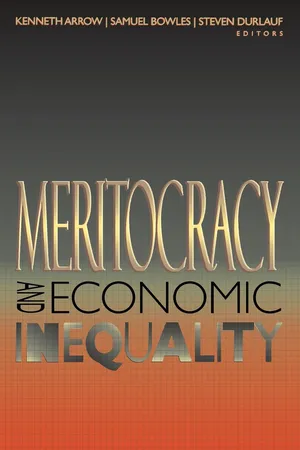
eBook - PDF
Meritocracy and Economic Inequality
- 367 pages
- English
- PDF
- Available on iOS & Android
eBook - PDF
Meritocracy and Economic Inequality
About this book
Information
Publisher
Princeton University PressYear
2018Print ISBN
9780691004686
9780691004679
eBook ISBN
9780691190334
Table of contents
- Cover
- Title Page
- Copyright Page
- Contents
- List of Contributors
- Introduction
- PART ONE: MERIT, REWARD, AND OPPORTUNITY
- PART TWO: THE CAUSES AND CONSEQUENCES OF "INTELLIGENCE"
- PART THREE: SCHOOLING AND ECONOMIC OPPORTUNITY
- PART FOUR: POLICY OPTIONS
- Index
Trusted by 375,005 students
Access to over 1.5 million titles for a fair monthly price.
Study more efficiently using our study tools.
Frequently asked questions
Yes, you can cancel anytime from the Subscription tab in your account settings on the Perlego website. Your subscription will stay active until the end of your current billing period. Learn how to cancel your subscription
No, books cannot be downloaded as external files, such as PDFs, for use outside of Perlego. However, you can download books within the Perlego app for offline reading on mobile or tablet. Learn how to download books offline
Perlego offers two plans: Essential and Complete
- Essential is ideal for learners and professionals who enjoy exploring a wide range of subjects. Access the Essential Library with 800,000+ trusted titles and best-sellers across business, personal growth, and the humanities. Includes unlimited reading time and Standard Read Aloud voice.
- Complete: Perfect for advanced learners and researchers needing full, unrestricted access. Unlock 1.5M+ books across hundreds of subjects, including academic and specialized titles. The Complete Plan also includes advanced features like Premium Read Aloud and Research Assistant.
We are an online textbook subscription service, where you can get access to an entire online library for less than the price of a single book per month. With over 1.5 million books across 990+ topics, we’ve got you covered! Learn about our mission
Look out for the read-aloud symbol on your next book to see if you can listen to it. The read-aloud tool reads text aloud for you, highlighting the text as it is being read. You can pause it, speed it up and slow it down. Learn more about Read Aloud
Yes! You can use the Perlego app on both iOS and Android devices to read anytime, anywhere — even offline. Perfect for commutes or when you’re on the go.
Please note we cannot support devices running on iOS 13 and Android 7 or earlier. Learn more about using the app
Please note we cannot support devices running on iOS 13 and Android 7 or earlier. Learn more about using the app
Yes, you can access Meritocracy and Economic Inequality by Kenneth Arrow, Samuel Bowles, Steven N. Durlauf, Kenneth Arrow,Samuel Bowles,Steven N. Durlauf, Kenneth Arrow, Samuel Bowles, Steven Durlauf in PDF and/or ePUB format, as well as other popular books in Economics & Economic Conditions. We have over 1.5 million books available in our catalogue for you to explore.