A celebrated study of the origins of ancient Greek philosophy, now in English for the first time
How can we talk about the beginnings of philosophy today? How can we avoid the conventional opposition of mythology and the dawn of reason and instead explore the multiple styles of thought that emerged between them? In this acclaimed book, available in English for the first time, Maria Michela Sassi reconstructs the intellectual world of the early Greek "Presocratics" to provide a richer understanding of the roots of what used to be called "the Greek miracle."
The beginnings of the long process leading to philosophy were characterized by intellectual diversity and geographic polycentrism. In the sixth and fifth centuries BC, between the Asian shores of Ionia and the Greek city-states of southern Italy, thinkers started to reflect on the cosmic order, elaborate doctrines on the soul, write in solemn Homeric meter, or, later, abandon poetry for an assertive prose. And yet the Presocratics whether the Milesian natural thinkers, the rhapsode Xenophanes, the mathematician and "shaman" Pythagoras, the naturalist and seer Empedocles, the oracular Heraclitus, or the inspired Parmenides all shared an approach to critical thinking that, by questioning traditional viewpoints, revolutionized knowledge.
A unique study that explores the full range of early Greek thinkers in the context of their worlds, the book also features a new introduction to the English edition in which the author discusses the latest scholarship on the subject.
- 232 pages
- English
- ePUB (mobile friendly)
- Available on iOS & Android
eBook - ePub
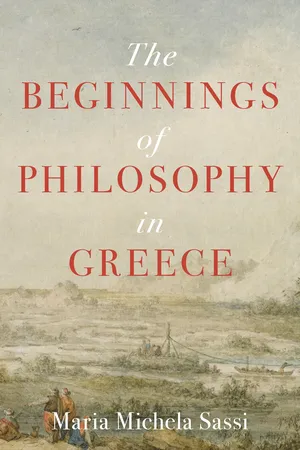
The Beginnings of Philosophy in Greece
About this book
Information
Publisher
Princeton University PressYear
2018Print ISBN
9780691204567
9780691180502
eBook ISBN
9781400889761
Topic
PhilosophySubtopic
Ancient & Classical PhilosophyCHAPTER ONE
Thales, Father of Philosophy?
Before the Presocratics
“Presocratic” refers to a long phase of Greek thought that stretches over two centuries (the sixth and fifth BCE). This label, still in use, first appeared in a handbook of universal philosophy published toward the end of the eighteenth century, during a period of “reorganization of historical consciousness,” which “was also one of new periodization.”1 And the demarcation has repeatedly been questioned over the past few decades, in the wake of a generalized anti-historicizing trend that has left its mark on the study of the ancient world.
Indeed, such a category as “Presocratics” may sound reductive in and of itself, since it groups under the same umbrella authors who differ greatly in intents, interests, and writing styles. Paradoxically, the main trait shared by these thinkers is that their works have come down to us as fragments, or through ancient testimonies or citations in the works of others. Other reasons to question the “Presocratic” categorization could easily be listed here, but first it will be more useful to reflect on the lasting fortune of the term.
Now, it is clear that the use of such a term identifies Socrates as the turning point at the end of a determined line of development within Greek thought. In this historiographical framework, the Athenian philosopher acts as the founder of ethical inquiry, thus marking a crucial break from a tradition that was mainly focused on the observation and analysis of the physical world. The ancient authors themselves have made vivid contributions to this picture. Socrates’s devoted pupil Xenophon, for instance, emphasizes his mentor’s lack of interest in the “nature of all things.” Conversely, he stresses his attention to the “human” condition and the elaboration of moral notions such as wisdom and courage (Memorabilia I, 1, 11–12, and 16). But Plato insists more than others on Socrates’s detachment from natural inquiry. In his Apology (19d), we see a Socrates on trial who is busy defending himself against the charge of having formulated dangerous cosmological doctrines. Again, in the still more dramatic setting of the Phaedo (96aff), Socrates devotes part of his final conversation with his disciples to explaining the reasons for his dissatisfaction with an inquiry into the natural world (peri phuseōs historia) like the one carried out by Anaxagoras, though he had initially been drawn to it. Moreover, throughout the first phase of Plato’s production, the character Socrates elaborates countless variations on the problem of defining certain moral concepts.
In the first book of Metaphysics, Aristotle builds on this preexisting framework to trace a powerful outline of the philosophical tradition that preceded him. Here, too, the backdrop is dominated by natural inquiry until Socrates intervenes, isolating the field of ethics and investigating it with a specific method (the search for universals and definitions: Metaphysics I, 6, 987b 1; Parts of Animals I, 1, 642a 28). According to this view, Socrates represents a rupture between an earlier phase of philosophy, where an interest for nature prevails, and a later and more complete one, characterized by dialectic, starting with Plato’s inquiry on the Forms (Metaphysics 1, 3, 983b 7; 1, 6, 987b 31). The sequence leading from the Presocratics to Socrates and then to Plato thus overlaps with a division of philosophy into physics, ethics, and dialectics. This combination will later be perfected (in particular by the Stoics) and make its way into the main text of Hellenistic historiography, Diogenes Laertius’s Lives of the Philosophers (I, 14; II, 16; III, 56).
Plato’s dialogues would have sufficed to present subsequent generations with the idea of Socrates as the primus inventor and discoverer of a new world—the one closest to man, to be sure, but never before glimpsed. And Cicero admirably condensed this depiction by describing Socrates as “the first one to call philosophy down from the sky and place it in cities and even into our homes” (Tusculanae, V, 4, 10). Yet it was thanks to Aristotle (though popularized by Diogenes Laertius)—and to the powerful organization of Aristotle’s philosophical construction—that this shift of the philosophical gaze came to be embedded in a strong evolutionary framework that was destined to reemerge in eighteenth- and nineteenth-century Germany, where it would serve the periodization needs of philosophical historiography. In fact, the utility of the Presocratic category can be explained through this process of refunctionalizing Aristotle’s outline, and Hegel’s Lectures on the History of Philosophy (1833) and Zeller’s Philosophie der Griechen (1844ff) offer the most illustrious and emphatic arguments for this reading of Aristotle. And its fall from grace, after all, is relative.2
It is true that the definition of Socrates as the after of the Presocratic period has encountered a growing number of objections. Is it not the case, for instance, that signs of ethical and anthropological interests are already present before Socrates? Consider the concern for the vicissitudes of the soul that pervades the Orphic and Pythagorean traditions, as well as the writings of Heraclitus and Empedocles. Some of the authors that we call “Presocratics” are contemporary with Socrates (e.g., Democritus), and where should we place the Sophists?3 However, these are relatively simple questions, and in asking them we are still moving along a predefined path. In fact, the majority of scholars may continue to use the current terminology for the sake of practicality, while others circumvent the problem by talking about “Preplatonic” thinkers (thus leaving Socrates in splendid isolation). The after of the Presocratics seems to posit a preliminary problem of definition, with little bearing on the evaluation of specific authors and contexts. But can we say the same about their before?
Another familiar formulation describes Thales as the “father of philosophy.” It is worth remembering that this, too, stems from an image created in antiquity. Thales is the first thinker from whom we have been handed down insights on nature, hints of geometrical demonstrations, as well as astronomical and meteorological interests; the sources report his opinions on problems that would become topical, such as the causes of earthquakes and of overflows of the Nile. His activity can be traced in Miletus between the second half of the seventh century BCE and the first decades of the sixth (among other things, he reportedly predicted a famous eclipse in 585 BCE, but this information must be taken with a grain of salt). A port city on the coast of Ionia and a congested crossroads between East and West, Miletus at this time was particularly prosperous and lively, as shown by the numerous foundations of new colonies across the Mediterranean and along the coastlines of the Black Sea. It is not by chance that, in the sixth century, the city will be home to Anaximander and Anaximenes (who, together with Thales, form the renowned triad of “Ionian scientists”), as well as Hecataeus. The last authored the first geographical treatise in Greek (Journey around the World), as well as a mythographical writing (Genealogies) wherein mythical tales are subjected to a systematic and rationalistic critique in order to retrieve their historical core from beneath the contradictory elaborations of legend. The exchange with different cultures (from both the East and the colonies) on one hand, and the needs of maritime trade on the other, trigger the elaboration of new theories geared toward understanding atmospheric phenomena, exploring new territories, and reflecting on Greek traditional knowledge.
Starting from the Hellenistic period, Thales is reported as the author of several writings, including a poem titled Nautical Astronomy. However, it is more likely that he did not leave behind any written work: the earliest sources that mention his doctrines, such as Herodotus and Aristotle, depend on an oral tradition. It is no wonder, then, that his image was soon surrounded by an aura of legend, imbued with the allure of the archetype.4 In a famous digression in Plato’s Theaetetus (164a–b), Thales is the name of the philosopher who, distracted while observing the stars, falls into a well, thus provoking the scorn of a Thracian servant girl—a memorable prefiguration, in the dramatic setting of the dialogue, of the tragic end that the city of Athens has in store for Socrates. This image will later enjoy widespread popularity as a metaphor for the failure of philosophical contemplation in the “life-world.”5 Conversely, Aristotle invokes Thales as grounds for rehabilitating the practical value of philosophy. He tells how, thanks to his knowledge in matters of astronomy, Thales was once able to predict an abundant olive harvest. He then bought all the oil mills in the region, only to sell them again when the right time came. He reportedly did this not so that he could make a sizable profit but in order to discredit those who, citing his humble lifestyle, had accused philosophy of being worthless (Politics 1, 11, 1259a 7–22). It is clear that for both Plato and Aristotle, Thales is “good to think with”; that is, he serves as an early figure upon whom to project that philosophical ideal of life that developed much later, between the Academy and the Peripatos.6 It must be noted, however, that both Plato’s and Aristotle’s accounts pivot around Thales’s meteorological and astronomical knowledge: neither author, in other words, has any doubt that the “first philosopher” concentrated his scrutiny on the natural world.
It is again Aristotle who, in the first book of Metaphysics, interprets this interest in natural inquiry as a turning point marking a new epoch. According to him, Thales’s role is as decisive as that of Socrates, and symmetrical to it. In fact, since Thales identified water as the principle of all things, he is seen as the “inaugurator” of the study of material causes that started the investigation of nature and, consequently, philosophy itself. In Aristotle’s view, philosophy then evolved into an understanding of all things (Metaphysics I, 3, 983b 20).7
This was another crucial move on the part of Aristotle. Admittedly, it was soon opposed by a tendency to trace the beginnings of philosophy to the East. Herodotus and Plato had already shown admiration for the lore accumulated by the Egyptians long before the Greeks appeared on the horizon. Plato knows something about Zoroaster (Alcibiades I, 122a), and Aristotle himself mentions with great interest the dualistic conceptions of Persian magi (On Philosophy, frag. 6 Ross; Metaphysics XIV, 1091b 10). But a number of other Greek authors, especially from the fourth century onward, assert the philosophical precedence of Persians, Chaldeans, Indian gymnosophists, and the Druids. Diogenes Laertius will vigorously argue against this position in the proem of his Lives of the Philosophers. According to an authoritative hypothesis, this work was written in an anti-Christian vein and its main purpose was to reclaim the Greek character of philosophy.8 The claim of a pre-Greek barbarian philosophy, resurrected within the framework of the new Christian one, will nevertheless prevail (thanks in particular to Clement of Alexandria’s Stromata, from the beginning of the third century CE) and make its way through modern historiographical philosophy until Brucker—that is, until the detour caused at the turn of the nineteenth century by the aforementioned “rebirth” of Aristotle’s historiographical paradigm. Once again, a triangulation took place (Aristotle-Hegel-Zeller), sanctioning the removal of the East from the history of philosophy and reinstalling Thales in his pioneering position. As we know, this endeavor was rather successful: until very recently, the majority of school textbooks started off inevitably, and unproblematically, in Greece with Thales.
In recent years, however, even this schematization has met increasing criticism. Giorgio Colli’s La sapienza greca is representative of the situation in Italy. Inspired by the desire to rewrite Herman Diels’s classic edition of the fragments of the Presocratics—to this day the reference work for the studies in the field (in the edition revised by Walther Kranz)—Colli’s project originally called for eleven volumes, but after the author’s death it was left incomplete at the third tome (devoted to Heraclitus). Nevertheless, its overall design is fairly clear, thanks in particular to the fact that Colli’s musings on the subject had already been expressed elsewhere. The reasons behind the project’s structure are especially evident: while the first book treats religious lore predating Presocratic thought, the second features the Ionians, preceded (as in the Diels-Kranz edition) by the semimythical figures of Epimenides and Pherecydes. In this overtly Nietzschean endeavor, Colli proposed a global reorganization of the approach to ancient thought, pinpointing the source of philosophy or, better yet, the source of “wisdom”—as opposed to “knowledge,” intended as an expression of decadent rationalism, and initiated as such by Socrates and Plato—and identifying it with ecstatic experience, in a ritual context dominated by Apollo and Dionysus. This hypothesis was developed at the price of many a forced interpretation, but it should nevertheless (or perhaps for this very reason) be credited with bringing to the fore a central hermeneutical problem, namely, the inseparability of the issue of the beginning of philosophy and that of the nature of philosophy itself.9
In fact, the identification of a specific starting point of philosophy tends to be tied to a specific choice concerning its objects, modalities, and purposes. The more convinced we are that philosophical activity has to do with a positive curiosity about the outside world, the keener we will be to accept Aristotle’s portrayal of Thales. This is what happened, for instance, in those positivistic accounts of authors endowed with great historical acumen such as Bu...
Table of contents
- Cover Page
- Title Page
- Copyright Page
- Dedication Page
- Contents
- A Note on This Edition
- Introduction
- Chronological Chart
- Chapter 1: Thales, Father of Philosophy?
- Chapter 2: Philosophy in the Cosmogonies
- Chapter 3: Writing Experiments
- Chapter 4: Adventures of the Soul
- Chapter 5: Voices of Authority
- Bibliography
- Index
Trusted by 375,005 students
Access to over 1.5 million titles for a fair monthly price.
Study more efficiently using our study tools.
Frequently asked questions
Yes, you can cancel anytime from the Subscription tab in your account settings on the Perlego website. Your subscription will stay active until the end of your current billing period. Learn how to cancel your subscription
No, books cannot be downloaded as external files, such as PDFs, for use outside of Perlego. However, you can download books within the Perlego app for offline reading on mobile or tablet. Learn how to download books offline
Perlego offers two plans: Essential and Complete
- Essential is ideal for learners and professionals who enjoy exploring a wide range of subjects. Access the Essential Library with 800,000+ trusted titles and best-sellers across business, personal growth, and the humanities. Includes unlimited reading time and Standard Read Aloud voice.
- Complete: Perfect for advanced learners and researchers needing full, unrestricted access. Unlock 1.5M+ books across hundreds of subjects, including academic and specialized titles. The Complete Plan also includes advanced features like Premium Read Aloud and Research Assistant.
We are an online textbook subscription service, where you can get access to an entire online library for less than the price of a single book per month. With over 1.5 million books across 990+ topics, we’ve got you covered! Learn about our mission
Look out for the read-aloud symbol on your next book to see if you can listen to it. The read-aloud tool reads text aloud for you, highlighting the text as it is being read. You can pause it, speed it up and slow it down. Learn more about Read Aloud
Yes! You can use the Perlego app on both iOS and Android devices to read anytime, anywhere — even offline. Perfect for commutes or when you’re on the go.
Please note we cannot support devices running on iOS 13 and Android 7 or earlier. Learn more about using the app
Please note we cannot support devices running on iOS 13 and Android 7 or earlier. Learn more about using the app
Yes, you can access The Beginnings of Philosophy in Greece by Maria Michela Sassi, Michele Asuni in PDF and/or ePUB format, as well as other popular books in Philosophy & Ancient & Classical Philosophy. We have over 1.5 million books available in our catalogue for you to explore.